If you publish consistently but still watch competitors get cited in ChatGPT and Perplexity, you’re not alone. I’ve been there. Most content teams are stuck writing generic blog posts because that's the workflow they've built, and nobody gave them a framework for what to publish instead. Production is already manual enough. Adding “AEO optimization” on top feels like one more thing to figure out without a playbook, especially when you’re already burning out.
Here’s the uncomfortable truth that’s also a relief: the format problem is more fixable than you think.
My goal here is to give you the playbook we use. By the end, you’ll have: (1) a format-by-intent map so you stop defaulting to a blog post when a comparison page would win, (2) per-format templates you can hand to a writer today, (3) a simple formatting checklist to run before publishing, and (4) a monthly measurement loop that tells you what to update next.
Why Do AI Answer Engines Cite Some Pages and Ignore Others?
AI engines don't read your article like a person does. They scan for passages they can extract and quote. If your content isn't packaged in a way that makes individual claims easy to pull, it won’t be cited, no matter how thorough it is.
Four variables determine whether a page gets cited:
-
Extractability: Can a specific claim be lifted out of context and still make sense?
-
Query relevance: Does the page's structure match the shape of the question?
-
Trust signals: Does the content cite evidence, name entities clearly, and avoid vague hedging?
-
Freshness: Is the information current enough to be reliable?
Most content teams optimize for none of these explicitly. We get stuck optimizing for word count, keyword density, and readability scores, which are useful for SEO but don't translate directly to AI citations.
The bigger misconception we had to unlearn was that ranking on Google means getting cited by AI. An AI answer engine retrieves passages, not pages. It cares if a specific paragraph answers the query, not if the domain ranks #1. You can have a page at position three in Google and never appear in a Perplexity answer because the individual paragraphs aren't self-contained enough to quote.
So what does this mean for us? Stop planning by topic and start planning by format and template. The difference between a blog post that gets cited and one that doesn't isn't prose quality. It’s whether the page produces clean, quotable chunks at the claim level.
What "Extractable" Looks Like on the Page
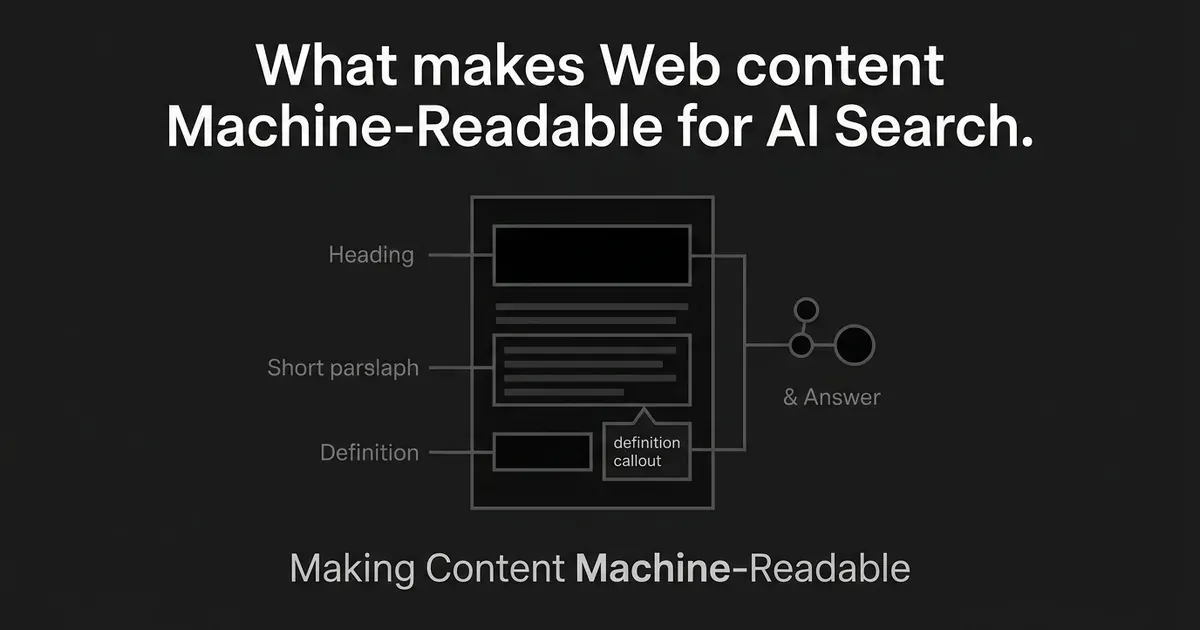
An extractable page leads every section with a direct answer. It's one or two sentences that can stand on their own without any surrounding context.
In practice, that means:
-
Atomic answers: 40–60 words at the top of every section that directly address the heading's question, before any explanation or evidence.
-
Short paragraphs: 2–4 sentences max, with one idea per paragraph. No topic shifts mid-paragraph.
-
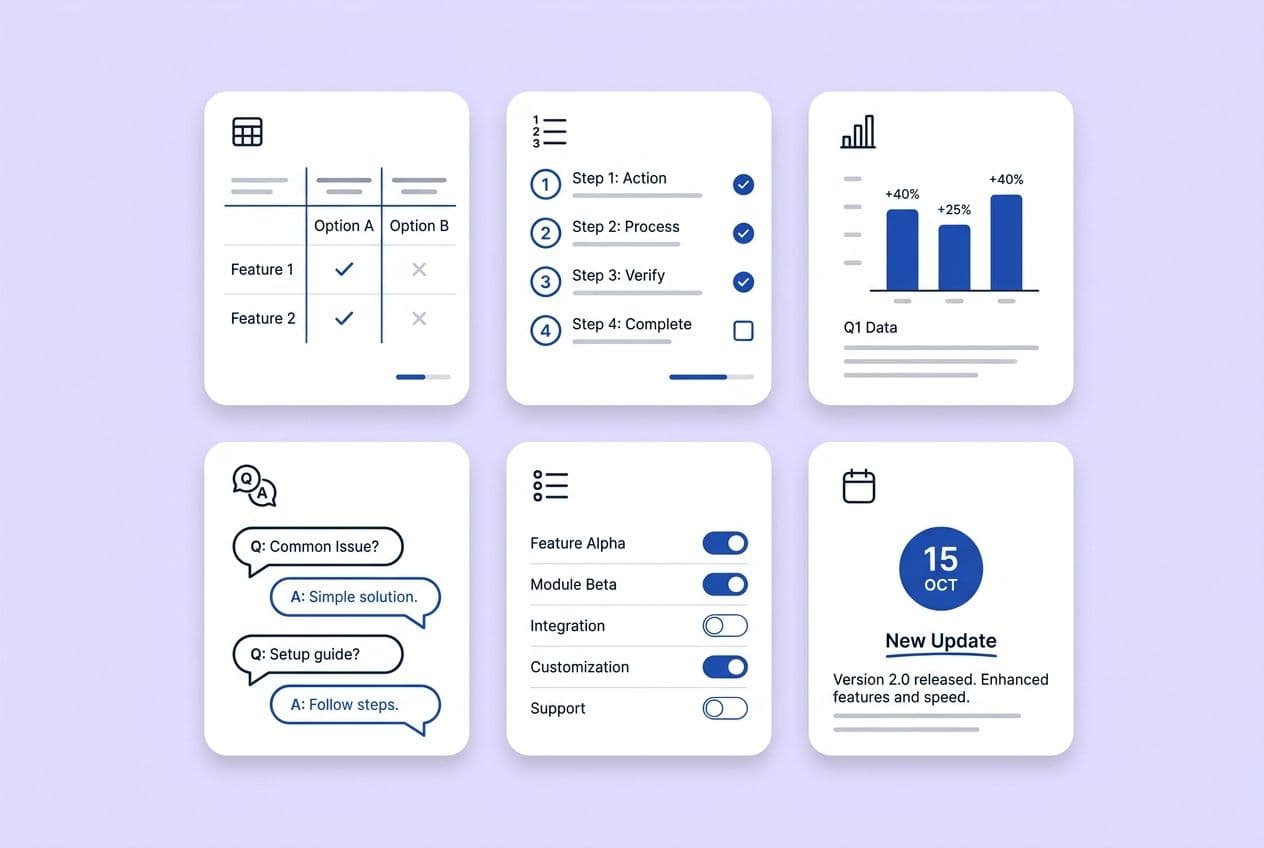
Lists and tables for anything involving comparisons, criteria, steps, or options.
Here's the test: if a reader (or an AI engine) can't get a clear answer from the first two sentences of a section, that section isn't extractable.
What "Trust" Looks Like to an AI Engine (and a Buyer)
Trust isn't about your domain authority. It's about whether individual claims are anchored to evidence an AI system can evaluate.
Strong evidence includes named studies or reports, specific benchmarks, documented processes with outcomes, and concrete examples with context. Vague language fails on two levels: it signals low confidence to a reader and gives an AI engine nothing to anchor to.
Two habits that we had to kill because they quietly destroy trust are hedging ("it might help to consider possibly...") and vague pronoun references ("they often do this because of that"). Just restate entity names instead of relying on pronouns. Spell out acronyms on first use in every section, not just once per article. AI systems process sections in isolation; they don't carry context forward the way a human reader does.
What Are the 7 Content Formats AI Answer Engines Cite Most Consistently?
These seven formats outperform generic blog posts because they produce clear, quotable answers structured around product facts, comparisons, procedures, or evidence. Generic posts fail not because they're long or short, but because their paragraphs don't contain self-contained claims.
The Formats That Win Commercial-Intent Citations (Where Buyers Are)
This trio (product pages, reviews, and comparisons) dominates "what tool should I use?" prompts. This is where the money is.
Product pages get cited when they lead with a clear definition, list features with specifics, and use language that mirrors how buyers describe their problem. They need a plain-English description in the first paragraph, a structured feature list, pricing signals, and a "best for" summary.
Product reviews get cited for "is X worth it?" prompts. The minimum viable structure here is a verdict up front, evaluation criteria listed explicitly, evidence for each score, and a section on limitations. (AI engines are smart enough to distrust reviews that find no downsides). Naming your methodology earns more trust than just saying "we tested this."
Comparison posts are the highest-citation format for SaaS commercial intent, period. They match "X vs Y" and "best X for Y" prompts, which is the exact language buyers use when they're 70% of the way through a decision. You absolutely need a criteria table, a "best for" summary, honest trade-offs, and a last-updated date. The table alone is often what gets extracted.
The Formats That Win Instructional Citations
Step-by-step how-to content earns citations for "how do I..." prompts, but only when the steps are actually numbered and each one starts with a verb.
We learned this the hard way. We had a brilliant, comprehensive guide on a technical process that got zero instructional citations. Why? It was written as beautiful, flowing prose. An AI couldn't parse it.
The structure that gets cited needs a prerequisites section, numbered steps (not bullets), a specific action at the start of each step, and a "what success looks like" checkpoint at the end. An AI can pull a numbered list easily.
It’s also worth naming the difference between a how-to that teaches a concept ("how attribution modeling works") and one that teaches a task. The concept piece needs a definition-model-components-example structure. The task piece needs the numbered steps.
The Formats That Win Credibility and Freshness Citations
Data reports and original research earn citations for "what does the data say about X?" prompts, and they also build trust signals that lift your other content.
The structure that works is methodology upfront (how you collected the data, sample size, date range), key findings stated as direct claims, and implications that connect findings to buyer decisions. The "who/what/when" of the data has to appear at the top, not buried in the footer.
News and announcements earn citations for timely queries, but only if they're actually news (a product launch, a regulatory change). The format requires a clear lede explaining what happened and why it matters, plus a date signal that's impossible to miss. Don't chase news cycles for content that isn't genuinely timely. AI engines can tell when "news" is just a rebranded blog post.
Dates are not optional for either format. A research report without a clear publication date gets treated as outdated. A news post without one is useless.
How Do You Choose the Right Format for the Intent (So You Don't Default to a Generic Blog Post)?
Pick your format by the shape of the prompt a buyer uses, not by what's easiest for your team to produce. This mismatch between format and intent is the most common reason I see content teams publish consistently and still get no citations.
Here's how prompt shapes map to formats:
-
"Best X for Y" → comparison post or review
-
"X vs Y" → comparison matrix
-
"How do I do Z?" → numbered step-by-step
-
"What is X?" → definition/framework + FAQ
-
"Is X worth it?" or "X pricing" → product page + review
-
"Latest news on X" → announcement/news post
-
"Data on X" or "benchmark for X" → research report
Pick your format by the shape of the prompt a buyer uses, not by what's easiest for your team to produce. Here's a practical exercise: pull your top 20 target prompts, assign a best-fit format to each one, and count how many of those formats you've actually published. That gap between what prompts buyers use and what formats you’ve shipped? That’s your content strategy problem, right there on a spreadsheet.
One guardrail, especially for SaaS teams: don't publish news updates unless they're genuinely industry-significant. A minor product update dressed up as a news post doesn't earn citations; it just dilutes your authority.
Intent → Best Format → Page Anatomy
| Buyer Intent | Example Prompt | Best Format | Required Page Elements |
|---|---|---|---|
| Commercial — compare tools | "Best project management tool for remote teams" | Comparison post | Criteria table, "best for" summary, trade-offs, updated date |
| Commercial — evaluate one tool | "Is [Tool] worth it?" | Product review | Verdict up front, scored criteria, limitations section |
| Informational — learn how | "How do I set up DKIM for email?" | Step-by-step guide | Numbered steps, prerequisites, verb-first actions |
| Informational — understand concept | "What is churn rate?" | Definition + FAQ | Direct definition, formula/model, FAQ cluster |
| Informational — find data | "SaaS churn rate benchmark 2024" | Research report | Methodology, key findings, implications, date |
| Navigational / brand | "DeepSmith pricing" | Product page | Tier descriptions, feature list, "best for" |
| Timely | "Google AI Mode update" | News post | Lede, context, publication date prominent |
What Templates Should You Use Inside Each Format to Maximize Citations?
Citations go up when you follow a proven page template, not when you improvise. The teams that consistently get cited aren't writing better prose. They're shipping pages built from patterns that AI engines recognize. They have a system.
Here are the templates with the highest return for SaaS content teams like ours:
Comprehensive guide (answer-first): H1 states the outcome; every H2 opens with a direct answer; evidence follows the answer. Headline pattern: "How to [outcome]: [specific method or tool type]."
Data-driven report: Method + results + implications. Each key finding is a standalone claim with its source. Headline pattern: "[Metric] Benchmarks for [Audience/Year]: [Key Finding]."
Definition/framework: Clear term, plain-English definition (1–2 sentences), model or visual, components, example. Headline pattern: "What Is [Term]? Definition, Framework, and How to Apply It."
Problem-solution map: Symptoms → root causes → fixes, in that order. I love this one because buyers searching "why does X happen?" need to feel you understand their pain before you pitch the solution. Headline pattern: "Why [Problem Happens] — and How to Fix It."
FAQ deep dive: Question clusters organized by decision stage, with every answer self-contained. Headline pattern: "[Topic]: Frequently Asked Questions (With Direct Answers)."
A note on voice: clarity beats clever across all five templates. A confident, plain-English answer in the first sentence of every section does more for citations than any fancy turn of phrase. Hedges, idioms, and jargon just make your content harder to extract.
Mini-Template: Comparison Matrix Page (The Most Citable SaaS Asset)
A comparison matrix page is the highest-leverage format for SaaS teams. It perfectly matches commercial intent, is highly extractable, and can earn citations for multiple prompts at once. It’s a workhorse.
Required components:
-
Criteria table: Tools as columns; evaluation criteria as rows; a specific rating in each cell (not "good," but "supports up to 10 users on free tier").
-
"Best for" bullets: One sentence per option, naming the specific use case where it wins.
-
Constraints and edge cases: What each option doesn't handle well. This is the part that makes your comparison trustworthy.
-
Last updated date: Prominent, please, not buried in the footer.
-
FAQ section: 3–5 questions covering the "but what if..." scenarios buyers have.
The criteria table is the prize. Make it specific enough to be useful and honest enough to be trusted.
Mini-Template: FAQ Deep Dive (Turning Informational Content Into Citable Blocks)
FAQ deep dives work because every question-answer pair is a perfect, self-contained citation unit. The format hands the AI a quotable answer on a platter.
How we build one that gets cited:
-
Cluster questions by decision stage: awareness ("what is X?"), consideration ("X vs Y?"), and objection ("does X work for my weird edge case?") questions go in separate groups. Don't mix them.
-
Avoid redundancy: If two questions have the same answer, merge them. A repetitive FAQ signals low effort.
-
Keep each answer self-contained: The answer should make sense even if you can't see the question. The AI might only pull the answer block.
Aim for 6–10 questions per FAQ section. Fewer than six doesn't create enough surface area for citations. More than ten can feel like padding.
What Formatting and Technical Signals Actually Increase AI Citations (and What's Outdated)?
Citation readiness comes down to four things: atomic answers, schema, freshness signals, and entity consistency. Everything else is secondary.
Editorial formatting — do these:
-
Lead every section with a direct 1-2 sentence answer before any context.
-
Use short paragraphs (2–4 sentences, one idea each).
-
Use bullet points for non-sequential items; numbered lists for steps.
-
Use tables for comparisons. They are the most parsable format for AIs.
-
Restate entity names instead of using pronouns across sections.
-
Spell out acronyms in every section they appear, not just once at the top.
Editorial formatting — stop doing these:
-
Opening sections with long, winding context ("For years, marketers have wondered...").
-
Hedging claims ("it might be worth considering potentially...").
-
Using "they," "it," or "this approach" without a clear referent in the same paragraph.
Technical — high-impact:
-
FAQPage schema: Huge return, especially for FAQ sections and definition posts.
-
Article schema: Worth implementing on all long-form content.
-
DefinedTerm schema: Use this on glossary pages and definition-heavy posts.
Technical — skip it:
- HowTo schema is deprecated. Don't waste your team's time here.
Freshness signals: Add a visible "Last updated" date at the top of every page, not just in the metadata. When you make a real update (not just fixing a typo), add a brief change note: "Updated June 2025: added pricing tier comparison." AIs treat visible dates as a trust signal.
Internal linking helps AI engines understand your site's structure and which topics you're an authority on. It doesn't directly cause citations, but it builds the foundation that supports them.
A "Citation QA" Pass Before Publishing (10-Minute Checklist)
Run this before every publish. We made this part of our workflow and it catches the most common, painful mistakes.
-
Answer-first opening? Does the article's first sentence state the core claim directly?
-
Section openers direct? Does every H2 section open with a 1–2 sentence answer, not context?
-
Table present where needed? Is any comparison or criteria list in a table, not just prose?
-
Dated data labeled? Does every statistic include its source and year?
-
Entities consistent? Are you using the same name for your product and key terms throughout?
-
Acronyms spelled out per section? Not just once at the top?
-
FAQ section included? Does the page have a FAQ block with self-contained answers?
-
"Last updated" visible? Is the date at the top, not just in CMS metadata?
-
Schema validated? Is your schema passing Google's Rich Results Test?
-
Hedges removed? Quick scan for "might," "could," "potentially." Cut them. Be direct.
How Do You Build an AI Citation Workflow Your Team Can Sustain (Without Adding Headcount)?
The teams that win AI citations consistently don't have more talent; they have a repeatable system. Period. The teams that don't win are improvising every article: a new brief, a different SEO pass, inconsistent schema. It’s chaos.
Here's the lightweight playbook that works for us:
1. Source credibility tiers. Define what counts as strong evidence: named industry reports, peer-reviewed research, primary data you collected, customer outcomes. This isn't just for trust; it's so writers can brief efficiently instead of hunting for evidence after the draft is done.
2. Template library per format. Build a template for each of your top three formats. We started with comparison page, how-to, and FAQ deep dive. Each template should specify required sections, the opener format, evidence requirements, and schema type. Writers shouldn't invent structure; they should fill in a proven frame.
3. QA gate. Use the 10-point checklist above. Make it a literal checkbox in your CMS. This catches the quiet killers: a missing date, no table, a vague opener.
4. Update cadence. High-value pages need a mini-review every 90 days. Assign ownership so it doesn't get forgotten during a busy sprint.
The bottleneck we always underestimated was the "last 20%" of the work that takes 40% of the time: internal linking, CMS formatting, distribution. Tools like DeepSmith address this by operating as an end-to-end pipeline. It handles the mechanical work of research, briefing, drafting, and linking in one connected workflow, so the team can focus on strategic judgment, not running an assembly line.
The bottleneck we always underestimated was the "last 20%" of the work that takes 40% of the time: internal linking, CMS formatting, distribution. Tools like DeepSmith address this by operating as an end-to-end pipeline. It handles the mechanical work of research, briefing, drafting, and linking in one connected workflow, so the team can focus on strategic judgment, not running an assembly line.
How Should You Measure AI Citations and Iterate After Publishing?
Treat AI citations the way you treat SEO rankings. Define your target prompts, track citation rates, and update the assets that are closest to winning. Without a measurement loop, you're just publishing on instinct and hoping for the best. I’ve been there; it’s not a strategy.
What to track:
-
Prompt set: The specific questions your buyers type into AI platforms. Not "project management software," but "best project management software for a 10-person remote team." The more specific, the more actionable.
-
Mention rate vs citation rate: A mention is your brand name appearing in an answer. A citation is a link to your page.
-
Page-level citation attribution: Which specific URLs are being cited, and for which prompts? This tells you which formats are actually working.
-
Platform differences: ChatGPT, Perplexity, Gemini, and Google AI Mode all behave differently. Track by platform to see where your gaps are.
Monthly iteration loop:
-
Identify "near-miss" prompts where a competitor is cited but you aren't.
-
Improve extractability on your page: add a direct answer up top, put comparisons in a table.
-
Strengthen evidence: add a named source or update a statistic.
-
Refresh the "last updated" date and add a change note.
-
Re-check your schema.
Prioritization rubric: Business value of the prompt × your visibility gap × ease of improvement. A high-intent prompt where a competitor is cited and your page just needs a table added? That's your first update.
Doing this manually with a spreadsheet is a nightmare. Tools like AI Visibility module automate this, tracking rates across all five major AI platforms so you can prioritize updates based on actual data, not guesswork.
How Do You Extend Citation Surface Area Beyond the Blog Without Multiplying Workload?
Repurposing is the easiest way to increase your citable artifacts without writing new content, but it’s the first thing to get skipped under deadline pressure.
AI engines pull from more than just your blog. Community threads, video transcripts, and newsletter archives all contribute. Your job isn't to be everywhere; it's to have your core claims represented in enough places that AI systems encounter you consistently.
The "one asset → many outputs" approach:
-
Comparison tables → LinkedIn carousels (one criterion per slide)
-
FAQ sections → Short Q&A threads on LinkedIn or X
-
Key data points → A "benchmark of the week" in your newsletter
-
Step-by-step processes → Short-form Loom videos for YouTube
DeepSmith's Agent Library handles this repurposing step directly. It can convert a published article into LinkedIn posts, newsletter emails, and X threads in your brand voice. This makes distribution a standard step, not the thing that falls off the to-do list. Repurposing doesn't directly cause citations, but it reinforces the AI's understanding of what your brand is an authority on.
One firm guardrail: keep claims consistent everywhere. A blog post saying "reduces churn by 20%" and a LinkedIn post saying "eliminates churn" creates confusion and erodes trust. Every output must reflect exactly what the original asset claims.