If you have ever argued with a writer about whether the intro paragraph needs to fit on one screen, you have run into the above the fold seo question. The honest verdict is mixed, but not in a wishy-washy way: Google has said pages with little visible content in that first screen can be affected by its page layout systems, and a Google rep has said Google wants to see some content above the fold. Neither statement sets a word count, a screen percentage, or a ranking bonus for cramming more text above the scroll line. The grade here is mixed for the broad "more is better" version of the claim, and fairly clear for the narrow, practical version: a visitor should be able to tell what the page is about and see the start of a real answer without fighting through an obstruction first.
That distinction is the whole article. So let's walk through what Google actually said, when it said it, and what that leaves you free to ignore.
What "above the fold" actually means
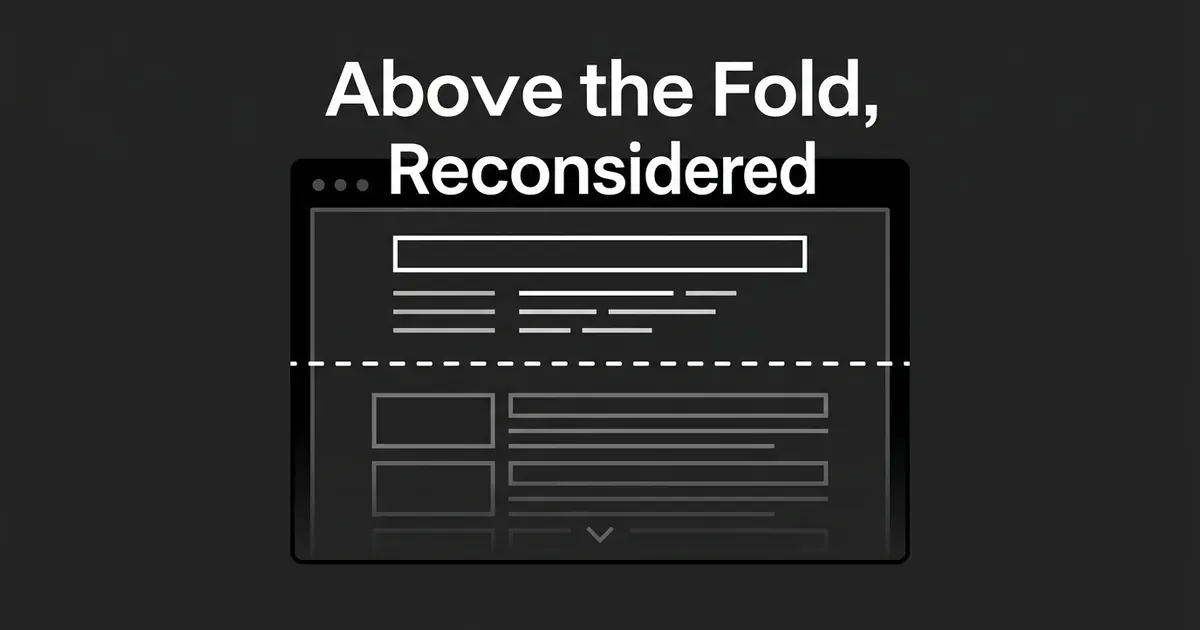
Above the fold is whatever a visitor sees in the browser before they scroll. It is not a fixed line, and it is not the same on every device. A tall phone screen shows less than a laptop, and a laptop shows less than an ultrawide monitor, so the boundary moves depending on what the reader is holding. Search Engine Journal used this same plain definition back in 2021 when covering Google's comments on the topic, and it still holds.
Above the fold content, in the SEO sense, means whether a page's actual, relevant material is visible on arrival. That is a narrower question than a few others it tends to get mixed up with:
- Whether Google can crawl and read text lower on the page (usually yes, if it is in the rendered HTML)
- Whether an ad or a large visual is blocking the article the visitor came for
- Whether content only shows up after a click, a tap, or a scroll, which is a rendering problem, not a placement one
Keep those separate, because the evidence behaves differently for each one.
There are two versions of the claim floating around content teams, and only one of them holds up. "Make the topic and some useful material visible in the opening screen" matches what Google has actually said. "Google gives a specific, known ranking boost to every word placed above the fold" does not. Treat the second version as a myth, not a fact you're just missing the citation for.
What Google actually said, and when
The 2012 page layout change
On January 19, 2012, Google announced a change aimed at page layout: it looked at a page's layout and how much content was visible to someone who arrived from a search result. Google said sites without much content above the fold can be affected, and that a first screen with very little visible content, or one where ads take up a large share of it, is a poor experience for that visitor. Sites like that, Google said, may not rank as highly.
It's worth reading that carefully, because it gets flattened into "no ads above the fold" more often than it should. Google explicitly said a normal amount of advertising above the fold was fine. The problem it named was excessive ads, or a layout that made the actual content hard to find. Google also called out pages with only a small amount of visible content as a separate part of the same concern. So the 2012 change was never a blanket rule against ads near the top, and it was never a rule that every paragraph needs to be visible immediately. It targeted the pages where a visitor had to scroll past a wall of ads to find anything real.
At launch, Google said the change noticeably affected less than 1% of searches globally. That figure describes how much Google's results shifted at the moment the change rolled out in 2012. It is not a current risk percentage, it is not the share of websites affected today, and it says nothing about what would happen to your traffic if your layout is thin now. People still quote that 1% figure as though it describes present-day exposure, and it doesn't. Google also said that after a site fixed its layout, its assessment would update as Google recrawled and reprocessed the page, which for a typical site could take several weeks back then. Don't promise a client or your team that same timeline today; Google's own announcement carries a note that parts of it may be outdated.
The 2014 refresh
Search Engine Land reported a refresh of this same page layout algorithm in February 2014, describing its focus as "Top Heavy," aimed again at excessive or distracting ads near the top of a page. That's useful as history, showing Google kept iterating on the same concern for a couple of years. It is not evidence of a separate, currently published penalty with its own numeric threshold. If you cite the 2014 refresh, attribute it to Search Engine Land's reporting rather than presenting it as a live Google rule.
2021: John Mueller's qualified answer
In May 2021, Search Engine Journal reported Google's John Mueller answering a direct question about whether Google prefers content above the fold. His answer: "I don't think we have strong preferences in that regard." Then the qualifier that matters more than the first sentence: "So the main thing is that we want to see some content above the fold." His reasoning was that a visitor should see part of the page's content right away, rather than scrolling past a big intro visual before finding out what the page is even about. He also said it isn't necessary for the content as a whole to sit above the fold, just some of it.
That's the clearest line for a writer or a marketing lead to hold onto: some visible, relevant material matters, but stacking as much text as possible above the scroll line is not a documented way to rank better. Mueller's comments are a quoted answer in a 2021 industry article, not a published ranking-weight specification, so don't treat the surrounding commentary as a measured comparison of how much weight Google gives content near the top versus content further down the page.
What 2025 documentation says about visibility and indexing
Google's mobile-first indexing best practices, last updated December 10, 2025, allow content to sit in accordions or tabs on mobile to save space, as long as it stays equivalent to what's on desktop. That alone undercuts any claim that every sentence has to be expanded and visible on first load to count for anything. It does not mean buried content always performs the same as content that's immediately visible; it just means a closed accordion isn't automatically a penalty.
The same documentation, and Google's lazy-loading guidance (also last updated December 10, 2025), draw a sharper line: don't lazy-load content that should be visible right when the page opens, because that can make it noticeably slow to appear. On top of that, faulty lazy loading can hide content from Google entirely. Google's crawler does not scroll, click, or type to trigger content the way a person would. If your primary content depends on an interaction to render, that's a rendering and indexing problem, not a fold placement question, and it deserves to be treated as one.
Keep those two things apart in your head: text that's simply lower on a normally rendered page is not the same situation as text that never appears in Google's rendered version because it needs a click first. A collapsed accordion holding content that's present in the mobile HTML is not, on its own, proof of a fold-related penalty.
The evidence for and against
The case for taking the opening of a page seriously: Google's 2012 announcement specifically warned about pages with very little visible content, and its 2021 comments say some content should be visible on arrival. Both of those point at the same underlying goal, which is helping a visitor recognize quickly that they landed on the right page.
The case against a rigid fold rule: Mueller didn't express a strong preference for putting all of a page's content near the top. Google's own mobile guidance permits accordions and tabs instead of forcing everything into view. None of the sources reviewed here publish a minimum word count, a required percentage of the viewport, an approved number of scrolls, or a direct ranking multiplier tied to a specific paragraph's position.
What stays genuinely unknown: none of this evidence quantifies the current ranking effect of nudging an ordinary paragraph higher on a page that's already useful. Nothing here says every page with a large hero image gets demoted, or that a short intro is automatically safe no matter what sits above it. There's no AI-search-specific threshold in any of this, and nothing proves that a sentence placed above the fold earns an AI citation it wouldn't otherwise get. No controlled placement study turned up in this research, so treat any claim about a measured traffic lift from fold changes as unverified until you see the source.
What this means for the opening of your content pages
Skip the search for a Google threshold that doesn't exist, and use an editorial question instead: when this page loads on a normal mobile screen, can someone tell what it's about and see the start of a real answer, without fighting through something in the way first? If yes, the opening matches what limited guidance there is. Everything else in a detailed article is free to live further down the page.
A useful opening usually has a clear headline followed promptly by a short answer or framing paragraph. That's an editorial choice grounded in what Mueller described, not a claim that Google demands a specific headline format or a maximum word count before the fold. Compare that to an opening eaten up by a large decorative image, a promo banner, or ads, where the actual article doesn't start until well down the page. That's closer to the pattern Google flagged as a problem back in 2012. Ads themselves aren't the issue; the documented concern is an obstruction that keeps a visitor from finding what they came for, not the mere presence of an ad near the top.
Check how a page actually renders on mobile rather than assuming a desktop layout holds up at a narrower width, since that's where fold placement issues tend to show up first. If your substantive opening only appears after a click or a scroll, that's a separate rendering or indexing concern, and Search Console's URL Inspection Tool can show you whether the content is present in the rendered HTML at all. That check tells you whether Google can see the content, not whether fold position carries a ranking signal on its own.
If you're reviewing drafts at scale, the check that holds up is simple: does the first visible part of each piece make its subject and usefulness obvious, while leaving room to go deeper below? That's a more reliable above the fold seo standard than inventing a fixed word count for what belongs above the fold, and it's the kind of check a writing pipeline that already builds in heading structure and keyword coverage during drafting can apply consistently, instead of a marketing lead eyeballing every draft after the fact.
What would change this verdict
A published, current Google test that isolates content position from ad load, rendering speed, and general page quality would move this verdict. Until that exists, the fair reading stays where Google's own statements leave it: visible, relevant material near the top matters, and a specific quota of above the fold content does not have documented support.