You ask an AI a question, and back comes a clean answer with a little numbered link next to it. It feels authoritative. It feels checked.
Here is the thing worth slowing down for: that citation is not proof the answer is true. It is proof the system pointed at a source. Those are two different promises, and the gap between them is where a lot of confusion lives.
If you have ever wondered how that citation got there, and why the same question can cite different pages on different engines, you are asking the right question. This is really about grounding in AI answers: the step that ties a written sentence back to a retrieved source. Let's walk the whole path together, from your question to the link you click, so you can read those answers with clearer eyes.
What "grounding" actually means in an AI answer
Grounding is the act of tying a claim the model wrote back to a specific piece of evidence it was handed. That is the whole idea. Nothing more mystical than that.
It helps to separate two questions that sound alike but are not.
Factuality asks: is this claim true in the world? Grounding asks: is this claim supported by the documents the model was given? A grounded AI answer can still be wrong if the source itself is wrong. And a true statement can still be ungrounded if the model just knew it and never pointed anywhere.
So grounding is about source-attribution discipline, not absolute truth. It is the model showing its work, not the model being right. Hold that difference in your head and half the confusion around AI citations clears up on its own.
Why does this matter to you? Because when you test your own brand in an AI engine, you are watching grounding in action. The engine is deciding which pages are worth pointing at, and yours is either in that set or it is not.
RAG is the most common way engines do this grounding, and it is where citations are born. Let's define it.
What is RAG, in one plain breath
What is RAG? Retrieval-Augmented Generation is a technique that lets a language model pull in outside information at the moment you ask, then write its answer from that fresh information instead of from memory alone.
Think of it as an open-book exam. The model does not have to recall everything. It looks things up first, then answers with the book open in front of it.
The idea was first proposed in 2020 by a team at Facebook AI Research and University College London. They paired the model's own trained memory with a searchable index of documents, so the model could reach for evidence on demand. That pairing is the seed of nearly every answer engine you use today.
Here is why this connects to citations. When the model answers from documents it just retrieved, those documents can be named. The retrieval augmented generation citations you see are simply the system telling you which retrieved passages it leaned on. No retrieval, no honest citation. The two are joined at the hip.
There is a practical reason engines lean on this rather than just training everything into the model. Looking things up at query time means the answer can reflect today's information, not a snapshot from months ago, and it means the source can be named and linked. An answer the model simply recalled from training cannot be traced back to anything. An answer it retrieved can.
Every major engine that shows sources, ChatGPT, Perplexity, Gemini, Claude, Google AI Mode, runs on some version of this. The details differ. The shape does not.
The five moves that turn your question into a citation
Under one small link sits a five-step pipeline. Once you can name the steps, the whole thing stops feeling like magic.
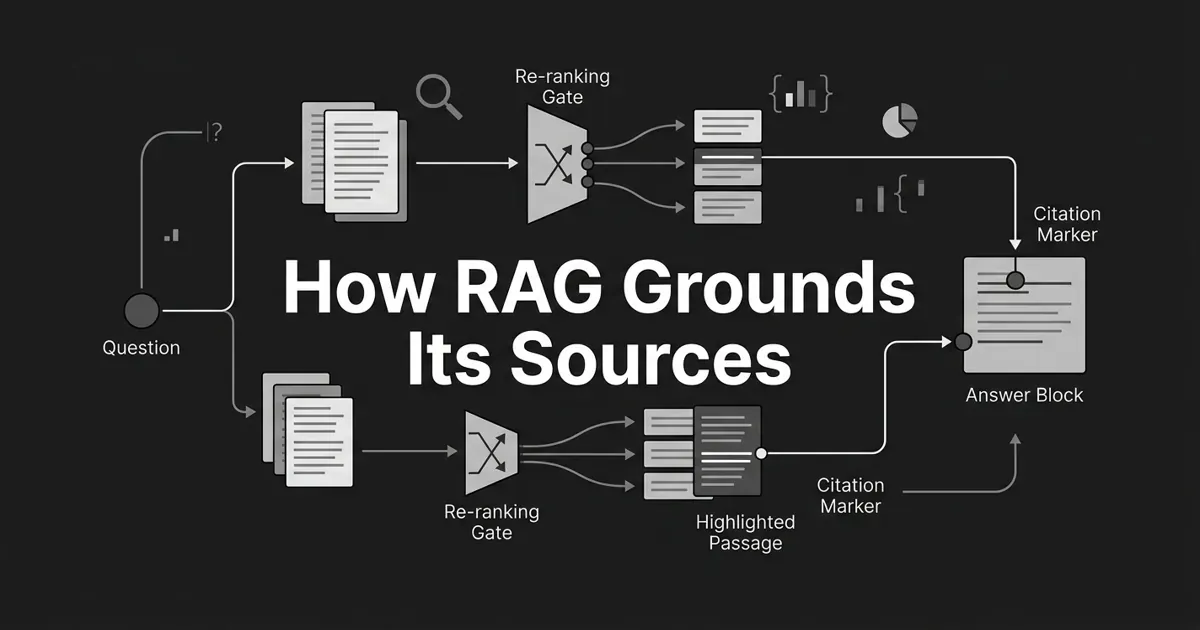
Here is the pipeline in plain prose: retrieve, augment, generate, ground, cite.
Retrieve. Your question gets turned into a search, and the system pulls the handful of passages most likely to answer it. This is the model reaching for the book.
Augment. Those passages get pasted into the hidden prompt the model actually reads, usually numbered, alongside an instruction like "answer using only these sources." Placement matters more than you would guess: models tend to pay closest attention to the start and end of what they read and skim the middle, an effect researchers call "lost in the middle." So careful systems put the strongest passage first and the next strongest last.
Generate. The model reads your question next to those numbered sources and writes the prose answer. This is the part you think of as the AI thinking.
Ground. As it writes, the model marks which source backs each claim, tagging sentences with the id of the passage they came from.
Cite. The system resolves those tags into the clickable numbers and footnotes you see, each one wired to a real retrieved source.
Notice where the citation actually lives. Steps one through four are all upstream. The citation itself is step five: the visible tip of four decisions you never see. That is why understanding the pipeline is how you understand the citation.
How RAG picks the sources it can cite
Here is the part that decides everything: the model can only cite what retrieval handed it. If your page never gets retrieved, no amount of good writing will get it cited. So how RAG picks sources comes down to three quieter choices made before the model writes a word.
The first is chunking. A knowledge base is too big to read at once, so documents get split into small passages, or chunks, that get retrieved as units. A common starting point is around 512 tokens per chunk with a little overlap so meaning does not get sliced at the edges. Smaller chunks sharpen precision for narrow questions. Larger chunks keep more context for broad ones. Split a page badly and its best answer can get cut in half, which quietly costs it citations.
There is craft here too. Some systems split on structure, keeping headings, sections, and table rows intact. Others split by meaning, grouping sentences that belong together and breaking where the topic shifts, so each chunk stays about one thing. You do not need to memorize the methods. You just need to know that how a page is cut decides how cleanly it can be found.
The second is retrieval itself. Good systems blend two ways of searching. Dense retrieval matches on meaning, so it catches paraphrases and concepts. Keyword retrieval matches on exact terms, so it catches names and precise phrases. On its own, meaning-based search misses the exact term, and keyword search misses the synonym. Blend them, and you catch both the idea the reader meant and the exact word they typed. This blend is why a page can get pulled in even when it never used the searcher's exact wording, and it is a big part of how RAG picks sources that a plain keyword tool would have skipped.
The third is re-ranking. The first pass is fast and a little rough, so a second, more careful model re-scores each passage against the question and picks the final few that will actually be cited. Some engines run several layers of this before anything reaches you, and apply a quality cutoff so weak matches get dropped. If too few passages clear the bar, the system can throw the batch out and search again.
Feeling like a lot? Hold onto one sentence: retrieval decides the candidates, re-ranking decides the finalists, and only the finalists can be cited.
How the model ties a single sentence back to a source
Retrieval hands the model a small stack of numbered passages. Now the model has to attach each sentence it writes to the right one. This is the grounding step, and it happens a few different ways.
The most familiar is inline citation: the model writes a claim and appends a number that points to a source. Cleaner systems go finer, tying each phrase to the specific passage that supports it, which is more auditable because you can check claim against evidence line by line. Some go the other way and generate the answer first, then hunt for support and attach the citation afterward.
Under the hood, many systems plant the anchors early. At the moment a document is indexed, each chunk gets tagged with quiet markers and metadata: the source title, the page, a section id. When the model writes, it is asked to keep those markers out of the prose but to list the ids it used in a separate structured field. After it finishes, the system swaps each id for a real link, a page highlight, or a footnote. That is the machinery that turns a retrieved passage into something you can click and verify.
There is one more layer that separates careful systems from sloppy ones: verification. Even with anchors in place, a cited passage might not truly support the sentence attached to it. So some systems run a second check after the model writes, either counting shared words between the claim and its source or running a small model that judges whether the source actually backs the claim. When the sources fall short, a well-built system is tuned to say "I don't have enough information" rather than invent.
Teams that care about this watch two simple things. One: of the citations the model added, how many actually support their sentence? Two: of the claims that needed a source, how many got a correct one? High on both means the answer is honest about where it came from. Low on either means the citations are decoration. Neither check is perfect, though. A verifier that only counts matching words can be fooled by a source that uses the same terms to say the opposite thing.
The instruction the model gets shapes all of this. A vague "use the sources to answer" produces vague, hopeful citations. A strict "answer only from the numbered sources, tag every sentence, and if the answer is not here, say so" produces citations you can actually trust. That is what retrieval augmented generation citations really are: a pointer, and only a pointer, that is trustworthy exactly as far as the instruction and the check behind it.
Why a grounded AI answer can still get things wrong
Grounding lowers the odds of a made-up answer. It does not drop them to zero. This is the honest part, and it is worth sitting with.
A Stanford study looked at leading AI legal research tools, the kind built on retrieval and sold on their sourcing. Even those systems produced unsupported answers a meaningful share of the time. Retrieval helped, and the retrieval-based tools did beat a general-purpose model. It did not deliver the clean, hallucination-free promise the marketing implied. In fact, some of those tools looked safer mostly because they refused to answer more often, not because they answered more accurately.
The researchers grouped the failures, and the pattern is useful for anyone reading AI answers. Sometimes the wrong passage got retrieved, so the model built on a bad foundation. Sometimes the right passage got retrieved but got applied to the wrong situation. Sometimes retrieval was perfect and the model still reasoned its way to the wrong summary. A citation sat at the end of the sentence in every case, looking just as confident.
That is the lesson to carry. Citation presence is not citation accuracy. A source pinned to a sentence proves the model pointed somewhere, not that it read the source correctly, not that the source is true, and not that the model stopped where the source stopped.
Even the strongest models leave a gap. On a benchmark built by Google DeepMind to measure exactly this, across finance, technology, retail, medicine, and law, top models ground their answers correctly around four out of five times when the source is sitting right in front of them. Models a notch below land closer to three in four. Strong, genuinely. Perfect, no. So a grounded AI answer earns your attention, not your blind trust. When the stakes are real, click the source and read it yourself.
None of this means grounding in AI answers is broken. It means grounding is a discipline with limits, not a guarantee. Knowing the limits is what lets you use these answers well instead of over-trusting them.
What the citation looks like across the major answer engines
You see a single tidy number. Underneath, every engine made those five decisions its own way, which is exactly why the same question can cite different pages depending on where you ask.
ChatGPT, after it searches the web, hides small markers in the text as it writes, then the interface swaps them for the numbered, clickable footnotes you see, often a few per answer. Claude's system takes a structured route, returning citations as data attached to each part of the answer, complete with the exact quoted text and where it sits in the document.
Perplexity runs a long, layered version: parse the question, retrieve several ways, re-rank in stages, then let the model write only from the evidence that survived, with citation numbers pinned to specific claims. It leans toward pages that answer in the first hundred words and that stay fresh, and it will drop a source that readers ignore. Gemini and Google AI Mode pull self-contained answer blocks out of pages rather than whole pages, and lean hard on structured data and consistent signals across the web when deciding whom to trust. Say something one way on your site and another way elsewhere, and that inconsistency can quietly cost you the citation.
Different plumbing, same five moves. And here is the part that matters for you: whether your brand shows up as one of those cited sources is decided by this exact machinery, running on your content, without you in the room.
That is the real stakes underneath a citation. AI answers are citations before they are truths, so the question for your brand is not "is the AI right," it is "when a buyer asks, are my pages the ones it reaches for." You can guess at that, or you can watch it. DeepSmith tracks which prompts mention your brand and which pages, yours or a competitor's, win the citations across ChatGPT, Gemini, Perplexity, Claude, and Google AI Mode, so you can act on the gap instead of wondering about it.
Not sure where you stand today? Start by looking. You can start a free trial and see which answers already point to you, and which point somewhere else.