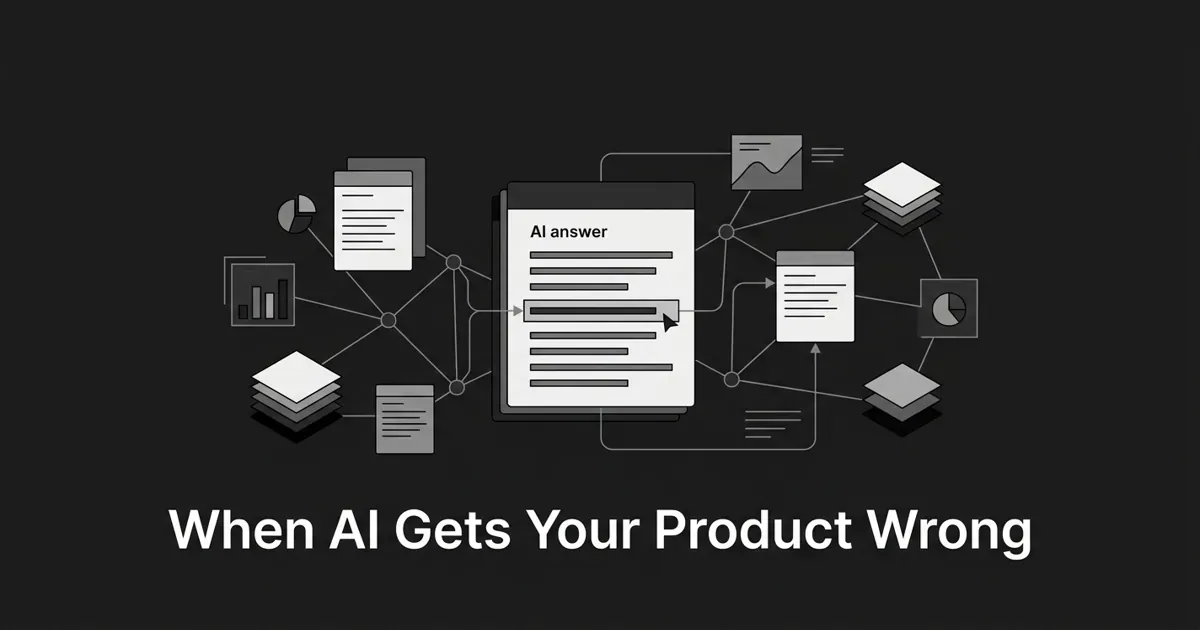
You typed your own product name into ChatGPT, and the answer came back wrong. A feature you shipped last quarter is missing. A capability you never built is listed as yours. Maybe the whole category label is off. If your first thought was "AI describes my product wrong," take a breath, because this is fixable, and you are the right person to fix it.
That "ChatGPT wrong about my features" feeling is common right now, and it is worse than a typo on your site, because a buyer at the top of their research reads that answer and believes it. The good news is that you do not have to argue with the model. You have to fix the small set of sources it reads, and you can fix AI product information at the source once you know which sources those are.
Here is the part nobody tells you. A wrong answer is the default state for any brand that has not audited its source footprint. Even top production models still get facts wrong on straightforward summarization tasks, and product questions are harder than that. So this is not a sign you did something wrong. It is a sign no one has done the work yet. Let's do it together.
This guide is for one marketing lead, working with a small team or alone, who needs to audit how large language models describe their product and then fix the wrong claims at the source. By the end you will have a repeatable audit, a diagnosis for each error, and a fix list ranked by leverage. We are staying on factual feature accuracy here, not pricing freshness or the separate problem of AI never mentioning you at all.
Build your prompt library
Start where your buyers start. Before you can measure what AI gets wrong, you need the exact questions people ask about you.
Write 30 to 50 prompts across five buckets that mirror real buyer behavior:
- Direct evaluation: "What is [Brand]?" and "What does [Brand] do?"
- Comparison: "[Brand] vs [Competitor] for [use case]?"
- Feature lookup: "Does [Brand] have [feature]?" and "Does [Brand] support [integration]?"
- Use-case fit: "Best [category] tool for [persona or company size]?"
- Risk and reputation: "Is [Brand] any good?" and "Common complaints about [Brand]?"
For each prompt, write down the ground truth before you look at any AI answer. Pull your correct facts from your own docs and spec sheet: the real feature names, the real integrations, the supported platforms. Then list the known-wrong claims you want to catch if they appear, like a deprecated feature or the wrong category.
You know this step is done when you have a spreadsheet with one row per prompt, a ground-truth answer, and a checklist of facts the model should mention. If you would rather not build the prompt set from scratch, mapping and prioritizing the prompts that matter for AI discovery is a task you can systematize.
Where people go wrong: they test three vanity prompts, see a nice answer, and stop. The feature errors hide in the feature-lookup and comparison prompts, which are exactly the ones busy people skip.
Run every prompt across each engine
One engine is not the audit. ChatGPT, Perplexity, Gemini, Claude, and Google AI Mode each pull from different sources and reach different verdicts, so an answer that is right in one can be wrong in another.
Run each prompt three to five times per engine. Models vary run to run, and you want the pattern, not a single lucky pull. Turn on browsing or search grounding where the engine offers it, since that is closer to how a real buyer sees the answer.
For every run, capture five things: the full response, the cited source URLs, the model version, the date, and a screenshot or share link. The cited URLs matter most. Those are the exact pages you will fix later, so do not skip them.
This is the point where doing it by hand starts to hurt. Thirty prompts across five engines at three runs each is 450 answers to collect and log, and then you get to do it again next quarter. This is the manual work a platform removes: tracking mention and citation across engines on a schedule is exactly what tools like DeepSmith run for you, so the collection happens automatically and you spend your time on the fixes. If you are staying manual for now, that is completely fine. Just block the time and log every cited URL.
You know the step is done when every prompt-and-engine cell has at least one recorded answer with its sources. Where people go wrong: they optimize only for ChatGPT and never check that Perplexity is quoting a stale review site.
Score each answer for factual accuracy
Now turn a pile of answers into a ranked problem list. Without scoring, everything feels equally broken and nothing gets fixed.
Score every cell on five dimensions, one to five each:
- Factual accuracy: is every concrete claim correct?
- Completeness: does it surface the features and integrations you expect?
- Source quality: does it cite authoritative pages or random blogs?
- Positioning: does it describe you the way you want to be described?
- Citation presence: is your own site among the cited sources?
No time for a five-point rubric? Use three buckets: right, partial, wrong. That alone will show you the pattern. When you are grading, remember that testing factual accuracy is a different job from judging whether the tone sounds like your brand. Grade the facts first.
Here is a common mistake worth calling out. Do not chase mention rate at the expense of accuracy. A confident answer that names three features you never built is worse than no mention at all, because a buyer acts on it. Fix wrong before you chase more. The "ChatGPT wrong about my features" answers usually cluster in the feature-lookup and comparison buckets, so watch those rows closely when you sort your grid.
You know this step is done when every answer has a verdict and you can sort your grid to see your worst prompts and engines at the top.
Trace every wrong answer back to its source
This is the step that separates a fix from a guess. You cannot correct an answer until you know where the model read it.
For each wrong cell, open the cited URLs and ask four questions:
- Is the source itself wrong, and the model just repeated it faithfully?
- Is the model paraphrasing your own docs but garbling the detail?
- Is it lifting from a competitor's comparison page?
- Is it hallucinating with no visible source at all?
Your answer decides everything downstream. If a bad third-party page is the culprit, the fix is editorial: update that page. If nothing credible exists, the fix is structural: publish a source the model will pick up. Either way, you cannot fix AI product information you have not traced, so resist the urge to start editing before you know the origin of each error. Mapping which pages AI engines actually cite for your brand is the whole game here, and when a competitor keeps winning a prompt, reverse-engineering the pages behind their citations tells you what to publish against.
Where people go wrong: they rewrite their own homepage in a panic when the model was actually quoting a two-year-old listicle. Trace first, then fix the thing the model is really reading.
Fix the sources models actually read
Here is the reframe that makes this manageable. You are not arguing with the model. You are editing the small set of pages it trusts. Work them in order of leverage, and remember most of them are not your own website. When AI describes my product wrong is the complaint, the cure is almost always in these external sources, not in a rewrite of your homepage.
Wikipedia and Wikidata
Wikipedia is the single most-cited source across major engines for branded questions, because it feeds both the models and the knowledge graphs behind them. Wikidata is its structured twin, and it is far easier to edit.
You cannot edit your own Wikipedia article directly. Doing so violates the conflict-of-interest policy, and the edit gets reverted. The supported path is an independent editor who works from your notability, meaning real coverage in reliable secondary sources like a funding article or analyst inclusion. Plan three to six months, and use the article's talk page to request corrections rather than editing the page yourself.
Wikidata is the faster win. With a verified account you can update fields like official website, developer, industry, inception date, and product type. Getting your brand recognized as a clean entity that engines can resolve is upstream of almost everything else.
Review profiles: G2, Capterra, and the rest
Models lift feature grids from review portals almost verbatim. If your G2 profile lists a deprecated feature or the wrong tier names, the model repeats it word for word. Claim your vendor profile, update the feature list, integrations, and descriptions, and refresh at least quarterly. Update the same day on any rename.
Your own site and its schema
Your site is the canonical source for your specs, so make it unambiguous. Keep /features, /integrations, /docs, and a dated /changelog current, and use the product names the model can parse rather than internal codenames. Models reward recency, so a public changelog with real dates helps. A neglected changelog is a leading cause of LLM outdated product info, because the model has no recent signal telling it what changed.
Then add structured data in JSON-LD so engines that ground in Google and Bing can disambiguate you. The types that matter are SoftwareApplication, Organization with a sameAs array pointing at your Wikipedia and Wikidata pages, and FAQPage. Choosing the schema types with the best evidence behind them keeps you from marking up everything and hoping. One honest caveat from the research: schema improves grounding for engines that read it, but ChatGPT and Claude without browsing do not consult live schema, so treat it as plumbing, not a magic lever.
llms.txt and canonical surfaces
Publishing an llms.txt file gives crawlers a clean, machine-readable map of your key pages. It is worth doing as a canonical surface. Be honest with yourself about what it is, though: no major model vendor has confirmed they read llms.txt at inference time, so it improves crawling and retrieval, not guaranteed citations.
Pro tip: when you finish this step, your fastest wins are almost always the third-party pages, not your homepage. A single corrected G2 field or Wikidata property often moves more answers than a week of rewriting your own copy.
Unblock the AI crawlers in your robots.txt
Here is a quiet one that undoes all the work above. If your robots.txt blocks the crawlers that feed the models, they cannot see your fresh pages, and you are stuck with whatever they learned last year. This is the hidden cause behind a lot of LLM outdated product info.
Open your robots.txt and check for blocks on GPTBot, ClaudeBot, PerplexityBot, Google-Extended, and Bytespider. Many teams added a blanket AI-bot block during the 2023 crawler backlash and simply forgot it was there. Allow the crawlers you are comfortable with, especially the ones tied to engines your buyers use.
You know this step is done when the bots for your priority engines are no longer disallowed. Where people go wrong: they publish a perfect changelog and never notice the one line in robots.txt keeping every model from reading it.
Report errors through official feedback channels
You can also tell the engines directly. This will not flip an answer overnight, but the reports feed the evaluation pipelines that shape future responses, so it is worth a few minutes on your worst errors.
Use the thumbs-down on any wrong answer and write a clear correction in the box. For ChatGPT specifically, OpenAI runs a content reporting form for factual errors. For Google AI Overviews, use the feedback link under the Overview, which Google has said it reads. Claude and Perplexity take in-product feedback only for now.
Where people go wrong: they treat feedback as an instant edit, get frustrated when nothing changes that day, and give up. Log it, move on, and let it compound alongside your source fixes. That is how you steadily correct AI product description problems over a quarter rather than a day.
Put the whole thing on a repeating loop
One audit is a photograph. Models drift, sources churn, and your product keeps changing, so a single pass goes stale fast. The goal is a light, repeatable rhythm you can actually keep.
A cadence that works for a lead without a dedicated AEO team:
- Quarterly: the full 30-prompt, five-engine audit.
- Monthly: a 10-prompt spot-check on your top comparisons and anything you shipped.
- Weekly: open the top cited sources for your brand and flag any going stale.
- Triggered: re-audit after any launch, rename, or repositioning.
Track share of voice in AI answers the same way you track share of search, and hold your prompt and engine sets steady so competitive benchmarking stays comparable across runs. Report it in the same meeting where you report everything else. When it becomes a number leadership sees, it stays funded.
You know the loop is working when your worst-prompt list gets shorter each quarter instead of resetting to zero. Over a few cycles, the goal is simple: every time you correct AI product description errors at the source, fewer of them come back, and the answers buyers see start matching the product you actually ship.
What to do next
Start with one prompt. Search your own core use case in ChatGPT today, write down what it gets wrong, and open the source it cited. That single trace will teach you more than any framework, and it turns a vague worry into a concrete fix.
From there, the work is honest but not hard: build the prompt set, score the answers, trace each error, and fix the handful of pages the models trust. If the collection and tracking is the part that keeps falling off your plate, that is the piece worth automating. DeepSmith runs the monitoring across engines, surfaces the exact URLs winning each citation, benchmarks you against competitors, and then turns each gap into on-brand content you can publish, so the audit and the fix live in one place instead of a spreadsheet you dread reopening. If you want to see your own gaps before you commit, you can start a free DeepSmith trial and run your first audit on real data.
You are closer than this felt ten minutes ago. Fix one wrong answer this week, and you have already started.