

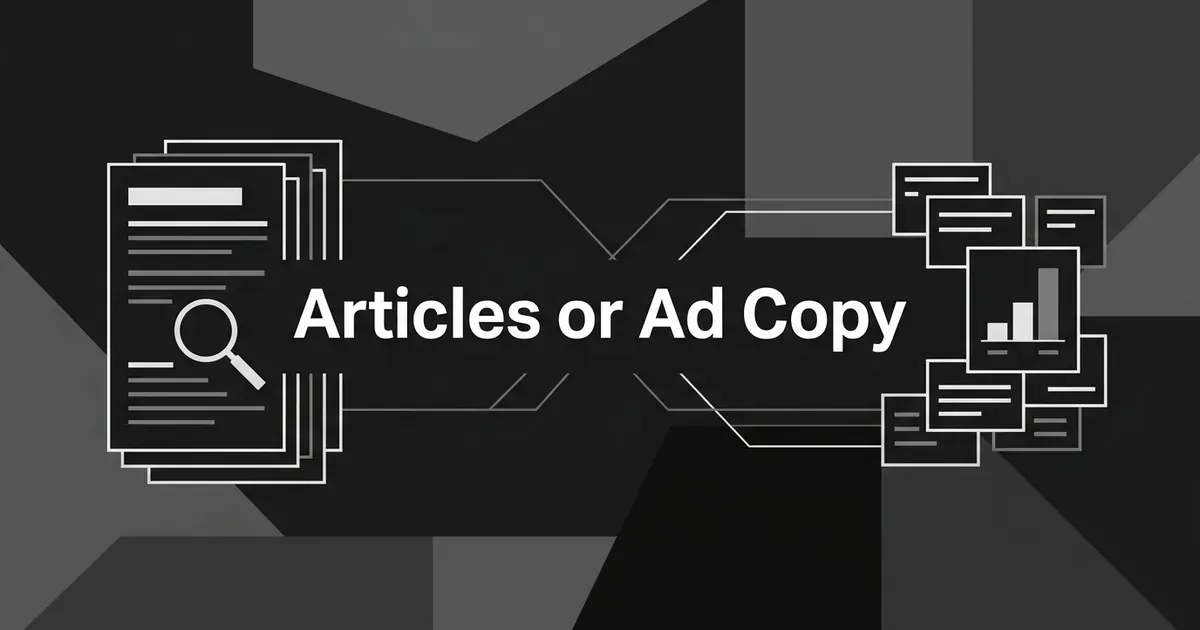
Frase researches, writes and scores long-form SEO articles, while Anyword writes short-form ad and social copy and predicts which variation will perform. Frase suits a team running an article program, and Anyword suits a team running campaigns across channels. DeepSmith is a strong alternative when one article has to feed every channel, because its Writer produces a publish-ready, SEO and AEO optimized article grounded in Deep IQ, and every finished article arrives with social posts ready to copy.
If you are weighing Frase vs Anyword, the first thing to settle is what your team ships most often. Frase is built around ranking articles, with keyword research, SERP analysis and live SEO scores. Anyword is built around channel copy, with templates for ads, social and email and a score that predicts which variation will do better. Both start at $49 a month, or $39 billed yearly, so the entry price rarely decides it. This page covers what each tool does, where each one stops, and where DeepSmith fits for a team that wants one article to become every channel version.
Frase vs Anyword: the short answer
- Choose DeepSmith if you want AI answer tracking, publish-ready SEO and AEO articles grounded in Deep IQ, and social posts and channel versions of each article in one platform, from $99 a month ($80 billed yearly).
- Choose Frase if your main output is ranking articles and you want keyword research, SERP analysis, SEO and GEO scores and CMS publishing, from $49 a month ($39 billed yearly) with 10 articles a month.
- Choose Anyword if your main output is ad, social and email copy and you want a predictive performance score on every variation, from $49 a month ($39 billed yearly) with unlimited words and 50 predictions a month (100 on yearly billing).
| Criterion | DeepSmith | Frase | Anyword |
|---|---|---|---|
| Entry price per month | $99 (Pro) | $49 (Starter) | $49 (Starter) |
| Annual price per month | $80 | $39 | $39 |
| Output at entry tier | 20 articles a month | 10 articles a month | Unlimited words, 50 predictions a month (100 yearly) |
| Free trial | 7 days | 7 days, no card | 7 days, 2,500 words |
| Long-form generation | Yes | Yes | Yes |
| Short-form copy | Partial | Partial | Yes |
| SEO content scoring | - | Yes | Partial |
| Internal linking | Yes | Yes, Professional and up | Not listed |
| CMS publishing | Yes | Yes | Partial |
| Scheduled publishing | Yes | Yes | Not listed |
| AI visibility tracking | Yes | Yes | Not listed |
| Repurposing into channels | Yes | Yes, Professional and up | Partial |
| API access | Yes, read-only | Yes | Yes, Enterprise only |
| G2 rating | 4.8/5 | 4.8/5 | 4.8/5 |
Pricing and features as of September 2026, from each vendor's site and public reviews.
Frase

Frase is an SEO and AI search content platform that covers research, briefs, drafting, scoring, publishing and monitoring in one tool. It is built for content marketers, small in-house teams and agencies that run an article program and want a public price. Plans are Starter at $49 a month ($39 billed yearly), Professional at $129 ($103 yearly) and Scale at $299 ($239 yearly), with Enterprise quoted.
What stands out is how much of the article workflow sits in one place. Frase reads the pages ranking for a query, builds a brief, drafts in a brand voice, and shows live SEO and GEO scores in the editor. It publishes to WordPress, Webflow, Sanity, Wix or its own FraseCMS, and AI visibility tracking runs on every plan, starting with ChatGPT and Google AI on Starter. API, MCP and CLI access come with every plan as well.
The limits show up at the lower tiers. Starter is one seat and one domain, and it leaves out the content calendar, internal linking suggestions and repurposing. Perplexity tracking needs Professional, and Claude and Gemini need Scale. Our Frase review goes through the plans in more detail. Reviewers praise the research speed and rate it 4.8/5 on G2 (310 reviews, checked September 30, 2026). Capterra reviewers also give it 4.8/5 from 335 reviews, and the complaints center on uneven AI writing quality, editor friction and usage limits.
Anyword

Anyword is an AI marketing copy platform that writes ads, social posts, emails, website copy and blog posts, then scores the variations with a Predictive Performance Score. It is built for marketing, demand gen and social teams that produce a lot of short-form channel copy. Starter is $49 a month ($39 billed yearly) and Data-Driven is $99 ($79 yearly), while Business and Enterprise are quoted.
What stands out is the scoring. Anyword says the score is trained on millions of A/B tests and picks the better of two variations 82% of the time, which is a vendor claim that hasn't been independently verified. Every plan also gets 100+ templates, the Data-Driven Editor, brand voice controls, the Blog Wizard and a Chrome extension, with unlimited generated words.
The limits sit around the scoring and the long-form side. Predictions are capped, at 50 a month on Starter with monthly billing and 100 on yearly billing, and the channel integrations, copy analytics and custom models start at Business, which has no public price. The Blog Wizard's SEO score uses target keywords, readability and originality, and its pages describe no keyword volume data, SERP analysis or internal linking. The Anyword review covers the plans and the editor in more detail. Reviewers give it 4.8/5 on G2 (1,228 reviews, checked September 30, 2026). On Capterra it is 4.8/5 from 391 reviews, and reviewers note that long-form output needs editing.
DeepSmith: the alternative that turns one article into every channel

Frase and Anyword each cover half of a marketing team's week. Frase makes the article, and its Professional plan can turn it into a LinkedIn carousel, X thread, newsletter snippet and Instagram carousel. Anyword makes the channel copy, and it can summarize a web page into new copy, but its pages don't describe turning a finished article into channel versions. A team that wants both ends up with two subscriptions, or with one tool stretched past what it was built for. DeepSmith vs Anyword covers that head to head in more detail.
DeepSmith starts from the article. The Writer turns one planned idea into a finished article that is researched, linked inside and out, and delivered with a cover image and publish-ready metadata, with SEO and AEO formatting built in during writing. Deep IQ stores your company, products, personas, brand voice and content types as structured context, so every article is grounded in the same facts and voice without a fresh brief each time. Every finished article arrives with social posts already written and ready to copy, and the Apps Library turns it into versions for LinkedIn, X, Medium, Substack, newsletter and nurture email, Reddit and more, adapted to each channel's tone and length.

Tracking sits in the same platform, so what you learn about AI answers decides what the Writer produces next. DeepSmith reports mention rate, citation rate and share of voice, with a per-engine breakdown and a competitor leaderboard. Autowrite can write an article on a scheduled date and take it through to published. Plans are Pro at $99, Grow at $199 and Scale at $399 a month, or $80, $160 and $299 billed yearly, with 20, 40 and 90 articles a month and a 7-day free trial with no long-term contracts. DeepSmith isn't an ad-copy template library, so the channel versions it writes come from your articles. It is rated 4.8/5 on G2.

Long-form SEO content
Frase is the stronger tool for ranking articles. It offers keyword research with volume and difficulty, analysis of the pages ranking for a query, topic clusters, briefs, and a Writer that drafts the whole article in one pass in your brand voice, across 16 content types. The editor shows live SEO and GEO scores, and Content Guard watches pages for decay and drafts fixes you approve. A SERP analysis is the step that tells you what the ranking pages already cover, and Frase builds it into the brief.
Anyword's Blog Wizard writes full posts from a topic or brief, with an outline, an SEO score and a plagiarism checker. It doesn't describe keyword volume data or analysis of the top-ranking pages, and reviewers report that long-form and specialist output needs substantial editing. For a team whose growth depends on search rankings, that gap matters.
What DeepSmith does: the Writer builds keyword coverage, heading structure, schema markup, metadata and internal links into the article while it writes, and the linking is automated from your Content Map rather than done by hand. Output is meant to be publish-ready, so the review is about editorial judgment, not cleanup.
Short-form copy and performance scoring
In an Anyword vs Frase matchup on channel copy, Anyword is the stronger tool. Its 100+ templates cover ads, social, email, landing pages and product descriptions, and the Data-Driven Editor generates variations and scores each one. The scoring is the reason to pick it, and the vendor's accuracy figure is a claim to test in a trial rather than a number to rely on. The cap matters too, since words are unlimited but predictions are not.
Frase handles short-form in a narrower way. Content Atomization turns a published article into a LinkedIn carousel, X thread, newsletter snippet and Instagram carousel on Professional and up, and its pages describe no ad, email or product-copy templates. If your channel copy comes from your articles, that can be enough. If you write net-new ads, it isn't a fit.
Publishing and workflow
Frase has the more complete publishing path. It publishes to WordPress (filling Yoast or Rank Math fields), Webflow, Sanity, Wix and FraseCMS on all plans, schedules from a calendar on Professional and up, and has an agent that can publish a content type on its own inside a quality bar and a monthly cap. A review queue adds an approval step before anything goes live.
Anyword works inside other tools more than it publishes to them. The Chrome extension brings scoring and brand voice into ChatGPT, Google Docs, Notion, Canva, Facebook and LinkedIn. Content export to a CMS is listed only for Drupal and Sitecore, both in beta and on Business or Enterprise, and no WordPress integration is listed. Our roundup of AI content tools with CMS auto-publish compares the wider field.
What DeepSmith does: Produced Content lets you review, edit and revise an article, then publish straight to WordPress, Webflow, Strapi, Sanity or Contentful, or to your own webhooks. Autowrite handles the hands-off version, writing on the scheduled date and landing the finished article for you.
Pricing and value
At the entry tier the two are level on price, and the difference is what the money buys. Frase Starter is $49 a month ($39 yearly) for 10 articles, 50 audit pages, one seat and one domain, with no overage option. Professional is $129 ($103 yearly) for 40 articles, three seats and five domains, and Scale is $299 ($239 yearly) for 100 articles, five seats and up to 10 domains. Frase says its refund policy generally excludes unused annual months.
Anyword Starter is the same $49 ($39 yearly) for unlimited words and 50 predictions, and Data-Driven is $99 ($79 yearly) with three seats. The data-connected features, custom models and API sit on Business and Enterprise, which are quoted, and the terms say fees are non-refundable. Frase publishes a price for every self-serve step, and Anyword's higher tiers need a sales call.
What DeepSmith does: tracking and writing come on one self-serve plan. Pro at $99 includes 20 articles a month, 50 tracked prompts and five seats, and the 7-day free trial shows real data and real drafts before you pay.
From insight to action
This one is a split, because the two tools learn different things. Frase tracks AI visibility daily, with 50, 200 and 500 prompts across Starter, Professional and Scale, and Content Guard turns decay signals into drafted fixes. Anyword learns from performance data connected from your ad, social, CRM and email platforms, which starts at Business, and uses it to shape the next round of copy. Its pages don't describe tracking brand mentions or citations in AI answers.
What DeepSmith does: it joins the two steps in one loop. AI Visibility shows where you are missing from AI answers, Opportunity Agents return content ideas that each carry the data point behind them, and the idea moves from New Ideas to Planned Content to a written article. Repurpose and the Apps Library then carry that article into your channels. Designing that kind of AI content production workflow is easier when the steps share one set of data.
Which should you choose
- DeepSmith: a good fit if your team publishes articles and also needs the LinkedIn, X, newsletter and email versions, and wants AI answer tracking, brand-grounded writing and scheduled publishing in one self-serve plan.
- Frase: a good fit if you are an in-house team, solo marketer or agency whose main output is ranking articles, and you want keyword research, SERP analysis, SEO and GEO scores and a clear price at each step.
- Anyword: a good fit if you are a marketing, demand gen or social team writing a lot of ad, social and email copy, and you want a predictive score to help choose between variations.
If Frase isn't the right fit, our Frase alternatives guide lists eight other options. If Anyword isn't, the Anyword alternatives guide does the same.
Frase or Anyword comes down to articles versus campaigns, and DeepSmith is the option when both outputs start from the same article. You can start a 7-day free trial to see tracking and writing working together before you pay.


