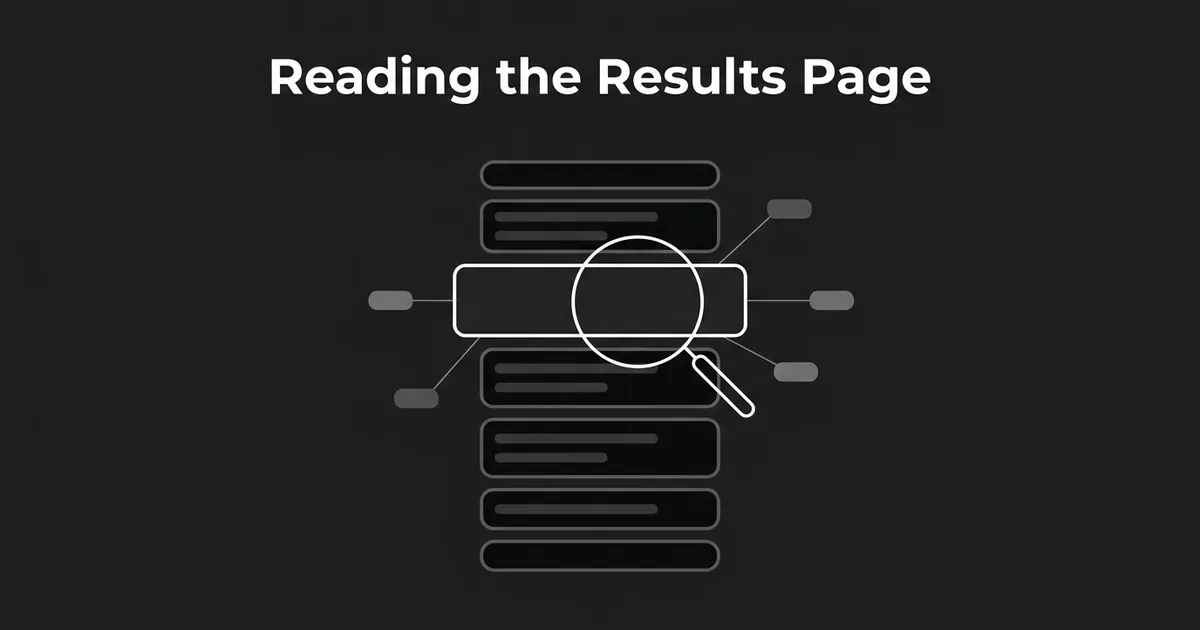
A SERP analysis is the practice of looking at the search results for a target query to understand what searchers actually want, which kinds of pages and result features are already meeting that want, and whether the piece you are about to write fits. SERP stands for search engine results page, and that's the whole idea in one sentence: a keyword tells you what someone typed, and the results tell you what a search engine decided that meant. If you have ever planned a piece around a keyword and watched it underperform anyway, a mismatch between the query and the results is usually why.
What is a SERP analysis?
You take the query you're considering, search it the way a reader would, and look closely at what actually shows up. Not just the ten blue links either. A modern results page can include articles, product or category pages, videos, images, related questions, and other enhanced features, and Google treats these as distinct types of results it can show depending on the query. An ad might sit at the top too, but an ad tells you someone is willing to pay for that click, not that the page underneath earned its ranking. Keep those two things separate when you're reading a page.
The goal of a SERP analysis is editorial, not technical. You're not trying to reverse-engineer Google's ranking algorithm, and you don't get access to private user-intent data by staring at ten results. What you get is evidence: a snapshot of what a search engine currently judges to be useful answers for that exact query. Google says its ranking systems work first to understand the intent behind a query, then assess relevance and usefulness, and that the weight given to different factors changes by query. A SERP analysis is your window into the output of that process, not the process itself.
Keep the SERP analysis definition simple when you're explaining it to your team: it's reading the evidence on the results page so you can decide, before anyone starts writing, what the content actually needs to be.
What the results reveal about search intent
Search intent is the goal behind a query, the thing the searcher actually wants to accomplish. Four labels come up constantly in SEO writing, and they're useful as long as you treat them as working categories rather than strict boxes:
| Intent | What the searcher wants | Example query | Common mismatch |
|---|---|---|---|
| Informational | Learn something or get an answer | how to learn business English | A sign-up page instead of an explanation |
| Commercial | Compare options before deciding | Duolingo alternatives | A single-product pitch with no comparison |
| Transactional | Complete an action, often a purchase | sign up for Duolingo | A long educational essay instead of a clear path to act |
| Navigational | Reach one specific site or page | Coursera English login | An unrelated general article |
These categories overlap more than people admit. A query can sit across two of them at once, and a single word can mean completely different things depending on who's typing it. "Blender" might mean a kitchen appliance or 3D-graphics software, and a results page mixing both is telling you the query itself is ambiguous, not that the search engine got confused. When you see a genuinely mixed page, the honest move is to notice the mix, not force the query into a category it doesn't fit.
This is where a SERP analysis earns its keep over guessing from the keyword alone. The keyword "best SUV" doesn't tell you much by itself. Look at what actually ranks for it and you'll typically find rankings and reviews built to help someone compare options, not an individual manufacturer's product page. That's the signal: the market has already told you, through what it clicks on and what search engines keep surfacing, that this query wants a comparison, not a pitch.
What page type and format tell you
Once you know the rough intent, the results page still has more to tell you, and this is the part writers skip most often. Three separate questions are hiding inside "what should I write":
Page type is the kind of destination being offered: an article, a product page, a category page, a video. Format is the shape that page takes: does an article explain, compare, list, or review? Angle is the specific take that makes one answer more useful than the ten others already sitting on the page. These are different decisions, and collapsing them into one loses information you need.
Take a query like "best air fryer." Blog posts might dominate the page type, and recommendation lists might dominate the format within those posts, but you'll usually also see product reviews, a scattering of ads, and a few purely informational pages mixed in. That mix is the point. A single rigid label ("this is a commercial query, full stop") throws away the texture that actually tells you what to build. The useful read is closer to: readers here mostly want a comparison list, some also want a single-product review, and a page that tries to be both usually does neither well.
None of this means you copy what's already ranking. Matching the observed need doesn't require repeating another page's structure or wording. If everyone ranking for a query already published the same generic list, a genuinely useful, differently angled answer can still be exactly what the format calls for. Google's own guidance points content creators toward helpful, reliable, people-first pages rather than pages built primarily to mirror what already ranks. Reading the SERP tells you the shape of the need. What you put inside that shape is still yours to earn.
A short hypothetical makes this concrete for a B2B team. Say your marketing lead is deciding what to commission for a query about evaluating two categories of software. If the visible results are mostly comparison content helping buyers weigh their options, greenlighting a straight sales landing page risks answering the wrong question entirely: the reader wanted help deciding, not a pitch for one option. Flip it around, and if the results are mostly direct product pages, commissioning a long conceptual essay risks the same mismatch in reverse. Neither call is obvious from the keyword. Both are obvious from ten minutes looking at the page.
Why SERP analysis matters before you write
Here's the actual cost of skipping this step. A writer can turn in a genuinely well-written, accurate, on-brand piece, and it can still miss, because the piece was never going to serve the need the results page revealed. No amount of polishing after the fact fixes a brief that asked for the wrong thing. Adding more keywords or tightening the headers doesn't repair a strategic mismatch, because the problem was never in the execution.
For a marketing lead deciding what goes on the calendar, the useful question a SERP analysis answers is whether a query calls for an explainer, a comparison, a product page, or maybe a different query altogether. That decision shapes the brief, which stage of the funnel the piece belongs to, what kind of expertise needs to write it, and whether a page already on your site should be updated instead of a new one built from scratch. A SERP analysis can also surface a real content opportunity, a query where the current results are thin or off-target, but finding a gap doesn't by itself prove a new page will rank or that the topic is worth the team's time. That judgment still belongs to a person.
It also helps to hold three separate questions apart: does the content fit the intent, is the content actually good, and is ranking realistic given who else is competing. A page can nail the intent and still be forgettable. Another can be genuinely valuable and still miss what the query wanted. Strong competitors and heavy result features can make visibility hard even when everything else about the piece is right. None of that is a reason to skip the analysis. It's a reason to be honest about what the analysis can and can't promise you, which is exactly why SERP analysis matters most before a brief gets written rather than after a draft is already sitting in review.
This is the part of the process DeepSmith removes the manual grind from rather than the judgment. The platform's Content Map turns your site and your competitors' sites into one shared map of topics and funnel stages, so you can see coverage gaps and untapped topics as data instead of a hunch, and Opportunity Agents surface content ideas with the specific evidence attached, so the call to write something isn't made blind. The editorial decision covered in this article, whether a piece fits what the results show, still sits with your team. The tooling just gives you a faster, more current read of what those results actually look like before you commit a brief to the calendar.
What a SERP analysis can't tell you
A results page is evidence, not a vote from every person who ever typed that query. It shows what a search engine is currently displaying in one context, and that context moves. Google has said that time, location, language, and personal settings can all change what a given searcher sees, so treat any single page you pull up as one observed instance, not a fixed, universal truth about that query.
Ads complicate the picture in a specific way. Paid placements can tell you commercial interest exists around a query, but their presence says nothing about which organic page type is actually earning its ranking underneath them. Keep the two apart when you're reading a page.
Result features carry the same caution. Google decides on its own whether a page qualifies as a good featured snippet; a publisher can't request or mark a page for that placement. The same logic extends to newer AI features: being eligible doesn't guarantee inclusion, and there's no confirmed threshold, no fixed number of matching-format results, no authority score that flips a page from "won't rank" to "will." Anyone offering you a precise number here is guessing.
It's also worth being precise about what a Google SERP can and can't predict about AI answer engines. A traditional results page can absolutely inform your sense of a topic's shape and demand, but it doesn't tell you what ChatGPT or Perplexity will cite for the same question. Google has said its AI features can draw on related searches across subtopics and show a different set of links than the standard results page, and Pew Research's July 2025 analysis of search behavior found that only about 18 percent of the Google searches it studied produced an AI summary at all, with clicks on links inside those summaries notably rare. That's one dataset from one study period, not a permanent number, but it's a useful reminder that the presence of a results feature and the presence of a click are two different things. Reading a SERP still gives you the most current read on what a query wants. It was never going to hand you a guarantee.