You picked Anyword for one reason. It scored your copy before you spent a dollar on media. Now something has changed. Maybe the price moved, maybe your team needs long-form as well as ad variants, or maybe your CEO asked why a competitor keeps showing up in ChatGPT and you do not.
Whatever moved you, the search for Anyword alternatives is harder than it looks. Take a breath. Most of the confusion comes from one thing, and once you see it, the shortlist gets short fast.
Here it is: a predictive performance score is not the same as an SEO score, a content score, a GEO score, or an AI-visibility metric. They sound alike. They answer completely different questions. A predictive score guesses how a piece of ad copy will convert before you publish it. The others tell you whether your content is findable and whether AI engines are naming you.
That distinction is the whole map. Once you know which question you actually need answered, the list of tools like Anyword sorts itself. Let's walk it together.
How we picked these AI marketing copy tools
This is a fit ranking for marketing leads, not a controlled performance test. No independent conversion study exists comparing these eight products, and we are not going to pretend otherwise.
We compared each tool on six things:
- Predictive performance capability. Does it score copy before publication the way Anyword does?
- Brand voice control. Can you store your voice once and have it hold across every output?
- Channel breadth. Ads only, or ads plus long-form, email, social, and product content?
- Long-form and SEO or GEO strength. Can it carry a search and AI-search program, not just a headline?
- Workflow and publishing depth. Scheduling, approvals, CMS publishing, distribution.
- Total plan cost. What you actually pay at the tier that fits your team.
One finding shapes everything below. None of the seven reviewed Anyword competitors documents an Anyword-style predictive performance score on its current pages. Not one. They trade prediction for something else: workflow breadth, long-form output, SEO and GEO execution, ecommerce scale, or a lower price.
So if predictive ad scoring is the thing you cannot live without, you should know that going in. If it was one feature among several, you have real options, and most tools like Anyword will give you more elsewhere than they take away here.
Quick comparison of the 8 best Anyword alternatives
| Rank | Tool | Best fit | Predictive scoring | Price signal | Honest tradeoff |
|---|---|---|---|---|---|
| 1 | DeepSmith | Marketing leads who need AI-search visibility plus content production | No ad-conversion score; measures mentions, citations, share of voice, sentiment | $99 / $199 / $399 per month, custom Enterprise | Not the pick if pre-publication ad scoring is non-negotiable |
| 2 | Jasper | Enterprise teams with strict brand governance | None documented | $69 per seat monthly, or $59 billed yearly; Business custom | Cost and a 12-month Business commitment |
| 3 | Copy.ai | Go-to-market teams automating repeatable workflows | None documented | Chat $29; Growth $1,000; Expansion $2,000; Scale $3,000 per month | Sharp jump from Chat to credit-based workflow tiers |
| 4 | Writesonic | Long-form with SEO, GEO, and AI-search monitoring | None documented | $79 / $199 / $399 effective monthly billed annually | Broad for an ad-only team; monthly rates not displayed |
| 5 | Simplified | Campaign teams that also need design, video, and social | None documented | Starter $59 monthly; Pro $119; Business $239 | Campaign credits and conflicting pricing surfaces |
| 6 | Hypotenuse AI | Ecommerce brands producing catalog content at scale | None documented | Basic price not stated; Custom and Enterprise custom | Specialist, narrower than a general copy suite |
| 7 | Scalenut | SEO and GEO-led content operations | Content and GEO scores, not conversion prediction | $59 / $89 / $199 monthly; lower on annual | Weekly prompt refreshes; limits vary sharply by tier |
| 8 | Rytr | Budget short-form drafting | None documented | Free; $7.50 and $24.16 effective monthly on annual billing | Character limits and a light workflow layer |
1. DeepSmith

Best for: Marketing leads who need to see where their brand shows up in AI search, find the content gaps, and turn those findings into on-brand, publish-ready articles without running a second workflow to do it.
Here is the problem most content teams are living with right now. You have an SEO tool in one tab, an AI writer in another, and no idea whether ChatGPT or Perplexity is naming you when a buyer asks about your category. The measurement and the production never talk to each other.
DeepSmith puts both in one platform. It tracks how AI engines answer questions about your brand, shows you where you are invisible or losing, and produces the content that closes those gaps from the same data.
What you can measure
AI Visibility reports mention rate, citation rate, share of voice, sentiment, and visibility trend. You can open any tracked prompt and read the actual answer an engine gave, see which of your pages got cited, and see which competitor pages are winning the citations you want.
Ten engines are covered: ChatGPT, Gemini, Perplexity, Claude, Google AI Overviews, Google AI Mode, Grok, Meta AI, Microsoft Copilot, and DeepSeek. Coverage rises with your plan. Pro tracks ChatGPT, Grow adds Perplexity, Scale adds Gemini, and Enterprise or Custom covers all ten.

Content Map crawls your site and your competitors' sites into one shared topic taxonomy, sorted by Awareness, Consideration, and Decision. It shows coverage gaps, untapped topics, and how deep each topic actually goes. Sitemaps are rechecked every 24 hours, so new pages fold in without a re-import.
What you can produce
Opportunity Agents read that data and return content ideas with the evidence attached. Not a brainstorm. Each idea arrives with the specific data point that justifies it, which is what lets you defend a backlog instead of guessing at one. Visibility agents accept a 30, 90, or 180-day window, and every run is logged.
Content Studio moves an idea through New Ideas, Planned Content, and Produced Content. The Writer researches, writes, structures for SEO and AEO, adds internal and external links, generates a cover image, and writes the publish-ready metadata. Internal linking pulls from your enriched sitemap and can place up to five strategic links during generation, which is the hour a week most teams currently spend cross-referencing by hand.
Autowrite is the part that changes your calendar. Configure an article at planning time and it writes itself on its scheduled date, with nobody in the app. That is what turns a content calendar from aspirational into operational.

Deep IQ holds the brand context every module uses: company positioning, products, personas, brand voice, visual guidelines, and reusable content types. Set it once and every draft is grounded in it. No re-briefing, no voice drift, no invented product claims.
When an article is finished, Repurpose and the Apps Library turn it into LinkedIn posts, X threads, newsletter emails, Medium and Substack versions, and more, in the same voice. Publishing goes straight to WordPress, Webflow, Strapi, Sanity, Contentful, or your own webhooks, with Markdown and HTML export as a fallback.
Pricing
| Plan | Monthly | Annual effective | Articles | Prompts | Seats | Engines |
|---|---|---|---|---|---|---|
| Pro | $99 | $80 | 20 | 50 | 5 | ChatGPT |
| Grow | $199 | $160 | 40 | 100 | 7 | ChatGPT, Perplexity |
| Scale | $399 | $299 | 90 | 200 | 10 | ChatGPT, Perplexity, Gemini |
| Enterprise | Custom | Custom | Custom | Custom | Custom | All ten |
There is a 7-day free trial, no long-term contracts, and no cancellation fees. Multi-Workspace keeps separate brands or client accounts fully isolated, each with its own context and plan.
The honest scope note
DeepSmith does not try to replicate Anyword's predictive performance score, and we are not going to dress up a visibility metric as one. Its measurement layer answers a different question: where AI engines mention or cite you, and who is beating you to it. Its production layer acts on that answer.
For a marketing lead whose real problem is invisibility in AI search plus a production bottleneck, that is the right question. If your only job is picking the highest-scoring paid-social variant before launch, this list does not document an equivalent anywhere, and you should know that rather than be sold a substitute.
2. Jasper

Best for: Enterprise marketing teams that need governed brand voice, stored knowledge, defined audiences, and multi-channel campaign production.
Jasper produces articles, emails, ads, social posts, and images, with more than 100 specialized agents and connected pipelines across SEO and GEO, campaigns, email, social, personalization, and research.
Brand Voice is the real strength. It captures voice, tone, style, and visual guidelines, and Jasper says it scales those rules across brands, audiences, geographies, and languages, flagging off-brand tone and suggesting adjustments. Jasper IQ stores context, rules, and brand logic so they carry into pipelines, agents, Canvas, Grid, AI Studio, and the API.
Key features: 100+ agents, Brand Voice, Knowledge, Audiences, Jasper IQ, Canvas, Grid, and no-code custom agents on Business. Documented integrations include Slack, Google Drive, SharePoint, Adobe Workfront, Semrush, Box, BigQuery, Webflow, Microsoft Word, Google Docs and Sheets, Chrome, Zapier, Make, Monday.com, and Asana, with Salesforce in beta for Business.
Pricing: Pro is $69 per seat monthly, or $59 per seat billed yearly, and the displayed Pro allowance is one seat, 2 Brand Voices, 5 Knowledge assets, and 3 Audiences. Business is custom. A 7-day Pro trial is offered.
Honest limitation: cost and commitment. Business pricing is custom and carries a stated 12-month commitment, and Pro is priced per seat, so a small team scales its bill with its headcount. Jasper is worth it when governance and channel coverage matter more than a copy-performance estimate. It is not the budget option.
3. Copy.ai

Best for: Go-to-market teams that want repeatable workflows for marketing and sales content, not a standalone copy editor.
Copy.ai has grown past the short-form ad generator it started as. Chat runs on OpenAI, Anthropic, and Gemini models. Workflows chain research, generation, and integrations into processes you run again and again. Infobase stores your company and product information, and Tables and Actions handle the structured steps in between.
Key features: multi-model Chat, Workflows, Infobase, Tables, Actions, and Brand Voice, which can analyze your existing on-brand content or be defined by hand. You can hold several distinct voices for different authors or audiences.
Pricing: Chat is $29 per month for 5 seats with unlimited Chat words and projects. Then it jumps. Growth is $1,000 per month for 75 seats and 20,000 Workflow Credits, Expansion is $2,000 for 150 seats and 45,000 credits, and Scale is $3,000 for 200 seats and 75,000 credits. The reviewed pricing display did not state a free trial.
Honest limitation: plan economics. Unlimited Chat words does not mean unlimited workflow runs, and the gap between $29 and $1,000 is the whole product. Credit use varies with task complexity and step count, so there is no fixed cost per run. Budget for the tier that matches the automation you actually want, not the one on the shelf.
4. Writesonic

Best for: Teams that want long-form articles and broad marketing copy alongside SEO, GEO, site audits, and AI-search monitoring.
If your brief has widened from ad copy to a full content program, Writesonic is the broadest option here. It advertises 80+ tools spanning product descriptions, Facebook and Google ads, blog and article writing, emails, ebooks, Amazon formats, LinkedIn posts, YouTube content, landing pages, meta tags, cold emails, and press releases.
Key features: the AI Article Writer and Content Strategy tools for long-form, Sonic Editor for rephrasing, expanding, shortening, checking, and publishing, plus meta tags and keyword extraction on the SEO side. AI-search features include GEO workflows, prompt and answer monitoring, audits, and competitor or advertising monitoring depending on tier. Integrations run to 20+ native connections plus an API, including WordPress, Sanity, Contentful, Drupal, Vercel, Google Search Console, GA4, Ahrefs, and a Chrome extension.
Pricing: the reviewed plan cards showed annual effective monthly rates, not month-to-month prices. Starter is $79 per month billed annually for 1 user with 15 AI articles a month, 50 prompts and 50 answers tracked daily, and 10 audits at 100 pages each. Basic is $199 for 25 articles and 100 prompts. Growth is $399 for 50 articles and 200 prompts. Enterprise is custom and covers all ten AI platforms.
Honest limitation: breadth. Writesonic says it is trained on high-performing copy and understands what converts, but that is positioning language, not a numeric predictive score you can act on. An ads-only team pays for audits, articles, and prompt tracking it will not touch. Confirm the monthly rate before you budget, because the display shows annual.
5. Simplified
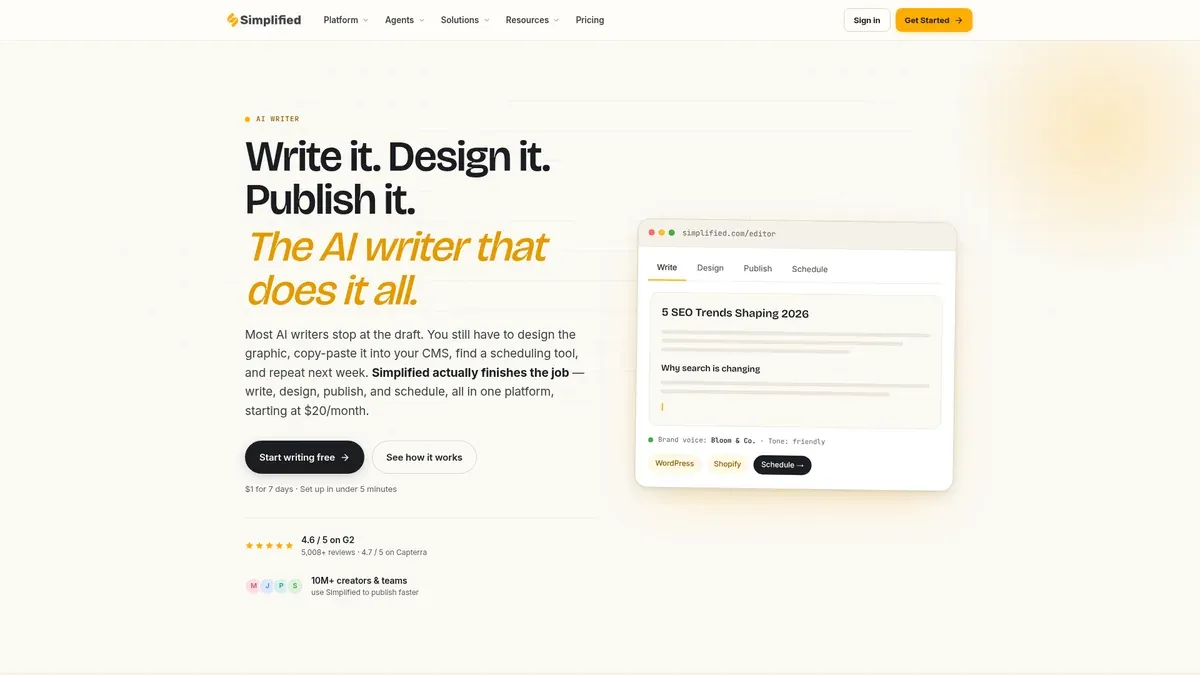
Best for: Campaign teams that want copy generation bundled with design, video, social scheduling, approvals, and publishing.
Copy is rarely the only bottleneck. If you are also waiting on a designer for every ad visual, Simplified collapses that into one place. The AI Writer carries 50+ templates for blogs, ads, social, products, email, YouTube, product listings, newsletters, press releases, and website copy. Riley is a marketing agent that plans, creates, and publishes campaigns, including copy, designs, video, captions, ads, and reports.
Key features: a Knowledge Base for brand guidelines, samples, tone, and style, plus colors, fonts, products, customers, and approved examples. Campaigns default to approval with auto-publish as an opt-in, and scheduling runs one-time, daily, weekly, or monthly. Direct WordPress and Shopify publishing is documented, with WordPress output including metadata, Yoast fields, drafts, and scheduling. Integrations include Ahrefs, Search Console, GA4, Shopify, HubSpot, Klaviyo, Google Ads, Meta Ads, Webflow, Contentful, Slack, Notion, Asana, and Monday.
Pricing: Starter is displayed at $59 monthly or $79 billed annually with 5 campaigns, 100,000 AI words, 100 designs, 50 videos, and 7 social accounts. Pro is $119 monthly or $99 annual with 15 campaigns and 3 seats. Business is $239 monthly or $199 annual with 40 campaigns and 7 seats. One campaign means brief to approval, and one credit produces one output type: a six-post social batch, a three to five email sequence, or a three-variant paid ad set. Extra campaigns are $10.
Honest limitation: packaging clarity. Campaign credits cap what a plan can produce, and a newer homepage surface showed a different Free, Pro, and Growth structure with $0, $20, and $85 figures that conflicts with the detailed plan table. Check the live plan selector before you commit. Dedicated SEO scoring and keyword-density analysis still need your existing SEO tools.
6. Hypotenuse AI

Best for: Ecommerce brands that need product descriptions, catalog enrichment, and marketplace-ready content in a controlled voice.
This one is a specialist, and that is exactly the point. If your real bottleneck is 40,000 SKUs rather than a paid-social calendar, a general copy suite will not fix it.
Hypotenuse AI positions itself as an AI-first Product Experience Management platform. It generates product descriptions and more than 20 ecommerce content types, including meta titles and descriptions, category pages, and blog articles.
Key features: attribute enrichment from web sources, UPCs, specification sheets, and images. It creates tags and categories for Google, Amazon, Walmart, or your own taxonomy, and supports thousands to millions of SKUs through bulk CSV or XLSX workflows. Brand voice is trained on real content and governed with rules. HypoChat handles web research and document work, and HypoArt covers images. Integrations are catalog-shaped: Akeneo, Mirakl, NetSuite, Plytix, Salesforce Commerce Cloud, Salsify, Shopify, Stibo, WordPress, and Webflow.
Pricing: Basic covers fewer than 100 products with 1 seat and 40+ languages, but the price and word allowance are not published. Custom and Ecommerce Enterprise are both custom, with enterprise catalog, enrichment, governance, bespoke models, PIM and ERP connections, and dedicated support. A free try without a card is offered. Unused words roll over on annual subscriptions but not monthly ones.
Honest limitation: scope, plus opacity. It is narrower than a general performance-marketing suite, so it is the wrong default if you mostly write paid-social variants and lifecycle campaigns. And you will need a sales conversation to learn what Basic costs.
7. Scalenut

Best for: SEO and GEO-led content teams that want prompt discovery, content scoring, optimization, and publishing in one tool.
Scalenut sits where search work and AI-search work meet. Cruise Mode handles long-form blog production, and the AI Writer offers Write, Instruct, and Connect modes with brand tone, statistics, NLP terms, an SEO score, keyword recommendations, SERP data, competitor analysis, editing, and publishing.
The GEO side covers brand mentions, historical trends, prompt coverage, competitor share, citations, content gaps, prompt opportunities, and a GEO score.
Key features: Plus adds advanced audits, on-page and internal-linking functions, topic gaps, WordPress and Shopify auto-publishing, Social Upreach, and a Backlinks Marketplace. Professional adds a keyword planner, cannibalization analysis, a dedicated customer success manager, and GEO experts or agents.
Pricing: Starter is $59 monthly or $24 effective monthly billed annually, covering 1 workspace, up to 10 prompts refreshed weekly, and ChatGPT plus Google AI Overviews. Plus is $89 or $36 annual, with 2 workspaces, 25 weekly prompts, and 4 team members. Professional is $199 or $80 annual, with unlimited workspaces, 100 weekly prompts, and Perplexity added. The annual rates are presented as a limited-offer 60% saving, so treat them as promotional. There is a 7-day free trial.
Honest limitation: the scores are not prediction. An SEO score and a GEO score tell you about search readiness and AI-answer coverage, not about how an ad will convert. Prompt refreshes are weekly rather than continuous, and workspace, engine, and content quotas shift sharply between tiers. It is a search-led content operation, not a broad ad-copy hub.
8. Rytr

Best for: Individuals and small teams that need inexpensive, lightweight generation for short-form copy and the occasional long piece.
Sometimes the honest answer is that you do not need a platform. You need a fast drafting tool that costs almost nothing.
Rytr offers 40+ use cases and templates across long-form, SEO, creative, personal, and professional writing, with autocomplete, continue writing, expand, grammar checking, rewording, shortening, and command functions. It supports 20+ pre-programmed tones and 40+ languages, and Tone Match can analyze a writing sample and mirror it.
Pricing: Free gives you 10,000 characters a month in one language with no card. Unlimited is $7.50 effective monthly on annual billing, with unlimited generations, 1 Tone Match, and 50 plagiarism checks a month. Premium is $24.16 effective monthly on annual billing, with multiple Tone Match profiles, 100 plagiarism checks, 35+ languages, and triple the input limit.
Honest limitation: workflow depth. Character and input limits, a light governance layer, and no confirmed third-party integration matrix make it a poor fit for a department that needs shared context, scheduled production, approvals, and distribution. The integrations page was under construction, so do not plan around CMS, CRM, ad-platform, or social publishing connections. Rytr's homepage reports more than 8 million users and $500 million saved, and those are vendor-reported figures rather than verified benchmarks.
How to choose the best Anyword alternative for your team
Not sure which one is yours? The AI marketing copy tools above solve different problems, so match your situation to the row below and stop there.
Your leadership is asking about AI search and you have no answer. Choose DeepSmith. You get the measurement and the content that closes the gaps from the same data, which is the only setup that turns a visibility problem into a publishing plan.
You run a large brand with strict governance across regions and languages. Choose Jasper. Brand Voice, Knowledge, and Audiences are built for exactly that, and the agent library covers the channels.
Your work is repeatable go-to-market motions, not one-off copy. Choose Copy.ai, and budget for a workflow tier rather than Chat.
Long-form search content is now the priority. Choose Writesonic for the widest tool set, or Scalenut if you want scoring, topic gaps, and prompt tracking in a tighter SEO-led loop.
Copy is only half your bottleneck and design is the other half. Choose Simplified.
Your bottleneck is a product catalog. Choose Hypotenuse AI. Nothing else here is built for attributes, taxonomies, and millions of SKUs.
You need cheap drafting and nothing else. Choose Rytr.
Predictive ad scoring is genuinely non-negotiable. Then be honest with yourself. None of these eight documents an equivalent, and no independent study shows any of them converts better. Keep Anyword for that specific job, or run one of these alongside it for the content work it does not cover.
Most marketing leads we talk to are not in that last group. They are in the first one. The AI-search question landed on their desk, and the content backlog was already too long before it did.
If that is you, you can see real data and real drafts before you pay anything. Start a 7-day DeepSmith free trial and find out where AI engines are naming you today.