If you already pay for SEO software and leadership has started asking about AI search, it's fair to wonder whether you need to buy something new. The short answer is that most of your SEO toolset still does its job, and what's missing is one kind of evidence. SEO tools tell you how people can find your site through search results. GEO tools add a look at what AI engines actually say about your brand, which pages they cite, and which competitors they name. This guide walks through geo vs seo tools, and the wider question of generative engine optimization vs seo software, one piece at a time so you can see which of your current tools still apply, which questions they can't answer, and where you need something added.
The short comparison
Here is the side by side. Read the columns as capabilities, not as two separate shopping aisles, because a single platform can have both.
| Criterion | Conventional SEO tooling | GEO and AI-search tooling |
|---|---|---|
| Main question | Can people find the site through search, and how does it perform there? | Does an AI answer mention the brand, cite its pages, or favor a competitor? |
| What it observes | A URL, a query, a search result, a crawl finding, a referring link | A prompt, a generated answer, a brand mention, a citation, a cited URL |
| Common inputs | Site crawl, search queries, page inventory, backlinks, analytics | Buyer questions, brand names, a competitor set, the engine, the market, sampled answers |
| Visibility measures | Impressions, clicks, click-through rate, position, index coverage | Mention rate, citation rate, share of voice, cited pages, how the answer describes you |
| Technical work | Crawling, indexing, internal links, redirects, rendering, metadata | Mostly the same work, plus checking that each provider's search crawler can reach the page |
| Content work | Cover the intent, give useful information, structure the page clearly | The same foundations, checked against the gaps you see in answers and citations |
| Competitor view | Competing pages, queries, links, and topic coverage | Competing brands and the exact pages that show up in sampled answers |
| Demand research | Keyword and search-query research | Prompt discovery and a monitored set of buyer questions |
| Repeatability | Varies by market, device, and time | Also varies from one generated answer to the next |
| Production | Built into some platforms, not into every tool | Built into some platforms, not into every tool |
Neither column can promise a ranking, a citation, or a sale. Each one answers a different question, and that's the main thing to carry through the rest of this article.
What an SEO tool is for, and what a GEO tool adds
SEO tools support work on search discovery and performance. That covers technical crawlers, webmaster reporting, keyword research, position tracking, link analysis, and content planning. These are different products with different data, so it helps to separate the ones that report what a search engine itself observed (like Search Console) from the ones that report what a crawler or a third-party dataset found.
A GEO tool, short for generative engine optimization tool, is built to measure and improve how you show up in generated answers. The usual functions are submitting or observing questions, capturing the answers, spotting brand mentions, pulling out the cited sources, comparing against competitors, and watching how all of that changes over time. If you want the categories laid out more fully, what a GEO tool is covers them.
"GEO tool" isn't a standard feature list, so one product might only monitor answers while another also suggests content or writes it. And GEO and AEO (answer engine optimization) get used with overlapping meanings by different vendors. In this article we'll use "AI search optimization tools" as the broad everyday term for software that measures or supports visibility in AI-driven search, and we won't pretend it gives anyone a view into an engine's internal ranking.
The shared layer: SEO work that still applies
Most of what your SEO tools do keeps its value. A page has to be reachable before anything else about it matters, and Google says a page needs to be indexed and eligible to show with a snippet to be eligible for its generative AI features. Google is also clear that meeting its requirements doesn't guarantee crawling, indexing, or showing up. So these are entry conditions, not promises.
Crawling and technical health
A crawler still finds broken links, server errors, awkward redirects, and content that's hard to reach. If your key information depends on JavaScript, the same rendering checks you already run are still worth running. Google's guidance recommends making important information available as text and keeping the page experience good. One caution is that a clean test in one crawler doesn't prove every AI engine retrieves your page the same way, so treat one provider's behavior as that provider's behavior.
Internal links and site structure
Internal links still help people and search systems find your pages, and a content inventory still shows you thin spots, old pages, and missing decision-stage content. What changes is the extra question of which of those pages AI engines actually cite. A sitemap and a cited-pages report answer different questions, and you'll want both. If you're building that habit, citation source audit is a good place to start.
Useful content and topic coverage
Accurate, substantial, well organized pages that satisfy the reader are the overlap that matters most. Keyword research can give you vocabulary and topic context, and what you see in AI answers can show how a question gets answered and which sources get picked. Both can feed the same editorial backlog, though they aren't the same dataset and one doesn't replace the other.
Structured data, metadata, and AI files
Keep structured data accurate and matching what's visible on the page, and keep doing the metadata work you already do. Google states that structured data isn't required for its generative search features, that there's no special schema you need to add, and that special AI text files, Markdown copies, or an llms.txt file aren't required for showing up in Google Search. That's a Google statement, so don't stretch it into a claim about every service that might read those files.
Clear writing, without the myths
Clear headings, readable sections, and short direct answers where they fit are sensible habits. They aren't a proven formula. If a tool gives you an AI readiness score, how GEO tools score content explains what sits inside one. Google's guidance on optimizing for generative AI features says there's no ideal page length and no need to split content into tiny chunks. It also warns against making a page for every small variation of a query just to influence rankings or AI answers.
Website analytics
Analytics still matters once an AI referral arrives. Search Console covers performance before the visit and Google Analytics covers what people do afterward, and clicks and sessions won't always match.
The different layer: measuring generated answers
The gap isn't that your SEO reports are bad. It's that they were built to answer a different question. A crawl can tell you a page is reachable, but it can't tell you whether ChatGPT named you when a buyer asked about your category. The table below shows what each common report can and can't tell you on its own.
| Existing report or signal | What it can show | What it can't show by itself |
|---|---|---|
| Technical crawl | Errors, links, metadata, and reachable content | Whether an AI engine mentioned or cited the page |
| Indexability check | Indexing status in the system being checked | That an engine will pick the page as a source |
| Keyword position report | Position under that report's search settings | Whether a generated answer names or cites you |
| Backlink report | Links found in that dataset | Which links are shown as citations in AI answers |
| Keyword research | Search topics and demand in that dataset | A full count of real prompts across AI products |
| Content coverage report | Topics you have and are missing | Whether more pages on a topic will earn more citations |
| AI crawler requests in server logs | A request attributed to that crawler | A user-facing citation, training use, or a sale |
| Referral analytics | Recorded visits from known sources | Answers people read without clicking, or every influence on a purchase |
| Optimization score | How a page does against the vendor's own rubric | Access to an engine's internal selection logic |
Each row is a different observation for a different question. None of them is obsolete.
The units are different
An SEO report counts impressions, clicks, click-through rate, and average position. Search Console defines average position as the position of the topmost result from your site, so it shouldn't be relabeled as a citation position in an AI answer. GEO measures work on a different unit, the answer, and AI visibility analytics covers what that category reports.
- A brand mention means the answer names your brand. It doesn't need a link.
- An owned-page citation means the answer links to one of your pages as a source. A link can appear without the brand being named in the text.
- Mention rate is the share of eligible monitored answers that contain your brand, under that tool's matching rules.
- Citation rate is the share of eligible monitored answers that cite one of your pages.
- Share of voice is your visibility relative to a defined set of competitors. One published formula divides your mentions by all brand mentions, and not every vendor uses that one.
- Sentiment classifies how the brand is described. Being recommended, being described accurately, and being on a shortlist are separate things.
A small example shows how these fit together. This is an illustration, not a customer result or a market benchmark. Say you monitor 100 valid answers. In 30 of them the brand is named, and in 12 of them an answer links to one of your pages. Across the whole comparison set there are 120 brand mentions, 30 of them yours, counting each brand once per answer. Your mention rate is 30%, your citation rate is 12%, and your share of voice under that formula is 25%. Those numbers describe your monitored sample, not all AI users or the whole market.
Four answers that look similar but aren't
It helps to be able to tell these apart when you read a report.
- The answer names you and cites your product documentation. That's a mention and an owned-page citation.
- The answer names you but cites a third-party review. That's a mention, and no owned-page citation.
- The answer links to a research page of yours without naming you in the text. That's a citation, and no mention.
- The answer names a competitor while explaining a limitation. That's competitor visibility, but not necessarily a recommendation.
Why one query isn't a baseline
One manual check can show you a possible gap, and it can't give you a stable number. A study on arXiv, "Don't Measure Once", collected repeated answers from ChatGPT, Gemini, Google AI Mode, and Perplexity across four campaign verticals. It found that the sets of cited sources overlapped only about 34% to 42% from one day to the next, and the sets of brands overlapped about 45% to 59%. Even answers collected within the same day differed from each other. That's one study on one set of campaigns, so it doesn't give you a universal number of runs. What it does support is checking the same questions repeatedly and looking at the history.
Traditional search results vary too, so the point is that you need a way to sample answers, keep them, and compare like with like.
Native reports now overlap with GEO tools
This part changed the most in 2026. You may have read that Google offers no AI visibility reporting, and that's out of date.
Search Console's generative AI report
Google announced dedicated Search generative AI performance reports on June 3, 2026, and its documentation says they had rolled out to sites worldwide by August 31, 2026. The Search report covers impressions from AI Overviews and AI Mode, and Discover has its own separate report. Google's announcement describes the details. The main measure is impressions, meaning how many times links to your site were shown in a generative AI feature, broken out by page, country, date, and device. The newest data can be preliminary, standard Search Console limits apply, and the data is already part of your overall Search performance, so you shouldn't add it on top of the total.
The documentation we reviewed doesn't describe a cross-engine brand mention panel, competitor share of voice, a full history of generated answers, or a count of conversational prompts. So it's a strong source for what Google showed, and it's not a view of ChatGPT or Perplexity.
Bing Webmaster Tools' AI Performance
Microsoft introduced AI Performance in Bing Webmaster Tools as a public preview on February 10, 2026. It covers Microsoft Copilot, AI-generated summaries in Bing, and some partner integrations, and you can read Microsoft's announcement for the full list. It reports total citations, average cited pages per day, page-level citation activity, and trends over time. Microsoft says these numbers don't establish ranking, authority, or where you appeared inside an answer, and the announcement doesn't describe a traffic or conversion metric for the dashboard.
What is left for third-party tools
Native reports and third-party GEO monitoring now overlap, so the useful distinction is how the data was collected. A search provider's report describes real activity on the surfaces it supports. A third-party tool runs a panel of questions you choose and captures the answers across the engines you select. Neither one is simply better, and GEO tool integrations shows how Search Console and analytics can connect to them. It's more useful to ask which method a given number came from.
Technical controls: search access is not training permission
Many teams get stuck on crawler settings. Googlebot controls crawling for Google Search, including its AI features, while Google-Extended covers certain training and grounding uses elsewhere in Google and isn't the switch for Search AI features. On the OpenAI side, OAI-SearchBot surfaces sites in ChatGPT search, GPTBot supports training its foundation models, and ChatGPT-User handles some user-initiated actions.
OpenAI's crawler documentation says its search and training settings are independent, so a site can allow OAI-SearchBot and disallow GPTBot. OpenAI also says a robots change can take about 24 hours to affect its search systems, which is not a promise of indexing or citation. For Google, blocking in robots and using noindex aren't interchangeable, because a crawler generally has to fetch a page to read its page-level directive. Check access and indexing controls before you decide that low citations are a content problem.
From what you see to what you publish
Take a made-up company that sells renewal-management software. It ranks for relevant search topics, but it keeps missing from monitored answers about renewal workflows for small SaaS teams. The team shouldn't decide SEO has failed, and shouldn't assume more articles will fix it. A sensible order looks like this:
- Confirm the gap by checking repeated answers for the same question and settings.
- Look at the exact competitor and third-party pages being cited, not only the brand names.
- Check technical eligibility, including access, indexing, snippet controls, and search-crawler permissions.
- Map what you already have, and see whether a page on your site already answers the question fully and accurately.
- Pick the fix: improve an existing page, add genuinely missing coverage, correct old product information, or solve a separate technical issue.
- Write useful material with real product facts, criteria, limits, and examples, and don't copy a competitor's unsupported claims.
- Publish, keep a dated change log, and confirm the page can be reached.
- Check again with like-for-like answer samples, native reports, identifiable referrals, and business outcomes.
This is a testable response to evidence and not proof of cause. No one should attach a guaranteed citation lift to it. When you report on it, keep three layers apart: observed answer exposure (mentions, citations, descriptions), recorded website visits from identifiable AI referrals, and real business outcomes like qualified inquiries. A rise in monitored citation rate alone doesn't show the work caused any revenue.
DeepSmith: measurement and production in one place
DeepSmith is built for the situation in that last section, where seeing the gap and doing something about it usually live in separate tools. It's one platform for AI search analytics and content production. It doesn't replace a technical crawler or your website analytics, and it's not trying to. Where it fits is the workflow from AI visibility evidence to content ideas to finished articles.
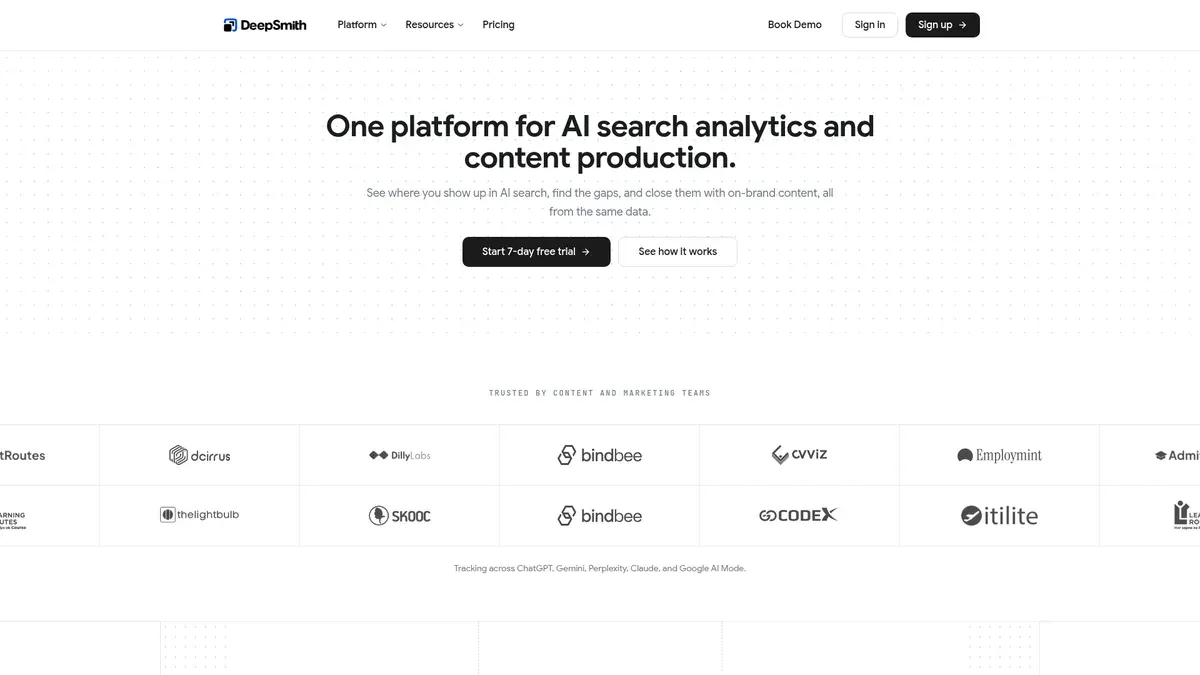
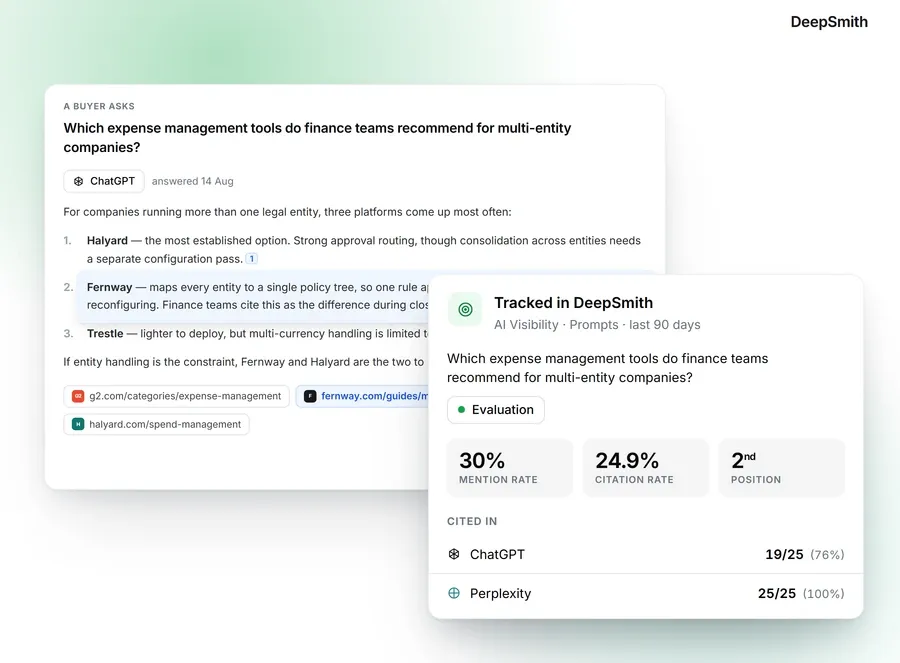
On the measurement side, AEO (AI Search Visibility) tracks mention rate, citation rate, and share of voice with trends, plus a per-platform breakdown, a competitor leaderboard, and the sources AI cites most. You define the questions, and Discover Prompts can suggest a starter set from your product, persona, and buyer-stage context. Each tracked prompt keeps its answer history, and a Pages view shows which of your pages get cited and which prompts drive those citations. Competitor citations show who wins for your prompts and on which exact pages.
Content Map turns your site and your competitors' sites into one topic map by buyer stage, so you can tell a coverage gap, where a competitor publishes more, from an untapped topic, where you have nothing. Sitemaps are checked every 24 hours. Opportunity Agents read your AI visibility or Content Map data and return ideas, each with the data point behind it.

On the production side, Content Studio moves an idea through New Ideas, Planned Content, and Produced Content. The Writer produces a researched, brand-grounded article with internal and external links, a cover image, and publish-ready metadata, grounded in what you store in Deep IQ (company, product, persona, voice, and content type). Autowrite can generate planned articles on a set date. From Produced Content you can review, edit, and publish to WordPress, Webflow, Strapi, Sanity, or Contentful, or to your own webhooks. Repurpose and the Apps Library then turn a finished article into channel versions. The numbers in the screens above are demo data, not customer results.
A few scope facts are worth stating plainly. The API and the MCP server are read-only, so they let you pull workspace data into your own tools and don't create or publish content. Webhooks notify other systems and don't publish either. On pricing, Pro is $99 a month and tracks ChatGPT, Grow is $199 and adds Perplexity, Scale is $399 and adds Gemini, and Enterprise covers all ten engines. Pro's single engine is a narrower view than the higher plans, and it comes with 20 articles a month and 50 tracked prompts, so a small team gets measurement and production together from the first plan. There's a 7-day free trial and no long-term contract. We don't have documented results to point to, so we won't promise a citation lift.
Which tools to look at, by situation
When you compare geo vs seo tools, the honest way to choose is to name the question you can't answer today and pick the capability that answers it.
| Your situation | What to focus on |
|---|---|
| Pages can't be fetched or indexed reliably | Technical diagnosis and access controls |
| You can't explain your Google Search performance | Native Search reporting and page and query analysis |
| Leadership asks whether AI answers name the brand | A defined question set, answer capture, and mention measurement |
| Competitors show up in answers and you don't know why | Cited-page inspection, repeated observations, and a coverage check |
| Tracking shows gaps but the backlog doesn't move | Evidence-backed planning and a production workflow |
| You need to show commercial impact | Linking visibility to identifiable referrals and business outcomes |
If you're deciding between a tracker and one that also writes, tracking-only versus tracking-plus-content tools goes through the tradeoffs. If you want the wider field, best GEO tools compares what's available, and the best AI visibility tools roundup focuses on tracking. For a view of what software can't do here, see what GEO tools cannot do, and for how the measurement itself differs, prompt tracking versus keyword tracking.
If you'd like to see this on your own questions, you can start a 7-day DeepSmith free trial, add the buyer questions you care about, look at the pages AI cites, and try the content workflow. The trial won't promise you a citation gain, but it will show you real data on your own brand before you pay.
Related guides
- How Tracking, Content and Technical Tools Fit Into One AEO Stack: See how tracking, content and technical tools hand work to each other in one AEO stack, what data flows between them, and where gaps or overlaps usually appear.
- How to Run a 30-Day GEO Pilot and Judge the Result: Plan a one-month pilot with a scoped topic set, a baseline and exit criteria, then judge whether to continue.
- How to Set Up a GEO Workflow From Tracking to Publishing: Lay out a working loop from tracking to gap analysis to briefs to publishing, with owners and handoffs at each step.
- How to Tell Whether an AI Citation Is Actually Helping You: Judge a citation by position in the answer, framing, link visibility and the prompt it answers, instead of counting every one equally.
- The Weekly AI Visibility Review: A Meeting Agenda and Template: Run a short recurring meeting with a ready agenda, a review template and clear owners for follow-up actions.