You already know which cluster this page anchors. What you probably do not have is a clear picture of what goes on the page, how long it should be, and how to connect it to everything else you have published. This guide walks you through how to create a pillar page in seven steps, from scoping the topic to wiring the internal links that hold the cluster together. By the end you will have a page that reads as the hub of a real body of work, not a long blog post with ambitions.
Here is the short version. A pillar page covers one broad topic as a useful overview: a descriptive title, a clear introduction, a direct answer near the top, navigation your reader can actually use, one well-labeled section per major subtopic, real examples, a short FAQ, and a contextual link out to each deeper page in the cluster. There is no required word count. Around 2,000 words is a sensible planning starting point, and a genuinely deep topic can run 3,000 to 5,000. Completeness and scannability matter more than the number.
One thing to hold onto before we start: none of this guarantees an AI citation. Structure makes your page easier for people and machines to understand. It does not force an answer engine to quote you. We will keep that line clear the whole way through.
Step 1: Set a broad, bounded promise
Before you write a single heading, write one sentence.
Use this shape: this page gives [audience] a complete working overview of [broad topic], including [major areas], so they can [outcome], with deeper detail in the supporting pages.
Then write a second sentence that says what the page will not cover. Something like "this page explains the structure and the linking model, not the separate process for generating spoke questions." That exclusion line is the most useful sentence in your brief. It is the thing that stops the pillar from quietly swallowing your entire cluster.
Now test the topic itself. It should be broad enough to justify several related subtopics, and narrow enough that a complete overview does not turn into a 50,000-word document. It should be relevant to your audience and your product context. It should have one clear primary intent. It should be stable enough to stay useful, unless you meant it to be time-bound.
Done when: you can name the topic in one sentence, you can say who it is for and what they get, and you can list what the page will not do.
Common mistake: starting from "let's write the longest guide possible." A topic as wide as "business" produces an outline that is a catalog of unrelated subjects. A topic as narrow as one long-tail question deserves a single focused article, not a hub. A useful pillar has boundaries before it has paragraphs.
If you are not sure whether your site already covers parts of this topic, that is worth checking before you commit. DeepSmith's Content Map crawls your site and your competitors' sites, classifies every page onto a topic and a funnel stage, and shows how deep each topic already is. Use it to confirm the cluster you have, not to rethink the cluster decision you already made.
Step 2: Map your approved spokes to page sections
You have a spoke list. Turn it into a section map.
Every major spoke gets one natural parent H2 on the pillar. For each one, write three things down: the one-sentence answer that section will give, the deeper job you are reserving for the spoke, and the anchor phrase you will probably use to link to it.
Keep the hub broad and the spoke specific. That split is the whole reason the cluster works. The pillar owns the overview and the navigation. The spoke owns the detailed procedure, the evidence, the comparison, the exhaustive examples.
One practitioner planning heuristic puts a cluster somewhere around 10 to 20 subtopics. Treat that as a rough sizing signal and nothing more. It is not a quota, and it is not a required link count. A hub with four strong spokes is better than one with four strong spokes and eight weak ones added for symmetry.
Done when: no approved spoke is homeless, no H2 exists only to add words, and no two sections are competing to answer the same question.
Common mistake: writing a heading list that sounds comprehensive but has no relationship to the pages you actually have. The other version of this mistake is worse: pouring all the spoke detail into the hub, which leaves your supporting pages reading like near-duplicates of it.
Step 3: Build the answer-first pillar page structure
Now you build the skeleton. Draft the whole architecture before you fill in a single paragraph.
Good pillar page structure has these components, and each one has a job:
| Component | What it must do | Done when |
|---|---|---|
| Title, URL, and H1 | Name the broad topic plainly | A reader can predict the subject without hype |
| Short introduction | Say who it is for, the problem, and the result | The reader knows if this page is theirs |
| Direct-answer summary | State the practical answer early | A scanner gets the core answer without reading it all |
| Table of contents | Expose the page's architecture | Every major H2 is listed and every jump link works |
| Definition and boundaries | Say what the topic is and is not | The page has a shared vocabulary |
| Why it matters | Connect it to a real decision | It answers "why should I care" without selling |
| One H2 per major subtopic | Give each spoke a concise overview | Each has a distinct job and a reserved destination |
| Examples or checklists | Make the framework concrete | The reader can compare it with their own work |
| Limitations and mistakes | Set expectations honestly | The method is not sold as effortless |
| FAQ, three or four questions | Catch real follow-up questions | Answers are short and not section reruns |
| Summary and soft CTA | Point forward | The ask follows the teaching |
Keep what serves your topic. Cut anything that would become filler. This is a flexible skeleton, not a mandatory list of headings.
Inside each section, use the same rhythm: answer first, explain second, show or qualify third, then point to the deeper next step. That pattern is what makes a passage extractable without turning your page into a pile of disconnected snippets.
Pro tip: put the must-know material first and order everything in descending importance. Scanners and deep readers both get served by the same pyramid.
Done when: someone reading only your title, intro, summary, table of contents, and H2s understands the promise and can jump to what they need.
Common mistake: hiding the answer under a long generic introduction, then bolting an FAQ onto the bottom to compensate. An FAQ cannot repair a page that is hard to navigate.
Want a pillar content example to picture this against? Take the page you are reading. The hub sections are definition, scope, structure, depth and length, the internal-link pattern, technical readiness, and final QA. The plausible spokes are a page on anchor text, a page on crawlable links, a page on orphan-page audits, and a page on measuring AI citations. Each section gives the working answer, then hands off. That is the pattern, not a rule that every pillar needs four spokes.
When you go looking at any pillar content example in the wild, read it for that relationship rather than for its word count. Ask which sections hand off and where. A page that lists ten subtopics and links to none of them is a long post wearing a hub's clothes.
Step 4: Write every section to overview depth
This is where most pillars go wrong, in both directions.
The right depth is enough to answer the basic subtopic question and orient the reader, and not so much that the pillar becomes a copy of the spoke.
For each major subtopic, include a direct answer near the start of the section, the essential context to understand it, the main steps or criteria at overview level, one example or caveat when it genuinely helps, and a clear next question that the spoke answers.
A section is too shallow when it is a keyword, a teaser line, and a vague promise to learn more. It is too deep when it reproduces the spoke's full procedure and evidence. Your reader should leave the pillar with a correct working understanding and still have a real reason to open the spoke.
Do not force equal word counts across sections. A definition may need three sentences. A central process may need fifteen. Allocate depth by reader importance and complexity, not by formula. If one subtopic is eating the page, check whether you have drifted into writing a single-topic article.

Which brings us to pillar page length, the question everyone asks first.
Google has said plainly that it has no preferred word count. Practitioner guidance commonly treats 2,000 words or more as a starting benchmark for a pillar. One design guide describes an in-depth guide as typically 3,000 to 5,000 words, while warning that not every topic needs a 5,000-word page. That same guidance notes a sharp 2,000-word page can outperform a rambling page twice its size. Treat all of that as practical experience, not as a search-engine rule.
So the honest answer on pillar page length: start around 2,000 words for a genuinely broad topic, expand toward 3,000 to 5,000 only when the approved scope requires it, and stop when every important section is useful and the page is easy to scan.
Here is the stop test. You are done when the intro and direct answer establish the subject, each major subtopic has a useful overview, the primary intent and its important adjacent questions are addressed, examples and caveats make the guidance usable, every relevant spoke has a section and a destination, the page does not repeat the full spoke content, and the next paragraph you would write adds repetition rather than a new decision, explanation, example, or caveat.
Common mistake: treating "comprehensive" as "include every detail." The opposite failure is just as common: one sentence per spoke, called coverage.
Writing a long hub is also where product facts and brand voice tend to drift, especially if more than one person is drafting. DeepSmith's Deep IQ holds your positioning, your product details, the claims to make and avoid, your personas, and your brand voice as structured context that every draft is grounded in. That keeps the language and the product claims consistent. You still make the strategic call on angle and accuracy.
Step 5: Wire the pillar page internal links to your spokes
Add the links after the structure and the section copy are stable. Trying to link while you are still moving sections around is how destinations get orphaned.
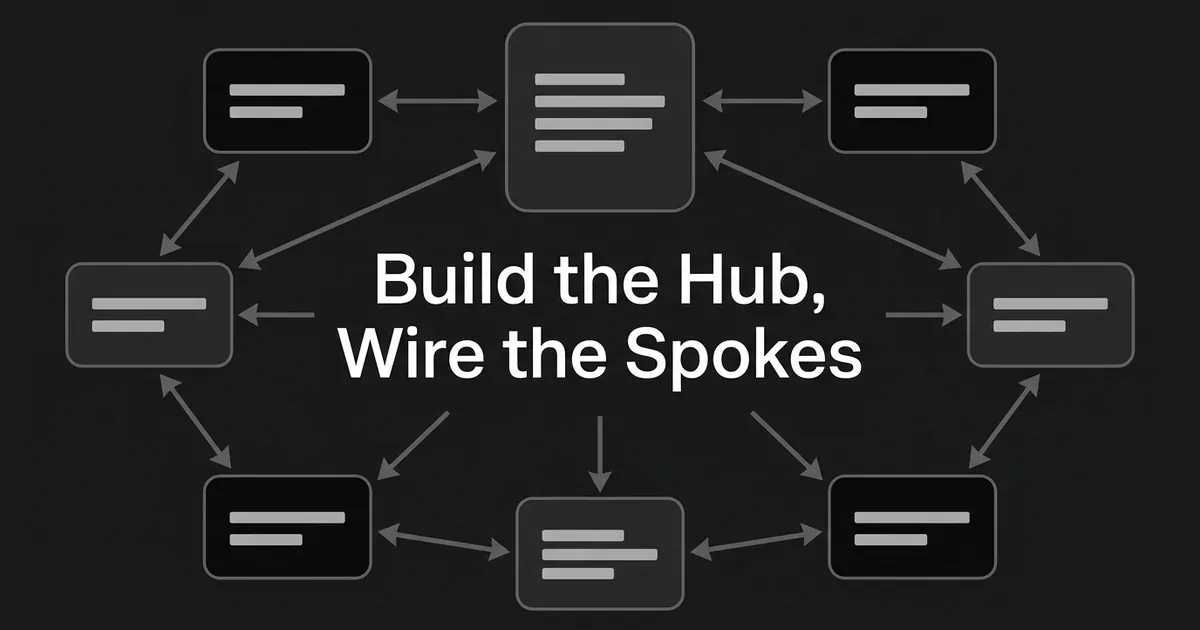
The pattern for pillar page internal links is reciprocal, and it is simpler than it sounds:
- The pillar links to each relevant spoke, from the section where that relationship is clear.
- Each spoke links back to the pillar, in the body, using a natural phrase.
- A spoke links to another spoke only when the reader's next question makes the connection useful.
Place the hub link inside the spoke's body, ideally where the spoke's relationship to the parent topic comes up. Do not lean on a global menu to do that job. On the pillar side, put the spoke link in the relevant section rather than in a detached "related links" dump at the bottom. A contextual sentence explains why the destination is worth opening. A link block does not.
Anchor text should be descriptive, short, and relevant to both ends. "How to audit internal links" tells a reader what is next. "Click here" and "read more" tell them nothing. Vary the wording naturally across related destinations while keeping the subject obvious.
Use ordinary crawlable anchor elements with real destinations. That sounds basic, and it is the thing that quietly breaks most often.
Done when: every relevant spoke is linked from the hub, every spoke has a return path, every cross-link has a reader reason, the anchors predict the destination, and nothing is broken or orphaned.
Common mistake: links only in the footer, every page linked to every other page, the same destination repeated for no reason, or links stuffed into every paragraph. There is no Google-approved ideal link count. The right number follows the number of relevant destinations and the reader's next logical question.
Manual cross-referencing across a large site is the part most teams skip when they are behind. DeepSmith's Content Studio Writer researches the article, works from your enriched site context, and inserts up to five strategically placed internal links during generation, along with external links, a cover image, and publish-ready metadata. That removes the manual scan for the links it finds. It is not a cap on what a pillar should have, so review the output and complete the hub-to-spoke pattern yourself.
Step 6: Make the page scannable and technically eligible
A pillar that a crawler cannot reach is a private document.
Keep the important information in visible page text. Use a descriptive title, URL, and H1. Use clear H2 and H3 headings, short paragraphs, and lists or tables where they make a relationship easier to see. Make the table of contents work. Write useful image alt text. If you use structured data, make sure it accurately describes what is actually on the page.
Google is precise about its AI features, so it is worth repeating carefully. Standard SEO best practices still apply to AI Overviews and AI Mode. There are no additional technical requirements, and there is no special schema you must add for those features. A page needs to be indexed and eligible to appear in ordinary Search with a snippet before it can be eligible as a supporting link in them. Eligibility is not a promise of indexing, serving, or citation.
For links, use a real anchor with an href that resolves to an actual address. JavaScript can inject links if the final markup follows crawlable-link practices, and server-rendered or pre-rendered content is safer across crawlers. Do not use a robots file to hide an HTML page from results, and do not put your core answer somewhere a crawler cannot reliably reach it.
One practitioner AEO guide recommends Article, HowTo, and FAQPage markup as machine-readable signals. That is a reasonable option when the markup matches your visible content. It is not an admission ticket.
Done when: the copy that matters exists in the rendered page, every jump link and internal link works, your markup agrees with what is visible, and there is no access barrier to the guide itself.
Common mistake: treating schema as the thing that earns the citation, or assuming technical eligibility means the page will be served.
Step 7: Run the publish and citation-readiness check
One last human pass, across five layers.
- Scope. The page owns one broad topic and has not absorbed the spokes.
- Answer quality. Every H2 gives a clear, useful answer with honest caveats.
- Cluster wiring. Hub-to-spoke, spoke-to-hub, and any spoke-to-spoke links are present and descriptive.
- Technical access. Title, URL, H1, visible text, navigation, crawlable links, images, and markup are sound.
- Measurement. After publishing, watch whether the page is being mentioned or cited, and for which prompts.
Google's people-first questions make a good editorial test here. Is the description substantial and complete? Does it give information beyond the obvious? Will the intended audience feel they got what they came for? Does it show real expertise and avoid factual errors? Is it written for people rather than for a word-count target?
If your reader has to go searching again for a better basic explanation, the pillar is not finished.
Done when: the page stands alone as an overview, the cluster is navigable in both directions, the page is retrievable, and you can explain why every major section and every link exists.
Common mistake: claiming that a word count, a schema type, or a link count earns an AI citation. Google gives an eligibility condition for its AI features, not a formula for how answers pick sources, and behavior varies across engines.
Measurement is the part that is genuinely hard to do by hand. DeepSmith's AI Visibility tracks mention rate, citation rate, share of voice, and page-level citation attribution across supported engines, plus which competitor pages are winning the prompts you care about. Read that as evidence of where you stand, not as proof that a structural change forced anyone to cite you.
What to do next
Take the cluster you already have and do Step 1 today. One sentence for the promise, one sentence for the exclusion. That is fifteen minutes, and it is the step everything else depends on.
Then map your spokes to sections. Then build the skeleton. The writing gets much easier once the shape is settled, and you will not be guessing at pillar page structure halfway through a draft.
If you would rather have the structure, the internal linking, the metadata, and the production work handled in one workflow, start a DeepSmith free trial. It runs seven days, with no long-term contract, so you can see real drafts before you decide.