You wrote the thorough version. The answer is in there, somewhere around the fourth section, after all the background you felt you owed the reader. Then you asked an AI engine the exact question your page answers, and it cited someone else.
That stings. It is also fixable, and the fix is usually not a rewrite.
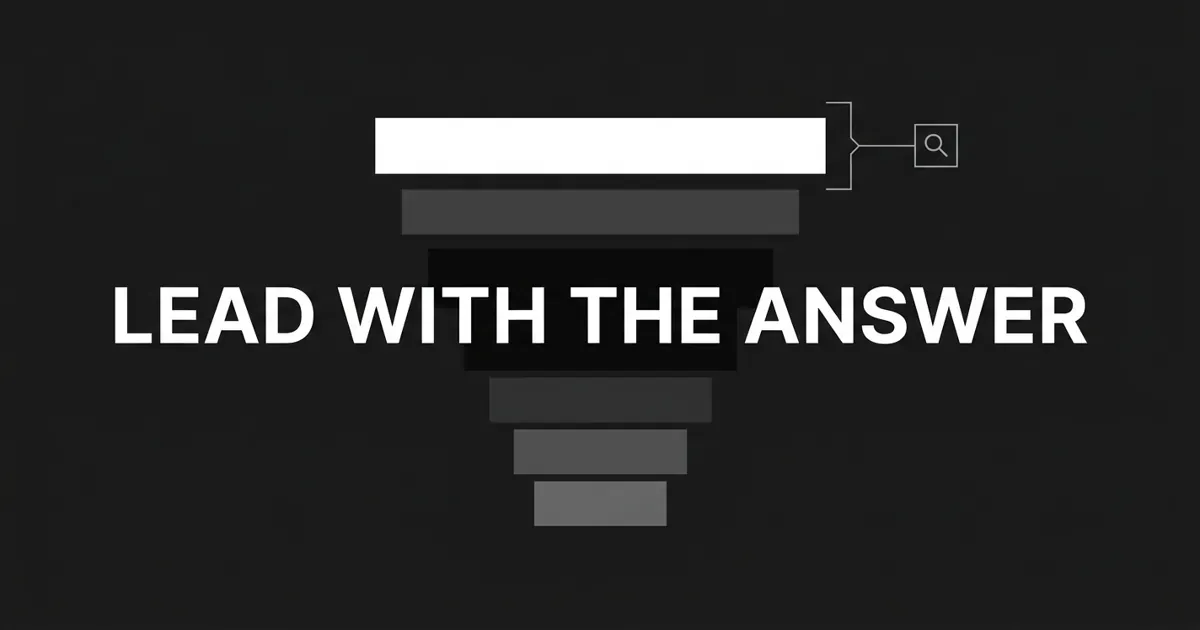
Here is the short answer. Put the article's direct response near the top of the substantive content, then layer explanation, method, evidence, examples, limitations, and optional background underneath it in descending order of importance. That ordering is what an answer-first content structure means at the article level.
Notice what is not in that sentence. No word count. No chunk size. No special markup. Google says there is no ideal page length, no need to break content into tiny pieces, and no need to write in a special way just for generative AI search. What you are changing is order.
Most advice on how to structure content for AI search jumps straight to formatting. Search "structure article for AI citation" and you get a checklist of page elements: add a table, add bullets, add an FAQ block. Those things help, and we cover them elsewhere. Order comes first, because no amount of formatting rescues an answer sitting under 900 words of setup.
So this guide stays at one level: sequencing a whole article. Which section goes first, how to rank the ones after it, and where evidence and caveats belong. Seven steps, all of which you can do on an outline before a single sentence gets polished.
Take a breath. You probably have the right material already. It is just in the wrong order.
1. Decide the one question and the answer payload before you outline
Start here, every time. Choose the primary question the article answers and the outcome the reader should reach by the end.
Then write yourself a short private brief with three things in it: the direct answer, the main condition that would change that answer, and the small set of supporting points that make the answer usable. Three or four sentences is plenty. Nobody else has to see it.
If your topic has two unrelated answers, you have two articles. Split the intent, or pick one primary answer and make the other one clearly subordinate.
Pro tip: If you cannot decide the answer at the brief stage, the article is not ready to outline. Resolve the scope first. Outlining around an undecided answer is how background ends up on top, and it is the most common reason a good draft buries its own payload.
How you know it is done. You can state the primary question, the direct answer, the audience, and the action you want them to take, without looking at your outline. Every planned section has an obvious job in supporting that answer.
Where teams go wrong. Starting from a broad topic instead of a question, then letting history, definitions, or keyword coverage decide the running order. A page can cover twenty related terms and still fail to answer the one question the reader arrived with.
2. Check the question against the prompts buyers actually type
A prompt is not a keyword. Nobody types "structure article for AI citation" into ChatGPT. They ask a full question, in their own words, with their situation attached.
So take your primary question and write it the way a buyer would say it out loud. Then write the important variants, because intent and buying stage change the wording. Decide which kind of answer they want: informational, comparative, procedural, or decision-oriented. That choice quietly sets your section order.
Now go look at what the engines currently say. Which pages get cited for those prompts? What do those pages answer well, and where do they trail off? The gap you find is usually your first section.
This is the point where tracking pays for itself. DeepSmith's AI Visibility area lets you define the prompts you care about, then see per-prompt mention and citation rates, the full answer history, which of your pages get cited, and which competitor pages win instead. Discover Prompts generates a starter set from your product, persona, and buyer-stage context, so you are not staring at a blank list. It tells you what to aim at. It does not promise the engine will pick you.
How you know it is done. You have one primary prompt cluster, a named audience and stage, and a short ordered list of the follow-up questions the article has to answer. You also know the job: earn a new citation, convert an existing mention into one, or fill a real coverage gap.
Where teams go wrong. Optimizing for one keyword string, or for one screenshot of one engine on one day. Google has said its AI features may fan out into multiple related searches across subtopics and data sources, so a single wording is never the whole demand. Engines differ from each other too. A Yext analysis of 17.2 million distinct AI citations collected in late 2025 across Gemini, Claude, Perplexity, and SearchGPT found meaningfully different source preferences by model and by sector, and the authors are careful to call that correlation, not cause.
3. Put the direct answer above the supporting stack
This is the move that changes everything else, so give it a minute.
Place the answer-bearing section near the top of the article's substantive path. Then put the smallest amount of explanation needed to understand that answer. Then the method. Then the proof. Do not make anyone walk through a history lesson, a long definition, a methodology note, or a product pitch to reach the response they came for.
Here is the reassuring part. You rarely need new material to lead with the answer content you already wrote. You need to move it up.
A reliable default sequence looks like this:
- The direct answer or decision.
- What that answer means and when it applies.
- The ordered method or implementation steps.
- Evidence, examples, and decision criteria.
- Exceptions, edge cases, and limitations.
- Optional background or deeper context.
- The next action, then your FAQ block.
That is the inverted pyramid for AI: broad and essential at the top, narrowing as you go. It is borrowed from journalism, where the same shape lets an editor cut from the bottom without losing the story. Nielsen Norman Group applies it to web content for a simple reason. A reader should be able to stop at any point and still hold the main point.
Worth saying plainly: this is a strong default, not a law. The inverted pyramid suits task-completion writing, which is why it fits a how-to guide so well. It works against narrative forms that depend on suspense, and nobody should force it there.
Common mistake: The teaser. You promise the answer in the opening, then hold it hostage until the conclusion because the reveal feels satisfying to write. It is satisfying to write and expensive to publish. A reader who stops early leaves with nothing, and a retrieval system scanning your page finds setup where the payload should be.
How you know it is done. Someone who stops reading after your first answer-bearing section knows what your page says and what the rest of it will add. The answer makes sense on its own, without waiting for a later conclusion to explain it.
Where teams go wrong. Drafting in the order the research was gathered, because chronology is easier to write. It usually puts definitions first and the payload last.
4. Rank your H2s by importance, not by the order you researched
You have your answer on top. Now sequence what follows.
List every question a reader will have after they read the direct answer. Rank those questions by how many of your readers will actually ask them. The most necessary and widely useful sections go first. Narrow scenarios, edge cases, historical context, and optional depth move down.
Treat the sequence as a dependency chain. Nobody should need an advanced exception to understand the basic procedure. Your article should not bounce between beginner and expert material either, which is what happens when sections get placed in the order they were written.
Make the headings actions, not labels. "Score each page" beats "Page scoring." One job per H2, and numbered H3 substeps only when a step genuinely splits into distinct parts.
Then run the cut test. Delete your least important section on paper. Does the direct answer still stand, and does the main procedure still work? If yes, your order is sound. If the whole thing wobbles, something essential is sitting too low.
Deciding what belongs on the page and what belongs on a different page is its own skill. DeepSmith's Content Map crawls your site and your competitors' sites, classifies every page onto a shared topic taxonomy and a funnel stage, and shows coverage gaps, untapped topics, and per-topic depth. Opportunity Agents read that data and hand back content ideas with the evidence attached. Use it to see which supporting sections are missing from your library and which ones deserve their own article instead of a subsection here.
How you know it is done. Reading only the H2 sequence, top to bottom, reveals the logic of the article. Each heading follows naturally from the one before, and they all advance the same primary question.
Where teams go wrong. Giving every section equal weight. A 600-word background section that outranks the procedure your reader came to perform is not thoroughness. It is a queueing problem, and the reader pays for it.
5. Layer evidence, examples, and conditions underneath the answer
Proof belongs after the claim it supports. Not before it, and not instead of it.
Under each major answer or procedural section, add the material that helps someone trust it or apply it: the relevant evidence, a concrete example, the criteria for choosing, the source-backed fact, and the conditions under which your advice changes. Keep all of it subordinate to the answer above it.
Relevance is the filter. The 2023 Generative Engine Optimization study tested nine content interventions and reported source-visibility gains of up to 40% in generative-engine responses, with citing sources, adding relevant quotations, and adding statistics among the methods that improved visibility. Keyword stuffing performed poorly against the baselines. That study ran under specific conditions and did not isolate article ordering as a variable, so read it as support for real evidence over decoration, not as proof that any outline wins.
Which means the rule is simple. Every number you use needs a real source and its actual context. Never drop a statistic in because a passage looks more quotable with one.
Caveats need placement logic too. Put a caveat where it protects the reader before they could act on the main advice incorrectly, not in a footnote at the end and not stacked so high that it displaces the answer.
Production is where this order tends to collapse, especially at volume. DeepSmith's Content Studio takes a planned idea through the Writer and returns a researched, brand-grounded article with internal and external links, a cover image, and publish-ready metadata. Deep IQ supplies the company positioning, product facts, persona detail, brand voice, and the claims to make or avoid, so the same structure and the same standards survive from article one to article forty. That removes manual rework. It does not remove your editorial judgement about what evidence belongs where.
How you know it is done. Every major recommendation has an identifiable reason, example, or evidence path behind it, and a reader can still follow the main procedure without reading every supporting detail.
Where teams go wrong. Opening with a data dump. Burying the conclusion under citations. Letting exceptions crowd out the common case. And borrowing practitioner claims about fixed retrieval sizes or citation multipliers as though they were published platform rules.
6. Audit the outline, not the sentences
Before you polish a single sentence, review the shape. Sentence-level editing on a badly ordered article is expensive, and it hides the real problem.
Pull up the answer-bearing section and the H2 list. Nothing else. Then work this audit:
- Can you find the primary answer before any background or history?
- Does the first major section tell the reader what the page will resolve?
- Does each H2 answer the next likely question or move the procedure forward?
- Do high-importance sections sit above low-importance detail?
- If you remove the last optional section, does the core guide still work?
- Do exceptions appear after the main rule, but before a reader could act on it wrongly?
- Does the FAQ add genuinely common questions, or just restate the article?
- Is the article's usefulness dependent on a summary block to make sense?
- Did any statistic, study, or product claim get in without a source behind it?
Run one more check that has nothing to do with order. A perfectly sequenced page still needs to be reachable. Google says a page has to be indexed and eligible to appear in ordinary Search with a snippet before it can be a supporting link in AI Overviews or AI Mode, and OpenAI tells publishers not to block OAI-SearchBot if they want to be included in ChatGPT Search summaries and snippets. Access and structure are separate problems. Fixing one never fixes the other.
How you know it is done. A colleague can summarize your page from the answer section and the H2 sequence alone, without reading the draft. The main procedure survives when optional depth is removed.
Where teams go wrong. Swapping the ordering audit for a word-count target or a keyword-density check. No source supports those as AI-citation thresholds, and Google has specifically rejected both an ideal page length and the idea that you need to split pages into tiny pieces.
7. Measure the published page before you reorder it again
Publishing is the start of the feedback loop, not the end of the job. Give the page a couple of weeks, then test your prompt cluster on the engines that matter to your business.
Record four things: whether your brand gets mentioned, whether your page gets cited, which page gets cited if it is not the one you expected, and which competitor wins when you do not. Watch how all four change by platform and by prompt wording.
If the page is not cited, diagnose before you rewrite. The cause might be intent mismatch, thin evidence, missing topical coverage around the page, a crawl or indexing problem, plain competition, or a retrieval pattern specific to one engine. Reorder the article only when the evidence says your answer or a supporting section is genuinely hard to find. Rearranging sections because one engine ignored you once is guesswork with extra steps.
This is the other half of what DeepSmith does. AI Visibility reports mention rate, citation rate, share of voice, sentiment, and visibility trend, with per-platform breakdowns, competitor comparisons, and page-level citation attribution tied back to the prompts driving it. Ten engines are covered across the plans: ChatGPT, Gemini, Perplexity, Claude, Google AI Overviews, Google AI Mode, Grok, Meta AI, Microsoft Copilot, and DeepSeek. Coverage rises by tier, so Pro tracks ChatGPT, Grow adds Perplexity, Scale adds Gemini, and Enterprise covers all ten. Tracking shows you what happened. It does not prove why.
How you know it is done. The page has a tracked baseline, a defined prompt set, page-level attribution where it is available, and a date in the calendar to review it.
Where teams go wrong. Treating one answer from one engine as a verdict. Confusing a brand mention with a page citation, which are different outcomes with different fixes. And promising your leadership that a new outline will produce a citation, which no structure can guarantee.
Your next step
Do not reorder your whole library this week. Pick one page you believe deserves to be cited and is not, and audit only its H2 sequence against Step 6. That is a thirty-minute job, and it usually shows you the problem immediately.
Then apply Steps 1 through 5 to the next article you brief, while the outline is still cheap to change. Lead with the answer content on one new piece, see how it reads, and let the habit spread from there. Almost everything else you will read about how to structure content for AI search sits on top of this one decision, so it is a good decision to own early.
If you want the tracking and the production sitting in one place, the questions you are targeting, the gaps you are missing, and the articles that close them, you can start a free DeepSmith trial and see real data and real drafts before you pay.