You asked Perplexity a question your company should own, and someone else's page came back as source number two. That stings. It also tells you exactly where the work is.
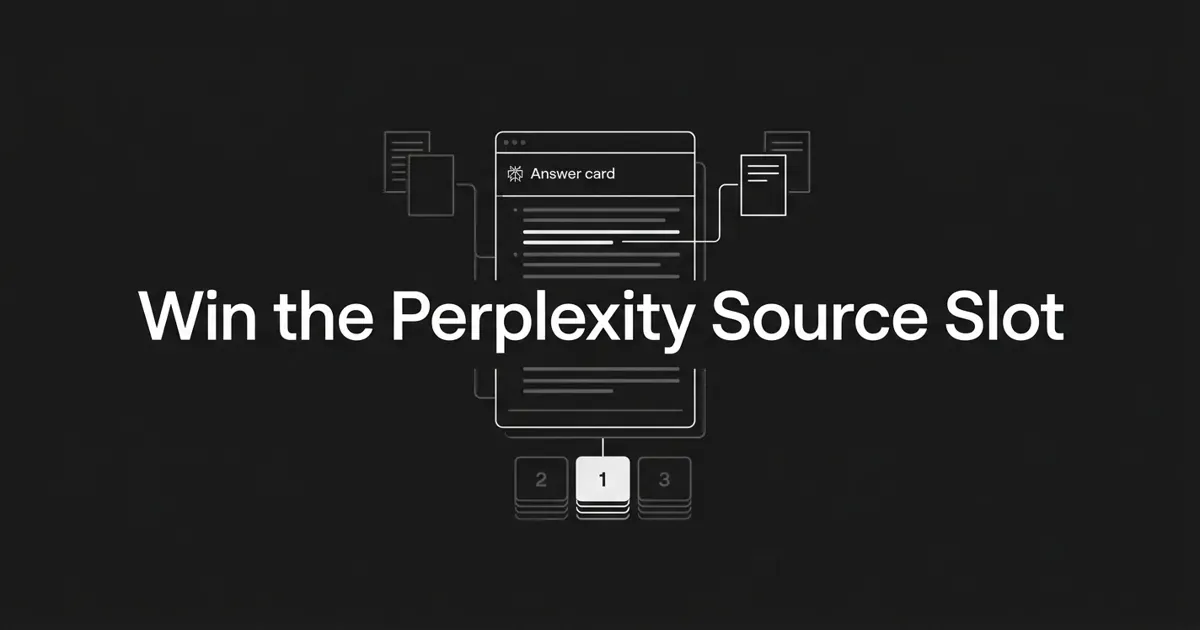
Here is the good news. Learning how to get cited in Perplexity is mostly a set of small, concrete fixes to pages you already have. Perplexity pulls a handful of candidate pages for each query and shows only three or four of them as sources. Your job is to be one of those slots, over and over, for the questions your buyers ask.
You do not rank in Perplexity the way you rank on a results page. There is no list of ten blue links to climb. There is a short numbered set of sources under an answer, and you are either in it or you are not. If you want the mechanics behind that shortlist, we cover how Perplexity chooses its sources separately. This guide is the doing part.
This guide walks you through nine steps, in the order you should do them. Crawl access first, because it takes minutes. Authority last, because it takes months. By the end you will know what to change this week, how to tell it worked, and what it really takes to become a Perplexity source on the questions you care about.
Take it one step at a time. You are closer than you think.
Step 1: Let Perplexity reach and read your pages
Nothing else on this list matters if the crawler cannot get in. This is the cheapest win available to you, and plenty of teams are quietly failing it.
Perplexity runs two declared agents. PerplexityBot is the indexing crawler. Perplexity-User is the live fetch that runs when someone asks a question right now. Check your robots.txt and confirm both are allowed, and check that your firewall or CDN is not blocking them either. The official user agents are published in Perplexity's own crawler documentation, so you can match them exactly rather than guessing. If you want the full walkthrough of the file itself, our guide to configuring robots.txt for AI crawlers covers the syntax bot by bot.
Access is only half of it. Neither agent runs your JavaScript. If your content only appears after a client-side render, the page can look empty to Perplexity even though it looks perfect to you. Serve your content in the initial HTML through server-side rendering or static generation. The mechanics of how Perplexity crawls and fetches pages explain why that raw HTML matters so much.
Speed counts too. Aim for pages that load in under two seconds, and keep your answer content out of paywalls and login walls.
How you know it is done: you can name every Perplexity agent your site allows, and you can view source on a key page and read the actual answer text in the raw HTML.
Where people go wrong: trusting robots.txt as a guarantee in either direction. Cloudflare reported in August 2025 that Perplexity used stealth, undeclared crawlers that ignore no-crawl directives, while Perplexity's documentation says its declared bots respect the file. Allow the declared bots, then verify with your server logs instead of assuming.
Step 2: Choose the questions you want to win
You cannot optimize for everything, and you do not need to. Pick the questions where a citation actually changes a buying decision.
Write out the prompts your buyers type. Not keywords. Full questions, in their words, at the stage they ask them. "Best tool for X with a small team" is a prompt. "X tool" is a keyword. The difference matters because Perplexity decomposes a query into the information need behind it, which means a page answering the real question can be cited even when it never repeats the exact words. Our breakdown of AI prompts versus keywords shows how to convert an existing keyword list into a trackable prompt set.
Twenty to fifty prompts is plenty to start. Group them: category questions, comparison questions, alternatives, pain points, branded questions.
Then run each one in Perplexity and write down who gets cited today. Those pages are your benchmark. You are not guessing at a standard, you are reading it.
This is the part that eats an afternoon by hand, and it is where a platform earns its place. DeepSmith generates a starter prompt set from your product, persona, and buyer-stage context, then checks those prompts on a schedule and reports mention and citation rates per prompt. Perplexity coverage starts on the Grow plan at $199 a month.
How you know it is done: you have a written prompt list and, for each prompt, the pages Perplexity cites right now.
Where people go wrong: picking prompts by search volume. Volume tells you about Google. Buyer intent tells you what a Perplexity source slot is worth, and it is the only sane way to decide which questions you are trying to rank in Perplexity for.
Step 3: Put the answer in the first 40 words
Here is the single highest-leverage writing change on this list. Perplexity prefers passages where the core answer fits in about 40 words or fewer, and the first sentence or two of a paragraph is the part most likely to get lifted.
So lead with the answer. Every section, every time.
State the claim in one clean declarative sentence, then explain, then add nuance. No warm-up. No "in today's landscape." If a reader who has never seen your page could pull that first sentence out on its own and still understand it, you have written something extractable.
Watch your pronouns. A sentence that opens with "it" or "this" needs the paragraph around it to make sense, which makes it a bad candidate for lifting. Name the subject again instead.
Do the same at the top of the page. Answer the title's question in the opening paragraph, before any context-setting.
This is the core of answer-first content, and it is the fastest way to turn a page you already have into one Perplexity can quote.
How you know it is done: you can strip the first sentence out of any section and it still reads as a complete, standalone answer.
Where people go wrong: writing a beautiful narrative build-up. It reads well to a human and disappears in retrieval, because the fact is buried three paragraphs deep.
Step 4: Write headings the way people ask them
Your headings are the map Perplexity uses to find the passage that matches a query. Make them match real questions.
"How does Perplexity choose sources?" beats "Source selection methodology." One mirrors how someone actually asks. The other sounds like a slide title.
Go through your key pages and rewrite H2s and H3s into the phrasing from your prompt list in Step 2. Keep one question per heading, and answer that exact question in the passage underneath. A heading that promises one thing and delivers three is a heading that matches nothing cleanly.
Pro tip: each heading plus the passage beneath it should work as a self-contained unit. If someone landed on that section alone, with no page around it, would they get a complete answer? That is roughly the shape retrieval sees.
You do not need a separate page for every phrasing variant. One well-structured page with several question headings usually covers a family of related prompts better than five thin pages competing with each other.
How you know it is done: your headings read like questions a person would type, and each section answers only its own heading.
Where people go wrong: clever headings. Wordplay is invisible to a retrieval system that is matching intent.
Step 5: Raise the fact density of every page
Perplexity scores candidate pages partly on information density, which is facts per word. Pages that are mostly filler get filtered out before anyone sees them.
Count the checkable facts in your last article. Numbers, dates, named methods, specific steps, real constraints. Then count the sentences that assert nothing. That ratio is what you are fixing.
Cut the throat-clearing. Replace "it's important to note that many companies struggle with visibility" with the actual finding, the actual number, the actual named thing.
Structure helps as much as substance. Bullet lists and numbered steps parse cleanly, so they get quoted often. Comparison tables are strong candidates too, as long as they are real semantic tables with clear headers and one fact per cell, not screenshots or layout tricks. Our guide to structuring comparison and data tables covers the patterns that quietly fail extraction.
Length matters at the low end. Pages under 300 words rarely earn perplexity source citations on competitive questions. Somewhere in the 600 to 1,500 word range, with real density, tends to be enough. Padding to hit a number works against you.
How you know it is done: every paragraph contains at least one thing a reader could verify or act on.
Where people go wrong: confusing length with substance. A long page of hedged generalities is less citable than a short page of specifics.
Step 6: Add the machine-readable layer
You have made the page readable. Now make it legible to a machine.
Start with JSON-LD structured data, which is the format to use over Microdata or RDFa. Article or BlogPosting on every post, FAQPage where you have real Q&A, HowTo on step guides, Product and Organization where they apply. In at least one empirical study, structured data came out as the strongest predictor of AI citation, which makes it a small job with an outsized payoff. If you are starting from zero, our walkthrough of Article schema for AI search is the place to begin, and Google's Rich Results Test will tell you whether it parsed.
Add a visible FAQ block to pages that answer definitional questions. Keep each answer self-contained and short, around 40 to 80 words, one question and one complete answer. Those blocks get cited often because they need no surrounding context.
Then consider an llms.txt file at your root: a plain Markdown map of your key pages with a one-line description each. Adoption is still concentrated among developer-focused companies, and it is not a ranking factor, so treat it as cheap insurance rather than a lever. Ahrefs has a clear explainer on what llms.txt is, and we looked at whether llms.txt improves AI visibility against the available evidence.
Schema markup, heading structure, and metadata are part of how DeepSmith writes an article in the first place, not a cleanup pass afterward. That is what keeps the technical half of Perplexity AEO from becoming a permanent backlog item.
How you know it is done: your schema validates without errors, and your FAQ answers stand alone.
Where people go wrong: shipping schema that contradicts the visible page. Mismatched dates and missing authors are worse than no markup at all.
Step 7: Make the page visibly trustworthy and current
Perplexity favors sources that look accountable. That means a human name on the work and a date you can defend.
Give every article a named author with a real bio, role, and credentials. Add an About page with your team, history, and contact details. Connect those identities with author and organization markup so engines can resolve who wrote and who published. Our guide to author and organization schema walks through the entity hygiene side of this.
First-party evidence is the part most teams underuse. Original data, your own case studies, numbers only you have. That is experience a competitor cannot copy, and it is exactly what gets lifted into an answer.
When you cite, cite primary. Original research, government data, official documentation. Secondary aggregators dilute the trust signal you are trying to build.
Freshness has a deadline. For anything where the answer changes, pricing, product releases, regulations, news, pages older than about 90 days see citation drop-off. Evergreen definitions age more gracefully. Refresh your priority pages at least quarterly, show a visible last-updated date, and make the update real rather than cosmetic.
How you know it is done: every priority page has a named author, a visible date within your refresh window, and at least one fact only you could publish.
Where people go wrong: bumping the date without changing the content. That is a signal engines get better at ignoring every year.
Step 8: Show up where Perplexity already looks
Your own site is not the only place a citation can come from, and if you only optimize the site you are competing for a fraction of the slots.
Perplexity deliberately balances its sources across types: mainstream media, community platforms, niche experts, video. Community content does very well here, with Reddit appearing in a large share of Perplexity answers and YouTube in a meaningful slice, because forum consensus reads as real-world validation. In some categories a noticeable chunk of citations comes from video rather than written pages.
So participate, honestly. Answer questions in the subreddits and forums where your buyers already are, with disclosure and without link-dropping. Post substantive answers on Quora and Stack Exchange where they fit. Where your topic is naturally visual, tutorials, reviews, comparisons, publish on YouTube too.
Bring community signal onto your own pages as well. Real customer quotes, forum snippets with attribution, case studies with actual numbers. That is source material Perplexity can lift.
A brand that shows up in the community, on video, and on its own site has three ways to become a Perplexity source instead of one.
How you know it is done: for your top ten prompts, you can point to at least one non-website surface where your brand or expertise is visible.
Where people go wrong: treating this as a link-building campaign. Spammy participation gets removed by moderators long before it gets cited.
Step 9: Track your citations and repeat what works
You cannot improve what you are not measuring, and Perplexity AEO is a loop, not a launch.
Track four things per prompt: mention rate, whether the answer names your brand; citation rate, whether it links your page; share of voice against competitors; and which specific URLs get cited. That last one turns perplexity source citations into a pattern you can copy, because it shows you which page shapes are working.
You can start free. Run your prompt list manually every week and log the results in a sheet. Filter Perplexity referrals in your analytics. Watch your server logs for PerplexityBot hits to confirm crawling. Our guide to testing whether ChatGPT and Perplexity cite your content explains how to run that spot check so the results mean something, including running each prompt several times because answers vary between runs.
Manual tracking breaks down somewhere around thirty prompts and a monthly cadence. DeepSmith runs the checks on a schedule and reports citation rate per prompt, which of your pages earn citations, and which competitor pages are taking the slots you want, then feeds those gaps straight into the content that closes them. Tracking and producing sit in the same platform, so the finding and the fix are not two separate projects.
Expect this to take time. Crawl fixes can show up in days, structural rewrites in a few weeks, authority and community work over months.
How you know it is done: you have a baseline citation rate per prompt and a monthly review where the number moves.
Where people go wrong: checking a single query once, seeing nothing, and concluding it does not work. Perplexity answers vary run to run. One check is an anecdote, not a measurement, and it will tell you nothing about whether you rank in Perplexity for that question.
What to do next
Do not attempt all nine steps this week. Pick the two that are cheapest for you.
For most teams that means Step 1 and Step 3. Confirm the crawlers are allowed, then rewrite the openers of your five most important pages so the answer sits in the first 40 words. Both are done in an afternoon, and both affect every question you want to win. Perplexity AEO rewards the boring fixes first, and most of it is plain answer engine optimization pointed at one engine.
Then pick one prompt, one page, and drive it all the way to a citation. A single proven loop teaches you more than a nine-step plan you never finish. That is how you become a Perplexity source: one page at a time, on questions that matter.
Want the tracking and the writing in one place instead of a spreadsheet and a backlog? Start a free DeepSmith trial and see which prompts you are already close on. It takes seven days to find out, and you get real data before you pay.