You asked Perplexity a question about your own category, and a Reddit thread took the top citation. A competitor picked up another. Your page, the one you spent three weeks on, never made the numbered list.
That stings. It is also solvable, because how Perplexity chooses sources is not a mystery box. It is a pipeline with named stages, and your page either clears each one or it quietly drops out.
Here is what you will walk away with: the mechanics behind those numbered citations. What happens between someone pressing enter and the answer appearing, which gate silently removes most pages, and why the sources that win often look unremarkable next to yours. Once you can see Perplexity citation behavior as a process instead of a verdict, it stops feeling personal.
We are staying on mechanics. The step-by-step tactics for winning those slots are a separate conversation. Understand the machine first, and the tactics stop feeling like guesswork.
Let's walk through it together.
Perplexity source selection is a pipeline, not a single ranking
Perplexity source selection is a sequence of filters, not one score. A page has to survive every stage to appear as a numbered citation, and failing any single stage makes the rest irrelevant.
Start with what Perplexity actually is. It is an answer engine, not a chatbot. Every query triggers a live web retrieval before a single word gets written. There is no training-only fallback for factual answers, so every answer is grounded in pages pulled at query time.
The default synthesis model is Sonar, Perplexity's own fine-tuned model, and you can swap the backend to something like GPT-5 or Claude 4.6 Sonnet for the writing step.
Here is the part that matters for you. Switching the backend changes how the answer reads. It does not change which pages were retrieved. Retrieval and reranking are shared across backends, so the citation list stays mostly stable for the same query no matter which model writes the prose. Phrasing moves. Sources mostly do not.
So a citation is not an opinion the model formed. It is the visible artifact of a selection process that finished before generation started.
That reframe is worth sitting with. When you ask why a page got cited and yours did not, you are really asking which stage yours failed at. That is a much smaller, much more answerable question.
It also changes what "optimizing" means. If how Perplexity chooses sources is a series of gates, there is no single dial to turn up. There is a specific gate you are failing, and a specific fix behind it.
The six stages behind every Perplexity answer
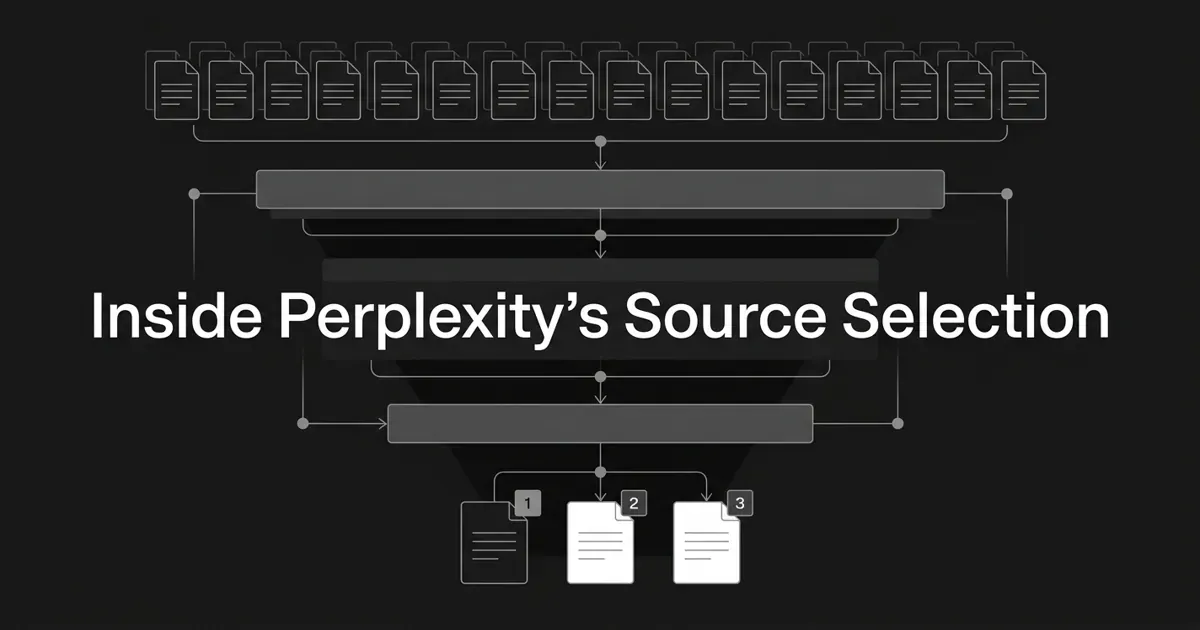
Every Perplexity answer runs through six stages: intent parsing, hybrid retrieval, three-layer reranking, claim extraction, final selection, and citation alignment. Each one is a filter.
- Query intent parsing. The system classifies the query as factual, procedural, comparative, multi-part, navigational, or transactional. Intent decides which retrieval channels open and how the ranking weights get set. A "what is" question leans toward encyclopedic and reference sources. A "how to" question leans toward step-by-step guides. A "best X for Y" question leans toward listicles, reviews, and forum threads.
- Hybrid retrieval. Two retrievers run in parallel. BM25 handles lexical matching, catching exact keywords and rare terms. Dense embeddings, via Perplexity's own pplx-embed model, catch passages that are conceptually similar even when the wording differs. The results merge, and pages that score on only one of the two tend to drop out.
- Three-layer reranking. The merged candidate set passes through three learned rerankers. L1 scores topical relevance. L2 scores freshness and down-weights stale content, hard, on time-sensitive queries. L3 scores authority and quality using signals like backlink profile, brand mentions, E-E-A-T indicators, HTTPS, and schema markup. Pages that fail any layer never reach the model.
- Source verification and claim extraction. Surviving pages get parsed for quotable, self-contained claims. The system is hunting for passages that answer the question with verifiable specificity: numbers, dates, named entities, named studies.
- Final selection. The top candidates get scored with engagement proxies (click-through, dwell time, bounce-rate analogs) and cross-page consistency checks. Pages whose claims agree with other retrieved sources get boosted.
- Post-hoc citation alignment. The model writes the answer and attaches numbered markers as it goes. Then a verification pass checks that each cited passage actually supports the claim it is attached to. Citations that fail get swapped or dropped.
Notice how late extraction happens. Four stages of work go into finding your page, and it can still lose at step four because nobody can lift a clean sentence off it.
Your action here: pick one page you wish got cited, and read it as a machine hunting for one quotable sentence. Can you find one in ten seconds? That is the test.
How your pages enter the candidate pool at all
Before any ranking happens, Perplexity has to have your page. It gets there through two crawler channels plus third-party search coverage.
PerplexityBot is the declared indexing crawler. It respects robots.txt, uses a documented user-agent string, and publishes its IP ranges. It is an indexing crawler, not a training crawler.
Perplexity-User is the on-demand fetcher, triggered when a live query needs a specific URL. It generally ignores robots.txt, because it serves a user-initiated fetch rather than bulk indexing.
Third-party search APIs, notably Bing, supplement the index to guarantee breadth, especially on news and long-tail queries. Your page can enter the pool without Perplexity's own crawler ever being the one that found it.
There is a complication worth knowing about. In August 2025, Cloudflare published evidence that when PerplexityBot is blocked, fetches were still happening through generic stealth agents rotating across IP addresses and networks. Cloudflare de-listed Perplexity as a verified bot and added detection heuristics. Perplexity has disputed some characterizations of its crawling practices, and the current state of the behavior is not settled. Treat it as contested rather than concluded.
Speed is the friendlier part of this story. Crawl-to-citation latency runs from minutes to days for high-authority pages, and new content becomes discoverable in Perplexity faster than in traditional search once external signals accumulate. Publishing something genuinely useful today can show up in answers this week.
One caution on scale. Perplexity does not publish a formal index size. Third-party estimates put it in the hundreds of billions of URLs, but treat that as directional, not fact.
Your action here: check whether your robots.txt blocks PerplexityBot. If a rule from three years ago is quietly excluding you, that is a five-minute fix with outsized consequences.
The Perplexity ranking factors that decide what survives
The Perplexity ranking factors sort into three groups by where they apply: retrieval, reranking, and synthesis. Different stages, different levers.
At retrieval, three things decide whether you enter the candidate set:
- Hybrid match. You need both keyword relevance and semantic similarity. Matching only one is usually not enough.
- Topical depth. Pages with narrow, deep focus beat pages that skim many topics.
- Topical authority. Domains with concentrated expertise on the query's subject get a boost.
At reranking, the filter tightens:
- Freshness. Perplexity has the strongest recency bias among the major AI search engines. Third-party analysis estimates roughly 40% of ranking weight is freshness-driven, which is directional rather than confirmed. Pages with visible last-updated dates, current-year references, and current statistics measurably outrank older equivalents.
- Factual density. Verifiable specifics beat hedging language and positioning copy. Numbers, dates, named studies, named entities.
- Structural clarity. Clear heading hierarchy, short paragraphs, one claim per section. Dense prose defeats extraction later, so it gets penalized earlier.
- E-E-A-T signals. Author bios, primary-source citations, an about page, contact information, HTTPS, schema markup.
- Engagement proxies and off-site mentions. Web-wide brand mention volume correlates at roughly 0.66 with citation likelihood on branded queries. Being talked about elsewhere shows up here.
At synthesis, the last set decides whether a surviving page becomes a visible citation:
- Extractability. The ideal cited block runs roughly 40 to 60 words: one self-contained passage stating a fact, statistic, comparison, or procedure.
- Claim density. A page with eight discrete citable facts outperforms a page with one long argument at the same relevance level.
- Answer-first formatting. Open a section with the bottom line, then elaborate. The extractor finds a quotable claim on first read instead of hunting.
- Structured data and currency markers. FAQ, HowTo, Article, Organization, and Product schema improve extraction accuracy. Inline phrases like "as of" plus the year reinforce freshness.
- Page speed. Faster pages get crawled and re-crawled more often, which keeps them in the candidate set.
An honest caveat: none of these weights are officially published. They come from reverse-engineering and third-party analysis, so hold the numbers loosely and the direction firmly.
If you only fix one thing this month, make it factual density on your best page. It helps you at reranking and at synthesis, both.
Why Perplexity cites a source like Reddit so often
Perplexity's source-type preferences are stable and a little counterintuitive. Reddit is the single most-cited domain, at roughly 6.6% of all Perplexity citations across query types, rising to around 46.5% of top citations in social-leaning categories. Wikipedia dominates encyclopedic and definitional queries, appearing as the dominant source in roughly 47.9% of them.
Neither of those is a policy decision. Both are emergent properties of the pipeline you just read.
Reddit threads are packed with specific, current, experience-based claims full of named entities and numbers. That is exactly what the extractor rewards. Wikipedia is topically focused, well structured, frequently updated, and written in attribute-friendly factual statements. Also exactly what the extractor rewards.
So when you ask why Perplexity cites a source that has no brand, no design budget, and no marketing team behind it, the answer is usually that the source said something specific and said it cleanly.
The rest of the hierarchy follows the same logic:
- YouTube is a first-class source, pulled through transcripts rather than visual content.
- Major news outlets win on breaking news and original reporting.
- Government and institutional sources win on scientific, medical, legal, and policy questions.
- Academic papers surface in Academic mode and Deep Research, where peer-reviewed work is prioritized.
- Niche forums and Q&A sites rank well when they carry lived experience or technical detail on a narrow topic.
- Ecommerce product and review pages win shopping queries where specs, prices, and review counts are extractable.
And the demotion? Listicle content from SEO-driven blogs is consistently pushed down. Pages heavy on hedging, generic positioning copy, or thin summaries of other people's work rarely survive extraction.
Read that as encouragement, not a threat. The thing that beats you is specificity, and specificity is something you can actually add. You already know your numbers, your process, and your edge cases. Most of that never makes it onto the page because it feels too granular to publish. To the extractor, that granular detail is the whole product.
Users can also constrain the pool themselves. Perplexity has offered six documented Focus modes (Web, Academic, Social, Reddit, YouTube, and Writing), and the product has been migrating that idea into a broader "Choose sources" picker that combines web, uploaded files, and organization files. Focus modes never changed the ranking logic. They changed which channels were eligible in the first place.
Where most pages actually lose the citation slot
Every page runs a five-gate gauntlet, and knowing which gate you failed tells you what to fix:
- Indexed. Perplexity has to have crawled or fetched the page.
- Retrievable. It has to pass hybrid keyword and semantic retrieval for that specific query.
- Reranked-in. It has to survive relevance, freshness, and authority scoring.
- Extractable. It has to contain a self-contained passage that can be quoted without distortion.
- Citable. That passage has to genuinely support a claim in the answer and pass the alignment check.
The most common failure is gate four. The page gets indexed, retrieved, and reranked in, then loses because the model cannot find a clean quotable passage. Another page with a nearly identical claim, written more cleanly, takes the slot.
Sit with that for a second, because it is genuinely good news. The most common reason you are not cited is not that your content is weak. It is that the answer is buried, hedged, or spread across three long paragraphs.
The gap between "good page" and "cited page" is often one rewritten paragraph.
This is also the most useful lens for reading Perplexity citation behavior on any query you care about. Open the answer, look at each cited page, and ask what passage the model could have lifted. You will start seeing the pattern within a handful of queries, and it is almost never the prettiest page that wins.
Knowing which gate you are failing takes seeing real answers over time, not one spot check on a Tuesday. That is where tracking helps: DeepSmith checks your prompts on a schedule and reports citation rate, mention rate, and which of your pages Perplexity actually cites, with Perplexity coverage included from the Grow plan up. Whether you use a tool or a spreadsheet, the principle holds. One observation is an anecdote. A trend line is a diagnosis.
Citation density is not citation accuracy
Perplexity cites more than its peers. One large-scale benchmark put it at roughly 21.87 inline citations per response against 7.92 for ChatGPT's search mode, about three times the density. Sources appear as numbered markers at the end of claim-bearing sentences, clickable, with a side panel listing each one.
The overlap with other engines is smaller than you would guess. Only about 11% of Perplexity's cited sources also appear in ChatGPT's citations. Winning one engine does not carry over to the next.
Now the caveat that keeps Perplexity citation behavior honest. Density is not accuracy. The Tow Center study at Columbia Journalism Review tested eight generative search engines on news queries in March 2025 and found that over 60% of answers across all of them contained an incorrect citation. Perplexity was the best performer of the eight and still failed on 37% of news queries.
The failure modes are consistent: a citation that is on-topic but does not support the claim, a link to a page that exists without the referenced passage, a URL that no longer resolves, the right domain but the wrong article, and occasionally a plausible-looking URL that 404s.
None of that is unique to Perplexity. It is systemic to grounded AI search. Perplexity's retrieval-first architecture and alignment pass reduce the rate without eliminating it.
For you, this means two jobs, not one. Earn the citation, and check what the answer says once you have it. Being cited alongside a claim you never made is its own problem.
What to do with all this
Here is the throughline: how Perplexity chooses sources is a pipeline, not a popularity contest. Indexing, then hybrid retrieval, then three layers of reranking, then extraction, then alignment. Every "why them and not us" question is a question about which gate you failed.
Most pages fail at extraction, which is the most fixable gate on the list. You do not need a bigger domain. You need a clearer paragraph.
Start with one page. Give it a direct answer in the first 60 words of each section, add the specific numbers and names you already know, put a real updated date on it, and read it back asking whether a machine could lift one clean sentence.
That is the whole first step. One page, one pass, this week.
When you are ready to see which prompts you win, which pages Perplexity cites, and where competitors are taking your slots, DeepSmith tracks all of it and produces the content to close the gaps in the same place. You can start a free trial and see real data before you pay.
You are closer to this than you think.