You asked Grok a question about your own category, and it named a competitor. That stings. It is also fixable, and probably faster than you think.
Grok builds answers from a mix no other assistant uses, so the work that got you into ChatGPT only carries you partway. To optimize for Grok answers you have to think about live conversation, not just pages. This guide walks you through eight steps to get mentioned in Grok, from mapping the prompts your buyers ask to proving the work moved something.
Take it one step at a time. You do not need all eight running this week.
Step 1: Learn where Grok's answers actually come from
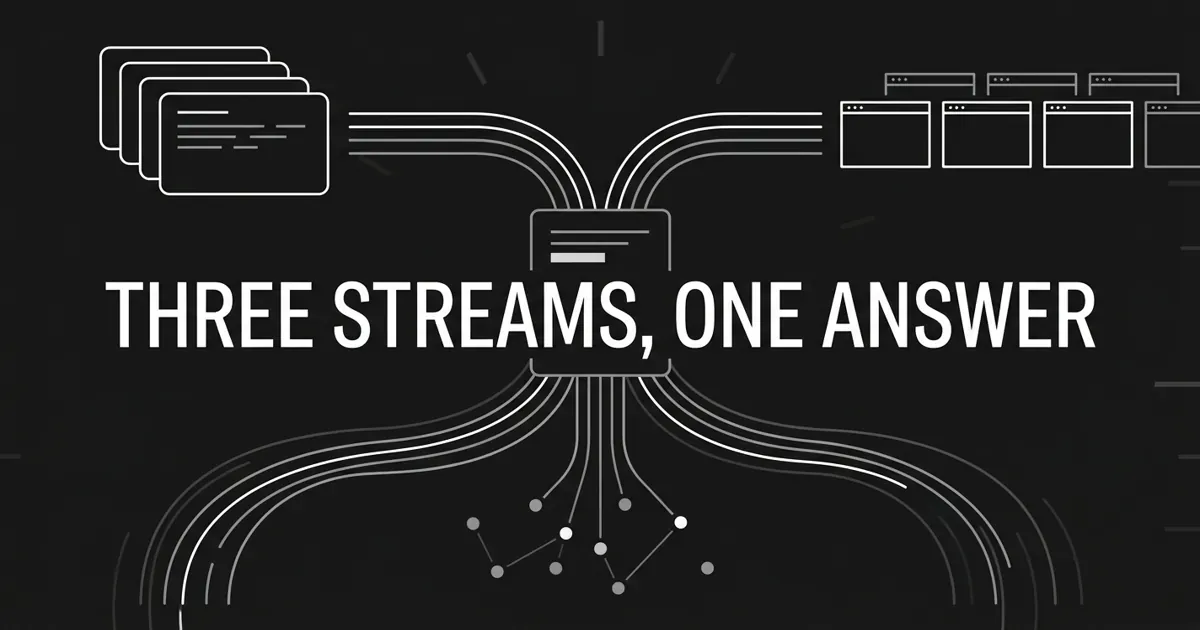
Grok composes every answer from three streams at once: public posts on X in real time, live web search, and what the model already learned during training.
That first stream is the whole difference. Grok is xAI's assistant, and it reads public X posts at query time. You can reach it inside X, on grok.com, on iOS and Android, and through the xAI API. Other assistants lean on web search plus training data. None of them have live X conversation sitting in the retrieval mix.
The third stream matters too. Grok 4.5 carries a knowledge cutoff of February 1, 2026, so anything the model "just knows" about you is frozen at that point until retrieval refreshes it.
The audience is not small. SpaceX's S-1 filing in May 2026 put Grok at roughly 117 million monthly users against about 550 million monthly active X users. Call it one in five X users touching Grok in a given month.
What to do: open Grok and run five questions from your category. For each answer, note which stream fed it: an X post card, a web link, or a confident claim with no source at all.
How to tell it is done: you can say, for your category, whether Grok leans on live X chatter or web pages. Most B2B categories lean web. Most consumer and news-adjacent ones lean X.
Where people go wrong: treating Grok like Googlebot with a personality. If you optimize only your own blog, you are working on one of three streams and the smallest slice of the citation pie. Teams that optimize for Grok answers successfully work all three, and they weight the effort toward the streams their category actually uses.
Step 2: Map the prompts your buyers actually ask
Your Grok AEO work starts with questions, not keywords. Aim for 30 to 50 real questions buyers ask an assistant before they choose in your category.
Where do you find them? You already own the sources. Sales call recordings, support tickets, review-site Q&A, People Also Ask boxes, Reddit threads, and Quora questions all carry the exact phrasing people use. Pull the language verbatim. Do not tidy it up.
Then cluster by intent: comparison, how-to, definition, pricing, and alternatives. Each cluster behaves differently in AI answers, so they deserve separate scorecards.
What to do: build one sheet with 30 or more distinct questions, each tagged by intent, funnel stage, and any competitor the question names.
How to tell it is done: you can hand the sheet to someone new and they could run it without asking you what anything means.
Where people go wrong: two failure modes, both common. Tracking vanity phrasing nobody actually types. And tracking only your own product name, which is far too late in the journey to tell you anything about share of voice.
If 30 questions feels like a lot, start with ten from your comparison cluster. That is where buyers are closest to a decision.
Step 3: Audit where Grok surfaces you today
Before you change anything, get a baseline. You cannot tell whether a tactic worked if you never measured the starting point.
Run every prompt from Step 2 through Grok on a clean account, once a week. For each answer, capture the full text, every domain cited, and every inline link. Then score three things: is your brand mentioned, is your domain cited, and is your brand the lead recommendation or a footnote near the end.
Those are different outcomes and they need different fixes. A mention without a link means Grok knows you but does not trust a page of yours enough to point at it. No mention at all is a different problem entirely.
What to do: hold the baseline for at least one full weekly cycle before you touch anything. Log mention rate, citation rate, primary-recommendation rate, and the mix of domains Grok cited per prompt.
How to tell it is done: you have a week of rows, and you can name the three prompts where you are weakest.
Where people go wrong: running prompts from a personalized X account, where your own follow graph and history skew what comes back. Use a clean account. Also, do not test one surface only. Grok inside X, Grok on grok.com, and Grok through the API often disagree on the same prompt.
Running this by hand is completely doable at 30 prompts. It gets heavy at 200, across five engines, every week. That is the job DeepSmith automates: it runs your prompt set on a schedule and reports mention rate, citation rate, and share of voice per prompt across ChatGPT, Perplexity, Gemini, Claude, and Google AI Mode. Grok is not one of the tracked engines today, so keep your Grok pass manual. The tracked engines still tell you something useful, because a page that gets more citable for them usually gets more citable everywhere.
Step 4: Make every owned page citation-ready
Grok cannot cite what it cannot cleanly extract. Most pages fail on extraction, not on quality.
Take your highest-value pages first: homepage, product pages, category explainers, comparison pages. For each one, do six things. Lead every section with a direct factual sentence. Back claims with named sources and concrete numbers. Use a clean H1, H2, H3 hierarchy. Add schema markup, at minimum Organization, Product, FAQPage, and Article. Put a real author byline with credentials on the page. Stamp a visible last-updated date.
Pro tip: named-author pages with verifiable credentials correlate with higher citation rates than anonymous corporate content. If you have a subject-matter expert on staff, get their name and background on the page. It is one of the cheapest wins on this list.
Co-citation helps too. When your brand appears in articles that also name analysts, standards bodies, or well-known publications, engines start treating you as a recognized entity in that topic graph rather than a stranger.
What to do: fix five pages this month, not fifty. Validate the schema when you are done.
How to tell it is done: a reviewer can pull the page's main claim out of the first paragraph in one sentence, and your schema validates clean in Rich Results Test.
Where people go wrong: hedged language ("we might be the best option"), the answer buried under 300 words of setup, generic or missing author bios, and no schema at all.
This is the part of the loop DeepSmith handles during writing rather than after it. Heading structure, schema, internal links, and metadata get built into the article as it is produced, so there is no separate optimization pass waiting on your calendar.
Step 5: Show up on the platforms Grok cites most
Here is the finding that should reshape your plan. Ahrefs analyzed more than 1.9 million US queries in June 2026 and catalogued every domain Grok cited. User-generated content dominates, and it is not close.
Directionally, the shares looked like this:
- Reddit takes roughly one in six citations, the single largest slice
- YouTube sits just behind it, around one in seven
- Facebook is close to one in seven as well
- Instagram, Quora, Amazon, and TikTok each land in the mid single digits
- Wikipedia holds around three percent, the biggest non-UGC reference source
- x.com itself accounts for under two percent
Read that last line twice. Grok's home turf is a small slice of its own link-outs.
So where should you spend? Pick one or two surfaces where your buyers genuinely hang out, and commit.
- Reddit: substantive comments in relevant subreddits, answering the question properly. Not link drops.
- YouTube: tutorials and honest reviews, with named entities in the title, description, and transcript.
- Quora: answers to category-defining questions, backed by sources.
- Wikipedia: a neutral-tone article supported by third-party references that establish notability.
What to do: choose two surfaces and set a weekly cadence for each. One person, one hour, twice a week beats a launch-week blitz.
How to tell it is done: within 90 days your brand has earned mentions or links on at least three of these surfaces for at least one prompt cluster, and someone owns the ongoing process.
Common mistake: posting promotional copy that the community flags within an hour. Communities can smell a marketing team from a long way off. The other one is trying to be everywhere at once and doing all of it badly.
Step 6: Publish facts on X, not just links
This is the step no other engine rewards the same way, so it deserves real attention.
Grok reads public X posts in real time. That means your X account is not only a distribution channel. It is a publishing surface with its own retrievable artifacts, and it is the fastest lever you have on brand visibility in Grok.
What actually feeds retrieval is extractable fact. A clear claim, a named entity, a number, a date. A meme does not give Grok anything to lift.
What to do: post structured, factual content on your target topics. Use threads to walk through a definition, a comparison, or a data point. Get your executives and subject-matter experts posting on the same topics with the same factual scaffolding, because several credible accounts saying compatible things is a stronger signal than one brand account repeating itself. Reply substantively inside category conversations rather than only broadcasting.
How to tell it is done: you have a consistent cadence of named-entity posts, and your prompt testing shows Grok surfacing your posts in the post-stream card for at least some buyer prompts.
Where people go wrong: here is the honest picture on X Grok citations. Your posts feed the answer far more often than they earn a link in it, because x.com is a small share of Grok's link-outs. Expect influence on the answer, not a steady stream of referral clicks. Judge the work on whether the answer changes.
One more trap: stuffing keywords into your X bio or handle does nothing. Grok reads posts, not bios. Entity association comes from repeated, topical posting over weeks.
Step 7: Lead with the answer, then the evidence
If you only change one thing about how your team writes, make it this. Answer first, evidence second, depth third.
The pattern is simple enough to teach in a meeting. First sentence answers the question directly. Second sentence scopes it with the honest qualifier. Third sentence supplies the evidence: a statistic, a named source, a date. Everything after that adds depth for the human reader.
Definitive phrasing matters more than most writers expect. "X is Y" gets lifted. "X might arguably be considered Y in some cases" does not. Hedging reads as low confidence, and low confidence is easy for a model to skip.
What to do: take your ten highest-value pages and rewrite only the first paragraph of each section using the answer-first pattern. Leave the rest alone for now.
How to tell it is done: every key paragraph passes the lead-sentence test. Cover the rest of the paragraph and the first sentence still answers the question on its own.
Where people go wrong: burying the answer under a story, piling on qualifiers, and reaching for marketing language like "revolutionary" or "best-in-class" that carries no verifiable claim. If a sentence cannot be checked, it cannot be cited.
Step 8: Track, benchmark, and iterate
You have made changes. Now prove they did something.
Set a weekly or bi-weekly cadence and run the same prompt set every time. Track four numbers per prompt: mention rate, citation rate, primary-recommendation rate, and share of voice against three to five named competitors. Log X Grok citations separately from web citations so you can see which stream is actually shifting.
Tag every run with the date, the surface (grok.com, Grok in X, or the API), and the prompt ID. Store the full response text and the parsed list of cited URLs, not just a yes or no. Six weeks from now you will want to reread an answer, and a checkbox will not help you.
What to do: hold the cadence for eight weeks before you judge anything. AI answers move week to week for reasons that have nothing to do with you.
How to tell it is done: you have eight weeks of trend data per prompt, and you can point at a specific action behind a specific move: a Reddit thread, a rewritten comparison page, a run of expert posts on X.
Where people go wrong: three habits ruin this step. Measuring once and stopping. Tracking only your own brand, so you never see who is taking the answers instead. And blending mentions and citations into one "visibility" number, which hides the most useful diagnostic you have. A mention is a name-drop. A citation is a link to your domain. They call for different fixes.
There is a fourth, quieter mistake: publishing something good and never touching it again. AI engines favor fresh sources, so put every important page on a quarterly refresh, even the ones performing well.
This is where a platform earns its place. DeepSmith keeps the tracked-engine version of this scorecard running on a schedule, shows which of your pages earn citations and which competitor pages are winning your prompts, and feeds those gaps straight into what gets written next. The measuring and the fixing sit in one place instead of two.
What to do next
Pick the one step where you are weakest and do only that for two weeks.
If you have no baseline, that is Step 3. If your pages hedge, that is Step 7. If your X account is a link dump, that is Step 6. Most teams find the biggest early gain in Step 5, because earned presence on Reddit and YouTube moves more Grok citations than another blog post will.
You do not need a bigger team to optimize for Grok answers. You need a prompt list, a weekly hour, and the patience to let eight weeks of data tell you the truth.
If you want the tracking and the content production running in the same loop instead of living in two tools, start a free trial of DeepSmith and see what your prompts say about you.