Your brief names a topic. It does not tell you what the reader will ask next, or what an answer engine will go looking for on their behalf. That gap is where most outlines quietly fail. If your last one felt thin halfway through drafting, this is usually why, and it is fixable.
This guide shows you how to outline content for AI search by starting from real questions instead of a topic label. You take one primary question plus the related questions already surfaced for it, and you finish with a section-by-section outline a writer can pick up without guessing. Search "outline article for AI answers" and you will mostly find formatting tips. Formatting is the last mile. Planning is what decides whether the page covers the job the reader came with.
What you need: one primary question, the question set already surfaced for it, a clear reader and outcome, and somewhere to record decisions.
Step 1: Lock the one question your article answers
Start smaller than feels comfortable. One article, one reader job.
Rewrite the assignment as a single primary question in the reader's own language. Then write the outcome in operational terms: what should they be able to decide, plan, or do when they close the tab? Name the audience, their knowledge level, the buyer stage, and any constraint that changes the answer.
Then set the boundary. Say out loud what this page will not solve. Without that line, related questions creep in and your focused guide turns into a resource center nobody finishes.
A topic and a question are not the same thing. "AI search" is a subject area. "How do I build an outline from the questions AI search surfaces?" is a job.
| Field | What to record |
|---|---|
| Core question | One question, in the reader's words |
| Reader | Role, knowledge level, relevant context |
| Desired outcome | The decision, plan, or action this enables |
| Primary intent | Usually Know or Do for a how-to, but classify it, do not assume |
| Boundaries | What is in, what is out, what is a companion topic |
| Success test | What the reader can produce when they finish |
You know this step is done when a writer can state the page's job in one sentence, and every later question can be tested against it.
The mistake almost everyone makes: starting from a broad topic and accepting every related question that appears. That is how a 1,500-word guide becomes a 6,000-word pile.
If you keep reader and product context stored somewhere structured instead of re-explaining it per brief, this step gets much faster. That is what Deep IQ does inside DeepSmith: your positioning, products, personas, brand voice, and content types held as context every brief and draft can draw from. It fills in the reader row for you. It does not decide the core question. That call stays yours.
Step 2: Inventory every surfaced question before you judge it
Resist the urge to edit while you collect. Collection first, judgement later.
Copy each surfaced sub-question into a working list exactly as it appeared. Keep the qualifiers: the audience, the constraint, the comparison, the timeframe, the desired outcome. A shortened question is a different question.
Add a one-word relationship note to each: definition, reason, method, option, constraint, comparison, troubleshooting, validation, or next step. Mark your primary question separately. It is the anchor. Everything else is a candidate, not a requirement.
| ID | Question as surfaced | Relationship to the core question | What the reader needs from it | Status |
|---|---|---|---|---|
| Q0 | The primary question | Anchor | The main task | Must cover |
| Q1, Q2, Q3 | One full sub-question per row | Supports, constrains, tests, or extends Q0 | The specific need behind it | Review |
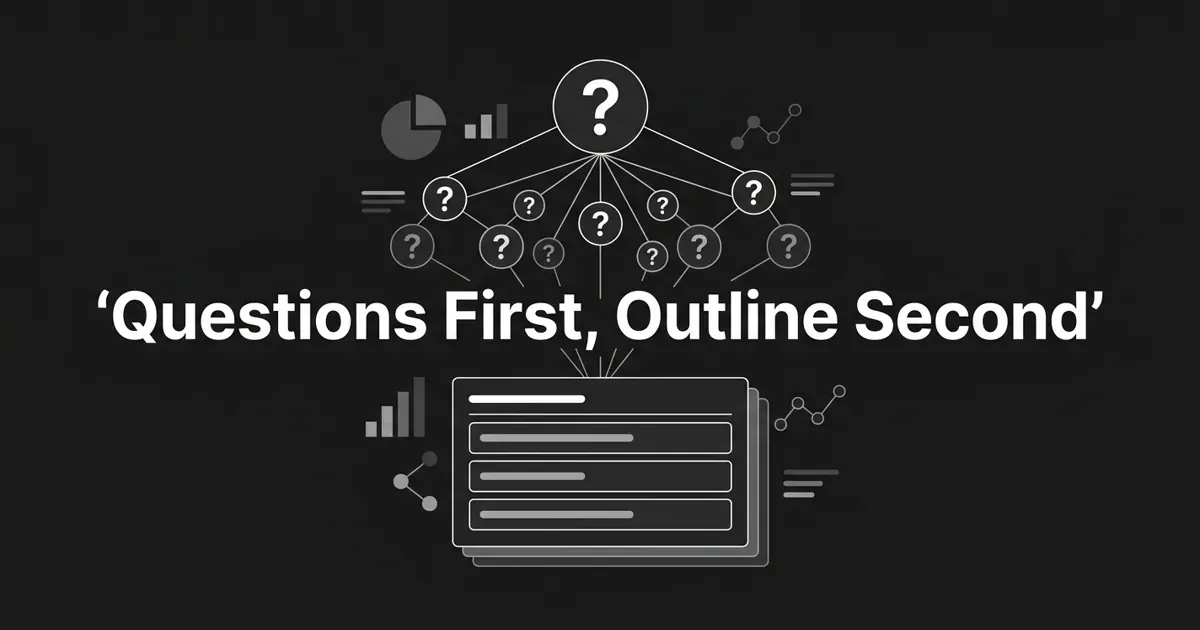
Google's own illustration of query fan-out is a helpful shape to hold in your head. One primary question, "how to fix a lawn that is full of weeds," expands into related questions about the best herbicides, removing weeds without chemicals, and preventing weeds in the first place. One is an options question. One is a constraint or alternative-method question. One is a prevention and follow-on question. That reading is an editorial interpretation, not a section formula Google publishes.
You know this step is done when every surfaced question appears exactly once, nothing has been quietly paraphrased into a different need, and follow-up needs are in the list alongside the obvious first answer.
Where people go wrong: treating each phrase as a keyword rather than a question with a job attached, and assuming the order an engine surfaced things in is the order your article should use.
Step 3: Normalize and deduplicate the question set
Your raw list is longer than your article needs to be. Good. That is what this step is for.
Split compound questions when they hold two independent jobs. Merge questions that ask the same thing in different words. Keep two questions separate only when changing the constraint genuinely changes the method or the decision. Flag anything ambiguous instead of guessing what the asker meant.
For each surviving item, write a small card:
| Field | Purpose |
|---|---|
| Canonical job | The one need left after duplicate wording is stripped |
| Source phrasings | The original variants, kept so the decision is auditable |
| Conditions | Audience, constraint, context, comparison dimension |
| Dependency | What has to be understood first |
| Candidate section | Where it might live |
| Status | Cover, merge, separate page, park, or discard |
Do not polish headings here. You are recording jobs, not writing the article.
Common mistake: counting synonyms as coverage. Ten phrasings of one job are one coverage requirement, not ten sections. A question-based content outline gets its power from compression, not from length.
You know this step is done when each card asks one answerable question, and a writer could understand why two cards are separate without ever seeing the original prompt set.
Step 4: Label each question by intent and job
Two labels per question. That is all this takes.
The first is search intent: informational, navigational, commercial, or transactional. Semrush also maps these to Google's Know, Do, Website, and Visit-in-person categories, which is often the easier read for a how-to. One question can carry layered intent, so pick the dominant reader job and note the secondary need instead of splitting hairs.
The second is an editorial function, and this is the label that will save you at sequencing time: orient, define, diagnose, perform, compare, choose, handle a constraint, troubleshoot, validate, or continue.
Then mark each question as essential to the core task, helpful support, or outside the promise.
Language gives you signals, not verdicts. "What" and "why" often mean learning. "How" often means action. "Best" or "buy" may mean evaluation. Context overrules the pattern every time.
If your team already has evidence about which formats dominate for this question, glance at it here. Look for recurring content types, formats, and result features. Treat it as a validation signal. It does not get to overrule the reader job you locked in Step 1.
You know this step is done when every retained question has an intent and a function, and the function labels have started to reveal an order on their own.
The mistake to watch: letting commercial or navigational questions ride along as "extra FAQs" inside an informational guide. If the reader's task changes, the page probably should too.
Step 5: Decide what stays, what moves, and what gets parked
Every question needs one disposition. No maybes.
Keep a question in the article when it serves the same reader, the same job, and the same decision path. Merge it into an existing section when it is a supporting angle rather than a second task. Move it to a companion page when the dominant intent, audience, funnel stage, format, evidence burden, or outcome materially changes. Park it when it is interesting but does not help this reader finish this job.
| Decision | Use it when | What it does to the outline |
|---|---|---|
| Cover in an existing section | Same job, same reader, supporting detail | Add it to that section's question list |
| Cover in a new section | Same promise, distinct sequential task | Create a section job and a completion test |
| Merge | Same need, different wording | Keep one canonical question, record the variants |
| Separate page | Different intent, outcome, audience, or evidence burden | Add a companion-page note and a link placeholder |
| Park | Not needed for the promise | Send it to the backlog, not the draft |
| Discard | Duplicate, ambiguous, or unsupported | Record why, rather than dropping it silently |
Ahrefs suggests grouping subtopics with similar intent and creating enough pages to cover a topic without letting them compete with each other. That is the same instinct, applied to your question set.
One caution worth taking seriously. Google warns that spinning up separate content for every possible variation or fan-out query, mainly to expand rankings or AI visibility, can fall under its scaled content abuse policy. More URLs are not automatically more useful. The test is whether the extra page helps a person.
This is the step where a picture of your existing coverage earns its keep. DeepSmith's Content Map puts your site and your competitors' sites on one shared topic taxonomy with funnel stages, coverage gaps, untapped topics, and per-topic depth. When you are deciding whether a question belongs here or on its own page, you can see whether that page already exists, whether the topic is thin, and whether the decision-stage coverage is missing. The map informs the call. You still make it.
You know this step is done when every question has exactly one disposition, the keepers read as one coherent answer path, and your separate-page list looks like a genuinely useful queue.
Step 6: Sequence the survivors into a reader path
Here is the part that feels like real editing again. Take a breath, because this is the good bit.
Order your sections by what the reader must know or decide first. Not by the order an engine surfaced them in. Put orientation and the main result early enough that the reader can see the path. Put prerequisites and constraints before the actions they affect. Put options and comparisons after the criteria needed to judge them. Put validation, troubleshooting, common mistakes, and next steps after the core method.
One primary job per H2. Use H3s only where a step genuinely splits into distinct parts.
For a how-to, this sequence rarely lets you down:
- Define the task and what "finished" looks like.
- Establish prerequisites, inputs, and constraints.
- Walk the core method in order.
- Handle the meaningful options and edge cases.
- Check the result and fix the common failures.
- State the next action, or the boundary of the method.
That is an editorial sequence, not a quota. Drop a stage when your question family does not need it.
Three questions to run over the order before you lock it. Can a first-time reader move forward without jumping backward? Does each section consume what the last one produced, or set up the next? Is a late section genuinely a follow-up, or is it late only because it appeared late in an AI answer?
Pro tip: use the fan-out list as a coverage checklist, never as your table of contents. A question-based content outline compresses duplicate questions and expands only the distinct decisions a reader has to make. Engines expand queries to retrieve and synthesize. Readers need dependencies.
You also do not need to structure headings around questions word for word. Google says its systems understand synonyms and general meaning, so a clear, accurate heading beats an exact-match one that reads like a robot wrote it. Record the canonical question in the brief and let the writer choose the wording.
Step 7: Turn the map into a section brief your writer can use
You are close now. One record per section, and the outline becomes a handoff.
The record tells the writer what the section must accomplish. It does not draft the prose.
| Field | What the writer needs from it |
|---|---|
| Section job | The decision, action, or understanding it supplies |
| Mapped questions | The canonical question or cluster assigned here |
| Must-cover points | Concepts, constraints, or steps that cannot be skipped |
| Answer-start slot | A reminder to lead with the direct takeaway when drafting |
| Point of view | The expert angle, decision rule, or interpretation required |
| Evidence need | Examples, data, first-hand detail, or product facts to gather |
| Dependencies | What comes before, what this enables |
| Link needs | Internal and external targets for the linking step |
| Completion test | What the reader can state or do afterward |
| Failure mode | The misunderstanding this section must prevent |
| Boundary | The related question deliberately left for another page |
A section is ready when its question list is finite, its job reads as a verb plus an outcome, its completion test is observable, and no other section has to answer the same question for it to work.
This is also where content outline AEO decisions actually live, well before anyone writes a sentence. Plan a navigable hierarchy. Reserve a direct-answer slot near the top of each substantive section, without writing the answer yet. Use a list, table, or comparison block only where the question's shape calls for one. Keep each section self-contained enough to stand on its own while the article still flows. Skip the universal word counts and rigid header syntax. Google says there is no ideal page length.
When the brief is this specific, the handoff gets easy. In DeepSmith, Content Studio is where that handoff runs: New Ideas holds the backlog, Planned Content is where an idea gets a date, and the Writer turns a planned idea into a researched, brand-grounded, publish-ready article with internal and external links, a cover image, and metadata. Autowrite can run that on a schedule if you want it hands-off. None of it replaces the thinking you just did. It carries it forward.
Step 8: Audit the outline before anyone drafts
Fifteen minutes here saves a rewrite later. Run the finished outline back against your original inventory.
Coverage check. Every surfaced question carries one status: cover, merge, separate page, park, or discard. Every covered question maps to exactly one primary section. Every merge has a stated reason. Every separate-page call names the different job that justifies it. The primary question gets the most direct path through the piece.
Quality check. No section is just a keyword bucket. No two sections compete to answer the same question. Prerequisites come before actions, checks come after them. There is a real point of view or evidence requirement where a generic summary would be weak. The page boundary is visible. Product, brand, and customer claims are either approved or marked as placeholders.
Handoff check. Important content will exist as text on the page. The page will be crawlable, indexable, and reachable through internal links. Any structured data added later matches what is visible and follows the normal guidelines. Sound familiar? It should. Google says the same foundational SEO practices apply to its AI features, and a page generally needs to be eligible to appear in Search to be eligible as a supporting link. Good content outline AEO work does not exempt you from the basics.
You know the outline is done when a second editor can trace every question from input to section to completion test, and the writer can draft without deciding scope or inventing missing sections.
The last mistake to avoid: calling an outline complete because it has a lot of sections. Complete means every important question got a deliberate decision, and every section moves the same reader toward the same outcome. Your final outline will usually be shorter than the raw question list. It will also be far more useful.
What to do next
Take the next brief on your desk. Just one.
Write the core question and the reader outcome. Inventory the surfaced questions without touching their wording. Merge, classify, and give every one a disposition. Sequence what survives by dependency, then fill in a section record for each H2.
That is the whole loop. It gets faster every time you run it, and by the third article it stops feeling like extra work. The people typing "outline article for AI answers" into a search box are usually looking for exactly this, not another formatting checklist.
If the bottleneck is not the method but the hours, that is worth naming too. DeepSmith is an AI search analytics and content production platform in one: it shows where you appear in AI answers, finds the gaps, and produces on-brand content to close them, all from the same context. You can see how it handles the brief-to-published stretch on a 7-day free trial, with real data and real drafts before you pay.