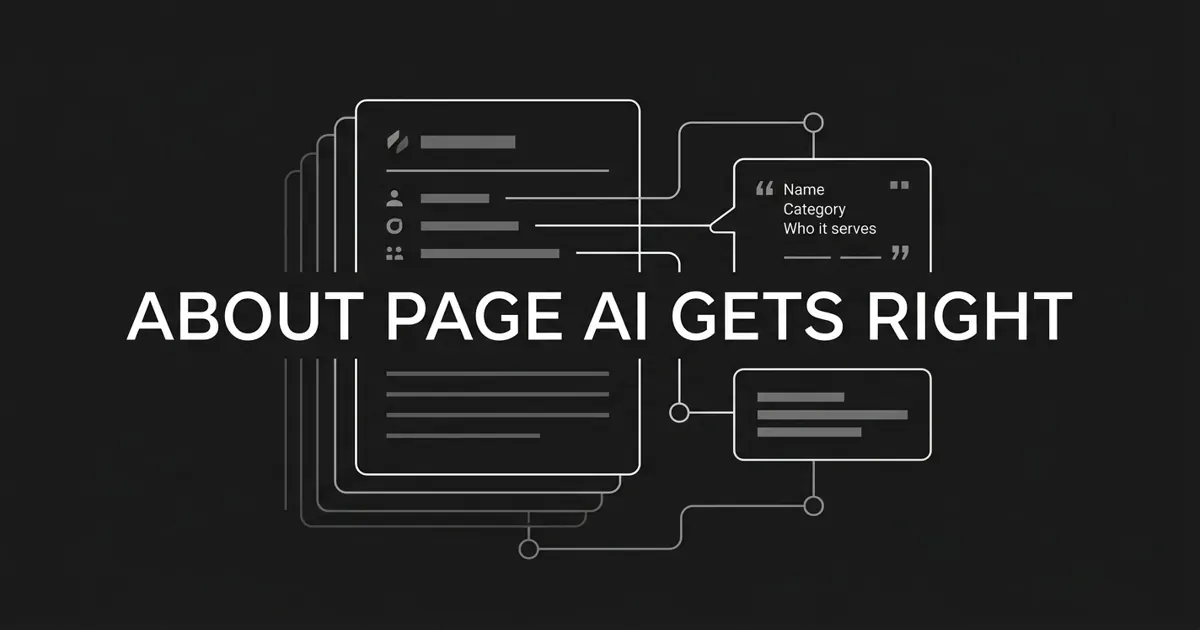
Your About page reads fine to a human. Then a buyer asks ChatGPT what your company does, and the answer calls you something you're not, hands your founder's credentials to the company, and never mentions who you actually serve.
That's not a writing-talent problem. It's an ambiguity problem, and ambiguity is fixable.
This guide gives you eight steps to turn company and bio facts into clear, testable copy. By the end you'll have a fact sheet, a rewritten page, and a prompt set you can re-run whenever something changes. If you've been searching how to write About page for AI and finding schema tutorials, this is the other half of the job: the sentences themselves.
One honest limit before we start. Clear copy makes accurate paraphrase much more likely. Nothing you write forces an engine to use your page or repeat you word for word.
First, get clear on what About page AI representation means
Three outcomes get lumped together, and separating them saves a lot of frustration.
Mention is whether an engine names you at all. Citation is whether it links your page as a source. Representation accuracy is whether the description keeps your real category, offering, audience, roles, dates, and qualifiers intact.
You can be mentioned without being cited. You can be cited and still described wrong. The difference between a mention and a citation matters when you decide what to fix first.
About page AI representation is that third outcome, and it's the one your words genuinely influence. You'll see the work filed under About Us page AEO, which is really just a label for answer-oriented writing, not a hidden syntax.
Worth naming what this guide leaves alone. It won't cover organization or author markup, entity and knowledge-graph strategy, or repairing an answer that's already gone wrong. Those are real jobs, just different ones, and each has its own playbook.
One boundary does carry over. If your page can't be crawled or indexed, no sentence rescues it. Google's guidance is that a page has to be indexed and eligible to appear with a snippet before it can show up as a supporting link in AI features, and even then inclusion isn't guaranteed. Assume access is handled, then do the writing work.
Step 1: Map the questions your page has to answer
Start with questions, not paragraphs. What would a buyer, a journalist, a candidate, or an AI user ask about you?
For the company, list identity, offering, audience, the problem you solve, differentiators, and operating facts like location, founding year, or leadership. For each person, list current role, employer, expertise, prior roles, credentials, and accomplishments.
Here's a starter prompt set you can steal:
- What is [Company]?
- What does [Company] do?
- Who is [Company] for?
- What problem does [Company] solve?
- What products or services does [Company] offer?
- How is [Company] different from the alternatives?
- Who is [Person] and what is their current role?
- What does [Person] specialize in?
- What did [Person] do before joining [Company]?
- Summarize [Company] using only the About page.
Now the important part. Don't add a fact just because a prompt asks for it. Mark every prompt as supported by an approved fact, deliberately out of scope, or unanswered. Silence is a decision you get to make.
How you know it's done: every important prompt has either a planned sentence or a written "not stated" decision, and the page's main subject is settled before you draft.
Where people go wrong: opening with "We're passionate about..." before deciding what the company is. Nobody should have to infer your category from your mood.
Step 2: Build one fact sheet before you write prose
Prose written from memory drifts. Prose written from a fact sheet doesn't.
Build one table for the company and one per person. One row per fact, with the approved wording, the timeframe, any qualifier, and who signed off.
| Company field | What to write down |
|---|---|
| Official name | Exact name plus any approved short form |
| Entity type | Plain-language category: platform, agency, studio, nonprofit, manufacturer |
| Core action | The verb that says what you do |
| Audience | The specific customers or organizations you serve |
| Problem or job | The problem you address or the job you help finish |
| Products and services | One factual line per offering, kept apart from the company line |
| Differentiators | Specific, defensible differences, not superlatives |
| Operating facts | Location, founding date, ownership, leadership, when verified |
| Boundaries | What you don't do, when the distinction prevents confusion |
| Time-sensitive facts | Effective dates and "since" years that keep a statement true |
For people, capture full name, current role and start date, current affiliation, area of expertise, actual responsibilities, prior experience, credentials, approved accomplishments, and the right next step for a reader.
Keep "current," "former," "founder," "co-founder," "advisor," "investor," and "board member" strictly distinct. A shorthand label is how a wrong answer gets born.
This is also where a shared context layer earns its keep. Deep IQ in DeepSmith stores your About Company positioning, differentiators, claims to make and claims to avoid, Products & Services profiles, buyer persona detail, and Brand Voice, so later content pulls from the same approved facts instead of someone's memory. The lesson holds whether or not you use a tool: centralize the facts before anyone drafts. It doesn't replace a human fact check.
How you know it's done: a reviewer can trace every sentence in the draft to one row, or label it clearly as framing rather than a claim. Every number has a unit and a timeframe.
Where people go wrong: blending company positioning with product features, then folding the founder's biography on top. Three records, always: company, product, person.
Step 3: Write the identity sentence first
Before you polish anything, answer one question in the lead: who are you and what do you do?
Use the full company name as the grammatical subject. State the category, the action, the audience, and the outcome in one or two direct sentences.
The pattern is simple: "[Company] is a [category] that [specific action] for [specific audience]." An optional second sentence adds the mechanism: "[Company] helps [audience] [finish a job] by [bounded method]."
Here's ours, using only facts we can defend. DeepSmith is an AI search analytics and content production platform in one. It tracks how AI engines answer questions about your brand, finds the gaps where you're invisible, and produces on-brand content to close them.
Notice what that sentence does. It names the subject, the category, the action, and the reader. No slogan, no adjectives doing work that nouns should do.
Pro tip: read only your first sentence aloud, then ask a colleague to repeat it back from memory. If they remember a mood but not your category, audience, and action, rewrite that sentence before touching anything else.
How you know it's done: a reader can answer who, what, and for whom from the first paragraph, without the navigation, the hero image, or the tagline.
Where people go wrong: swapping the category for a claim like "the future of work." That phrase tells an engine nothing about what you are.
Step 4: Write bio for AI search as its own record
A company page and a founder bio are related. They are not interchangeable, and merging them is one of the fastest ways to get described wrong.
On the About page, the company is the subject. In the bio, the person is the subject. Keep the facts congruent, keep the sentences separate.
The short pattern: "[Full Name] is [current role] at [Company], where [they] [specific responsibility]. [Name] specializes in [defined field] and previously [relevant experience]. [Name] holds [relevant credential]."
A few rules that do most of the work. Don't open a bio with a pronoun. Don't say "the company" before you've named it. Repeat the full name whenever a paragraph could be read as being about two different people. Use past tense and a date for former roles, present tense for current ones.
When you write bio for AI search, tailor the detail to the purpose. A speaker bio, a leadership page, and a byline don't need every career fact, but the facts they share should match.
How you know it's done: someone can copy the bio without accidentally copying company facts, and every current title carries a current-status decision. Author bios and author pages are a deeper craft of their own if you publish under bylines.
Where people go wrong: writing a founder's credentials as though the company earned them. "Founded by experts" is not a company credential.
Step 5: Split company, product, and person into separate blocks
Structure is attribution. When one paragraph carries three subjects, the qualifier attaches to the wrong one somewhere down the line.
Build the page as labeled blocks, each answering one question:
- What we do: the identity lead and core action.
- Who we serve: audience and use cases.
- Products and services: one factual description per offering.
- How we're different: specific, bounded differentiators.
- Company facts: verified founding, location, ownership, leadership.
- People: leadership and team bios, each with a full name and current role.
- Next step: contact, demo, or product path.
Use headings that describe the section, not headings assembled from target keywords. A company page AI describes correctly is one where a reader never has to guess which entity a sentence belongs to.
When a fact belongs to a product, name the product. When it belongs to a person, name the person. When a claim only applies to one plan, market, segment, or year, say so inside the sentence.
How you know it's done: no paragraph changes its grammatical subject without a heading or an explicit name.
Where people go wrong: the blended paragraph. "We founded the company, our platform does X, and she leads the team" is three claims with one fuzzy owner. Split it into three sentences with three named subjects.
Step 6: Edit each section so it survives a paraphrase
Facts approved? Good. Now edit for extraction, which is mostly plain-language editing with the stakes made visible.
- Prefer active voice. "DeepSmith tracks AI answers" names the actor. "AI answers are tracked by the platform" hides it.
- Use present tense for current facts and past tense for finished ones. Add a year when a change would matter.
- Choose direct verbs. "We analyze data" beats "we conduct an analysis of the data."
- Keep subject, verb, object, audience, and qualifier close together.
- Replace a vague pronoun with a name. "It helps teams" is unsafe when "it" could mean the company, the product, or a feature.
- Define category words before leaning on them. "Platform," "solution," "infrastructure," and "AI" don't mean the same thing to everyone.
- Put the key answer at the top of each section, then add context and qualification.
- Keep important facts in visible text. A hero image or video can support a fact, never be its only home.
Then bound your claims. Replace "serves everyone" with your actual audience. Replace "the leading platform" with a difference you can defend, or cut it.
| Risky copy | Safer pattern |
|---|---|
| "We empower modern teams with innovative solutions." | "[Company] helps [audience] [specific action] with [named product]." |
| "The platform makes it easy." | "[Product] lets [audience] [specific task]." |
| "She has led the company for years." | "[Name] has served as [role] at [Company] since [year]." |
| "Founded by experts and trusted by everyone." | "[Company] was founded in [year] by [names]. It serves [audience]." |
There's no magic word count here, and no required number of headings. Make the page long enough to answer its questions and short enough to carry no repetition. Writing self-contained sentences is the real skill: each one should still make sense when lifted out of its paragraph.
How you know it's done: every section can be summarized without changing the subject or dropping a qualifier.
Where people go wrong: treating "clear" as "short at any cost." A short sentence that drops the audience or the timeframe is less accurate than a slightly longer one that keeps them.
Step 7: Run a five-pass ambiguity review before you publish
If this feels like a lot, take a breath. This review is five focused passes, and each one takes minutes.
- Subject pass. Circle every "we," "it," "they," "this," "the company," and "the platform." Replace the ones whose referent isn't unmistakable.
- Role pass. Check every title and affiliation. Current roles get current language, former roles get past tense. Confirm founder versus co-founder versus advisor.
- Date pass. Replace "recently," "currently," and "for years" with a year or a status. Make sure the date and the tense agree.
- Claim pass. Qualify or remove unsupported numbers, awards, customer counts, rankings, and superlatives. Check that a product feature isn't presented as a company-wide result.
- Paraphrase pass. Ask a colleague, or a language model, to answer your prompt set using only the page. Compare each answer to the fact sheet.
Treat any dropped qualifier, merged entity, wrong role, wrong date, or invented claim as a failed draft, then fix the source sentence rather than the summary.
Some red flags worth scanning for: a slogan is the only description of your work, your name appears in the logo but not the body lead, "we" covers the company and a person interchangeably, a number has no unit or period, or the copy says "AI" without ever saying what you do.
How you know it's done: the fact sheet and the page agree line by line, and a test summary introduces no new fact.
Where people go wrong: editing for tone before repairing attribution. A beautiful sentence with the wrong subject is still wrong.
Step 8: Test the live page across engines, then keep the source current
Here's the part most teams skip. Publishing isn't the finish line, it's the first data point.
Run your prompt set in more than one place: ChatGPT, Gemini, Perplexity, Google AI Overviews or AI Mode, and Microsoft Copilot when your audience uses it. Record the date, the exact prompt, the answer, the cited page, and any mismatch.
Score these separately:
- Were you mentioned at all?
- Was the About page or bio cited?
- Did the answer get the category, offering, audience, role, and dates right?
- Did it merge you with a product, a parent company, or a similarly named entity?
- Did it turn a former role into a current one?
- Did it add a claim your page never made?
Don't treat one answer as a verdict. Engines use different models and retrieval systems, and results shift by engine, prompt wording, and date. A large Q4 2025 analysis of millions of AI citations found source preferences that differed noticeably by model, and its own authors cautioned that those patterns may not hold as systems change. Test broadly, and repeat.
Doing this by hand every month gets old fast. This is where AI Visibility in DeepSmith helps: Prompts tracks your questions with full answer history plus per-prompt mention and citation rates, Pages shows which of your pages get cited and which prompts drive them, and the Overview reports mention rate, citation rate, share of voice, sentiment, and trend. Engine coverage follows your plan. Pro tracks ChatGPT, Grow adds Perplexity, Scale adds Gemini, and Enterprise covers all ten engines. It's measurement and diagnosis, not control over an engine.
Then keep the source alive. Update the copy whenever a role, product, audience, location, owner, or date changes, and re-run the prompt set after anything material. Professional-bio guidance suggests refreshing a bio at least every six months and keeping every version congruent, which is a good rhythm for company copy too.
How you know it's done: the page has a named review owner, a fact sheet, a stable prompt set, and a written record of mismatches.
Where people go wrong: assuming a citation means accuracy. Open the cited page and compare it to the sentence the engine produced.
What to do this week
You don't need to rebuild the whole site. Pick one page.
Write the fact sheet, rewrite the identity sentence, split the blended paragraphs, run the five passes, publish, then run your prompt set and write down what came back. That's a week's work at most, and it's the highest-leverage week your About page has had in a while.
About Us page AEO isn't a secret syntax. It's the discipline of saying exactly who you are, for whom, in sentences nobody can misread.
If you'd like the testing and the content production to run in one place instead of two, start a free DeepSmith trial and see what AI engines currently say about you.