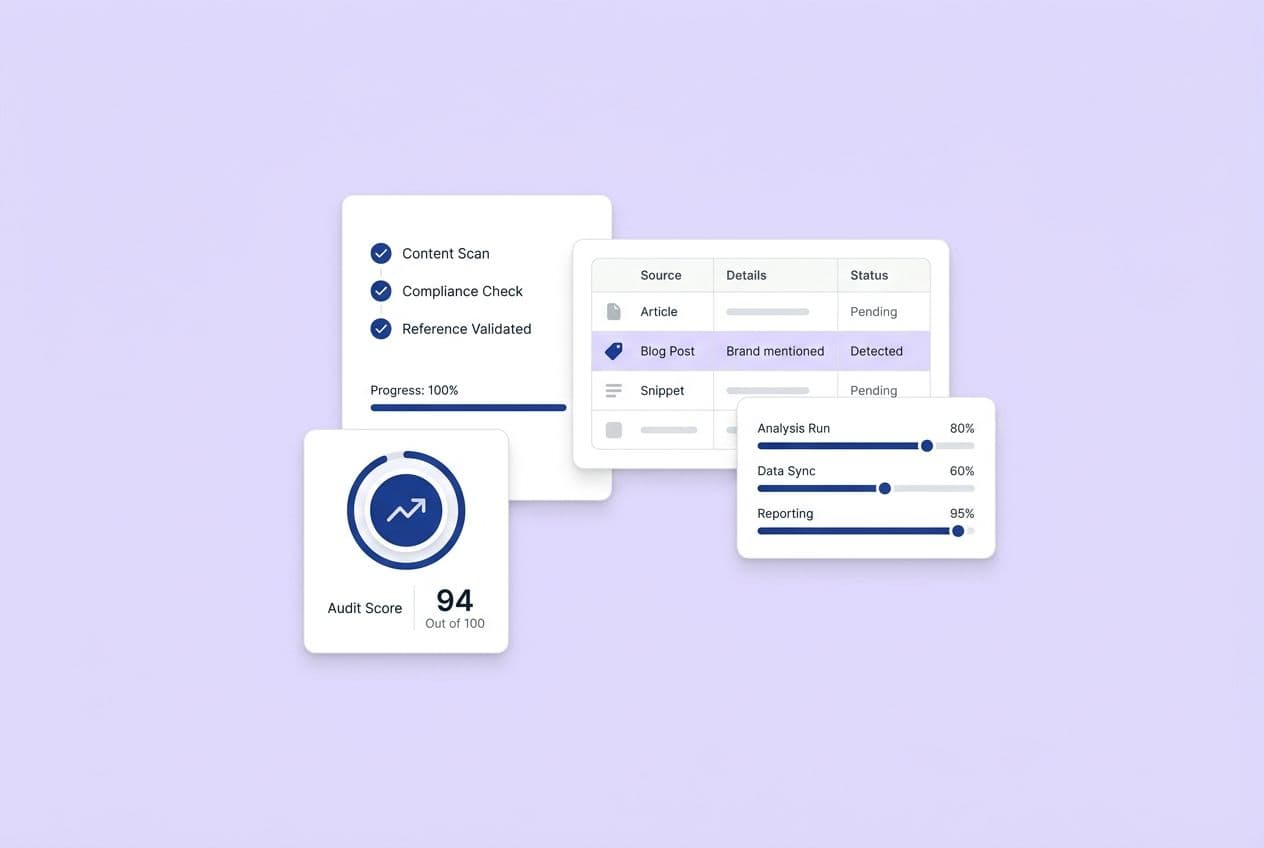
The complete playbook for an AI brand visibility audit looks like this: You compile a set of prompts using the exact words your buyers use. You test those continuously across the major AI engines. You grade the responses to see if you get mentioned, if you're cited, and if the AI shares positive (and correct) details about you. You diagnose the reasons you aren't appearing. Finally, you optimize the specific web pages and external platforms the AI is pulling from.
That’s really it. That's the entire playbook. Everything else is just execution.
I'm guessing this sounds familiar: You type a few queries into ChatGPT every couple of weeks, right? You notice the answers shift constantly. You watch rival companies dominate the spots where you belong. And your stomach drops because you can't confidently report what's going on to leadership. You're just armed with screenshots and stress. I completely understand. I've been in your shoes. The issue isn't a lack of effort. It's that ad-hoc queries do not make a system. You have zero baselines, zero trend lines, and zero clear tasks to tackle. Just a desktop full of screenshots and mounting panic.
This walkthrough will teach you how to transform those isolated queries into a repeatable audit that actually gets results.
When we're done, you'll walk away with an initial library of prompts built on genuine customer phrasing, a straightforward grading sheet you won't abandon, a monthly and quarterly routine you can easily justify to the executive team, and an action plan of repairs tied specifically to your discoveries.
What Does "Brand Presence in AI Answers" Actually Mean (and What Should You Measure)?
Brand presence in AI answers isn't one-dimensional. If you only track whether your brand gets named, you're flying blind. You’re missing the real risks to your reputation and revenue. It's entirely possible for a competitor to own the positive sentiment on Perplexity while your brand is invisible. And let's be honest, a "mention" that gets your pricing wrong is actively worse than no mention at all.
Start with a simple, usable scorecard. We’re aiming for something you'll actually maintain, not a 30-column monster. Let's focus on six key dimensions:
-
Mention rate: Is your brand named in the answer? (This is a simple Yes/No, which you’ll later tally up as a percentage).
-
Citation rate: Does the AI link to a source? And whose is it, yours, a competitor’s, or some third-party site?
-
Share of voice: Looking across all your prompts, how often are you mentioned compared to your top three competitors?
-
Position: Are you the first brand named, buried in the middle of a list, or mentioned as an afterthought? First mentions get the attention, even in AI answers.
-
Sentiment: Is the language positive, neutral, or negative? AI engines love to surface old, negative Reddit threads and call them "answers."
-
Accuracy: Is the information about your pricing, features, or company policies actually correct?
For your first scorecard, you can boil this down to five columns in a spreadsheet: Prompt, Platform, Brand Mentioned (Y/N), Citation Source, and Accuracy Flag. That’s more than enough to start spotting the patterns that matter.
AI visibility is not the same as SEO visibility. Yes, pages that rank well in search often get cited by AI, but it's not a one-to-one relationship. AI engines have their own logic. They pull from third-party directories, community forums, and review sites that your SEO tools might not care about. You can be ranking #1 for a term and still be completely invisible in an AI answer about your own category.
At this stage, "good" isn't about perfect scores. It’s about seeing your coverage and accuracy improve across your most important prompts, month after month.
What's the Difference Between a Mention, a Citation, and a "Ghost Citation"?
This is important, so let's be clear. A mention is when the AI types out your brand name in the text of the answer. A citation is the footnote, the link or source URL that it attributes the information to.
A ghost citation is the sneaky one. This is when your URL is listed as a source, but your brand name is nowhere to be found in the actual answer. The model read your page, used your information, and even gave you a link… but didn't give you the credit by name.
Ghost citations are a bigger deal than they seem. They represent lost brand recall. A buyer reads the answer and gets the information, but they never connect it to you. And because they only appear in the source list (not the main answer), they are incredibly easy to miss if you’re just scanning for your brand name. You have to track both.
Which AI Platforms Should You Audit First, and Why Do They Disagree?
Start with four: ChatGPT, Gemini, Perplexity, and Google's AI features (like AI Overviews). This is your baseline. Please, don't chase every shiny new AI tool that pops up on Twitter. These four are where the vast majority of your B2B buyers are asking questions today.
So why do they give you different answers for the same prompt? It's all about how they source information.
-
ChatGPT is a consensus engine. It looks for agreement from third-party sources like listicles, comparison sites, software directories, and analyst reports. If you're not on G2, Capterra, or the big "best of" lists in your category, you're basically invisible to ChatGPT for high-level questions.
-
Gemini seems to prefer first-party, structured content. Your own documentation, well-organized product pages, and authoritative content on your own site carry more weight here.
-
Perplexity is all about community sentiment. It leans heavily on Reddit threads, forums, and discussions between actual users. If your brand has a thin or negative community presence, Perplexity's answers will brutally reflect that.
-
Google AI features have the closest link to traditional SEO signals, but it’s not that simple. Good organic rankings are a huge help, but they aren't a golden ticket.
So which one should you care about most? It depends entirely on your ideal customer profile (ICP).
-
If your buyers are technical folks or early adopters who live on Reddit and in forums, put more weight on Perplexity.
-
If you rely on your owned documentation and well-structured product pages, pay close attention to Gemini.
-
If you're in a crowded category driven by "best X software" lists, you need to win on ChatGPT.
The goal isn't to get a perfect score on a single platform. It’s to find the patterns across all of them.
Platform Quick-Interpretation Table
| Platform | Typical sources | What to watch for | What usually fixes it |
|---|---|---|---|
| ChatGPT | Directories, listicles, comparison sites, third-party reviews | Missing from category lists; competitor dominates roundups | PR placements, directory listings, review generation |
| Gemini | Owned site, official docs, structured pages | Weak page structure; missing entity clarity; thin product pages | On-site structure, clear H1s, answer-first formatting |
| Perplexity | Reddit, forums, community discussions | Negative threads dominating; brand rarely discussed | Community engagement, case studies, practitioner content |
| Google AI | Mix of ranked pages, structured data | Ranked pages not getting cited; schema gaps | Strong rankings + structured formatting + internal links |
How Do You Build an Audit Prompt Set That Reflects Real Buyer Intent (Not SEO Keywords)?
A good audit starts with prompts that sound like your buyers, not your marketing team. This is a huge mistake I see people make. AI engines are built for conversational questions. Your buyers don't say "content marketing automation platform." They say, "what's the easiest way to publish blog posts consistently when my team is small?" If you're not asking questions the way they do, you're testing the wrong thing.
Build your prompt list around six types of buyer intent:
-
Problem-aware / unbranded: "What's the best way to [solve a pain]," "tools for [a specific workflow]"
-
Category: "Best [category] software for a [specific role or company size]"
-
Comparison: "[Your brand] vs [Competitor] for [a specific use case]"
-
Alternative: "Alternatives to [Competitor]"
-
Implementation: "How to [set up a specific process]"
-
Pricing / trust: "Is [Brand] legit," "Does [Brand] integrate with [another tool]" (Yes, these feel awkward to ask, but I promise you, your buyers are asking them).
Where to find these prompts without guessing:
-
Sales call notes and demo transcripts. This is a gold mine.
-
Onboarding questions from your newest customers.
-
Support tickets, especially the "how do I" questions that come up over and over.
-
Your existing keyword research. Just translate the sterile head terms into natural questions.
A few rules for writing good prompts:
-
Use buyer words. Ditch your internal feature names.
-
Add context. "for a startup," "without engineering help," "for a team under 10 people."
-
Don't be so broad that the answer is useless. "best marketing tool" is a waste of a query.
How many prompts do you need?
-
Day 1: Start with 20. That’s enough to find real patterns.
-
Month 1: Aim for 40–60. As you learn, you can add more comparison and trust-based questions.
Keep these prompts in a "prompt library," which can be a tab in your audit spreadsheet or a separate doc. And please, use the exact same wording every time you audit. Consistency is what lets you compare results over time.
Copy/Paste Prompt Templates (Fill-in-the-Blanks)
Don't overthink it. Start with these and just swap in your own details.
-
"What's the best [category] tool for [role] at a small company?"
-
"How do I [solve specific pain] without [constraint — e.g., 'a big team' or 'developer help']?"
-
"Best [category] software for [use case or industry]"
-
"[Your Brand] vs [Competitor] — which is better for [specific use case]?"
-
"What are the best alternatives to [Competitor] for [role]?"
-
"How do I set up [specific workflow] using [category tools]?"
-
"Is [Brand] good for [company type or use case]?"
-
"Does [Brand] integrate with [common tool in your stack]?"
-
"What do people say about [Brand] on Reddit?" (Run this one on Perplexity, specifically.)
-
"How much does [Brand] cost for a [team size] company?"
How Do You Run the Audit Step-by-Step (So It's Repeatable, Not a Screenshot)?
The audit is a simple grid: prompts × platforms × runs. The "runs" part is where people usually fall down, but it's non-negotiable. AI answers are not deterministic. You can get different results for the same prompt on the same platform just by refreshing the page. A single run tells you next to nothing.
Step 1: Set Up Your Audit Sheet
Create a spreadsheet with these columns. Keep it simple. Prompt | Platform | Run # | Brand Mentioned (Y/N) | Mention Position | Cited Domains | Your Domain Cited (Y/N) | Sentiment | Accuracy Notes | Other Notes
You'll have one row for every run, meaning multiple rows for each prompt.
Step 2: Control Your Variables
-
Use an incognito or logged-out browser window.
-
Copy and paste the exact prompt wording every time. Don't paraphrase on the fly.
-
Note the date of each audit cycle.
-
When asking unbranded questions, don't include your brand name. That just skews the results.
Step 3: The Multi-Run Protocol
-
Run each prompt on each platform 5–10 times. (Five is fine if you're short on time).
-
Spread the runs out over a couple of days, not all in one sitting.
-
From these runs, you can calculate a visibility percentage (the % of runs where your brand appeared) and persistence (do you show up consistently, or just once in a blue moon?).
A brand that shows up in 9 out of 10 runs is in a totally different spot than one that shows up in 2 out of 10. That's the insight you lose with a single screenshot.
Step 4: Capture Citations and Sources
Every time you get an answer, log the domains in the citations. As you do this across all your prompts, you'll start to see the same domains appear again and again. This is your AI discovery supply chain, the list of sources the AI engines actually trust for your category.
Step 5: Score and Summarize
At the end of an audit cycle, you should be able to calculate:
-
Mention rate for each prompt and platform.
-
Citation rate (how often you get cited vs. your competitors).
-
Share of voice against your top 3 competitors.
-
Accuracy risks (anywhere the AI is saying something wrong about you).
-
Negative sentiment flags.
Don't have much time? You can do a meaningful audit in about two hours. That covers roughly 20 prompts across 2 platforms with 5 runs each, plus time to summarize what you found. This gives you a real baseline and a starting backlog.
Your output should be a simple, one-page summary of your findings: what prompts are you missing from, where are competitors beating you, and what's factually wrong.
Once you’ve proven out this manual process and are ready to scale it, you can look at tools. For example, DeepSmith's AI Visibility — Prompts module can automate the tracking of mention rates and citation rates across all the major platforms, giving you trend data without you having to run the prompts yourself.
Beginner Scoring Rubric (Simple, Consistent, Fast)
| Dimension | 0 | 1 | 2 |
|---|---|---|---|
| Presence | Brand not mentioned | Mentioned but vague or buried | Named clearly and prominently |
| Citation | No citation; competitor cited | Third-party cite (review/directory) | Your domain directly cited |
| Sentiment | Negative or dismissive | Neutral / factual | Positive framing |
| Accuracy | Clear factual error | Incomplete or ambiguous | Accurate and current |
The goal here is consistency, not perfect precision. The value is having a baseline you can compare against next quarter.
How Do You Diagnose What's Causing Gaps (Missing Mentions, Wrong Info, Competitor Dominance)?
Every gap you find in your audit has a cause you can fix. The trick is to read the patterns in your spreadsheet before you jump into action. Don't just start fixing things randomly.
Failure Mode 1: You never appear on unbranded prompts. This is a classic category presence problem. It usually means you don't have enough third-party sources (directories, listicles, review sites) telling the AIs that you belong in the category. It can also mean your own content isn't aligned with how people search for solutions. The fix: Build off-site consensus and create more category-level content.
Failure Mode 2: You appear, but aren't cited. The AI knows you exist but isn't confident enough to pull from your pages. This often happens when your content is too thin, too sales-y, or poorly structured. The AI mentions you based on its general knowledge but can't find a specific page on your site to "prove" the claim. The fix: Improve your page structure and make your content more easily extractable.
Failure Mode 3: Ghost citations. Your URL is in the source list, but your brand name isn't in the answer. This is an on-page branding issue. Your company name isn't prominent in your H1s or opening paragraphs, your page titles are ambiguous, or your entity definition is weak. The AI doesn't know who "you" are. The fix: Make your on-page entity signals crystal clear.
Failure Mode 4: Hallucinations and wrong information. The AI is making things up about your pricing, integrations, or features. This happens when you have old, stale pages, inconsistent messaging across your site, or you just haven't provided a clear, unambiguous source of truth for the AI to use. The fix: Go on an accuracy-first content update mission.
A Perplexity-specific issue: On Perplexity, if you see your brand appearing and disappearing from answers, it often tracks back to community sentiment. If a negative Reddit thread is getting a lot of attention, your brand gets tied to that conversation. This isn't an on-page problem, it’s a community presence problem.
What Did the Model Use to Decide? (Your Source Map)
Go back to your audit sheet and pull all the domains you logged in the "Cited Domains" column. List them out by how many times they appear. The top 10 domains are your source map. This is the actual infrastructure the AIs are using to form an opinion about you.
This list is your roadmap. It tells you:
-
Which directories or review sites you absolutely need to be listed on.
-
Which publications or communities you need to earn coverage in.
-
Which of your competitor's pages are doing the heavy lifting for them.
If your source map is just a list of your competitors' websites and a bunch of generic listicles that don't mention you, you know exactly where to point your PR, partnership, and community efforts.
What Are the Highest-Leverage Fixes After the Audit (by Platform and by Failure Type)?
Don't try to fix everything. Fix the things your audit told you are broken. The fastest way to improve your AI visibility is to take a few, targeted actions that map directly to the failures you found.
Priority 1: Fix accuracy risks first. If an AI is saying the wrong things about your price or features, that is a direct threat to your revenue and trust. Fix it. Now. Go to those pages and make the critical facts impossible to misinterpret. Be clear, direct, and consistent across your entire site.
Priority 2: Restructure your content for extractability. AI engines don't read pages; they extract facts. You need to structure your key pages so the answer is easy to grab.
-
Start sections with a short, direct "answer capsule" (40-60 words).
-
Use H2s and H3s that are actual questions.
-
Keep paragraphs short and focused (2-4 sentences is plenty).
-
Add clear constraints: "This is best for X, but not great for Y."
Priority 3: Get on a freshness cadence. Stale pages are a primary cause of AI hallucinations. A simple 90-day update cycle for your most important pages and top-cited blog posts can work wonders. This sounds easy, but it’s hard to maintain on a small team.
For teams struggling with this, this is where a system like DeepSmith can help. It builds the SEO and AEO structure, linking, and publishing steps right into your workflow, so new and updated content ships correctly every time without a separate QA nightmare.
Priority 4: Build off-site consensus (especially for ChatGPT). Take your source map and start targeting the authoritative listicles, directories, and review sites on it. Getting featured there has a direct impact on how ChatGPT sees you. Encourage customers to leave detailed reviews that mention specific use cases and integrations.
Priority 5: Do the community work (especially for Perplexity). Keep an eye on recurring negative threads. Show up and be helpful. And start seeding the communities with real, valuable content like detailed case studies, technical walkthroughs, and customer stories.
How Do You Turn This Into an Ongoing Workflow (and Reporting Leadership Will Understand)?
This is a loop, not a one-time project. Your goal should be a light check-in every month and a deeper dive every quarter. It needs a clear owner and a living backlog that feeds your content and PR plans.
Monthly Cadence (90 minutes):
-
Re-run your 20–40 core prompts on 2–3 platforms.
-
Update the mention and citation rates in your scorecard.
-
Log any new accuracy issues you find.
-
Pick 1–3 small fixes from your backlog and assign them.
Quarterly Cadence (half-day):
-
Expand or refresh your prompt library.
-
Do a deeper dive on your competitors—what pages of theirs are getting cited, and why?
-
Re-prioritize your content and PR backlog based on what’s changed.
-
Update leadership on the trends, not just a single snapshot.
KPIs to Report Upward:
-
Mention rate on your priority prompts (is it trending up or down?)
-
Your citation rate vs. your competitors'.
-
Share of voice across your top 3 competitors.
-
Number of accuracy issues (open vs. resolved).
-
Any active negative sentiment flags.
When you talk to leadership, frame the "missing prompts" as a prioritized content roadmap. Each gap represents a decision: do we create content for this, build off-site presence, or both? Tools like DeepSmith can help connect those gaps directly to a production pipeline, so your roadmap doesn't just die in a spreadsheet.
Workflow Artifacts to Maintain:
-
AI Visibility backlog: A list of tickets for content updates, PR, review generation, and community responses.
-
Top cited domains list: Your outreach targets. The sources the AI actually trusts.
-
Top pages earning citations: Protect these pages. Refresh them on a schedule. Never let them go stale.
Ownership Model:
-
Content owns on-site structure and freshness.
-
SEO helps with prioritization and tracking rankings.
-
PR/Community owns the off-site and sentiment work.
To maintain visibility on these trends over time without having to rebuild a report from scratch every month, DeepSmith's AI Visibility Overview dashboard puts all your KPI cards for mention rates, citation rates, and competitor standings in one place. The data is always ready when leadership asks.
A Simple Monthly Checklist (What to Do in 90 Minutes)
-
Open your audit sheet and duplicate last month's tab.
-
Re-run your 20–40 core prompts (2–3 platforms, 3–5 runs each).
-
Update your mention rates, citation rates, and accuracy flags.
-
Log any new competitor citations or sentiment changes.
-
Compare this month to last month. What moved?
-
Pick 1–3 backlog items, assign owners and due dates.
-
Set a date for your next run and update your leadership summary.