You publish a good post. It ranks. Then you ask ChatGPT the exact question it answers, and something else gets named instead. That gap is not a mystery, and it is not a secret formula either.
This is a walkthrough of how to write a blog post for AI search, start to finish. One topic, one article, one measurement plan. A blog post that gets cited by AI is mostly a well-made post with a few habits added in the right order, and building them in as you go beats bolting them on after.
Here is the good news: most of the work is writing you already know how to do. You are just going to do it in a slightly different order.
Step 1: Pick one buyer question and give the post one job
AEO blog writing starts before the draft, with the question itself.
Start with something a real buyer would type or say. Not "content refresh." Something like "how do I know which old posts are worth updating?"
Write down four things before anything else: who this is for, what stage they are at, what they should be able to do afterward, and the three or four follow-up questions they will ask next. That short list is your brief.
Keep the job narrow. One post, one decision. If you are also trying to cover the whole category, you have a pillar page, not an article, and both will end up weaker.
Done when: someone else can read your brief and say in one sentence why this page should exist.
Where people go wrong: picking a keyword instead of a question. A keyword tells you what to title the piece. A question tells you what the page has to answer, which is what an engine is actually matching against. If you want the longer version of that distinction, a keyword list is not the same as a prompt list.
This is one of the two places where a tool earns its keep. DeepSmith tracks the prompts you care about and reports mention rate, citation rate, share of voice, cited pages, and which competitor pages win the answers instead of yours. Discover Prompts builds a starter set from your product, persona, and buyer-stage context, so you are not staring at a blank list. That helps you choose and defend a topic. It does not promise the finished article gets cited.

Step 2: Map the answer before you write a word
Turn your question into an answer map. What claims does the reader need? In what order? What evidence does each one require?
Then give every H2 one job. The shape of an AI citation blog post is simple: the direct answer near the top of the page, then the reasoning, the process, the examples, the caveats, and the next action. Headings should describe the task or the answer, not be clever. "Score each page" beats "The scoring conversation."
There is a real reason to front-load. A 2026 CXL analysis mapped 100 AI Overview citations to where they sat inside the source pages: 55% came from the top 30% of the page, 24% from the middle, and 21% after the 60% mark. CXL notes those bottom-of-page citations often came from FAQ blocks. Treat that as directional, not as a law. It tells you to make answers easy to find, not that a template wins.
Done when: every planned H2 answers a distinct sub-question, and your first screen tells the reader what the post answers.
Where people go wrong: hiding the answer under a long warm-up. If your first 200 words are scene-setting, an engine has to dig for the part worth quoting, and so does your reader. The deeper craft moves live in how to structure an article answer-first and outlining around the questions people ask.
Step 3: Gather evidence and keep a source ledger
Research the answer, not the keyword.
For every factual, numerical, or comparative claim, log four things in a simple table: the source, the date, what the source actually establishes, and the exact wording you can safely use. Add a fifth column for the limitation.
That ledger is small, boring, and it is the single thing that keeps a draft honest. It stops "correlates with" from quietly becoming "causes" somewhere between your notes and your draft.
Pro tip: if a statistic arrives without its population, sample, date, and method, it is not yet a statistic you can use. Either go find the study behind it or cut the sentence. An undated number in an AI citation blog post is a liability, not a credibility signal, and using statistics and quotes well is a craft of its own.
Done when: every non-obvious claim has a source and a scope, every number has a unit and a date, and you can say out loud what your evidence does not prove.
Where people go wrong: treating a vendor's marketing claim as neutral research, or rewriting a study's careful conclusion into something stronger because it reads better.
Step 4: Draft passages that stand on their own
This is the part that most changes how you write.
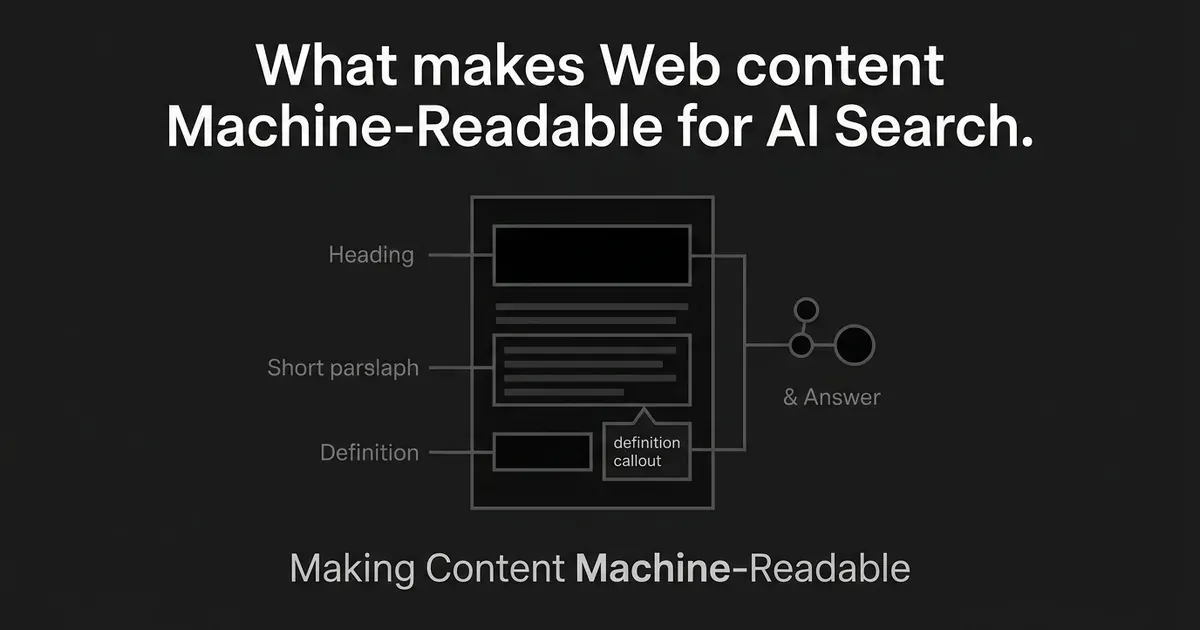
An engine rarely lifts your whole article. It lifts a passage. So each important answer needs to survive being pulled out of the page: state the claim, add the qualification, name the evidence, all in the same few sentences.
Practically, that means no orphan pronouns. "This works well for enterprise teams" means nothing once it is extracted. Name the thing. Keep the number next to its date and its denominator. Define a term before you lean on it. Never put a fact only inside an image.
Does the research back this up? Partly, and it is worth knowing exactly how much. The 2023 GEO paper tested nine content treatments across a benchmark of 25 domains. Its best-performing methods improved the baseline by 41% on one visibility metric and 28% on another. The strongest families were adding source citations, adding quotations, and adding statistics, each landing roughly 30% to 40% better than the unmodified baseline on the first metric. On Perplexity specifically, adding quotations improved that metric by 22% and adding statistics by up to 37%.
Read that as one bounded experiment, not a guarantee for your post. The authors say so themselves: engines change, and results depend on the query domain.
Done when: you can copy any section into a blank document and it still tells someone what is true, under what conditions, and where the evidence came from. The page still reads like an article, not a stack of index cards.
Where people go wrong: burying the qualification three sections away from the claim it qualifies. For the sentence-level version of this, see writing self-contained passages.
Step 5: Add the trust layer
Now ask the harder question. Why should an engine pick your page over the forty others that answer the same thing?
The answer has to be something you added. Original analysis. First-hand process detail. A comparison nobody else bothered to make. A synthesis that saves the reader four tabs. Google's own people-first guidance asks whether a page provides original information or analysis, adds substantial value beyond rewriting other sources, shows first-hand expertise, and has clear sourcing and accurate bylines.
So put a name on it. Make sure that person's relevant background is findable from their author page or your About page. Cite your sources visibly. Fix errors when you find them.
If AI helped make the piece, disclose it when a reader would reasonably want to know. Disclosure is a trust decision. It is not a replacement for review, evidence, or an accountable author.
Common mistake: believing AEO blog writing means saying "AI" more often. Search "write blog for ChatGPT citation" and you will find a lot of advice that amounts to exactly that. Keyword stuffing was one of the treatments the GEO paper tested, and in its Perplexity evaluation it performed 10% worse than doing nothing at all. Write for the reader's task, then make the answer easy to retrieve. Author signals get their own treatment in author bios and entity pages.
Done when: the page answers "why this source?" with something other than "because we published it." A blog post that gets cited by AI has to be worth citing to a human first.
Step 6: Format the page, then check it is reachable
Two jobs here, and teams usually do the first and skip the second. This is the step where AEO blog writing overlaps almost completely with plain good SEO hygiene.
Formatting first. Descriptive title, logical H2 and H3 hierarchy, short paragraphs, lists and tables where they genuinely help, links with meaningful anchor text, metadata that describes the real page. Main content in text, not locked inside an image or a script. Details sitting next to the claims they support. If you use schema, it should accurately describe what is visibly on the page. Headers, bullets and tables are what an engine parses first, so formatting for extraction is worth a pass of its own.
One thing to stop worrying about: Google states plainly that its normal search best practices still apply to AI features, and that no extra requirements, special AI optimizations, machine-readable AI files, or special schema are needed for eligibility. Structured data can help Google understand a page, and correct markup still does not guarantee any particular display.
Then the boring check, which is the one that actually blocks people. Run through it:
- Robots.txt, CDN, firewall, and WAF rules are not blocking the crawlers you want.
- The page is indexable and not accidentally noindexed.
- It has a crawlable internal link from a page that is already discoverable, and it is in your sitemap.
- Canonical, status code, mobile rendering, and page experience are sound.
- Nothing important lives only in an image or a client-side interaction.
- The page can produce a normal search snippet.
To appear in Google AI features as a supporting link, a page has to be indexed and eligible to appear in Search with a snippet. OpenAI says OAI-SearchBot surfaces sites in ChatGPT search and that a site opted out of it will not be shown there. Perplexity says PerplexityBot is what surfaces and links sites in its search, and that disallowing it prevents indexing of your text. These are access conditions. Passing them makes you eligible, not chosen.
Done when: the page is readable with styling turned off, the hierarchy tells the story, the facts are text, and every crawler you care about can reach it.
Where people go wrong: treating schema as a citation switch, or updating robots.txt while a WAF quietly keeps blocking the same bot. More on the markup question in schema markup for AI search.
Step 7: Publish, verify the live page, distribute
Do one editorial pass as an editor, not as the writer. Facts, source links, author info, brand voice, heading order, metadata, internal links, alt text, crawler controls.
Then publish, and go look at the live URL. Not the preview. The live page. Rendering differs, images break, canonical tags get rewritten by a plugin, and the version an engine sees is the one on the internet.
After that, distribute. Repurpose the piece into the channels your audience actually uses, and keep the same claim discipline in the LinkedIn post that you kept in the article. Distribution creates real discovery paths. It does not buy a citation.
Done when: the live URL loads correctly, it is linked from somewhere discoverable, the crawlers are not blocked, and your distribution assets are written.
Where people go wrong: treating "published" as "indexed." Those are different days.
This is the other place a platform does real work. DeepSmith's Content Studio moves an idea from New Ideas to Planned Content to the Writer to Produced Content, and the article arrives with research, internal and external links, a cover image, and publish-ready metadata already in place. Autowrite writes a configured piece on its scheduled date and drops it into Produced Content for review. From there you publish to WordPress, Webflow, Strapi, Sanity, Contentful, or your own webhooks. Review stays yours. That is production support, not a citation guarantee.
Step 8: Measure by prompt, page and platform, then fix what you find
Publishing is the middle of this process, not the end.
Take the prompt set you wrote in Step 1 and run it before or right at publication. That is your baseline. Then run the same prompts again later, and record five things each time: was your brand mentioned, was your page cited, which page, which platform, and what date. Read the actual answer, not only the dashboard number. "Mentioned but not linked" and "not there at all" are different problems with different fixes.
Keep the prompts identical between checks. Change the prompts and you have thrown away your comparison.
What the platforms give you directly: Google folds AI Overviews and AI Mode into overall Search Console web reporting, so it will not isolate every citation for you. Bing Webmaster Tools has an AI Performance report showing cited pages, citation trends, and grounding queries across Copilot and Bing's AI summaries, with the caveat that its data refreshes daily, can omit low-volume activity, and is not a complete log.
Now use what you see. If you are absent entirely, go back to eligibility: is the page indexed, crawlable, internally linked, and does it actually answer that prompt? If you are mentioned but not cited, the gap is usually evidence and passage independence, so return to Steps 3 and 4. If a competitor is winning, open the exact page and find the claim that won, then beat it honestly.

Re-run the prompt set after each meaningful change, and keep a change log. One answer is not a trend, and a before-and-after is an association, not a cause. If you want the full version of this, AI visibility measurement is its own guide.
DeepSmith's competitor-citation view shows who wins your tracked prompts and on which pages, and Content Map lays your site and your competitors' sites onto one topic taxonomy so coverage gaps and untapped topics become visible instead of guessed at. Opportunity Agents turn that evidence into ideas with the supporting data point attached, which is how a backlog becomes defensible rather than instinctive.
Done when: you have a dated baseline, a stable prompt set, records at the page and platform level, and a rule for when you revise.
Where people go wrong: rewriting a whole article after one wobbly answer, or optimizing toward a dashboard without ever reading what the engine said. If the fix turns into a rewrite, refreshing an existing article covers that path properly.
What to do next
Do not retrofit your archive this week. Take one post you are about to write anyway, and run it through these eight steps.
Write down its prompt set before you draft. Keep the source ledger while you research. Check the live page after you publish. Then look at the answers thirty days later and fix the one thing they point at.
That is the whole loop, and the second article through it is much faster than the first. It is also the honest answer to how to write a blog post for AI search: a repeatable sequence, not a trick you will find by searching "write blog for ChatGPT citation" one more time.
If you want the measurement and the production sitting in one place, start a DeepSmith free trial and see where you already show up before you write anything new.