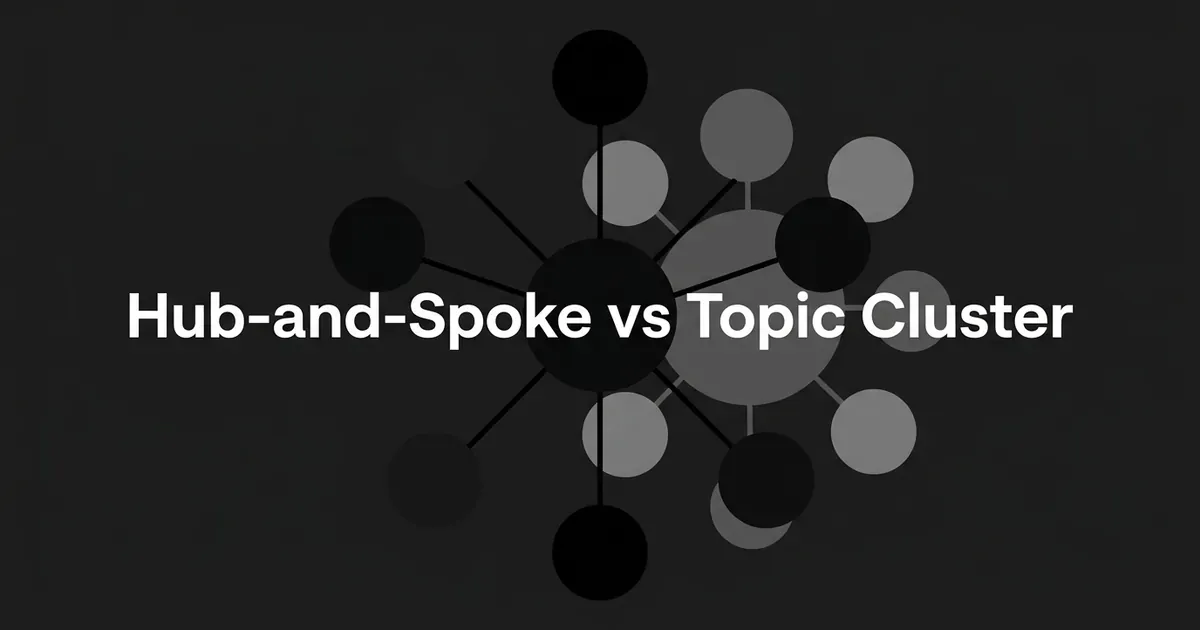
If you're deciding how to organize a group of related pages, you've probably run into both terms in the same breath: hub and spoke content marketing on one page, topic cluster on the next, describing what looks like the same diagram. That's not a coincidence. Search hub and spoke vs topic cluster and most of what comes back agrees on the basics: one broad central page connected by internal links to a set of narrower supporting pages, and both terms name a content cluster architecture built the same way underneath. The real differences show up somewhere else, in how deep that central page is expected to go and whether the links run in one direction or two.
Here's the short version, in one table:
| Hub-and-spoke | Topic cluster | |
|---|---|---|
| Central page called | Hub | Pillar page |
| Supporting pages called | Spokes | Cluster pages |
| Emphasizes | The shape of the link network | The topical strategy behind it |
| Typical use | Explaining navigation and site structure | Explaining SEO and content planning |
| Central page depth | Often lighter, navigation-first | Often heavier, a standalone resource |
If you're trying to decide which word to use in a planning doc or a brief, the short answer is: use topic cluster when you're talking about topical coverage and search intent, and use hub-and-spoke when you're talking about the shape of the pages and the links between them. Either term describes the same underlying system when a real one is in place.
What is hub-and-spoke content?
Hub and spoke content marketing organizes a set of pages around one central hub. The hub covers the broad subject and points readers toward the narrower spoke pages that go deeper on specific parts of it. The metaphor is literal: a hub in the middle, spokes running out from it, and the links holding the whole wheel together.
Three pieces make up the structure:
- The hub. The central page that frames the broad subject and directs readers toward related coverage.
- The spokes. The supporting pages, each covering a distinct subtopic or question.
- The links. The connections that turn a pile of separate pages into one working system.
In practice, a hub doesn't have to be exhaustive. Some hubs lean into being a navigation page, close to a table of contents: enough context to orient the reader, then a clear path to the spoke that actually answers their question. In that version, most of the depth lives in the spokes, not the hub. A robust hub-and-spoke setup usually has the hub linking out to every important spoke, each spoke linking back to the hub, and related spokes linking to each other where that connection genuinely helps the reader.
The term gets used loosely too. Some writers apply "hub-and-spoke" to any arrangement where one central page connects to several related pages, without saying anything about whether those links run one way, both ways, or all the way across the spokes. That looseness is part of why the term can feel interchangeable with topic cluster: on its own, the label doesn't specify link direction or hub depth, so it's compatible with several different implementations.
What is a topic cluster?
A topic cluster is a group of related pages organized around one central pillar page, where the pillar gives a broad overview and the cluster pages answer narrower questions, subtopics, or use cases underneath it. The model was built to move content planning away from chasing individual keywords in isolation and toward covering a full topic on purpose.
What actually makes something a topic cluster isn't page count or pillar length. It's the combination of a clearly bounded subject, a central pillar, supporting pages with distinct but related coverage, and deliberate internal links that make the relationship visible to both readers and search engines. The usual roles:
- Pillar page. The broad overview. It sets context, introduces the major subtopics, and points to deeper coverage.
- Cluster pages. Focused pages that answer specific questions or go deep on one part of the subject.
- The internal-link network. Links between the pillar and the cluster pages, plus contextual peer links between cluster pages where they genuinely relate.
Worth saying plainly: a keyword list isn't a topic cluster. It might be useful for identifying which subtopics belong under a pillar, but until distinct pages exist and are linked together on purpose, there's no architecture yet, just a plan for one. Turning that plan into an actual topic cluster map is a separate, practical step from settling what to call the architecture once it exists.
Where the two terms describe the same thing
The overlap between the two models is wide enough that a lot of industry writing uses them as near-synonyms, and for good reason. Map the vocabulary side by side and the roles line up almost exactly.
| Hub-and-spoke language | Topic-cluster language | What it does |
|---|---|---|
| Hub | Pillar page | Frames the broad topic, points to related coverage |
| Spoke | Cluster page | Covers one narrower subtopic or question |
| Hub-and-spoke network | Topic cluster | The full group of pages plus links |
| Interlinking | Internal-link structure | Makes the relationship explicit |
Picture a central page on AI search visibility. It links out to focused pages on mentions versus citations, competitor citations, page-level citation tracking, and how answer engines use supporting sources. Each of those focused pages links back to the central one, and where two of them genuinely overlap, they link sideways to each other. Call that a hub-and-spoke system and you're right. Call it a topic cluster and you're also right. Changing the label doesn't change the URLs or the link graph sitting underneath them.
A useful way to hold the two terms at once: hub-and-spoke describes the shape of the network, and topic cluster describes the topical strategy that put it there. Neither is the "correct" or more modern version of the other. They just came from slightly different conversations (information architecture on one side, SEO content planning on the other) and landed on overlapping structures.
Does linking direction make them different?
Not on its own, but it's the first place implementations genuinely diverge. The most common fully built-out pattern runs both ways: the central page links out to the supporting pages, and each supporting page links back to the center.
Some guidance for topic clusters is explicit that every cluster page should link back to the pillar, with the pillar linking to the cluster pages that matter most. Some hub-and-spoke guidance goes further and recommends links between related spokes too, building a richer network rather than a strict center-to-edge pattern. Neither version is wrong. They're differences in how strict the linking rule is, not evidence of two separate architectures. Whether that pattern also helps you get cited in AI answers is a related but separate question from whether it serves human readers first.
What doesn't hold up: claiming every spoke has to link to every other spoke. Peer links should exist because they help the reader move between genuinely related pages, not because a diagram calls for full connectivity. A page that links to everything nearby usually isn't doing the reader a favor, it's diluting the value of every link on the page. And it's worth being precise about what internal links actually buy you: Google's own guidance is that links help it discover pages and understand how they relate, which is different from promising a ranking boost or a fixed transfer of authority. If your linking rationale depends on a guaranteed ranking outcome, that part of the plan is on shakier ground than the architecture itself.
Related pages sitting near each other without intentional links between them aren't a functioning cluster or hub-and-spoke system either way. They're an archive that happens to share a subject.
Does pillar depth make them different?
This is the other place where real variation shows up, and it's probably the bigger source of confusion between the two terms.
In one version, the central page is mostly navigational: a clear overview that orients the reader, then sends them on to the spokes for the actual depth. Success here looks like readers finding the right next page quickly. In the other version, the central page is a long, comprehensive resource in its own right, the kind meant to be useful even if a reader never clicks through to anything else. It might still link out to related pages, but it isn't relying on those links to cover the topic.
Some content strategists draw the line here on purpose: the hub distributes the subject across a network of pages, while the pillar page consolidates the subject onto one comprehensive page. Plenty of real sites land somewhere in between: a central page substantial enough to cover the major concepts without exhausting every subtopic, linking out to cluster pages that go deeper on the parts worth separating.
That hybrid is probably the most honest description of how most working systems actually look, and it's also why the terminology stays blurry in practice. A page can be both a hub and a pillar at once: the center of a network, and a page that holds up on its own.
None of this settles into a fixed rule. There's no universal word count that makes something a pillar page and no universal page count that makes something a topic cluster. Pillar depth is a design choice you make for your own site, not a reliable signal for telling the two models apart.
What doesn't count as either architecture
A few things get called clusters or hubs that genuinely aren't, and it's worth being able to spot them.
One long article, however comprehensive, is pillar content on its own. It isn't a cluster or a hub-and-spoke system until other pages exist around it with deliberate links connecting them. A category or tag page that auto-lists related posts can look like a hub at a glance, but a template-generated list isn't the same as an editorial decision to connect specific pages because they belong together. And a keyword map, no matter how well researched, describes possible coverage rather than an architecture that exists: it becomes one only once distinct pages and real links are in place. A strict content silo is a related but separate comparison, built around hierarchy rather than cross-linking, and outside what this piece is covering.
If you're auditing an existing content library to see whether it already has a working cluster, these are the checks worth running before you assume the structure is there.
Which term should you use, and when it matters
Apply this rule to whatever you're describing:
- If there's one broad central page, several narrower related pages, and deliberate links connecting them, you have a topic cluster or a hub-and-spoke architecture. Either label is defensible, and the choice mostly comes down to what you're emphasizing in that sentence.
- Reach for topic cluster when the conversation is about topical coverage, search intent, or content planning. It carries the strategic framing.
- Reach for hub-and-spoke when the conversation is about the visual or structural relationship between pages, independent of any SEO strategy sitting behind it.
- Use pillar page for the central URL specifically, and say plainly whether you mean a navigational hub or a comprehensive standalone resource, since that's the part readers and teammates actually need clarified.
- If there's only one page, call it pillar content, not a cluster. If related pages exist with no intentional links between them, call them related content, not a functioning system either way.
A content cluster architecture earns its name from the structure, not the label attached to it, so getting the label right matters less than getting the underlying structure right. A team that argues over whether their pages form a "true" topic cluster or a "true" hub-and-spoke system is usually avoiding the more useful question: does the central page do the job it's supposed to do, and do the links actually connect the pages the way a reader needs them to. Answer that, and the label follows on its own. If you're building this out for the first time, the mechanics of wiring pillar and spoke pages together are worth a closer look. So is the separate question of creating the pillar page itself, since that's where the terminology stops mattering and the actual work starts.