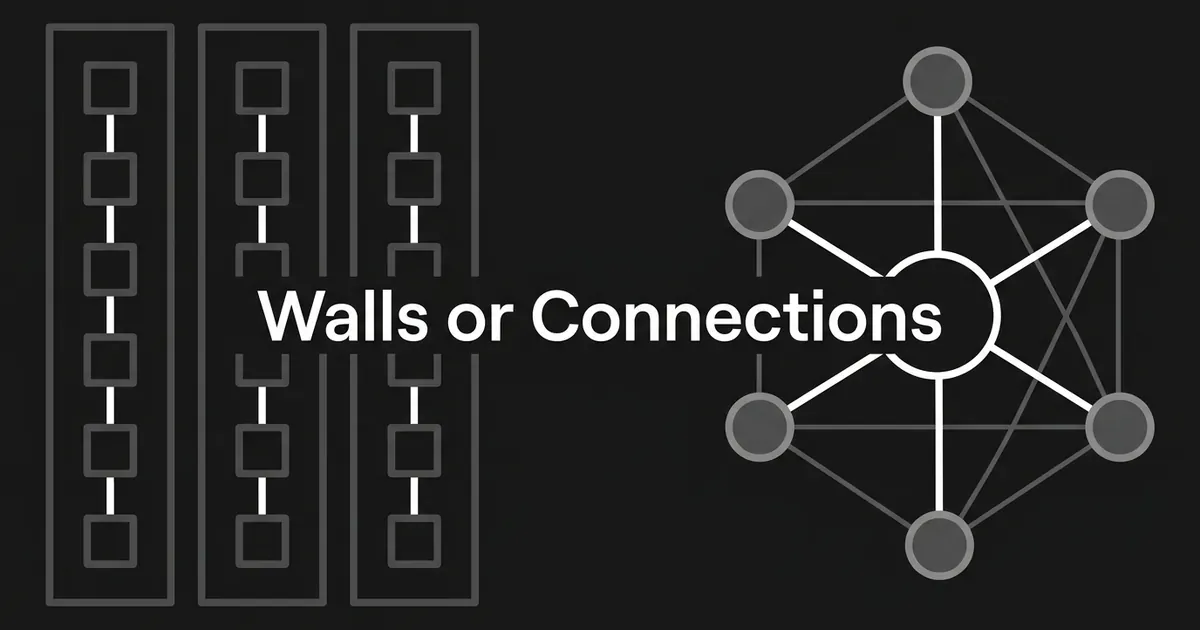
The choice between topic clusters vs silos is usually presented as a technical preference. It is closer to an editorial one. A rigid silo keeps each subject in its own room and refuses links across the walls. An interlinked cluster gives a subject a broad hub, a set of specialised pages beneath it, and permission to connect related pages wherever the connection is genuinely useful. Both impose order. They differ in what they do at the boundary, and that difference is what shows up when an answer engine goes looking for a page to cite.
The recommendation, stated up front: for most marketing-led sites, an interlinked topic cluster model built on a clear hierarchical spine is the better default, with rigid separation kept for subjects that are genuinely distinct. That recommendation does not rest on any announced preference from Google, OpenAI, or Perplexity. None of them publishes one. It rests on the conditions those engines do document, which favour pages that are crawlable, discoverable through links, indexed where the engine requires it, and connected to related content by descriptive anchor text.
The decision in one table
| Criterion | Rigid SEO silo | Interlinked topic cluster |
|---|---|---|
| Organising logic | Self-contained topical sections | A broad pillar plus specialised pages on related subtopics |
| Internal links | Concentrated within the section; strict versions prohibit cross-silo links | Pillar to spoke and back, plus contextual links between related pages |
| Navigation | Predictable and easy to govern | Hierarchy retained, with a richer contextual layer on top |
| Crawl discovery | Works when every important page is reachable through crawlable links | More internal paths, when the links are implemented correctly |
| Relevance context | Concentrated inside each section | Relationships made explicit across related questions |
| Topical authority | Depth inside a narrow subject | Breadth plus depth, and multiple search intents, easier to represent |
| User journey | Readers may return to search for adjacent information | Related information reachable without leaving the site |
| Main risk | Artificial walls, orphan pages, lost cross-topic context | Content bloat, duplicate intent, thin supporting pages |
| Best fit | Distinct products, departments, regulatory subjects | Interrelated topics and multi-stage buying journeys |
The winner is conditional. Framed as SEO silo vs topic cluster, the answer turns on how separable the subjects are. Silos win on containment and governance. Clusters win as the default wherever subjects overlap, journeys run across several stages, and the team is trying to close coverage gaps rather than simply add pages.
Topic cluster architecture
A topic cluster is a group of interlinked pages centred on an umbrella subject. It has three parts: a pillar page giving a broad overview of the main subject, cluster pages answering specific subtopics, questions, use cases, or stages of intent, and the internal links that connect them in both directions.
The model is hierarchical in subject scope, but it is not closed. Pillar and spoke describe the relationship between broad and narrow coverage. They do not require every spoke to be sealed off from every other cluster. A well-built cluster can preserve a clean category and funnel structure while permitting a relevant bridge to an adjacent topic.
Four things a topic cluster architecture does well:
- It maps broad and granular intent. The pillar orients the reader while spokes handle specific questions, which suits a subject that has informational, comparison, and decision-stage needs at the same time.
- It exposes relationships. Links from pillar to spoke and back state an explicit relationship between a broad topic and its supporting evidence. Contextual links between related spokes surface an adjacency that a rigid boundary would conceal.
- It creates more discovery paths. A page becomes reachable from navigation, from the pillar, and from related spokes. More paths do not guarantee crawling or citation, but they reduce dependence on a single menu route and make orphaned pages easier to spot.
- It supports a connected journey. Readers can move from overview to detail, and from one related question to the next, without returning to a results page.
What the model does not do is more important to state plainly, because this is where cluster advocacy usually overreaches. A cluster does not guarantee that any engine will crawl, index, rank, or cite a page. A pillar does not transfer authority mechanically to the spokes beneath it. Internal links do not make thin or duplicated content valuable, and thirty near-identical pages are a liability rather than evidence of expertise.
The failure modes are specific and worth recognising early. Content bloat, where several pages chase nearly the same intent and dilute one another. Pillar overload, where the hub tries to answer every detail and stops working as an overview. Orphaned spokes, published but never linked from an existing relevant page. Stale connective tissue, where links point at pages that were removed or redirected. Artificial symmetry, where every page links to every other page whether or not the link helps. Each of these is a maintenance problem, and each has the same mitigation: distinct intent per page, links placed where they help a reader, and periodic review of the map against the live site.
SEO silo structure
Siloing groups pages by topic into self-contained sections. In the strict version, pages inside a topical silo link to one another while the silos themselves remain isolated and do not link across. The defining rule is the boundary, not the mere existence of categories or folders. SEO practice distinguishes a physical silo, expressed in the site's information architecture, from a virtual silo, created mainly through internal-linking rules.
A content silo structure is not automatically the wrong answer. It makes a large site easier to govern, since a team can assign one owner, one taxonomy, and one editorial standard per section. It concentrates subject context, keeping pages on a narrow subject closely related. It gives predictable navigation, which matters when a reader already knows the category. And it genuinely suits subjects that are separate in reality: different audiences, different legal constraints, different product owners.
The cost sits entirely at the boundary. In the strict model, cross-topic links are prohibited, and that is the central trade-off in any SEO silo vs topic cluster decision. When two subjects overlap in a real buyer journey, the rule prevents the most useful link from being placed exactly where a reader needs it. Semrush frames the consequence in commercial terms: a visitor who cannot reach the adjacent page from the site may return to the search results and choose a competitor instead.
Isolation also creates orphan risk. A page with no useful path from outside its own narrow section is harder for people and crawlers to find and harder to contextualise, and the risk rises whenever navigation changes or linking rules are applied mechanically. Duplication follows close behind, since the simplest way to avoid a forbidden cross-link is to write the same concept twice in two silos.
One clarification matters more than it looks. A URL folder is not evidence of a topical relationship. Google's own guidance says it generally does not use URL structure by itself to work out a site's structure, which means navigation, crawlable links, and page content carry the weight. A content silo structure expressed only in the URL path, without the links to match, is a diagram rather than an architecture.
Crawlability and answer-engine traversal
It is tempting to describe an answer engine as crawling a whole cluster at answer time and following the pillar to the right spoke. No engine documents that behaviour, and the article does not need it. The defensible model is a pipeline with six stages, and architecture only touches two of them.
- Access. The relevant crawler must be permitted to fetch the page. Robots rules, CDN rules, hosting controls, authentication, and JavaScript blocking all affect this.
- Discovery. Pages need discoverable paths. Google uses links both as a relevance signal and to find new pages, and its navigation guidance recommends making important pages reachable through site navigation.
- Processing and indexation. For eligibility in Google's AI features, a page must be indexed and eligible to appear in conventional Search with a snippet. Eligibility is not a promise of crawling, indexation, serving, or citation.
- Interpretation. Important information needs to be in textual form, structured clearly, and connected to related content by descriptive, relevant anchor text.
- Retrieval and answer construction. The engine selects pages relevant to the question and may combine information from several searches. The selected page has to be useful and credible for the specific claim, not merely well connected.
- Attribution. The answer may show a source link. Citation selection varies by engine, model, query, time, and answer format.
Architecture influences stage two and stage four. It does very little at the others, which is why neither model wins automatically and why a blocked or unindexed page loses under both.
The link baseline is worth stating exactly. Google generally follows a link when it is an HTML anchor element with an href attribute resolving to a real address. Links that exist only as click handlers or script events are not a dependable substitute. Anchor text should be visible, descriptive, reasonably concise, and relevant to both the source and the destination, which rules out generic labels and keyword stuffing alike. Every page that matters should have at least one internal link from another page. A topic cluster makes that baseline easier to operationalise, because hub and spokes are expected to be connected. A strict silo can meet it too, but the boundary rule raises the chance that a useful page has no relevant path from outside its section.
Access is also engine-specific, which the architecture debate tends to skip. OpenAI documents OAI-SearchBot for surfacing sites in ChatGPT search results, GPTBot as a separate crawler for content that may train its foundation models, and ChatGPT-User for certain user-initiated visits. The controls are independent, so allowing search crawling while disallowing training crawling is a real option. Perplexity documents PerplexityBot and its own robots controls separately. Permitting Googlebot does not make a page available to Perplexity, and a Perplexity citation is not governed by the Google index alone. Any site architecture for AI search that ignores per-engine access rules is solving the second-order problem while the first-order one remains open.
Topical authority and search intent
Topical authority is a useful editorial description of breadth, depth, expertise, and relationships across a subject. It is not a switch a site flips by choosing one architecture over the other, and no engine publishes it as a ranking factor.
Each model makes something visible. A cluster makes topical coverage visible by connecting a broad subject to distinct subtopics and intents. A silo makes topical ownership and boundaries visible by keeping related pages together. Both support understanding when the pages are useful and the relationships are accessible. Neither creates authority from page count.
The safe claims are narrow and hold up: connected, relevant pages make it easier for people and crawlers to discover related content; descriptive internal links carry relationship and context; a well-maintained cluster covers more distinct questions without forcing one page to answer everything; a focused silo makes a discrete subject easier to govern; and weak, duplicated, inaccessible, or stale pages undermine either model.
Where the cluster model earns its default status is intent coverage. A subject with awareness, consideration, and decision-stage questions needs pages at each stage, and Google has said its AI features may use query fan-out, issuing multiple related searches across subtopics and data sources. That behaviour rewards a site with useful, answer-ready pages across a subject rather than one page attempting all of it. It is not proof that clusters are preferred. It is a reason the connected model tends to fit what the engines are documented to do.
What the AI citation evidence actually supports
No source establishes an AI-citation rate for a rigid silo against an interlinked cluster under otherwise identical conditions. That comparison has not been run publicly, and any article presenting a percentage lift for one architecture is reporting something that was measured elsewhere.
The GEO research on generative engine optimisation is the most-cited study in this area, and it is worth reading for what it did test rather than what it is quoted as proving. Its benchmark contains ten thousand queries across twenty-five domains, and it evaluates content and presentation interventions: adding citations, quotations, statistics, changes in fluency, authoritative tone, technical terms, keyword stuffing. Citing sources, adding quotations, and adding statistics produced the strongest reported improvements on its visibility measures. The study does not test topic clusters, SEO silos, URL folders, internal-link graphs, or any site-architecture change. Its results also vary by query and by position, with some style changes measuring negative at some ranks.
The honest reading is that citation-ready content, credible source presentation, and relevance affect generative-engine visibility. Architecture is not what that evidence measures.
Industry guidance is similar. Wix and Siteimprove describe the pillar-and-spoke mechanics, and Semrush recommends loosening strict silo rules in favour of natural links and topic clusters. These support the mechanics and the trade-offs. They are not controlled benchmarks, and the traffic examples they cite do not isolate architecture or measure AI citations at all.
Three claims are therefore worth avoiding: that Google rewards topic clusters as a ranking factor, that AI engines traverse a pillar before citing a spoke, and that a rigid silo prevents citation. A page inside a strict silo can be cited. It needs access, crawlable discovery, indexation where the engine requires it, relevant content, and a reason to be selected for that particular answer. The limitation is strategic rather than absolute: an isolated page has fewer discovery paths and less contextual support for related questions.
The hybrid most sites should actually run
Two words do most of the damage in the topic clusters vs silos debate, and separating them resolves it. Hierarchy answers where a page sits in the subject and the navigation. Isolation answers which useful pages that page is forbidden to link to. Silo advocacy tends to treat them as the same thing. They are not, and a site can keep a hierarchical menu, a clean URL convention, and clear ownership while adding contextual bridges between related topics.
That hybrid is the operating model worth recommending: a clear hierarchy for menus, categories, breadcrumbs, and ownership, pillar-and-spoke coverage within each subject, and only the cross-subject links that help a reader understand a genuine relationship. It preserves the silo's governance advantage and removes the walls that isolate overlapping information. It is a practical recommendation rather than an official rule, and it should be presented that way.

Structured data fits the same pattern. It can help search systems understand what a page is for, but Google states that no special schema is required for its generative features, that content does not need to be broken into tiny pieces, and that no special AI text or Markdown files are needed for eligibility. Structured data should agree with visible page content. It does not substitute for accessible prose and crawlable links.
DeepSmith for measuring and closing citation gaps

Architecture is a decision a team makes once and then has to live with. What usually goes missing afterwards is evidence: whether the pages in the map are being cited, which topics are thin, and which competitor pages are winning the answers the team wanted. DeepSmith is the measurement and production layer for that, not a third architecture model.
On the measurement side, AI Visibility reports Mention Rate, Citation Rate, Share of Voice, Sentiment, and Visibility Trend, broken down per platform, with prompt-level results, page-level citation attribution, and a view of the sources AI engines cite most. Citations attach to specific pages, which is the granularity an architecture decision needs: a cluster is working when its spokes earn citations for the prompts they were written for, and that is visible rather than inferred. Ten engines are covered across the tiers, with Pro tracking ChatGPT, Grow adding Perplexity, Scale adding Gemini, and Enterprise and Custom covering all ten.

Content Map is the part that speaks directly to the architecture question. It crawls and classifies every page on the site onto a granular topic taxonomy and a funnel stage of Awareness, Consideration, or Decision, then maps competitor sites onto that same taxonomy so comparisons are like for like. Per-topic depth shows page counts and funnel distribution, which is how a team sees whether a topic is thin, top-heavy, or missing its decision-stage pages. Coverage gaps show topics where a competitor publishes more; untapped topics show where a competitor publishes and the site has nothing. Sitemaps are re-checked every 24 hours and new pages fold in automatically.

From there, Opportunity Agents read that data and return ideas with the justifying data point attached, including agents for building topical authority on a chosen topic and for growing awareness, consideration, or decision-stage coverage. Content Studio takes an idea through New Ideas, Planned Content, the Writer, and Produced Content, and the writing pipeline scans the enriched sitemap and inserts strategically placed internal links during generation rather than leaving them as manual work afterwards. Autowrite runs the whole thing on a scheduled date with nobody in the app.
The scope limit is worth naming. DeepSmith measures and produces; it does not restructure a site, override robots controls, or make a blocked page crawlable. A team that only wants a taxonomy diagram, or that needs strict information governance with no measurement or production attached, does not need the platform. That is a scope difference rather than a shortcoming. The plan caveat is engine coverage: Pro, Grow, and Scale do not track all ten engines, so a team that needs all ten belongs on Enterprise or Custom. For most teams the constraint does not bite, because ChatGPT and Perplexity are where the majority of buyer research starts, and both are covered from the Grow tier.
Which architecture to choose
Choose interlinked topic clusters when the site covers one market with multiple related buyer questions, when the journey runs from education to comparison to decision, when products and use cases naturally overlap, and when the goal is to find coverage gaps and connect them to production. This is the default for most marketing-led sites.
Choose a rigid silo when subjects are genuinely separate and cross-links would confuse readers, when different teams, audiences, permissions, or regulatory requirements demand hard boundaries, or when governance is immature enough that a temporary boundary is safer than indiscriminate linking. Even then, the boundary should be tested against the reader's task rather than defended on principle.
Choose the hybrid for most established sites: hierarchical navigation and ownership, cluster coverage within each subject, selective contextual bridges across subjects. As a site architecture for AI search, it is the version that satisfies both the governance case and the discovery case.
Choose DeepSmith when the constraint is not the diagram but the evidence and the execution behind it: citation measurement per page and per prompt, competitor page visibility, topic and funnel gap analysis, internal linking built into production, and scheduled publishing in one workflow. A seven-day free trial gives real visibility data and real drafts before any commitment, with no long-term contract. Start a free trial.