You have a keyword list. It is long, it is sorted by volume, and it still doesn't tell you which page should exist.
That gap is what a topic cluster map fixes. A keyword list names phrases. A map names pages, and it gives each page a job, a reader, a buyer stage, and a boundary. It is the difference between a spreadsheet and a plan someone can actually write from.
This guide walks you through seven steps to build one from scratch, using a pillar and spoke architecture. By the end you'll have a pillar topic, a spoke set, a scope line for every page, and a map a writer can pick up without asking you a single question. If you've been searching for how to build a content cluster and kept landing on vague advice about "covering a topic thoroughly," this is the version with the actual steps in it.
One thing this guide leaves out on purpose: how to wire the pages together with internal links. Anchor text and link mechanics are their own job, and doing them well starts with knowing what pages exist. That's what we're building here.
1. Set the boundary before you touch a keyword tool
Here's the move almost nobody makes first, and it saves the most rework: write one sentence describing the cluster before you collect anything.
Use this shape. "For [audience], cover [bounded topic] so they can [outcome], supporting [business purpose]."
That single sentence does four things. It names one audience. It names one central problem. It names a business reason the topic belongs on your site at all. And it draws a line, so you can tell what belongs in the cluster and what doesn't.
Where does the raw material come from? Real buyer questions. Sales-call language. Support tickets. Your product documentation. Interviews with the person on your team who actually knows the subject. Search demand matters, and it is not the only input. The topic also has to fit what your site is for and what your reader needs.
Done when: someone outside the project can read your sentence and correctly sort five random topic ideas into "in" or "out."
Common mistake: starting with a giant industry label like "marketing" or "AI" and collecting every related term you can find. That gives you a taxonomy. It does not give you a cluster. Content cluster planning that starts too wide never finds its edges, and you end up with a list nobody can finish.
If you're feeling behind here, take a breath. This step takes twenty minutes, and it is the cheapest twenty minutes in the whole process.
This is also where stored brand context pulls its weight. DeepSmith's Deep IQ keeps your company positioning, products, buyer personas, goals, triggers, and challenges as structured records, so the boundary you write reflects your real audience instead of generic keyword ideas. It informs your judgment. It doesn't replace it.
2. Choose a pillar topic that is broad but bounded
Your pillar is the page that explains the topic at a high level and points the reader to depth. Picking it well is mostly about resisting two temptations: going too big, and going too small.
Run the candidate through three checks.
- Audience fit. Would your intended reader find this useful if they came straight to your site looking for it?
- Business fit. Does the topic connect naturally to your purpose, your expertise, or your product?
- Search potential. Is there evidence people actually search the topic or the questions around it?
A useful rule of thumb from the SEO world: look for roughly 10 to 20 plausible subtopics. Treat that as a starting heuristic, not a rule. It is not a Google threshold, and it is not a quota. A narrow subject can be well served by fewer pages. A subject with many genuinely distinct intents can carry more.
Done when: you can describe the pillar in one sentence, defend why your site should own it, and say out loud what the pillar will cover and what it will hand off to spokes.
Common mistake: picking a topic because the volume looks good, without asking whether you have a credible reason to cover it or whether it's too broad to serve one reader.
Pro tip: don't define your pillar by word count. Google says it has no preferred word count. A pillar is finished when the reader gets the framework they need and can see which page answers their next question. That's the test, not a number.
3. Gather the question universe, not just the keyword list
Now you collect. The goal is a raw pool of candidates, wide enough that you're choosing from real options rather than defending your first three ideas.
Pull from several angles on purpose:
- Head terms and broad topic phrases
- "What is" and definition questions
- How-to and implementation questions
- Problems, symptoms, and troubleshooting questions
- Comparisons and alternatives
- Tools, templates, examples, and checklists
- Cost, risk, and compliance questions where they apply
- Buyer-stage questions, from first learning through final evaluation
- Anything you hear repeatedly in customer conversations
Record where each idea came from. You'll want that later when someone asks why a page is on the list.
Done when: every candidate carries the question or term, its likely intent, its audience, its buyer stage, and one line on why it belongs. Notice the shape of that list. It's questions, not just keyword variants. That shift, from phrases to questions, is most of what separates good content cluster planning from a keyword export.
Common mistake: treating every spelling variation and modifier as its own page. A different phrase is not automatically a different intent, and this is where most bloated maps go wrong.
Two DeepSmith modules do real work at this step. Content Map crawls your site and your competitors' sites and classifies every page onto a shared topic taxonomy and a funnel stage, so you can see which topics you cover thinly, which are top-heavy, and which you have nothing on at all. Opportunity Agents then read that data and return ideas with the evidence attached, naming the specific competitor page or coverage gap that justifies each one. That turns coverage data into candidates. Deciding which questions your reader actually needs answered is still your call.
4. Group candidates by intent, not by wording
This is the step that decides how many pages you end up with, and it's the one people rush.
For every pair of candidates, ask one question: would a searcher be satisfied by the same page? Group them when the answer, the format, and the underlying task are substantially the same. Split them when the reader wants a different answer, a different depth, a different format, or is at a different stage.
There's a practical check you can run alongside your judgment. Compare the ranking results for two candidate queries. Semrush's clustering method compares the top 10 organic results for each keyword and groups terms when the same URLs keep showing up. Overlapping results are evidence that the queries share intent. They are not proof, and they vary by location, device, and time.
Here's a table you can use as you sort.
| What you see | Likely map decision |
|---|---|
| Same question, same desired outcome | One page, or one section of one page |
| Same topic, different task or format | Separate spoke candidates |
| Different buyer stage | Usually separate pages, or clearly separate sections |
| Results overlap substantially | Test as one page, then check audience and scope |
| Results differ materially | Treat as separate intents |
| Only the wording differs | Do not create a page |
Done when: every candidate is assigned to a page, a section, or an explicit parking lot. No two planned pages share a primary question and outcome.
Common mistake: grouping on semantic similarity alone. Two phrases can share most of their words and still need different pages. The reverse happens too: wildly different wording, same task.
One more caution. If your tool gives you an average difficulty score for a group, look at the primary term on its own before you prioritize. An average can hide one much harder term sitting inside a friendly-looking cluster.
5. Give every spoke one job and one boundary
Now turn each surviving intent group into a candidate page with a single job. This is the heart of a pillar and spoke architecture: the pillar orients, and each spoke goes deep on exactly one thing.
A balanced starting set often includes:
- Foundational definition and concept pages
- Core process and how-to pages
- Problem-solving and troubleshooting pages
- Method, framework, or template pages
- Use-case or audience-specific pages
- Comparisons and alternatives for people evaluating options
- Decision, implementation, cost, or risk pages where the topic warrants them
Don't force every cluster to have every type. The page set should follow the subject's real shape.
For each candidate, write one scope sentence:
"This page will help [audience] do, decide, or understand [specific outcome] by covering [boundaries], and it will not cover [adjacent topic]."
That last clause is the one that earns its keep. Exclusions expose overlap before anyone writes a word.
Done when: every spoke has one primary question, one outcome, one audience, one intent, and a stated in-and-out boundary. The pillar and every spoke have jobs that don't collide.
Common mistake: spokes that are too thin, one per tiny keyword variation, or too broad, so the spoke quietly duplicates the pillar. Both are fixable now and expensive to fix after production.
Common mistake to watch for: turning every related keyword into a new URL. If two queries need the same answer, they are one page. Save separate pages for genuinely different tasks.
DeepSmith's Opportunity Agents can help you pressure-test this set. There are agents for building topical authority on a chosen topic, for growing awareness, consideration, or decision-stage coverage, and for closing the gap against specific competitors. Each idea arrives with the data point that justifies it, so you can defend the backlog rather than guess at it. You still pick the angle and approve the scope.
6. Label every page with a stage and a priority
Every page on your map gets a funnel stage. Not because Google uses these labels, it doesn't, but because they reveal what your plan is missing.
- Awareness: definitions, fundamentals, symptoms, problem framing.
- Consideration: methods, use cases, comparisons, evaluation criteria.
- Decision: implementation, requirements, costs, risks, product evaluation, next steps.
Your cluster does not need an equal count at each stage. What the labels tell you is whether the plan is top-heavy with definitions, missing the decision support a buyer needs, or trying to sell before it has taught anything.
Then add a priority and, more importantly, a written reason. Weigh audience importance, business relevance, evidence of demand, the competitive gap, urgency, and how much effort the page takes. Keep the reasons in the map. Resist inventing a numeric scoring formula unless your team genuinely wants one and will document it.
Done when: every page has a stage, a priority, a rationale, and a place in the sequence.
Common mistake: calling every page "top of funnel" because it's informational, or slapping "Decision" on a commercial page that never gives the reader what they need to decide.
Ask two QA questions here. If the pillar is the only page someone reads, do they understand the topic? And if a reader wants depth, can your team point at the exact spoke that answers their next question?
Coverage is also something you can measure rather than estimate. DeepSmith's Content Map breaks your coverage of a topic down by buyer stage and lists the specific pages sitting at each one, so a gap in your decision-stage coverage shows up as a number instead of a hunch.

7. Draw the map, stress-test it, then hand it off
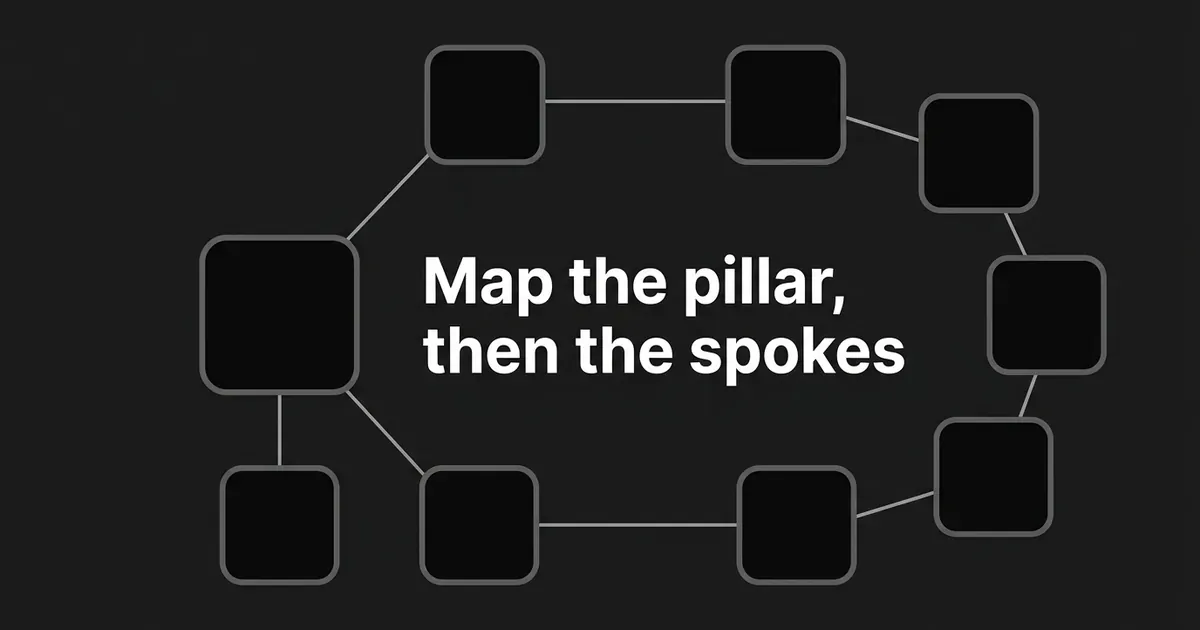
Time to put it on a page. Pillar at the center or the top. Spokes grouped around it by intent and stage.
Use two artifacts, not one. A table is your source of truth, because it's the thing a writer executes and an editor audits. A diagram is your communication layer, because it's what gets a plan approved in a meeting. Generate the diagram from the table so they never drift apart.
Here's the field set for the table. One row per proposed page.
| Field | What to record |
|---|---|
| Page type | Pillar, how-to, definition, comparison, use case, template, or another justified type |
| Working title | A clear label, not necessarily final copy |
| Primary question | The one question this page must answer |
| Secondary questions | Closely related questions that fit the same intent |
| Intent | Informational, problem-solving, evaluative, comparative, or decision-oriented |
| Funnel stage | Awareness, Consideration, or Decision |
| Audience | Who needs this page |
| Outcome | What the reader can do or decide afterward |
| Scope in | What the page covers |
| Scope out | What it deliberately leaves to another page |
| Evidence | Customer language, expert input, search evidence, or product context |
| Business relevance | Why this page matters to your organization |
| Priority | High, medium, or low, with the reason written down |
| Status | Candidate, approved, planned, in production, or parked |
| Owner | Who reviews it for subject accuracy |
| Freshness need | Whether the topic changes, and how you'll maintain it |
Before anything goes into production, run the map through these checks:
- The pillar has a precise one-sentence promise.
- Every spoke has a distinct primary question and outcome.
- Every candidate sits inside the pillar's boundary.
- No two pages target the same searcher task.
- The set covers the important questions, not just the easy keywords.
- Stage labels are explicit where they matter.
- Every page has a scope, exclusions, format, priority, and owner.
- Nothing depends on hitting a page count or a word count.
- Claims that need expertise or current data have a source or an owner named.
- Every page would be useful on its own, not filler added to make the cluster look bigger.
Done when: a writer can pick any row and know what to write, for whom, why it exists, how deep to go, and how it differs from its neighbors. And you can defend every row that's in, plus every one you left out.
Common mistake: treating the diagram as finished because it looks tidy. A neat map can still hide duplicate intent, a missing decision page, or a pillar that's quietly too broad.
From here the map hands off in two directions. It goes to production, where the rows become briefs and drafts. And it goes to the linking workflow, where the pages get wired to each other. That second handoff is a separate job with its own rules, and your map is what makes it possible.

DeepSmith's Content Studio is built for the first handoff. An approved idea moves through New Ideas to Planned Content to Produced Content, and giving an idea a date is what plans it. Autowrite can then generate a configured article on its scheduled date, grounded in the same stored persona, voice, and content-type context. The map decides what gets written. The platform handles the moving of it.
Know what topic clusters for AI search can and can't do
Let's be straight about this part, because a lot of advice out there isn't.
Google's own guidance on AI features is less magical than the AEO conversation suggests. The same foundational SEO practices apply to AI Overviews and AI Mode. There are no additional technical requirements and no special AI markup or structured data type needed just to appear. A page has to be indexed and eligible to show in Search with a snippet to be eligible as a supporting link. Meeting all of that still doesn't guarantee crawling, indexing, serving, or inclusion.
Google also says AI Overviews and AI Mode may use query fan-out, running several related searches across subtopics and data sources before assembling an answer. The two features can return different responses and different links, because they use different models and techniques. AI Overviews don't trigger for every query either.
So what does that mean for your map? Something real, just modest. A well-scoped cluster gives you multiple useful pages addressing related subquestions, which is a sensible way to prepare for a search experience that explores subtopics. Thinking about topic clusters for AI search is worth doing. Promising that a cluster forces an engine to cite you is not. Citation selection stays outside your control.
Build for the reader first. Then check the ordinary hygiene: nothing blocking crawling, important content available as text, a good page experience, structured data that matches what's visible, and the words your readers actually use in your titles and headings. Your map doesn't need an "AI-only" page type. It needs pages worth citing.
One more caution while we're here. Generative AI can help you research and structure content. Producing many pages that add nothing can run into Google's scaled-content-abuse policy. Volume without value is a risk, not a strategy.
Your next step
Pick one cluster. Just one.
Write the boundary sentence. Choose the pillar. Collect the questions, group them by intent, give every spoke a job and a stage, and put it in a table. That's how to build a content cluster a team can actually execute, and it's a week of thinking that saves a quarter of wasted drafts.
Your topic cluster map is a living document, not a deliverable you file away. Questions change, competitors publish, and a row you parked in March can become your highest priority in June.
Then brief the pillar and your two highest-priority spokes, and let the map be the source of truth for everything that follows.
If you want the evidence and the production in one place, start a DeepSmith free trial. Seven days, real data and real drafts, no long-term contract. Bring your map and see what comes back.
You're closer to this than you think. One cluster is enough to start.