You open the AI draft and it's fine. The structure holds, the grammar is clean, and every paragraph could belong to any company in your category. That flat, interchangeable quality is the reason AI writing sounds robotic to your readers, and no app fixes it for you. This guide gives you a seven-step manual edit that lets you humanize without a tool, built for marketing leads who want the speed of an AI first pass without publishing something forgettable.
Here's the short answer. You do not need a humanizer app to make AI text sound human. Make the draft specific to one real reader, swap vague claims for details you can verify, vary the rhythm, cut filler and lazy hedges, add a real point of view, then read it aloud and check the facts. That sequence is how you humanize AI writing, and it works on any draft from any model.
One thing to settle first: sounding human is not the same as sounding casual. It isn't slang, it isn't fake typos, and it is definitely not tricking a detector. Natural writing is clear, specific, aimed at somebody real, and shaped by a person who made choices. That's the whole game.
Step 1: Set the reader, the job, and the angle before you touch a sentence
Before you edit a single word, write yourself a one-sentence edit brief. Five fields, two minutes, done privately in a notes app.
- Reader: who is actually trying to solve this problem?
- Job: what does this article help them do?
- Angle: what's the specific point of view here, not the topic summary?
- Proof: which real examples, product facts, or expert perspectives can back it up?
- Voice: which three or four qualities should the prose hold throughout, like direct, practical, warm, or precise?
Why does this come first? Because most generic drafts aren't a word problem. They're a thinking problem. The model didn't know who it was writing for, so it wrote for everyone, which reads as writing for no one.
Try it on the opener. Something like "AI is changing the way businesses create content" says nothing to anybody. Something like "If your AI draft is structurally sound but could belong to any company, edit the argument before you edit the adjectives" has a reader and a stance. That's an illustration, not a data point, but you can feel the difference.
You're done when: your opening can name who the piece is for and what they'll be able to do. Every section has a job you can state out loud.
Common mistake: hunting for better synonyms before deciding what the article means. A polished sentence with no defined reader still reads as filler.
Step 2: Mark the generic lines before you fix any grammar
Read the whole draft once and fix nothing. Your only job on this pass is to mark. Highlight anything that could sit on a competitor's site unchanged, any claim with no visible support, any conclusion the draft already made once, and any passage that explains a topic without giving the reader a decision or a next move.
Then label each highlight with one of four words: keep, cut, prove, rewrite.
Five things worth marking every time:
- A broad claim with no named audience, situation, example, or consequence.
- An introduction that circles the runway before it lands the answer.
- A paragraph that restates familiar information without adding an angle.
- A confident product or performance claim nobody has checked.
- A run of sentences that all open the same way.
This is a quick diagnosis, not a hunt for banned phrases. You're looking for the places where the draft has no reason to exist.
Pro tip: do the argument pass before the word pass. If a paragraph has no reader, no detail, and no point of view, polishing its adjectives will not make it human.
You're done when: every paragraph has a purpose you can name, and every highlighted line has a plan attached to it.
Common mistake: asking a tool to make the whole draft "more human" before you decide which ideas deserve to survive. That changes the surface wording and keeps the generic thinking underneath.
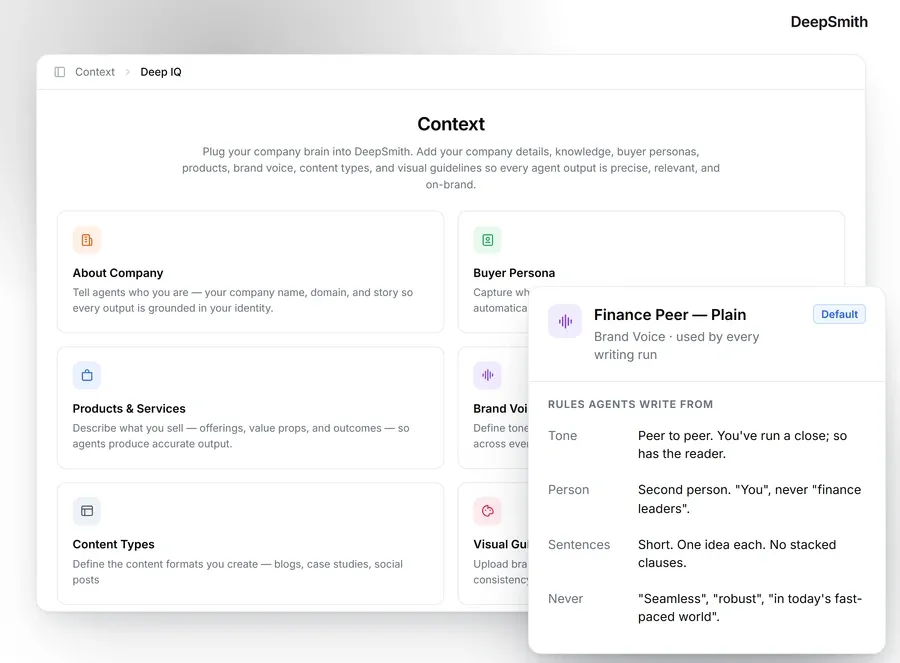
If your drafts keep arriving generic, the fix might sit upstream of the edit. A model writes vague copy when it has nothing real to work from: no product detail, no persona, no voice rules. Deep IQ, DeepSmith's brand context layer, stores that once as structured records: positioning, differentiators, claims to make and claims to avoid, buyer personas, brand voice, and content-type templates. Every draft the platform writes is grounded in those records instead of a fresh brief. It doesn't replace your judgment. It just means you spend the edit on the argument instead of correcting the same product facts every week.
Step 3: Replace abstractions with specifics you can verify
Here's where a draft starts to sound like a person. For every claim that matters, ask five questions: who exactly, in what situation, doing what, under which constraint, with what observable result?
Then run the specificity pass:
- Underline the abstract nouns. Success, innovation, efficiency, quality, impact, authenticity. They're easy to spot once you look.
- Ask what the reader would actually see, do, measure, or decide.
- Add one or two details that answer it.
- Verify those details. If you can't verify them, cut them or label them clearly as an illustration.
- Ask someone who knows when you don't. A five-minute question to a support lead beats an hour of guessing.
Watch what this does. "Marketing teams often struggle to keep content consistent" is a sentence anyone could write. "A team can have a useful style guide and still produce drafts that use three different names for the same product" is a sentence written by someone who has seen it happen. Same idea, completely different credibility.
Be selective here. You don't need a number attached to every sentence. One true detail does more work than five adjectives.
You're done when: each major section holds at least one detail that couldn't have been written correctly without understanding the reader's situation. Every statistic, date, quote, name, and product capability is either verified or gone.
Common mistake: inventing a customer story, an expert quote, or a personal memory to make a paragraph feel lived-in. A fabricated anecdote isn't human texture. It's a quality failure that costs you trust the moment someone checks.
This step is also where the manual work around the article gets expensive. Research, internal linking, external sourcing, cover images, metadata: none of it makes the piece sound more human, and all of it eats the hours you'd rather spend on the argument. DeepSmith's Content Studio runs that production layer, with the Writer handling research, planning, internal links against your sitemap, external links to your trusted sources, a cover image, and publish-ready metadata, with depth, length, and link counts set per article. The editorial judgment stays yours. The chores don't have to be.
Step 4: Vary the rhythm so the page stops sounding flat
Now look at shape. Scan your sentence lengths and your sentence openings before you read for meaning. If most sentences run the same length and start the same way, you've found a big part of why AI writing sounds robotic to a reader who can't quite explain why.
The moves that fix it:
- Break up several sentences in a row that share the same subject-verb pattern.
- Move openings away from "This," "It," and "There" toward the actual actor or idea.
- Use active voice when naming the actor makes the sentence clearer.
- Keep one main topic per paragraph.
- Reach for a heading, list, or table when the reader is comparing things or following a sequence.
- Read the paragraph out loud. Repeated beats and breathless clauses are far easier to hear than to see.
Use sentence-length guidance as a diagnostic, never as a rule. Plain-language guidance from the U.S. Office of Personnel Management puts the average around 15 to 20 words. The Australian Government Style Manual suggests an average near 15 words and a ceiling of 25 for digital content. Those are tools for finding dense passages, not a demand that every sentence match.
Here's a flat passage: "AI drafts are fast. AI drafts are useful. AI drafts are often generic. Editors need to add context." Now here it is with a pulse: "AI drafts are fast and often useful. They're also generic when the brief contains no real context. That's the editor's job: add the details the model didn't know."
Short sentence for emphasis. Longer one for reasoning. A direct instruction when the reader needs to act. That's the pattern, and it's most of what you need to edit AI to sound natural.
You're done when: the section scans easily, the important sentence carries emphasis, and the rhythm changes for a reason instead of at random.
Common mistake: making every sentence short. Uniformly clipped prose sounds just as mechanical as uniformly long prose, only more abrupt. Variation has to serve meaning.
Concision earns its reputation, by the way. Nielsen Norman Group tested five versions of the same website copy with 51 experienced web users, and the concise, scannable, and combined versions all measured better on reported usability than the promotional control, with the combined version far ahead. It's a small, older study about website tasks, so treat it as directional support for scannable writing rather than a law of prose.
Step 5: Cut the filler and make your confidence precise
This pass is fast and satisfying. Remove throat-clearing, redundant intensifiers, and anything that delays the verb.
Some swaps you'll make over and over:
- "It is important to note that" becomes nothing. Start with the point.
- "In order to" becomes "to."
- "Due to the fact that" becomes "because."
- "At this point in time" becomes "now," if you need the word at all.
- "Businesses can leverage" becomes the real actor and the real action.
- "It is recommended that" becomes a direct recommendation you own.
Then handle the hedges, and handle them carefully. "May potentially help" is padding. "May help when your bottleneck is a slow first pass" is an honest limit on a claim. The test isn't whether a qualifier exists. It's whether the qualifier names a real condition.
Common mistake: don't strip every hedge. Cut the vague ones, keep the ones that accurately describe uncertainty or scope, and make the condition explicit when you keep one.
Passive voice gets the same treatment. Switch to active when it matters who acted. Keep passive when the actor is unknown, irrelevant, or deliberately in the background.
You're done when: the paragraph reaches its point quickly, the verbs carry the meaning, and every remaining qualifier has a defensible reason to be there.
Common mistake: confusing confidence with accuracy. A shorter, punchier sentence is worse, not better, if it overstates what you can support.
Step 6: Add a point of view without performing a personality
This is the step people skip, and it's the one that matters most. Voice isn't decoration you sprinkle on at the end. It's the judgment a competent writer brings after understanding the reader's problem.
Say what matters and what doesn't. Name the trade-off the reader should notice. Tell them what you'd do first.
Ways to do it honestly:
- Prefer a clear verb over a corporate noun.
- Use "you" when speaking directly to the reader fits the piece.
- Add a useful opinion, not a decorative one, and explain why the recommendation matters.
- Name a real trade-off. Faster drafting isn't a win if review time climbs later.
- Show empathy for the reader's actual constraint without dramatizing it.
- Use contrast to make your angle visible: "Don't polish the generic paragraph. Replace it."
- Hold your brand's level of formality. Natural doesn't mean slangy.
- Add first-hand experience only where you or a named source genuinely has it.
Compare "Content teams should prioritize authenticity in their AI workflows" with "If the draft could belong to any competitor, stop polishing it and add the detail only your team would know." The second one has a spine. Somebody is clearly standing behind it.
This is also the honest answer to how you humanize without a tool. A person deciding what's worth saying is the part no app supplies, and it's exactly the part that makes AI text sound human.
You're done when: a reader could describe your stance in one sentence, and the prose sounds like the same person from top to bottom.
Common mistake: manufacturing personality with fake anecdotes, forced quirks, or borrowed internet slang. A short, honest explanation of what you know and don't know reads as far more human than an invented story.
Step 7: Fact-check, read it aloud, and run the publication pass
Split this into separate passes, because style edits are very good at hiding factual problems.
Pass A, meaning and evidence. Check the central answer, the audience, the logic, the examples, and every number, date, name, quote, product capability, and compliance statement. Cross-check against first-party or authoritative sources. Remove whatever you can't verify. Then ask the harder question: does this add analysis, or does it just restate what other pages already say?
Pass B, the read-aloud. Read the whole thing out loud at normal pace. Mark where you run out of breath, where you hear the same opening again, where you stumble, and where you lose the thread. Rewrite those lines. Read them again. This single pass catches more robotic rhythm than any checklist.
Pass C, voice and audience. Check tone, terminology, jargon, contractions, and examples against your reader and your brand rules. If a phrase sounds like a performance instead of a choice, cut it.
Pass D, mechanics and publishing. Grammar, punctuation, headings, lists, links, metadata, formatting. Confirm your key phrases appear naturally. Check the byline, and decide whether an AI-use disclosure is reasonable for your publication and your readers.
Google's own guidance is a useful backstop here. Using AI isn't automatically against Search guidelines, and it also earns no ranking advantage: the content is judged as content, on whether it's original, helpful, and made for people first. Google frames it as who, how, and why. Who created or reviewed this, how was it produced, and why does it exist. There's no preferred word count, and no special writing style reserved for generative AI features. Good editing improves usefulness. It doesn't guarantee a ranking or an AI citation, and any advice suggesting otherwise is selling you something.
You're done when: the article answers the question without sending the reader back to search, has no unresolved factual flags, reads smoothly aloud, carries a clear stance, and hands over a concrete next action.
Common mistake: treating a detector score as your final quality check. Detector scores measure the wrong thing. Reader trust, clarity, accuracy, and useful judgment are the actual bar.

Your editor's checklist
Keep this next to you on the next draft.
Before you edit: Who's the reader? What action should they take? What's the one-sentence answer? What does this draft know because of real product, customer, or subject-matter context? Which claims need a source? Which three voice qualities stay constant?
During the edit: Mark each paragraph keep, cut, prove, or rewrite. Replace the important abstractions with true specifics. Put the actor before the verb. Split overloaded sentences, join choppy ones. Vary openings and lengths. Delete filler and unjustified hedges. Add one useful opinion or decision rule per major section.
Before you publish: Does the intro answer the real problem fast? Does each section add something beyond a summary? Are all facts checked and all examples real or clearly labeled? Does it sound like one brand throughout? Does it read naturally aloud? Is it useful even if the reader never clicks another page?
What to do next
Take your next AI draft and run the sequence once, in order. Don't try to do all seven passes at the same time, because that's how the argument pass gets skipped and you end up rearranging adjectives again. Brief, mark, specify, rhythm, cut, voice, verify. The first article takes longer. By the third, most of it is automatic.
If the surrounding production work is what's really eating your week, that part can move off your plate. DeepSmith runs research, writing, internal and external linking, cover images, and publish-ready metadata inside one platform, grounded in your stored brand context, so your time goes to the angle and the judgment instead of the chores. There's a 7-day free trial with no long-term contracts, so you can see real drafts against your own context before you decide. Start a free trial and put the editing sequence in this guide on top of it.
You're closer than you think. Most drafts need one honest pass on the argument and one read-aloud, and they stop sounding like everybody else.