NeuronWriter and Rytr do different jobs. NeuronWriter analyzes the Google results for a keyword and scores long-form content against them, so it suits people who write articles meant to rank. Rytr drafts short marketing copy from templates in a voice trained on your writing, so it suits people who need quick copy at a low price. DeepSmith is a strong alternative when you want AI answer tracking, bulk planning and researched articles written on schedule from one plan.
If you are weighing NeuronWriter vs Rytr, the first thing to settle is what kind of writing you do most. Long articles that have to compete in search results need research into what already ranks, and NeuronWriter is built around that. Short ads, emails and product descriptions need speed and a steady voice, and Rytr is built around that. The two overlap less than the shared "AI writer" label suggests. This page compares them on pricing, features and fit, and it also covers where DeepSmith sits for teams that want research, scheduling and AI answer tracking together.
NeuronWriter vs Rytr: the short answer
- Choose DeepSmith if you want researched, publish-ready articles planned in bulk and written on their scheduled dates, with AI answer tracking on the same plan, from $99 a month with a 7-day free trial.
- Choose NeuronWriter if your work is long-form content that has to rank and you want term, heading and length guidance scored against the Google results, from $23 a month.
- Choose Rytr if your work is short marketing copy and quick drafts and you want a free plan, or $7.50 a month billed yearly, with a voice trained on your own writing sample.
| Criterion | DeepSmith | NeuronWriter | Rytr |
|---|---|---|---|
| Entry price (monthly billing) | $99/mo (Pro) | $23/mo (Bronze) | $0 (Free plan) |
| Entry price (billed yearly, per month) | $80/mo (Pro) | $19/mo (Bronze) | $7.50/mo (Unlimited) |
| Output at entry tier | 20 articles a month | 25 content writer analyses a month | 10K characters a month |
| Free trial or free plan | 7-day free trial | 7-day trial, no card | Free plan, no time-limited trial |
| Long-form generation | Yes | Yes, Gold and up | Partial |
| Brand voice | Yes | Partial | Yes |
| SERP-based content scoring | - | Yes | Not listed |
| CMS publishing | Yes | Yes, Gold and up | Not listed |
| Scheduled publishing | Yes | Not listed | Not listed |
| AI visibility tracking | Yes | Yes, 5 to 20 questions | Not listed |
| Bulk generation | Yes | Not listed | Not listed |
| Public API | Yes, read-only | Yes, Gold and up | Yes, usage-based |
| SOC 2 report | Yes | Not listed | Not listed |
| G2 rating | 4.8/5 | 4.4/5 | 4.7/5 |
Pricing and features as of September 2026, from each vendor's site and public reviews.
NeuronWriter

NeuronWriter is a content optimization editor built around the Google results. You enter a keyword, and it analyzes the top 10, top 30 or top-intent pages and turns them into suggested terms, entities, headings, questions and a live content score. Around that editor it adds AI drafting through Content Designer, templates and the Neuro assistant, plus internal link suggestions, plagiarism checks and schema generation. A smaller AI Visibility module monitors a set of questions for brand mentions and citations.
It is made for freelancers, small businesses and small to mid-sized agencies. The standout is the price for what it does. Plans run from $23 to $117 a month, and Gold at $69 adds unlimited team members, WordPress and Search Console connections, the API and an MCP server. The real limitation is that the entry tiers are gated, since Bronze and Silver don't list Content Designer, plagiarism checks or those integrations, and the AI visibility allowance is small at 5 to 20 monitored questions. Reviewers rate it well, with 4.4/5 on G2 from 31 reviews. The Capterra reviews page shows 4.9/5 from 17 reviews. Some reviewers say the AI drafts come out generic and that there is a learning curve.
Rytr

Rytr is a template-driven writing assistant. You pick a use case, a language and a tone, give it a short input, and edit the result in a document-style editor with actions to continue, expand, shorten and rephrase. It lists 40+ use cases, including emails, ads, captions, product descriptions, meta titles and landing page copy, along with 20+ preset tones. My Voice mirrors a writing sample you provide.
It is built for individuals, freelancers and small businesses that want quick, inexpensive first drafts. The standout is cost. There is a free plan with 10K characters a month and no card, Unlimited is $7.50 a month billed yearly, and Premium is $24.16 billed yearly or $29 monthly. The real limitation for search work is that Rytr documents no keyword research, SERP analysis, content scoring or internal linking, and it builds long-form pieces section by section rather than in one run. Reviewers like the ease and the price, with 4.7/5 on G2 from 820 reviews. Capterra shows 4.6/5 from 18 reviews. Some reviewers say the output is generic and needs editing, which is a common story with a first draft from any general AI writer.
DeepSmith: the alternative that researches, schedules and writes

The gap between these two tools is production. NeuronWriter scores what you write against the search results, and Rytr drafts the copy you ask for, but in both cases a person still picks the topic, opens the tool for each piece and moves the finished text to the CMS. Neither one documents scheduled publishing or bulk article generation.
DeepSmith closes that gap with a content production pipeline. The Writer turns one planned idea into a finished article and researches each one as it writes, with internal and external links, a cover image and publish-ready metadata. Planned Content lets you give ideas dates, one at a time or in bulk. Autowrite then writes each article on its scheduled date and lands it in Produced Content for review, or takes it all the way to published when you set it up that way.

Every run draws on Deep IQ, the brand context you set up once from your website: product, persona, brand voice, visual guidelines and content types. That gives you the voice control Rytr offers through a single writing sample, applied to every article along with your real product facts.
Tracking sits on the same plan. DeepSmith checks the questions you define across AI engines and reports mention rate, citation rate and share of voice, and Opportunity Agents return ideas with the data point that justifies each one. If you want to see how a gap becomes a backlog, we walk through how to turn visibility gaps into a content backlog in a separate guide.
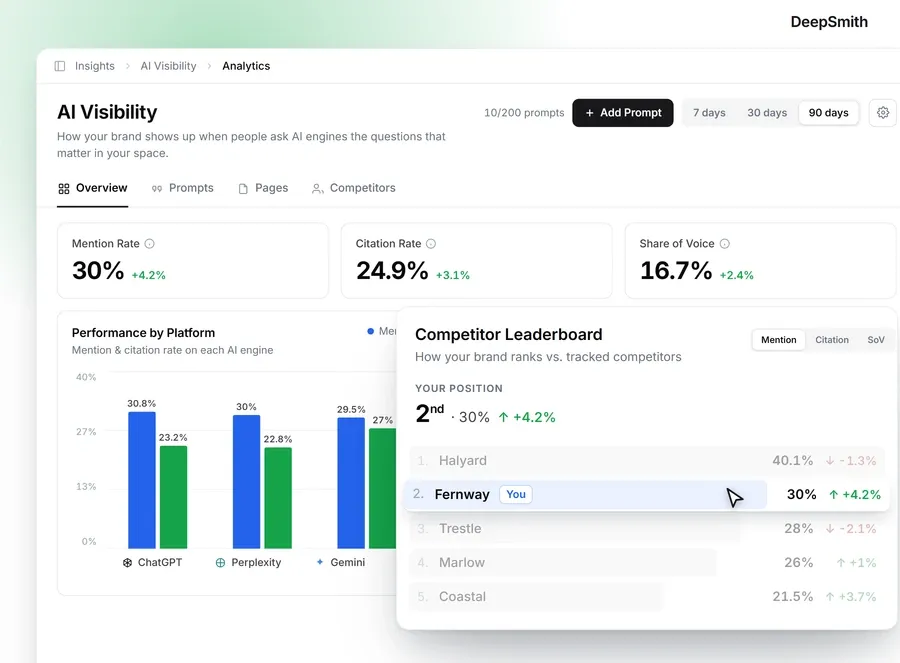
Pro is $99 a month ($80 billed yearly) and includes 20 articles, 50 tracked prompts and ChatGPT tracking. Grow is $199 and adds Perplexity with 40 articles, and Scale is $399 and adds Gemini with 90 articles. There is a 7-day free trial and no long-term contract. DeepSmith isn't built around a live term-by-term content score. It applies keyword coverage, heading structure, schema, internal links and metadata while it writes, and its articles publish straight to WordPress, Webflow, Strapi, Sanity or Contentful. We compare it with the SERP-editor approach directly in DeepSmith vs NeuronWriter.
Search research and content scoring
NeuronWriter is the clear winner here, because reading the Google results for your keyword is its core job and Rytr documents nothing comparable. Each NeuronWriter analysis looks at the first-page results for terms, titles, meta descriptions, headings and length, and recommendations are usually ready about a minute after you start a query. The editor then scores your draft on readability, heading structure, keyword density and length against what the top pages do. That kind of SERP analysis tells you what a page needs before you write it, which is hard to do from memory.
Rytr has SEO meta title and meta description generators as use cases, and its comparison pages mention a native SEO toolkit, but its product pages don't document keyword data, ranking-page analysis or content scoring. A score based on today's results is guidance and not a guarantee of rank, so treat it as a way to find missing subtopics and not as a target to hit exactly.
What DeepSmith does: the Content Map turns your site and competitor sites into one topic map and flags coverage gaps and untapped topics, so the decision about what to write starts from measured coverage. The Writer then applies keyword coverage, heading structure, schema and internal links as the article is produced, so the structure is in place when the draft lands.
Short-form copy and brand voice
Rytr is the better fit for short copy and voice matching, though NeuronWriter does ship templates of its own. Rytr's 40+ use cases and 20+ tones are on every plan, and My Voice learns from a writing sample, with one voice on Unlimited and multiple voices on Premium. NeuronWriter lists templates for intros and product descriptions, and its Neuro assistant can produce product descriptions, social posts, headlines and calls to action. Its AI Profile builds a brand voice from your website or uploaded documents, which the record scores as partial because advanced voice controls are still on its roadmap.
Both tools have drafts that reviewers call generic, so a human edit is part of the plan with either one. NeuronWriter lets you pick the model in its templates, including GPT 5, Claude Sonnet 4.5 and Gemini Flash 2.0, and from Gold it accepts your own OpenAI or Anthropic key.
What DeepSmith does: Brand Voice in Deep IQ holds tone and human-texture settings that shape every article, so you can keep a brand voice consistent without re-briefing each piece. Repurpose adds social posts to every finished article, and the Apps Library rewrites an article for LinkedIn, X, newsletters and other channels in the same voice.
Pricing and value
Rytr is cheaper at the entry point, and NeuronWriter gives you more for search work per dollar. Rytr's free plan costs nothing, and its paid plans stay under $30 a month. NeuronWriter's Bronze starts at $23 a month and includes 25 content writer analyses and 15,000 AI credits, which it says is close to 150,000 words on the cheapest models. Gold at $69 is where the team sharing, plagiarism checks, WordPress export and API access begin, so most teams doing real search work are looking at that tier.
The word "unlimited" on Rytr's middle plan covers generated characters only. More than one language, multiple voices and custom use cases are Premium only, and plagiarism checks are capped at 50 or 100 a month. On NeuronWriter, the AI visibility add-on starts at $9 a month for 10 questions, which matters if tracking is a main reason you are buying.
What DeepSmith does: the $99 Pro plan combines tracking and article production with a fixed monthly article allowance, so you can see the cost of a month of publishing before you start. If budget is the main filter, our list of NeuronWriter alternatives covers other options at similar prices. The Rytr alternatives list does the same for budget writing assistants.
Publishing, integrations and team access
NeuronWriter is ahead on publishing and integrations. It offers WordPress import and one-click export on Gold and up, Search Console data, a Chrome extension that works inside Google Docs and WordPress, a public API and an MCP server with 11 tools, and unlimited team members from Gold. Its integration list is still fairly narrow, and no SSO or SOC 2 report appears in the research, which is a gap in what could be verified and not proof that they don't exist.
Rytr includes a Chrome extension on every plan and a separate usage-based API with 10,000 free credits. It documents no CMS publishing, scheduled publishing or team plan, so a finished piece gets copied into your CMS by hand.
What DeepSmith does: articles publish to WordPress, Webflow, Strapi, Sanity or Contentful, or to your own webhooks. Our roundup of AI content tools with CMS auto-publish shows how others handle this step. Multi-Workspace keeps each brand or client in its own isolated workspace, seats run from 5 on Pro to 10 on Scale, and the platform is SOC 2, GDPR and ISO certified.
From insight to action
NeuronWriter is ahead on this axis, since it documents AI answer tracking and Rytr does not. The AI Visibility module reports share of voice, brand mentions in answers, domain citations, sentiment, competitors and opportunities, and rechecks questions about every 24 to 48 hours. The standard allowance covers Google AI Overviews and AI Mode, and ChatGPT and Perplexity sit behind the paid Advanced add-on. Rytr's pages describe a writing assistant and don't describe any tracking of AI answers.
Neither tool connects tracking to a production schedule. In NeuronWriter, an insight still ends with you opening the editor, and in Rytr there is no insight step at all.
What DeepSmith does: tracking, ideation and production run in a loop. AI Visibility shows where you are missing, Opportunity Agents turn that into ideas with the evidence attached, New Ideas holds the backlog, Planned Content dates it, and Autowrite produces each article on schedule. This is how a team can scale content output with AI without adding a person for each extra piece, and each article arrives as a finished piece and not a first draft you still have to rescue.
Which should you choose
NeuronWriter or Rytr comes down to the work in front of you. The NeuronWriter vs Rytr SEO or copywriting question has a different answer for a team that publishes research-backed articles than for a freelancer who writes ad variants all day.
- DeepSmith fits marketing teams and agencies that want to see where AI engines answer without their brand, plan articles in bulk and have researched, on-brand, publish-ready articles written on their scheduled dates, with tracking and production together on one self-serve plan.
- NeuronWriter fits freelancers, small businesses and small agencies writing long-form content for search who want term and heading guidance scored against the Google results at a low published price, with many teammates and no per-seat fees.
- Rytr fits individuals, freelancers and small businesses that mostly need short marketing copy, product descriptions and quick blog sections, want a free plan and don't need SEO research.
You can try DeepSmith with a 7-day free trial and run tracking and writing against your own site.