You bought a budget optimizer to fix one problem: drafts that ranked badly because nobody checked the terms. It worked. Then the job got bigger.
Now you need briefs your writers will follow. You need to know whether ChatGPT names your brand when a buyer asks who to buy from. You need articles that go out the door without you rewriting every header.
That is usually the moment people start looking at NeuronWriter alternatives. Not because the scoring was bad, but because scoring alone stopped being the whole job.
Here is the good news: the market has split into clear lanes. Some tools go deeper on technical page scoring. Some add a GEO or AI-visibility layer. Some are brief factories. One connects measurement to production so you are not stitching four tabs together.
This guide walks all eight: what each is best at, what it costs, and one honest limitation.
How we ranked these NeuronWriter alternatives
A roundup needs its rules stated up front. We ranked each tool on five things.
Optimization depth. How well it analyzes ranking pages, compares competitors, and turns that into page-level recommendations you can act on.
Semantic coverage. Related terms, NLP terms, entities, questions, and topics, so your draft is complete instead of stuffed.
Workflow value. Briefs, outlining, writing, editing, refreshes, and publishing, and how much manual rework is left on your desk.
AI-search relevance. Whether the tool measures or improves how you show up in AI answers. Writing with AI is not the same thing as being cited by AI, and we kept those separate.
Economics and fit. Published price, limits, seats, and credits, and who the plan actually suits.
One caveat, said plainly. This is a fit-based judgment built from documented capabilities and pricing, not a controlled test. Treat any tool promising guaranteed rankings or citations with care.
Quick comparison of the top NeuronWriter competitors
| Rank | Tool | Best fit | Content scoring | AI-answer capability | Starting price |
|---|---|---|---|---|---|
| 1 | DeepSmith | Teams connecting AI visibility data to production | SEO and AEO built into the writing pipeline | Mention rate, citation rate, share of voice, cited pages, competitor citations | $99/mo |
| 2 | PageOptimizer Pro | Technical on-page teams and agencies | Detailed page reports, LSI/NLP/TF-IDF scoring, word-count targets | AI Visibility Tracker across ChatGPT, Google AI, Gemini, Claude, Perplexity | $40/mo |
| 3 | Scalenut | Teams wanting SEO plus GEO in one editor | Live SEO+LLM content score, auto-optimization | GEO score and prompt coverage, tiered engine support | $59/mo |
| 4 | Rankability | Agencies measuring AI visibility | SERP and AI-source research feeding briefs | Mentions, citations, recommendations, sentiment across named platforms | $99/mo |
| 5 | SE Ranking Content Editor | SEO teams wanting an editor inside a full suite | Real-time Content Score and SEO article check | AI Search sold as a paid add-on | From $103.20/mo |
| 6 | Dashword | Small teams wanting a simple top-ten editor | Live content, word-count and readability scores | None stated in the reviewed material | $99/mo |
| 7 | WriterZen | Budget SEO specialists who love keyword planning | Final-draft score against Google's top results | None stated in the reviewed material | $270 one time, pricing page conflicts |
| 8 | Content Harmony | Brief-first teams and agencies | SERP reports and a content grader | None stated in the reviewed material | $50/mo for 5 workflows |
Prices are the ones visible on each vendor's own pages. Several run promotions or publish figures that contradict each other, and we flag those below rather than picking the prettier number.
1. DeepSmith
Best for: Marketing leads who need to see where their brand shows up in AI answers, find the content gaps behind that, and produce on-brand SEO and AEO articles without handing the draft to yet another disconnected tool.
Most tools like NeuronWriter answer one question: is this page optimized? The question your leadership asks now is different. Where do we appear when a buyer asks ChatGPT or Perplexity who to buy from, and what are we publishing about it?
DeepSmith is the only entry here built to answer both from the same data. It is one platform for AI search analytics and content production, and that pairing is why it ranks first for this reader.
Here is how the loop runs.
AI Visibility tracks the questions your buyers actually ask. You get mention rate, citation rate, share of voice, sentiment, and visibility trend, broken out per platform, with a competitor leaderboard and the sources AI cites most. Every tracked prompt keeps its full answer history, so you read the answer itself, not just a number. The Pages view shows which of your own pages earn citations and which prompts drive them. Discover Prompts builds a starter set from your product, persona, and buyer-stage context, so you are not staring at an empty list on day one.

Content Map turns your site and unlimited competitor sites into one shared topic taxonomy, with every page classified by topic and buyer stage. Coverage gaps show where a rival publishes more than you. Untapped topics show where they publish and you have nothing. Sitemaps re-check every 24 hours, so new pages fold in without a re-import.
Opportunity Agents read that data and hand back ideas with the evidence attached. Win a tracked citation. Turn mentions into citations. Close a decision-stage gap against up to four rivals at once. Each idea travels with the data point that justifies it, so you can defend the backlog in a meeting instead of guessing.
Content Studio is where ideas become published articles. New Ideas, Planned Content, Produced Content, with the Writer in the middle. Keyword coverage, heading structure, schema markup, internal links, and metadata are part of creation, not a review pass you do at 6pm. Autowrite goes further: configure an article when you plan it, and it writes itself on its scheduled date with nobody in the app. Produced Content publishes straight to WordPress, Webflow, Strapi, Sanity, or Contentful, or to your own webhooks.

Deep IQ keeps all of it sounding like you. Company positioning, products, personas, brand voice, visual guidelines, and reusable content types are stored once and used by every module. Repurpose and the Apps Library then turn the finished article into LinkedIn, X, newsletter, and Reddit versions, so distribution stops falling off the end of the week.
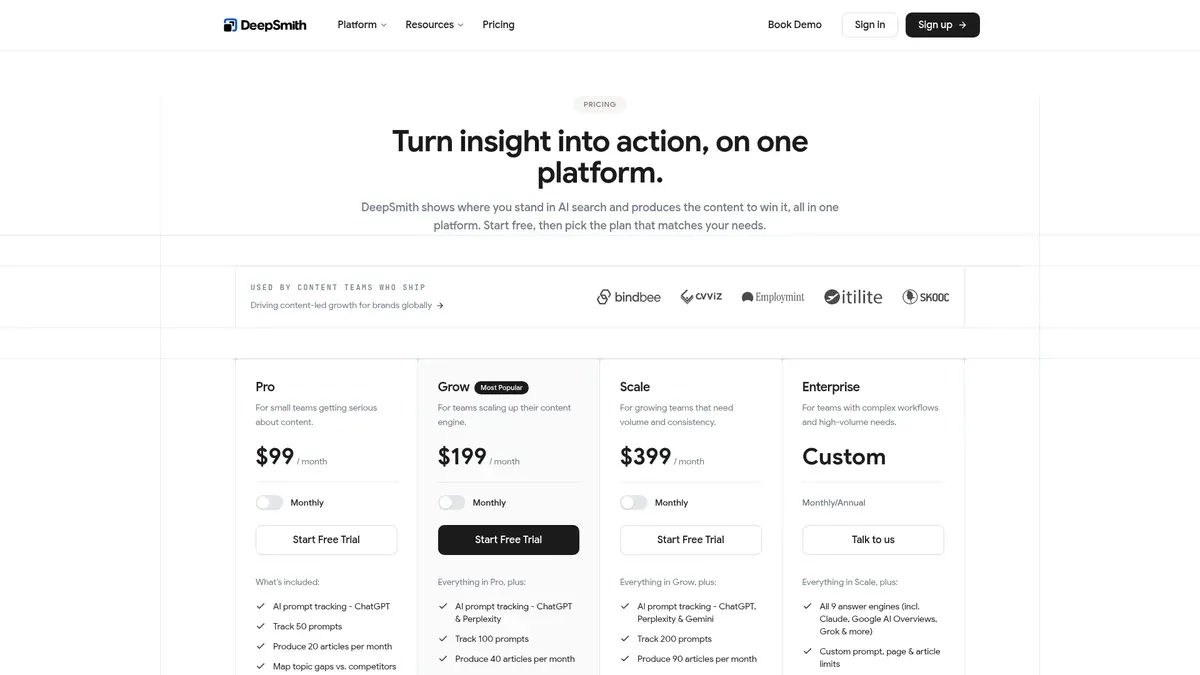
Pricing. Pro is $99/mo, or $80 billed annually, with 20 articles, 50 tracked prompts, 5 seats, and ChatGPT tracking. Grow is $199/mo, or $160 annually, with 40 articles, 100 prompts, 7 seats, adding Perplexity. Scale is $399/mo, or $299 annually, with 90 articles, 200 prompts, 10 seats, adding Gemini. Enterprise is custom and covers all ten tracked engines: ChatGPT, Gemini, Perplexity, Claude, Google AI Overviews, Google AI Mode, Grok, Meta AI, Microsoft Copilot, and DeepSeek. There is a 7-day free trial, no long-term contracts, and no cancellation fees.
Key features: AI Visibility with per-prompt citation tracking, Content Map coverage and gap analysis, Opportunity Agents with evidence-backed ideas, the Writer with SEO and AEO formatting built in, Autowrite scheduling, direct CMS publishing, Deep IQ brand context, and channel repurposing.
Honest scope note. DeepSmith is not built around a single public numeric SERP score the way a traditional content editor is. Its strength is the whole loop: measure, find the gap, produce, publish, distribute. If your only requirement is the deepest technical scoring report for one page, PageOptimizer Pro serves you better on that axis. For a team buying an integrated visibility and production workflow, that scope difference does not bite.
2. PageOptimizer Pro

Best for: Technical SEO practitioners, agencies, and anyone refreshing existing pages who wants granular, page-level recommendations rather than a content calendar.
If you loved NeuronWriter's scoring and want more of it, this is your tool. POP reports are built on the vendor's own SEO tests rather than page-one averages, and they get specific: exact keyword targets, variation words, focus and maximum recommendations, LSI terms, competitor-based word count, and LSI/NLP/TF-IDF scoring.
The Google NLP dashboard shows entities and categories found in your content and your competitors'. NextGen E-E-A-T runs an 80-point comparison against top competitors and hands back a roadmap. Schema recommendations read competitor markup and generate your own. POP Watchdog pings you when a competitor edits a page or an update moves things.
An AI Visibility Tracker checks whether AI recommends your brand across ChatGPT, Google AI, Gemini, Claude, and Perplexity, and shows who gets named instead.
Pricing. Basic is $40/mo with 20 POP Credits. Unlimited is $72/mo, or $62 billed annually, with 50 credits and unlimited POP runs under fair use. Teams is $143/mo, or $119 annually, with 120 credits and 5 to 100 sub-accounts. Credit bundles run from $15 for 10 up to $800 for 1,000, and credits do not expire. Extra seats are $12/mo.
Key features: POP optimization reports, Google NLP entities, E-E-A-T scoring, schema generation, a rerunnable Content Editor, POP AI Writer, Watchdog monitoring, 61 languages, and Google Docs, WordPress, and Chrome extension integrations.
One honest limitation. The credit model needs watching. A report costs 2 credits, a score rerun costs 1, and AI Writer burns 2 or 3 per 1,000 words depending on whether you supply your own API key. Watchdog page limits are stated inconsistently on the pricing page, showing 10, 100 and 500 in one place and 10, 200 and 500 in another, so confirm before you buy on that feature.
3. Scalenut

Best for: Content teams that want conventional SEO optimization and a visible GEO layer in the same editor.
Scalenut has openly rebuilt around AI search. You paste a blog URL, a focus keyword, and a region, and the editor shows your content score, prompt coverage, and schema status side by side.
The live score is an SEO and LLM blend: key-term usage, prompt coverage, readability, and schema completeness in one number. A separate GEO score combines SEO metrics with AI-readability signals. The Optimizer targets real prompts appearing in AI results, including trending questions asked on ChatGPT, Gemini, and Perplexity. Auto Optimize scans older posts, finds gaps, fixes SEO elements, and realigns them with current prompt trends, which is a genuine time-saver on a back catalog.
NLP analysis supplies semantically related terms, and reports include writing themes, top-ten competition, and citations from competitor sites.
Pricing. Starter is $59/mo, Plus is $89/mo, and Professional is $199/mo. Annual figures of $24, $36, and $80 per month are attached to a 60% off limited offer that also doubles several limits, so read those as promotional rather than standard. Paid tiers show a 7-day free trial.
Key features: live SEO and LLM content score, GEO score, prompt coverage, optimization reports, Auto Optimize for existing posts, NLP terms, competitor citations, and integrations with Semrush, WordPress, Shopify, and Copyscape, with auto-publishing to WordPress and Shopify.
One honest limitation. Plan caps are the thing to check. Prompts, GEO articles, optimizations, keyword clusters, and audited webpages carry separate limits per tier, and AI-visibility data refreshes weekly unless you upgrade to daily. Match those numbers against your publishing volume first.
4. Rankability
Best for: Agencies and multi-client teams that need AI mentions, citations, and recommendations tracked alongside traditional organic visibility.
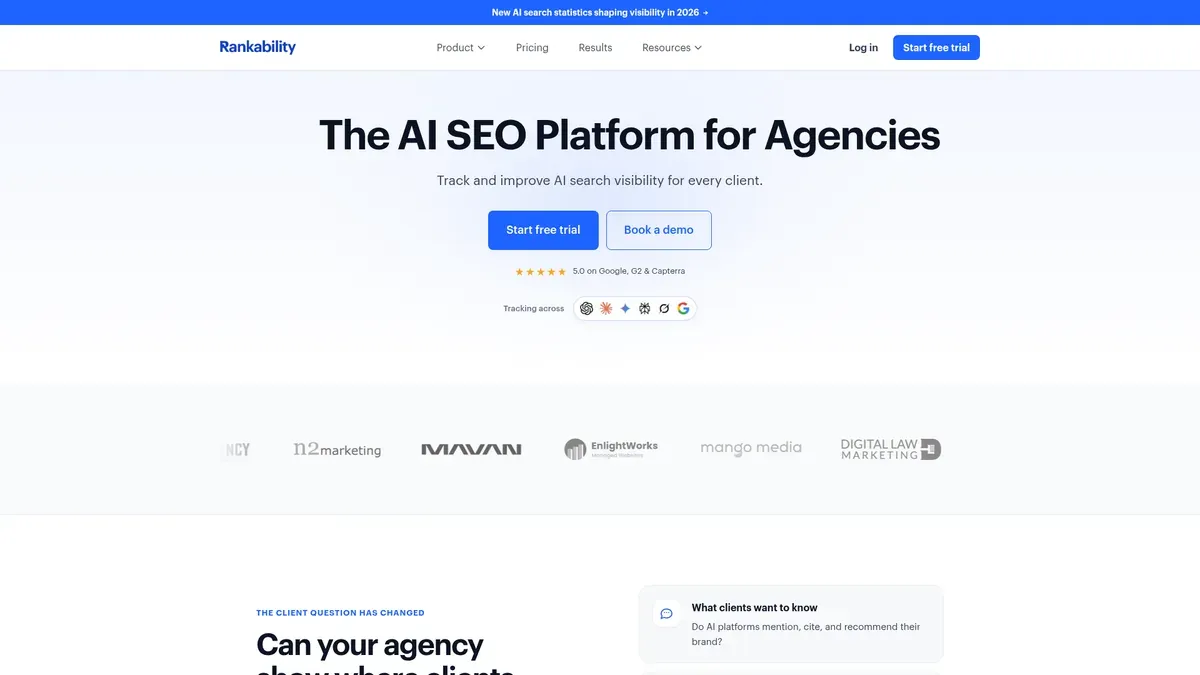
Rankability made AI visibility the headline rather than an add-on. It tracks organic rankings, AI mentions, AI citations, local-grid visibility, and video visibility, and it measures recommendations, sentiment, and trend across ChatGPT, Claude, Gemini, Perplexity, Grok, and Google. Every tracked prompt runs daily.
The writing side follows a clear path: Brief, Draft, Uniqueness, Optimize, Finalize. Copywriter researches both traditional Google competitors and the sources AI actually surfaces, then builds briefs with topics, subtopics, entities, and coverage requirements. Drafts can be grounded in a client Knowledge Base so services, policies, and proof points come from the client rather than from a model's assumptions. Optimize mode takes a live URL, runs fresh SERP and AI analysis, and tells you what to add, cut, or rewrite.
Pricing. Starter is $99/mo with 60 daily prompts and 1 brand workspace, covering ChatGPT, Google AI Mode, and Claude. Core is $199/mo with 125 daily prompts and 3 workspaces, adding Google AI Overviews and Perplexity. Team is $399/mo with 250 daily prompts and 10 workspaces, adding Gemini, Grok, and Copilot. Every plan includes unlimited users and a 7-day free trial.
Key features: daily AI visibility tracking, AI search readiness audits, page audits, AI-source-aware briefs, client Knowledge Base grounding, and extra AI platforms bought à la carte.
One honest limitation. The annual pricing on the site contradicts itself, showing $1,188, $2,388, and $4,788 on the plan cards and $990, $1,990, and $3,990 in the comparison table and FAQ. Confirm the annual number before you sign. Rankability also does not publish a single numeric content score, so if you want a familiar density-style report, POP or SE Ranking feels closer to home.
5. SE Ranking Content Editor

Best for: SEO teams that want a content editor sitting inside a wider suite, next to rank tracking, audits, and competitor research.
This is the option for people tired of one subscription per job. The Content Editor works in two stages. First you build the brief: set parameters, choose keywords, create an outline. Then you check quality against SEO parameters, fix text issues, and compare the article with your outline.
Requirements come from SERP analysis and organic-competitor data, and you can switch competitors off and recalculate. Content Score, readability, and text quality update live as you edit. Checks cover word and character counts, headings, paragraphs, images, keyword frequency, grammar, stop-word ratio, and readability. Related keyword suggestions include NLP-determined terms, with competitor placement, TF*IDF, and density.
It integrates with Google Docs, and collaborators see the same metrics without their own subscription, which helps when you work with freelancers.
Pricing. The Content Editor page shows Core from $103.20/mo and Growth from $223.20/mo. Add-ons include an Agency Pack from $69/mo, AI Search from $71.20/mo, and API access from $149/mo. Content Marketing limits are configurable, with extra articles from $39.20.
Key features: a two-stage brief and quality workflow, live Content Score, NLP-determined related keywords, TF*IDF and density data, competitor heading review, Google Docs collaboration, and the suite's keyword, backlink, audit, and Search Console integrations.
One honest limitation. AI Search is a paid add-on, and the reviewed page does not state which engines it covers or what citation metrics it reports. Treat it as available rather than proven. The article-limit structure per plan is also unclear, and add-ons can push the real monthly cost well past the headline.
6. Dashword

Best for: Small teams that want a focused, approachable editor built around the top ten results and a simple report-based price.
Dashword does not try to be a platform, and that is the point. You give it a URL and a target keyword, it scans the top ten search results, and it tells you what those pages have that you do not. Relevant terms come with a recommended usage count and a live count of what is already in your draft. Content score, word count, and readability update as you write.
Brief research pulls competitor outlines, keywords, and frequently asked questions. On the maintenance side it monitors your content, tracks traffic trends, flags pages losing traffic or getting none, regenerates keyword reports weekly, and adds new pages through a crawler. The API and MCP server are included on every plan.
Pricing. Startup is $99/mo with 30 content reports, 5 seats, and AI Writer up to 100,000 words. Business starts at $349/mo with 100 reports, 10 seats, bulk report creation, and SSO. Your first report is free with no card.
Key features: top-ten comparison, live content and readability scoring, content briefs on both plans, relevant terms with frequency guidance, content monitoring and traffic alerts, a Google Docs add-on, an API, and an MCP server.
One honest limitation. No AI-search, AEO, or citation-tracking capability is stated in the product material, so a top-ten Google analysis is all you should expect. The scoring formula is not published either, and at $99/mo for 30 reports, a low-volume solo user pays a lot per piece.
7. WriterZen

Best for: Budget-conscious SEO specialists who want keyword planning, topic discovery, and Google NLP guidance more than they want a publishing system.
WriterZen leads with planning. Content Creator pulls related information from the top 20 search results, and the editor serves up relevant queries, reworded insights from ranking articles, and user-intent questions from Google and Reddit. Google NLP Analysis suggests context sentiment and entities to include, and it feeds keyword selection and outline building. When the draft is done, you compare its score against the pieces sitting in Google's top results, with recommendations for originality, readability, and outranking competitors.
Pricing. This is where you slow down. Keyword Research shows $135, All-In-One Basic shows $270, and All-In-One Advanced shows $405, presented as one-time. The same page also says "Pay Once. Use Forever" and "$0 recurring fees for life," while displaying $2,856/year and a separate "Per month" label. Seat pricing appears as $9 per seat per month in one section and as a placeholder in the FAQ.
Key features: keyword research and clustering, topic discovery, Google NLP Analysis for entities and sentiment, AI-assisted outlining and writing, top-20 research, a final-draft SERP comparison, and a plagiarism checker.
One honest limitation. The pricing page contradicts itself about one-time, monthly, annual, and lifetime terms, so confirm the real number with the vendor before you count on lifetime economics. There is also no AI-search or citation tracking here. Google NLP and a SERP comparison are useful, and they are not the same thing as knowing whether an answer engine cites you.
8. Content Harmony

Best for: Content managers, agencies, and editorial teams whose bottleneck is producing consistent briefs and grading drafts, not writing inside a heavy optimization editor.
Some teams do not have a scoring problem. They have a briefing problem: every writer gets different instructions, so every draft comes back needing different repairs. Content Harmony is built for that.
The workflow is four steps. Analyze the keyword report, build the brief, share the brief, grade the content. The keyword report makes more than 100 API calls and analyzes dozens of pages to work out what Google rewards, and the search-intent analysis weighs hundreds of factors in each result. Briefs can carry related keywords, entities, topics, image and video requirements, SEO and brand requirements, questions to answer, competitor heading structures, and an AI-generated outline. The grader then checks a draft or a live URL against a Topic Model and names the missing subtopics and keywords.
Shareable brief URLs drop into Trello, Basecamp, Airtable, and Google Docs, so the handoff lands where your team works.
Pricing. Plans price by workflows per month: $50 for 5, $99 for 12, $199 for 25, $299 for 50, $599 for 100, $799 for 150, and Enterprise from $1,000/mo for 200-plus. All plans include unlimited users, unlimited projects, and rollover credits. Your first ten briefs can be bought for $10.
Key features: deep keyword and search-intent reports, customizable brief templates, entity and topic requirements, a Topic Model content grader, shareable brief URLs, and unlimited users on every plan.
One honest limitation. There is no published numeric score scale, and no AI-answer tracking of any kind in the reviewed material. It is a brief-and-grade system, so you still need somewhere else to write, schedule, publish, and distribute.
How to choose the best neuronwriter alternative for your team
You do not need to weigh all eight. Name your bottleneck, then pick the tool that removes it.
Your bottleneck is page-level scoring. Choose PageOptimizer Pro. Nothing else here goes as deep on exact term targets, entities, E-E-A-T, and schema for a single page.
Your bottleneck is brief quality. Choose Content Harmony. If your writers keep guessing because the instructions are thin, a better brief fixes more than a better score does.
You want SEO scoring with a GEO layer in one editor. Choose Scalenut, and check the plan caps against your volume first.
You run multiple client brands and AI visibility is the sale. Choose Rankability. Daily prompts, brand workspaces, and unlimited users fit an agency shape well.
You want one suite instead of five subscriptions. Choose SE Ranking, and budget for the add-ons.
You are a small team and want something simple this week. Choose Dashword. The free first report makes trying it easy.
You want lifetime-style pricing and NLP-led planning. Look at WriterZen, and confirm the pricing directly.
You need measurement and production in one loop. Choose DeepSmith. If leadership is asking what your AI search strategy is, if you keep finding rivals cited in ChatGPT for your own buyer questions, or if you are personally the bottleneck on SEO review and internal linking, a scoring tool moves none of that. You need to see where you are invisible, know which page to publish next, and get it out the door on brand.
One more thing, because it saves money. Optimizing for Google results and earning citations in AI answers are two different jobs. A tool that scores your page against the top ten is not tracking whether an answer engine names you. If both matter, buy for both on purpose.
Start with the data, not the draft
Pick one buyer question you care about. Type it into ChatGPT today and see who gets named. That single search usually tells you whether you have a scoring problem or a visibility problem.
If the answer stings a little, that is normal, and it is fixable. Seeing the gap is the first real step.
Start your 7-day DeepSmith free trial and get real visibility data plus real drafts before you pay a cent.