You liked what Oltre promised. See where your brand shows up in AI answers, find the gaps, then actually publish something about it. One tool, one loop, less manual work.
Now you are shopping again. Maybe the token model got confusing. Maybe the content allowance ran out halfway through the month. Maybe you just want to see what else is out there before you renew.
That is a normal place to be, and you are closer to a decision than you think.
Here is the thing most roundups get wrong. They compare AI visibility trackers to each other and forget the second half of the job. Plenty of tools will tell you that ChatGPT never mentions you. Far fewer will help you write and publish the page that fixes it.
So this list only includes tools that do both. The best Oltre alternatives track your visibility and then help you act on it.
How we picked the best Oltre alternatives
Every tool below had to clear five bars:
- It measures AI search visibility. Named engines, real metrics, ideally citations and competitors, not just a vibe check.
- It creates or optimizes content. Track-only tools are out. You already know you need the second half.
- There is a path from insight to published page. Ideas, briefs, drafts, optimization, publishing, or automated actions. Something that closes the loop.
- It fits a marketing team that cares about brand voice. Volume alone is not the goal if the output sounds like everyone else.
- Pricing is public where the vendor publishes it. Where a number is not disclosed, we say so instead of guessing.
For context, Oltre's own public ladder runs from a free tier at €0 with 150 tokens a month and visibility analysis only, up through Base at €89, Pro at €199, Business at €349, and a custom Enterprise plan. Content allowances on the visible plans go from zero pieces on Free to 24 pieces a month on Business. Oltre pricing is token-based, which is worth understanding before you compare it to anything article-metered.
One quick note on what got cut. Tools like LLMrefs, Rankscale, Scrunch, and Otterly are real products with real fans. Their public evidence points to monitoring, dashboards, audits, and recommendations rather than finished article production. They are monitoring-first tools, not full alternatives to Oltre for a buyer who wants both halves.
Quick comparison
| # | Tool | Best fit | Visibility scope | Production scope | Published pricing |
|---|---|---|---|---|---|
| 1 | DeepSmith | Teams that want one evidence-to-published-content system | ChatGPT on Pro, plus Perplexity on Grow, plus Gemini on Scale, all ten engines on Enterprise | Publish-ready articles, scheduled Autowrite, SEO and AEO structure, links, metadata, covers, CMS publishing, repurposing | $99 / $199 / $399 monthly, or $80 / $160 / $299 annually |
| 2 | Frase | A finished SEO and GEO publishing loop | ChatGPT and Google AI on Starter, Perplexity on Professional, Claude and Gemini on Scale | Research, drafting, optimization, publishing, Content Guard page repair | $39 to $239 monthly on annual billing |
| 3 | Writesonic | High article volume plus visibility | ChatGPT, Gemini, Google AI Overviews on self-serve, ten platforms on Enterprise | AI articles, site audits, SEO agents, automatic AI fixes, Action Center | $79 / $199 / $399 monthly billed annually |
| 4 | Surfer | SEO-led content production | ChatGPT, Perplexity, Google AI Mode, AI Overviews, Gemini | Document creation and optimization, topical maps, audits, internal links, brand voice | $49 to $999 monthly, plus a $158 AI Search Analytics option |
| 5 | Profound | Credit-based AEO agents | ChatGPT on Starter, three engines on Growth, up to nine on Enterprise | AEO-optimized content positioning through credit-based agents | $99 and $399 monthly billed yearly |
| 6 | Athena | Broad model coverage and optimization actions | Ten models on Starter, including Claude, Copilot, Grok, DeepSeek, Meta AI | Content optimization agent, on-page and off-page actions, self-learning improvement | Free tier, Starter shown at $295 and $300, Enterprise custom |
| 7 | Goodie | Actions, commerce visibility, revenue attribution | ChatGPT, AI Overviews, Perplexity on Explorer, up to eleven models on Enterprise | AEO content writer, blog generation, optimization, outreach, technical and social agents | Explorer $399 monthly, Pro and Enterprise on request |
| 8 | Semrush AI Visibility plus Content Toolkit | Existing Semrush users | ChatGPT, Google AI, Gemini, Perplexity | AI writing, data-driven ideas, SEO-boosted articles in a separate toolkit | $99 per domain annually, plus $60 for Content Toolkit |
1. DeepSmith: best for turning visibility evidence into published content
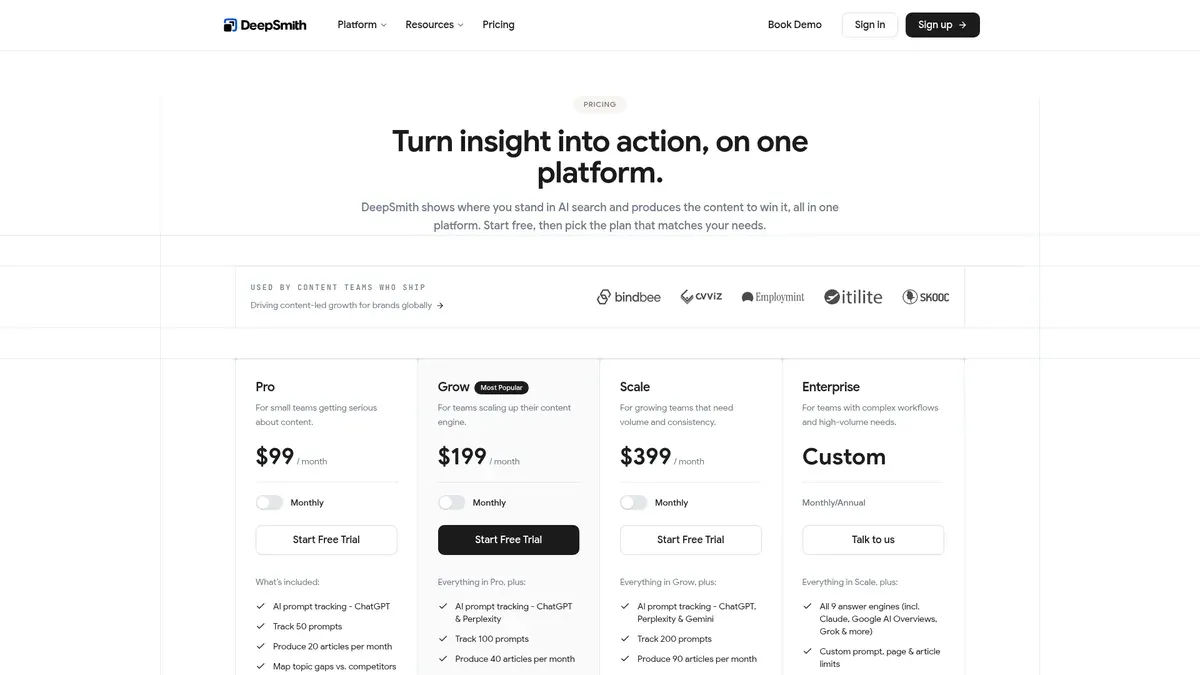
Best for: Marketing leads who need AI visibility findings and competitor gaps to become on-brand, publish-ready articles without carrying anything between tools.
DeepSmith is an AI search analytics and content production platform in one. That phrasing matters, because the gap between the two halves is where most content programs stall. You see the problem in one tab and then have to rebuild the whole idea in another.
Start with measurement. AI Visibility tracks mention rate, citation rate, share of voice, sentiment, and visibility trend, with a per-platform breakdown and a competitor leaderboard. Prompts shows the exact questions you track, with per-prompt mention and citation rates and full answer history. Pages shows which of your pages AI actually cites and which prompts drive them. Competitor citations shows who wins your prompts, on which exact page, and how they perform by platform.

Then the map. Content Map crawls your site and unlimited competitor sites into one shared topic and funnel taxonomy. Your site defines the taxonomy, so comparisons are like for like. You get coverage gaps, untapped topics, and per-topic depth by funnel stage, so a thin decision-stage cluster stops being a hunch. Sitemaps are re-checked every 24 hours, so new pages fold in without a re-import.
Here is where it stops being a dashboard. Opportunity Agents read your own data and return content ideas with the evidence attached. Get cited for a tracked prompt. Turn mentions into citations. Take a competitor's citations. Close a decision-stage gap against up to four competitors at once. Every idea carries the data point that justifies it, so you can defend the backlog in a meeting instead of guessing.
Production runs in Content Studio. Ideas move from New Ideas to Planned Content to Produced Content. Giving an idea a date is what plans it. The Writer turns one planned idea into a finished, brand-grounded article with research, internal and external links, a cover image, and publish-ready metadata. Autowrite takes it further: configure an article at planning time and it writes itself on its scheduled date with nobody in the app.

That is the difference between content as a task you run and content as a system that runs. If your publishing cadence collapses every time a quarter gets busy, that is the feature to look at first.
Brand accuracy comes from Deep IQ, which stores your positioning, claims to make and avoid, product facts, buyer personas, brand voice, visual guidelines, and content types. Every module reads from it, so output sounds like you without a fresh brief each time.
Distribution is built in too. Repurpose delivers social posts with every finished article, and the Apps Library turns one article into LinkedIn, X, Medium, Substack, newsletter, Reddit, Slack, and other channel-native versions.
Publishing goes straight to WordPress, Webflow, Strapi, Sanity, or Contentful, or to your own webhooks, with Markdown and HTML export as a fallback.
Pricing:
| Plan | Monthly | Annual (billed yearly) | Articles/mo | Tracked prompts | Seats | Engines |
|---|---|---|---|---|---|---|
| Pro | $99 | $80 | 20 | 50 | 5 | ChatGPT |
| Grow | $199 | $160 | 40 | 100 | 7 | ChatGPT, Perplexity |
| Scale | $399 | $299 | 90 | 200 | 10 | ChatGPT, Perplexity, Gemini |
| Enterprise | Custom | Custom | Custom | Custom | Custom | All ten engines |
There is a 7-day free trial with real data and real drafts before you pay, and no long-term contracts or cancellation fees.
Key features: AI Visibility, Content Map, competitor citation analysis, Discover Prompts, Opportunity Agents, Deep IQ, Content Studio, Autowrite, automatic internal linking, SEO and AEO optimization built into writing, cover images, metadata, CMS publishing, webhooks, Repurpose, Apps Library, multi-workspace support, and CSV and API export.
Honest limitation: Engine coverage scales with the plan. Pro tracks ChatGPT, Grow adds Perplexity, and Scale adds Gemini. If you need Claude, Google AI Overviews, Google AI Mode, Grok, Meta AI, Microsoft Copilot, and DeepSeek in the same measurement plan, that is Enterprise. For a team benchmarking across every engine at once, that matters. For most teams starting a program, the engines that carry your buyers come first, and you can move up as the program grows.
2. Frase: best for a finished SEO and GEO publishing loop

Best for: Solo marketers, in-house teams, SMBs, agencies, and multi-site brands who want writing, scoring, visibility monitoring, publishing, and page maintenance in one place.
Frase says every plan runs the full loop: research a topic, draft in your selected voice, optimize for SEO and GEO, publish to a CMS, and monitor AI visibility. It audits existing pages for SEO, GEO, and AI visibility scores.
The standout is Content Guard. It watches selected pages for Google decay, writes a fix, and republishes after your approval. If your problem is a back catalogue quietly sliding, that is a real answer. Professional adds a content calendar, internal-linking suggestions, AI crawler monitoring, and Perplexity. Scale adds Claude and Gemini, client-ready exports, and repurposing.
Pricing: Starter $39 a month billed yearly or $49 month to month, Professional $103 or $129, Scale $239 or $299, plus custom Enterprise. Publishing targets named include WordPress, Webflow, Sanity, Wix, and FraseCMS.
Limitation: Engine coverage and volume are tiered hard. Starter is one seat, one site, 10 articles, 50 audit pages, and 10 watched pages. Frase is a genuinely strong alternative when ongoing page repair matters most, but do not assume entry level includes every engine or agency feature.
3. Writesonic: best for high article volume plus AI visibility

Best for: Teams that need a sizable monthly article allowance alongside AI search tracking, site audits, and a path toward agentic workflows.
Writesonic's self-serve plans track ChatGPT, Gemini, and Google AI Overviews. You get AI articles, site audits, Content Strategy, an SEO and Content AI Agent, uploaded data, and Automatic AI Fixes. Growth adds sentiment analysis and trial access to Action Center actions. Enterprise expands tracking to all ten AI platforms and unlocks custom prompts, regions, languages, the full Action Center, Brand Explorer, Page Tracker, Prompt Explorer, alerts, and a strategy team.
Pricing: Starter $79 a month billed annually with 15 AI articles, Basic $199 with 25 articles, Growth $399 with 50 articles, then custom Enterprise. Daily prompt tracking runs 50, 100, and 200 across those tiers.
Limitation: Content Optimization and full Action Center access sit at Enterprise in the researched comparison, and self-serve plans get only limited agentic-workflow runs. Monthly-billing prices, cancellation terms, and API or MCP terms are not disclosed on the public pricing page, so ask before you commit.
4. Surfer: best for SEO-heavy content production
Best for: SEO-led teams that want deep document optimization, topical maps, and audits, with an AI-visibility layer alongside.
Surfer tracks visibility score, mention gaps, and competitor share of voice across ChatGPT, Perplexity, Google AI Mode, AI Overviews, and Gemini. Its SEO side is the deep part: Content Editor, Content Score, keyword research, topical maps, content audits, SERP analysis, one-click optimization, internal links, People Also Ask questions, alt tags, and image suggestions.
Surfer AI takes a target keyword, template, tone, organic competitors, and a customized outline, then writes. Surfer says it researches more than 300,000 words per article and can produce ready-to-publish content in under 20 minutes. Custom voices, custom knowledge, and writing points support brand differentiation, and bulk cluster creation is available.
Pricing: Discovery $49 a month billed yearly for 120 documents, Standard $99 for 360 documents, Pro $182, Peace of Mind $299 with unlimited documents subject to fair use, and Enterprise at $999. A separate AI Search Analytics plan is $158 a month. Integrations named are WordPress, Google Docs, Contentful, and Zapier.
Limitation: Surfer shines when SEO execution is the center of the workflow rather than AI visibility. The limits that bite are prompt refresh rates, tracked pages, workspaces, documents, and seats, and they move a lot between tiers. Check yours against the plan you are actually buying.
5. Profound: best for credit-based AEO agents
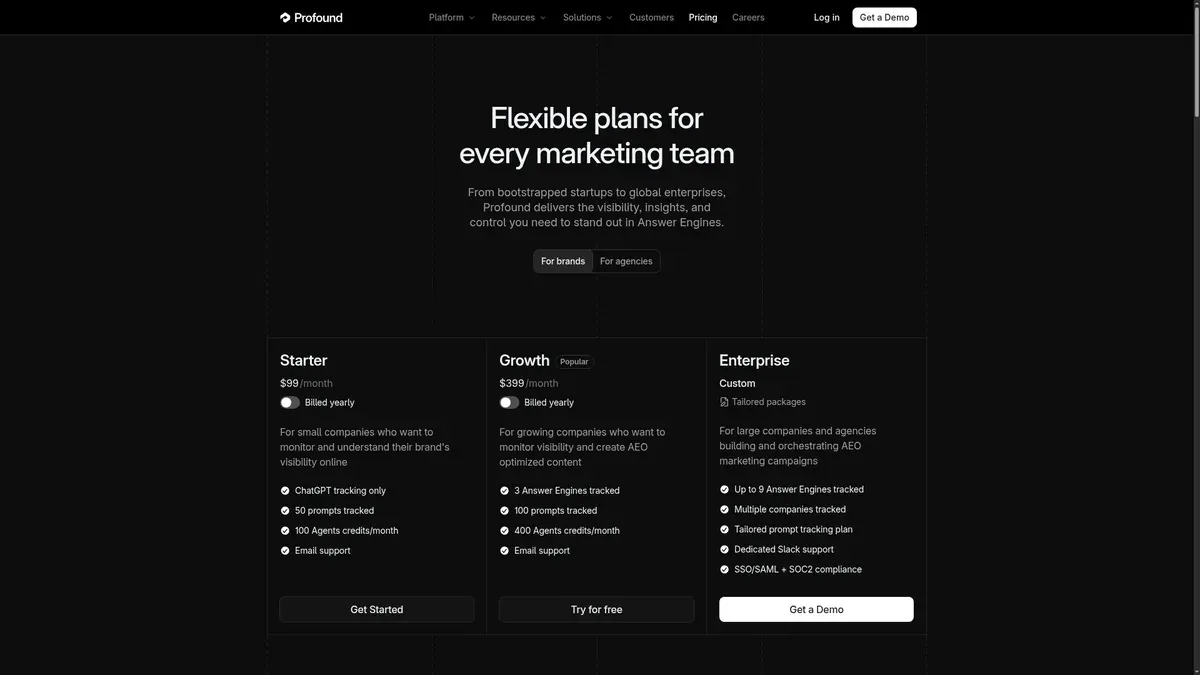
Best for: Growing companies that want visibility tracking with agent-based AEO work, or larger organizations that need multi-company controls and compliance.
Profound's Starter tracks ChatGPT with 50 tracked prompts and 100 Agent credits a month. Growth covers three answer engines with 100 prompts and 400 credits, and is positioned explicitly for monitoring visibility and creating AEO-optimized content. Enterprise supports up to nine answer engines, multiple companies, a tailored prompt plan, dedicated Slack support, SSO and SAML, and SOC2 compliance.
Pricing: Starter $99 a month billed yearly, Growth $399 a month billed yearly, both with two months free on annual billing, then custom Enterprise.
Limitation: Agents are credit-based, and each run consumes credits according to complexity. A simple action and a multi-step action do not cost the same. That makes output hard to compare against article-metered tools, and the public pricing page does not disclose a standalone article quota, exports, integrations, or seat limits. Ask how many typical research, writing, and reporting runs your credits actually buy.
6. Athena: best for broad model coverage and optimization actions
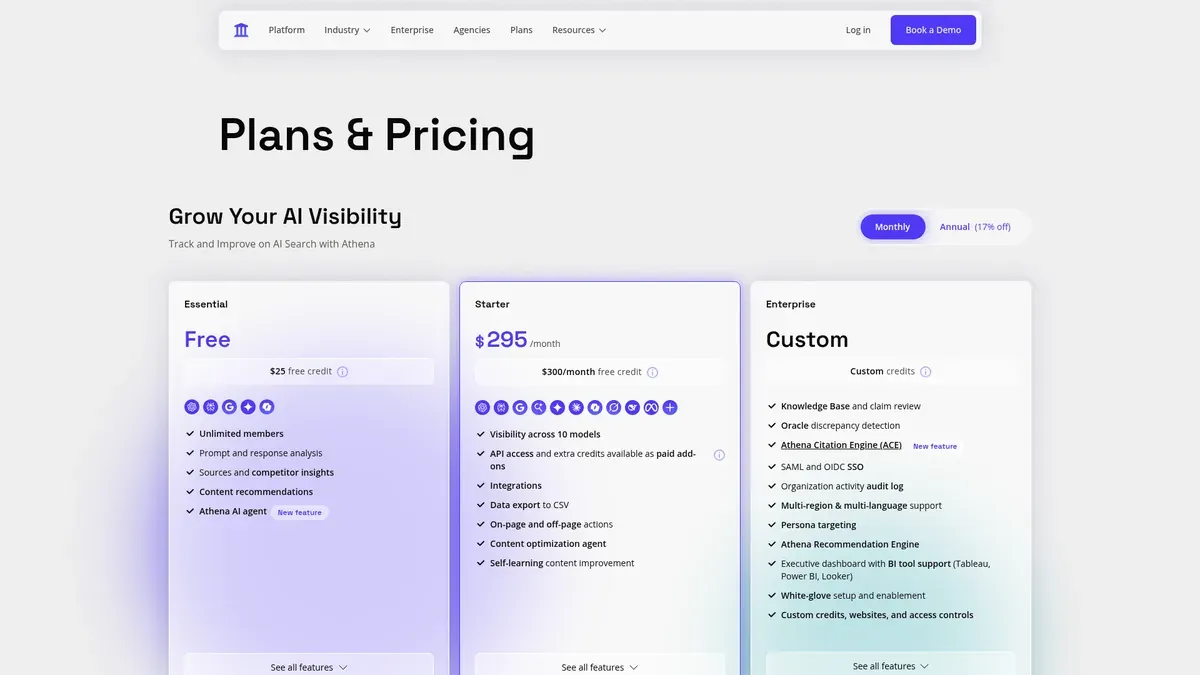
Best for: Teams that want visibility across a wide model set plus a content optimization agent with on-page and off-page actions.
Athena's Starter lists visibility across ten models: ChatGPT, Perplexity, Google AI Overviews, Google AI Mode, Gemini, Claude, Copilot, Grok, DeepSeek, and Meta AI. That is the widest self-serve coverage on this list. It includes 3,600 credits, a content optimization agent, self-learning content improvement, on-page and off-page actions, integrations, and CSV export.
The broader plan comparison adds a recommendation engine, knowledge base and claim review, brand voice and guideline enforcement, citation intelligence, multi-region and multi-language support, competitor benchmarking, GA4 and Search Console integration, Shopify and Webflow integration, BI tool support, audit logs, and SAML and OIDC SSO. There is a free Essential tier with 300 credits and $25 in free credit.
Pricing: Starter is displayed as both $295 and $300 a month in different places on the public page, with 3,600 credits and $300 a month in free credit. Enterprise is custom.
Limitation: That price inconsistency is the tell. Seats, support, detailed usage limits, and add-on pricing are not fully stated publicly. Treat the page as a starting point and get the quote in writing.
7. Goodie: best for AEO actions, commerce, and revenue attribution

Best for: Brands and agencies that want AI visibility connected to optimization actions, agentic commerce, analytics attribution, and multi-brand orchestration.
Goodie's Explorer tracks ChatGPT, Google AI Overviews, and Perplexity with 100 prompts, 3,000 AI responses a month, 10 optimization actions a month, Google Analytics revenue attribution, MCP server access, an AEO strategy call, three seats, and a seven-day trial. Pro adds Gemini, Copilot, and Rufus, with 250 prompts, 7,500 responses, 30 actions, SKU-level agentic-commerce visibility, and five seats. Enterprise goes up to eleven models, 500-plus prompts, 60-plus actions a month, custom revenue modeling, a dedicated strategist, full API and export, and unlimited seats.
The optimization section names an AEO content writer, content optimization, blog generation, an outreach agent, a technical agent, llm.txt and sitemap repair, and a social agent.
Pricing: Explorer $399 a month. Pro and Enterprise are demo-only. Monthly and yearly views show 20% savings on annual.
Limitation: Those labels establish that content actions exist, but the public page does not give an article-per-month quota or show the writing workflow end to end. If revenue proof and commerce visibility are your priority, Goodie is a serious candidate. Ask for a finished-content quota and a live workflow demo before you sign.
8. Semrush AI Visibility plus Content Toolkit: best for a modular Semrush stack

Best for: Teams already living in Semrush who would rather add components than adopt a new platform.
The standalone AI Visibility Base plan is $99 a month per domain billed annually. It includes AI visibility reports for any domain, one domain for Brand Performance analysis, up to 300 reports a day, an AI Visibility Overview, Competitor Research, and Prompt Research. Monitored platforms named are ChatGPT, Google AI, Gemini, and Perplexity.
Content Toolkit is separate. Its pricing material lists a $60 a month plan with a seven-day free trial, providing AI writing tools, data-driven content ideas, and SEO-boosted articles, with five SEO-boosted articles a month in the available description. It is positioned to create, optimize, and repurpose across SEO, AI search, social, and email.
Limitation: Modularity is the trade. These are two toolkit components, not one native production queue, so the $99 visibility plan does not include automated article production. Confirm the combined subscription, domain rules, content limits, and publishing integrations, and check whether a broader Semrush subscription is required.
How to choose your Oltre alternative
Take a breath. You do not need to evaluate all eight oltre.ai competitors. You need to name your bottleneck, then pick the tool built for it.
Your findings never become articles. The handoff is the problem, not the data. Choose DeepSmith. Content Map gaps, evidence-backed Opportunity Agents, Deep IQ context, Autowrite, CMS publishing, and distribution live in one workflow, so nothing gets retyped.
Your existing pages are decaying. Choose Frase. Content Guard watching pages and writing fixes is the most direct answer to that specific pain.
You need more articles, faster. Choose Writesonic, and accept that full optimization and the complete Action Center are Enterprise-level.
Your team is SEO-led first. Choose Surfer. Nothing here beats it for document optimization depth, topical maps, and SERP research.
You want agents, not a calendar. Choose Profound. Just get clear on what your credits buy.
You need every model tracked from day one. Choose Athena, and confirm the Starter price before you buy.
Commerce and revenue attribution are the pitch to your CFO. Choose Goodie.
You already run everything in Semrush. Choose the Semrush combination and plan for more configuration than a single-queue product.
One more thing worth saying plainly. These are all vendor-published plan figures, not independent benchmarks. None of them predict how well any of these oltre.ai competitors will write for your brand. Trials exist for a reason, so use one before you commit a budget.
Try the track-and-produce loop yourself
If the reason you liked Oltre was the loop, measure, find the gap, publish the fix, that loop is what DeepSmith is built around. Start a free trial and see real data and real drafts from your own site before you pay a cent. Start your 7-day free trial and give it your first prompt list this week.
You do not need a bigger team. You need one system that finishes what it starts.