The decision behind DeepSmith vs Surfer SEO is not a feature-for-feature contest between two writing tools. It is a decision about which search surface a content program intends to win. Surfer SEO is an on-page content intelligence platform built to help pages rank on Google results, and its architecture reflects that: SERP analysis, content scoring, and topical authority. DeepSmith is an AI search analytics and content production platform built to measure where a brand appears in AI answers, identify the gaps, and produce the content that closes them from the same data.
Both platforms generate drafts. Both apply stored brand context to those drafts. They separate on center of gravity, and they separate on where the work ends. Surfer scores and refines content that a team is already producing. DeepSmith runs the production itself and reports on whether the resulting pages are being cited.
This comparison examines Surfer's core optimization product, the Content Editor and the modules built around it, rather than its AI Tracker add-on, which warrants its own analysis. The relevant buying question here is narrower and more common: for a team deciding where the next content budget should sit, does the constraint lie in ranking pages higher on Google or in earning presence in AI answers while producing enough finished content to matter.
DeepSmith vs Surfer SEO at a glance
| Dimension | Surfer SEO | DeepSmith |
|---|---|---|
| Category | On-page content intelligence and optimization | AI search analytics plus content production |
| Primary job | Guide writers toward content that ranks on Google | Track AI visibility, then produce content that closes gaps |
| Signature metric | Content Score, 0 to 100, against SERP competitors | Mention rate, citation rate, share of voice, sentiment, visibility trend |
| Optimization target | Google ranking signals and on-page structure | AI citation patterns, with SEO fundamentals built in |
| AI search tracking | AI Tracker, an add-on module on higher tiers | Native AEO module: Overview, Prompts, Pages, Competitors |
| Content creation | AI Content Writer and Surfy inside the editor | Content Studio: New Ideas to Planned to Writer to Produced |
| Brand context | Custom Knowledge fields and brand voice presets | Deep IQ: positioning, products, personas, voice, visuals |
| Internal linking | Suggestions | Automatic insertion based on the Content Map taxonomy |
| Scheduling | Not native | Autowrite generates articles on scheduled dates |
| Publishing | WordPress and Google Docs integrations | WordPress, Webflow, Strapi, Sanity, Contentful, webhooks, Markdown and HTML export |
| Distribution | Requires external tools | Apps Library: LinkedIn, X, Medium, Substack, newsletter, and more |
| Multi-brand | Single workspace | Multi-workspace with isolated context and billing |
| Entry price | Essential, $89 per month billed annually, $99 monthly | Pro, $80 per month billed annually, $99 monthly |
| Higher tiers | Scale at $129, Scale AI at $229, billed annually | Grow at $160, Scale at $299, billed annually |
Two observations sit behind that grid. Surfer has the longer market history and the deeper on-page scoring apparatus, which is a genuine advantage for teams whose reporting still runs on keyword positions. DeepSmith includes an article allowance, five seats at entry, and native AI visibility tracking at a lower annual entry price, which changes the arithmetic for teams whose bottleneck is production volume rather than optimization precision.
What Surfer SEO is: optimization built around the SERP

Surfer SEO is a content intelligence platform that analyzes the pages currently ranking for a target keyword and converts that analysis into concrete recommendations on structure, term coverage, and length. The product deserves its reputation in that lane. Content Editor, the flagship module, scores a draft in real time against the top SERP results and suggests the terms and heading structure the ranking set has in common. Content Audit crawls existing pages and surfaces optimization opportunities against current competitors. SERP Analyzer places ranking pages side by side on shared on-page signals. A built-in keyword research tool supplies search volume and difficulty. Surfy and the AI Content Writer draft and rewrite inside the editor, and Custom Knowledge fields let a team encode tone and product positioning for those outputs.
That stack is coherent, and it is well regarded. Surfer carries a high aggregate rating across several hundred reviews on G2, and detailed independent reviews of the platform tend to converge on the same conclusion: the scoring engine is the reason to buy it. The integration ecosystem reinforces that position, with Google Docs for in-document optimization, WordPress for one-click publishing, Jasper for generation, Semrush for keyword data, and a ChatGPT plugin.
The limitations are structural rather than incidental. The center of gravity remains Google SERPs, and surfer seo ai visibility coverage arrives through the AI Tracker add-on rather than through the core architecture, which means it is gated to higher tiers and positioned as a monitoring layer beside the optimization work rather than the system the product was designed around. Surfer does not auto-publish or auto-schedule content, so a calendar still requires a person in the editor on the day. Distribution to channels beyond the website requires external tools. Entry-tier pricing sits above bare drafting tools, and the more advanced AI capabilities are reserved for the Scale AI tier.
None of that makes Surfer the wrong purchase. It makes Surfer a precise instrument for a specific job. Teams that already have writers, already have a workflow, and need a scoring layer to make drafts competitive on the SERP are buying exactly the thing they need. Buyers who begin searching for a surfer seo alternative are rarely dissatisfied with the scoring itself; they have usually concluded that scoring is a smaller share of the job than it was five years ago.
What DeepSmith is: tracking and production in one loop

DeepSmith combines AI search analytics with content production in a single platform. It tracks how AI engines answer the questions that matter in a category, finds where the brand is invisible or losing, and produces the on-brand content to close those gaps, all from the same underlying data. The production stance is explicit: DeepSmith is a production engine rather than a writing assistant, and output is publish-ready rather than a first draft requiring rescue.
The measurement half is the AEO module. Overview reports mention rate, citation rate, share of voice, sentiment, and visibility trend, with a per-platform breakdown, a competitor leaderboard, and the sources engines cite most. Prompts holds the tracked questions with per-prompt mention and citation rates and full answer history, and Discover Prompts generates a starter set from stored product, persona, and buyer-stage context. Pages attributes citations to specific URLs and shows which prompts drove them. Competitor citations identifies who wins citations for tracked prompts, on which exact pages, and how each competitor performs by platform. Ten engines are covered: ChatGPT, Gemini, Perplexity, Claude, Google AI Overviews, Google AI Mode, Grok, Meta AI, Microsoft Copilot, and DeepSeek. Coverage scales by tier: Pro tracks ChatGPT, Grow adds Perplexity, Scale adds Gemini, and Enterprise covers all ten.

The production half is Content Studio. Opportunity Agents read that visibility data and the Content Map and return ideas that each carry the data point justifying them, landing in New Ideas, the single backlog. Planned Content acts as the calendar. The Writer converts one planned idea into a finished, brand-grounded article that is researched, internally and externally linked, and delivered with a cover image and publish-ready metadata. Autowrite runs that pipeline on a scheduled date with nobody in the application, landing the result in Produced Content, where an article can be reviewed, revised, and published directly to WordPress, Webflow, Strapi, Sanity, or Contentful, or to custom webhooks, with Markdown and HTML export as a fallback. Every finished article arrives with social posts already written, and the Apps Library adapts it into platform-native versions for LinkedIn, X, Medium, Substack, newsletter and nurture email, and other channels.

Deep IQ sits under all of it: stored positioning and claim boundaries, a profile per product, buyer personas, brand voice settings, visual guidelines, and content-type templates, read by every module so that produced articles reference real products in the brand's actual register. Content Map does the same for the site itself. It crawls published pages, classifies each onto a granular topic and funnel stage, and maps unlimited competitor sites onto that taxonomy, so coverage gaps and untapped topics become measurements rather than hunches. That classification drives internal linking, ideation, and deduplication.
The constraint worth naming is that engine coverage is tier-gated. Pro tracks ChatGPT only, which is where most buyer research starts, then Perplexity arrives at Grow and Gemini at Scale, and the full ten-engine set sits at Enterprise. A team that needs every engine on day one should price the custom tier.
SEO vs AEO optimization: two different targets
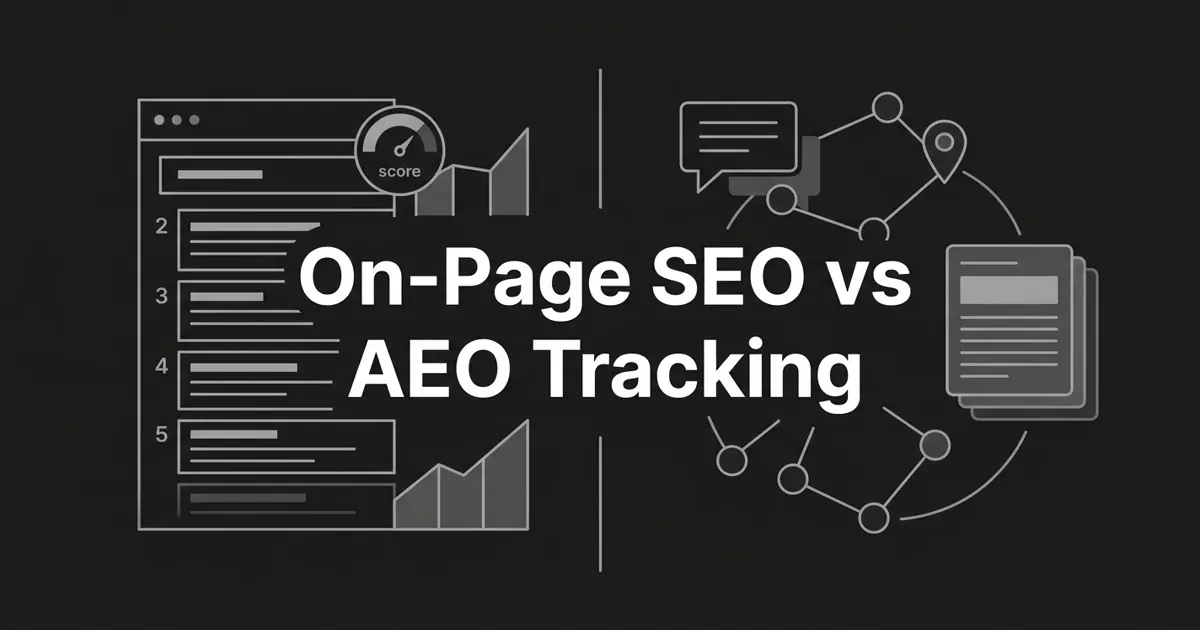
The seo vs aeo optimization distinction is the substantive question underneath this comparison, and it is not a matter of degree. Ranking on a results page and being cited inside a generated answer respond to different interventions. Classic on-page optimization works backward from the pages already ranking, matching their term coverage, depth, and structure closely enough to compete for a position in an ordered list. Answer engine optimization works backward from the questions buyers actually ask an assistant, and the unit of success is whether the model names the brand and links the page as a source.
The two overlap, and the overlap is real. Content that is well structured, factually clean, and topically thorough tends to perform on both surfaces, and Google's own published guidance on AI features in Search holds that existing search fundamentals continue to apply. What differs is measurement and prioritization. A Content Score cannot report whether ChatGPT names a brand when a buyer asks which tool to use. Mention rate and citation rate cannot report whether a page moved from position eleven to position six. Programs that need both signals either run two systems or accept a blind spot on one side.
For teams whose leadership has started asking about AI search, the practical consequence is that measurement has to come first. Tracking AI visibility across the engines that matter establishes a baseline; without one, content produced in the name of AEO is unfalsifiable. That sequencing is the architectural argument for a platform where tracking and production share a data layer rather than sitting in separate tabs. Weighing surfer seo ai visibility coverage against a native AEO module is, in the end, weighing an add-on against an architecture, and the difference surfaces in what each system can do once a gap is found.
Content scoring versus formatting built into generation
Surfer's mechanism is post-hoc scoring. A draft exists, the editor grades it against the SERP, and a writer closes the gap between the current score and the target. The feedback loop is tight and the guidance is concrete, which is why the model has held up for years.
DeepSmith's mechanism is different in kind rather than in quality. Keyword coverage, heading structure, schema markup, internal linking, and metadata are part of the writing pipeline rather than added after, and AEO formatting conventions, meaning citation-ready structure, crisp answers near the top of sections, and clear headings, are native to generation. The practical difference shows up in rework. A scoring workflow produces a draft and then a revision cycle. A generation workflow that already holds brand context, Content Map classification, and formatting rules produces something closer to final on the first pass.
Neither approach removes editorial judgment. A team that wants granular, term-level control over a single high-stakes page will find Surfer's editor more directly responsive to that intent, because it exposes the target and the delta explicitly. A team producing twenty to ninety articles a month will find a scoring loop applied to each of them expensive in hours that a pipeline absorbs.
Production, publishing, and where the work actually ends
The clearest structural separation between the two products is what happens after the draft is good. In Surfer, the draft leaves the editor and enters whatever workflow the team already runs: a Google Doc for review, a WordPress publish, then internal linking, then imagery, then metadata, then distribution, each in a different place. Surfer supports parts of that chain through integrations, and one-click WordPress publishing is genuinely convenient, but scheduling is not native and the assembled tool stack around the editor remains the team's responsibility.
In DeepSmith, that chain is the product. Internal linking is inserted automatically from the Content Map taxonomy rather than suggested for manual placement. Cover images and publish-ready metadata arrive with the article. Publishing targets five CMS platforms plus webhooks and export. Distribution assets are generated from the finished piece. Autowrite removes the requirement that a person be present on the publishing date at all.
The relevant question for a buyer is where the hours currently go. Teams that measure the true cost per article across briefing, drafting, review, linking, imagery, and publishing usually find that drafting is a minority of it. An optimization layer improves the drafting portion. A pipeline addresses the rest.
Pricing and cost per article
Surfer lists Essential at $89 per month billed annually, or $99 monthly, with Scale at $129, Scale AI at $229, and Enterprise custom, listed from $999 per year. DeepSmith lists Pro at $99 per month, or $80 billed annually, Grow at $199 or $160 annually, Scale at $399 or $299 annually, and custom Enterprise, with a seven-day free trial and no long-term contracts.
At the entry tier the headline numbers are close, $89 against $80 on annual billing, and the contents differ substantially. Surfer Essential is a single seat with limited AI article generation. DeepSmith Pro includes five seats, twenty articles a month, fifty tracked prompts, and ChatGPT tracking. The comparison at the mid tier is where the difference compounds: Surfer Scale AI at $229 annually carries the higher AI allowances and the AI Tracker capabilities, while DeepSmith Grow at $160 annually carries seven seats, forty articles a month, one hundred tracked prompts, and ChatGPT plus Perplexity coverage.
Expressed per article, DeepSmith Grow works out to $4.00 for each of its forty articles. Surfer Scale AI, on the article allowance associated with that tier, lands near $5 per article, and that figure covers optimization and generation rather than the finished, linked, imaged, and metadata-complete output DeepSmith counts as one article. Cost per article is a crude instrument, and it should be treated as directional rather than decisive, but the direction is consistent: the production-inclusive plan is not the more expensive one.
Surfer's Enterprise entry point, listed from $999 per year, is lower than most enterprise SEO contracts and is a real advantage for a small organization that needs custom terms without a large committed spend. The bound on that advantage is scope: the custom tier extends an optimization product, and the production and distribution work still sits outside it.
Where each tool genuinely wins
Surfer SEO is the stronger choice when the primary KPI is Google ranking position. Its Content Score, SERP Analyzer, and Content Audit are purpose-built for that objective, and no amount of AEO enthusiasm changes the fact that organic search still drives meaningful volume for most businesses. Surfer is also the stronger choice for a team that has writers it likes and a workflow it trusts, and wants a precise instrument to make existing output more competitive rather than a system that replaces the workflow. Its Google Docs integration in particular suits organizations whose editorial process already lives in documents.
DeepSmith is the stronger choice when the objective is presence in AI answers and the constraint is production capacity. AEO tracking is the core architecture rather than an add-on, which means the measurement, the ideation, and the writing all read from the same brand context and the same visibility data. For a marketing lead who has been asked what the AI search strategy is and does not yet have tracking, a framework, or content built for it, a platform that supplies all three is a shorter path than assembling an optimization tool, a tracker, a writer, and a distribution workflow. Agencies and multi-brand teams get a further structural benefit from multi-workspace isolation, with separate context and billing per brand.
Both products decline to promise outcomes, and that is correct. Neither guarantees rankings, citations, traffic, or revenue. Both supply instrumentation and guidance; results depend on content quality, competitive density, and algorithmic behavior nobody controls.
Which should you choose
The deepsmith or surfer seo question resolves cleanly once the binding constraint is named, because the two products are strong in non-overlapping places.
Choose Surfer SEO if Google rankings are the metric leadership reviews, if the team already produces content reliably and needs an optimization layer rather than a production engine, or if term-level control over individual high-value pages matters more than throughput. Teams whose editorial process runs through Google Docs will find the integration fits without disruption.
Choose DeepSmith if the goal is being cited in AI answers and the team also needs to publish more than it currently can. The combination is the specific case DeepSmith is built for: measurement that identifies the gap, and production that closes it, without a handoff between two systems. It is also the better fit for lean teams, where five seats and an article allowance at the entry tier do more work than a single-seat optimization license, and for agencies that need isolated client workspaces.
Consider running both if the program is large enough to justify parallel investment on both surfaces. Some teams use a scoring tool for keyword research and SERP-side refinement while running AEO tracking and production separately. The overlap in content creation is significant, so the case has to be made on measurement coverage rather than on drafting.
For teams evaluating a surfer seo alternative specifically because AI search has moved up the priority list, the honest framing is that the two products are answering different questions. Replacing a scoring tool with a tracking-and-production platform is a strategy change, not a swap.
The fastest way to resolve deepsmith or surfer seo for a specific situation is to look at real data rather than feature grids. A seven-day DeepSmith trial produces actual prompt-level visibility numbers for the brand and actual articles in the brand's voice, which makes the comparison concrete rather than theoretical.