DeepSmith vs Oltre is not a comparison between a tracker and a writer. Both platforms measure how AI engines answer questions about a brand, and both produce content intended to close the gaps that measurement exposes. The distinction sits one level deeper, in how each gets from a visibility gap to a page worth publishing. Oltre positions itself as an autonomous visibility teammate that creates, publishes, and indexes optimized content on autopilot. DeepSmith is a production engine rather than a writing assistant, grounding every draft in stored brand, product, persona, and voice context so the output arrives close to final. The decision turns on which constraint a team feels more acutely: the manual touchpoints between a finding and a live URL, or the rework a draft requires before it can carry the brand.
What follows examines both products where they genuinely diverge, states the limitations of each, and closes with a recommendation by situation. It is a head-to-head, not a roundup, and it stays on the depth question.
DeepSmith vs Oltre at a glance
| Dimension | DeepSmith | Oltre AI |
|---|---|---|
| Category | AEO tracking plus on-brand content production | AEO tracking plus autonomous content publishing |
| Production stance | A production engine, not a writing assistant; publish-ready output | Create, publish and index optimized content on autopilot |
| Engines named | ChatGPT, Gemini, Perplexity, Claude, Google AI Overviews, Google AI Mode, Grok, Meta AI, Microsoft Copilot, DeepSeek (ten) | ChatGPT, Claude, Perplexity, Gemini, Google AIO, Google AI Mode (six) |
| Engine gating | Tier-gated: Pro covers ChatGPT, Enterprise unlocks all ten | Not plan-gated on the public site |
| Brand context layer | Deep IQ, a named module with six elements | Present in the workflow, not surfaced as a named module with named sub-elements |
| Existing-content awareness | Content Map classifies every URL by topic and funnel stage, and maps competitor sites onto the same taxonomy | Index submission featured; URL classification not surfaced as a module |
| Publishing destinations | WordPress, Webflow, Strapi, Sanity, Contentful, webhooks, Markdown and HTML export | WordPress, Webflow, Shopify, custom CMS via webhook |
| Repurposing | Repurpose plus Apps Library across LinkedIn, X, Medium, Substack, email, and more | Not surfaced as a named module on the public site |
| Multi-brand | Multi-Workspace, each client isolated with its own context, content, and billing | Multi-site publishing mentioned; per-client workspaces not surfaced |
| Entry price | Pro $99 per month, or $80 annual; 7-day trial | Free at €0 (analysis only); Base €89 per month, roughly €71 annual |
Two ways to combine tracking and production
Most tools in this category sit on one side of the line, either measuring AI answers or generating articles. Both products here cross it, so the useful analysis compares the mechanism rather than the feature checklist.
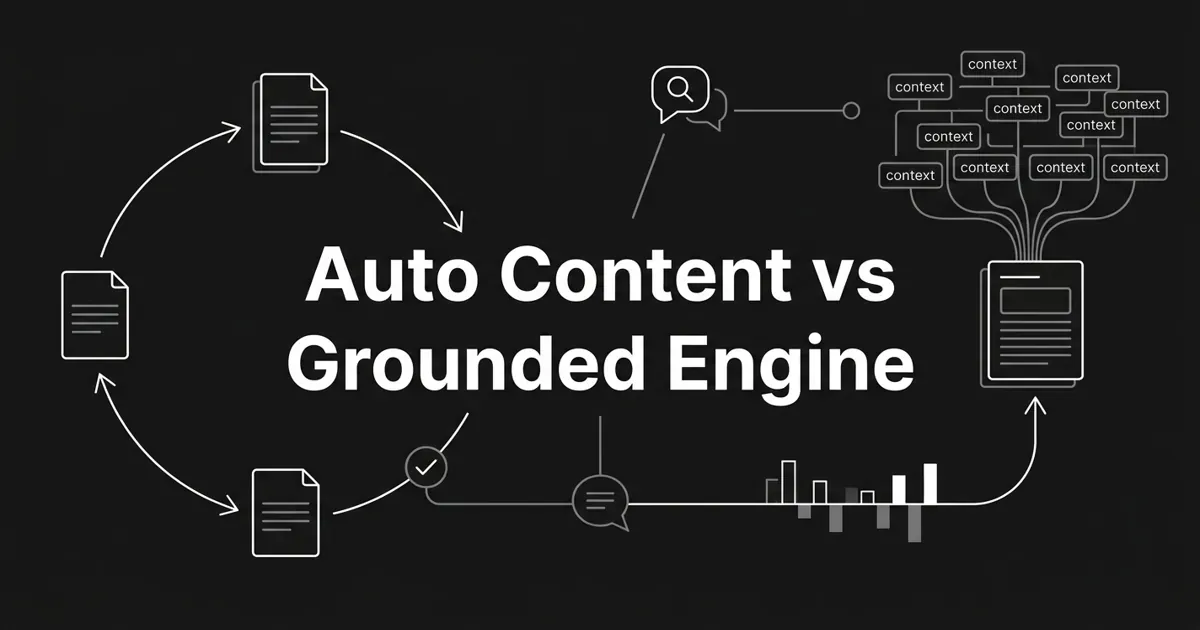
Oltre runs the combination as a continuous loop. Visibility tracking across AI engines and Google surfaces identifies prompts where competitors are cited and the brand is not, those gaps become content opportunities, drafts are produced against them, and the result is published to the connected CMS, submitted for indexing, and validated for schema. The narrative emphasizes approval over authorship, with a chat-style teammate that proposes the next step and executes it. The design goal is the smallest number of human touchpoints between a finding and an indexed page.
DeepSmith runs the combination through a shared context layer. The brand, product, persona, and voice records stored at onboarding feed both halves: visibility data determines what to write, and production drafts against that stored context so the article references real products and reads in the established voice without a fresh brief for each piece. The design goal is a draft that survives review rather than a pipeline that minimizes clicks. Autowrite exists for teams that want scheduled production to run unattended, but the emphasis stays on the finish quality of the asset.
Teams evaluating the wider category may want to look first at how platforms that track and write differ from single-purpose trackers. Neither design is inherently superior; they optimize different variables.
What DeepSmith is

DeepSmith is an AI search analytics and content production platform organized into seven areas sharing one brand-context foundation established during onboarding.
The AEO module handles visibility. It reports mention rate, citation rate, share of voice, sentiment, and period-over-period trend per platform, with a competitor leaderboard and the sources AI engines cite most often. The Prompts view holds tracked questions with per-prompt rates and full answer history, and Discover Prompts generates a starter set from product, persona, and buyer-stage context. The Pages view attributes citations to specific URLs and the prompts driving them, and competitor citations show which rival pages win on the same prompts.

Content Map answers what to write next. It crawls the brand's site and unlimited competitor sites onto one shared topic taxonomy, classifies every page by topic and funnel stage, and reports both coverage gaps where a competitor publishes more and untapped topics where the brand has nothing at all, with sitemaps re-checked every 24 hours. Opportunity Agents run on that map and on the AEO data, returning ideas with the data point that justifies each one attached.
Content Studio is production. Ideas move from New Ideas to Planned to Produced, with the Writer turning one planned idea into a finished article: researched, linked, fitted with a cover image and publish-ready metadata. Autowrite configures an article at planning time and generates it on its scheduled date with nobody in the application. Produced Content is where a human reviews, edits, and publishes to WordPress, Webflow, Strapi, Sanity, Contentful, or a webhook.
Deep IQ makes the rest cohere. It stores About Company positioning with claims to make and avoid, per-product profiles, buyer personas, brand voice settings, visual guidelines, and reusable content types. Content Map's classification of existing pages feeds the same pipeline, injecting internal links during writing and deduplicating the New Ideas backlog.

The limitations are worth stating. Engine coverage is tier-gated, so the entry Pro plan tracks ChatGPT alone and full ten-engine coverage requires Enterprise. Article volume is capped at 20, 40, and 90 per month for Pro, Grow, and Scale. Output stays on-brand only to the degree the context layer is populated and maintained, which is genuine setup work. And the platform does not guarantee rankings, citations, traffic, or revenue; it measures what the engines return.
What Oltre is

Oltre is an AI-search visibility and content-publishing platform presented as an online visibility teammate. Its stated function is to track how a brand appears across AI engines and search, identify where to act, then create, publish, and index content with minimal intervention.
On the tracking side, the site names six engines: ChatGPT, Claude, Perplexity, Gemini, Google AIO, and Google AI Mode. It also pulls Google Search Console data so organic SERP performance sits alongside AI-engine presence, a reasonable choice for teams that run the two channels as one program. Gap mapping identifies prompts where competitors earn citations and the brand does not, then presents those gaps as content opportunities. Mention rate, citation rate, and share of voice appear as metrics, with click attribution and ranking tracking also surfaced.
On the production side, the platform drafts content optimized for both AI citation and organic ranking, performs entity recognition and internal linking during production, publishes to WordPress, Webflow, Shopify, or any custom CMS by webhook, submits new URLs for indexing, and validates schema for crawlability. Multi-site publishing is supported, and onboarding is positioned as a matter of minutes with a free tier that requires no credit card.
The strengths are specific. The technical publishing chain is unusually complete: publishing, index submission, and schema validation in sequence means fewer places where a finished page stalls before an engine can retrieve it. Engine coverage is not gated by plan, so an entry plan sees the same engine list as a higher one. The free tier lowers the cost of an initial evaluation to zero, though it covers visibility analysis only.
The limitations follow from the same emphasis. Brand context exists in the workflow but is not surfaced publicly as a named module, so a buyer should confirm what the system stores about products, personas, and voice rather than assume parity with a dedicated context layer. Existing-content classification is not presented as a module, which matters for internal linking against a large back catalogue, and repurposing is not surfaced as a feature. Capacity is metered in tokens (150 on Free, 2,250 on Base, 6,000 on Pro, 12,000 on Business), and the pricing page does not define what a token measures. Content caps are separate and modest at the lower tiers: up to 4 pieces on Base and up to 12 on Pro.
Grounding: how much brand context each platform stores
This is the load-bearing difference, and it is where the choice between DeepSmith or Oltre usually resolves.
Generic output is the recurring failure mode of automated content, and the mechanism behind it is missing context rather than model quality. A system that knows the topic but not the product, the audience, or the voice produces something structurally competent and editorially anonymous, precisely the material that consumes review time. Teams that have run the last stretch of AI drafts through manual editing recognize the pattern: the first stretch arrives quickly and the remainder absorbs the hours.
DeepSmith addresses this by making brand context a first-class module rather than a settings page. Deep IQ holds six named elements, and every other module reads from them. The practical consequence is that a draft references real product features and stated value props, avoids claims marked as off-limits, addresses a defined persona, and follows a stored content-type template. The intended effect is that a draft arrives close to final because the system already holds the context a briefing document would otherwise have to supply.
Oltre's public surface does not break brand inputs into named elements. The platform evidently configures some brand information during setup, and the emphasis on entity recognition during production suggests attention to how a brand is represented. What is not published is the depth or structure of that layer. For a team weighing the Oltre AI visibility content loop against a grounded engine, the demo question is concrete: what does the system store about products, personas, and voice, and which parts of it reach the draft. Any evaluation of Oltre AI visibility content quality should run on the brand's own topics rather than on vendor samples.
The reason this outweighs engine counts on either side is arithmetic. Adding one more engine adds a column to a dashboard. Reducing the review burden on every article changes the throughput of the content function, and the effect compounds with volume.
Engine coverage and how each plan gates it
DeepSmith covers ten engines: ChatGPT, Gemini, Perplexity, Claude, Google AI Overviews, Google AI Mode, Grok, Meta AI, Microsoft Copilot, and DeepSeek. Coverage rises by tier, so Pro tracks ChatGPT, Grow adds Perplexity, Scale adds Gemini, and Enterprise and Custom cover all ten. The gating places broad multi-engine coverage on the upper tiers, but the engine carried from Pro up is ChatGPT, the surface most buyer research now begins on, so a program that concentrates on one or two engines is covered where it matters at the entry price.
Oltre names six engines and does not gate them by plan on its public site. For a team whose category shows meaningful divergence between engines, that structure is an advantage at the entry price point. The trade runs in the other direction higher up: DeepSmith's list contains all six of Oltre's and adds Grok, Meta AI, Microsoft Copilot, and DeepSeek, so the real choice is ungated breadth at the entry tier against a wider total surface on Enterprise.
The more useful question is not the raw count. Engines differ in how they select sources, and in most categories a brand's buyers concentrate on one or two surfaces. The practical test is whether the engines that matter are covered on the plan under consideration, and whether the visibility metrics reported are granular enough to act on. Neither platform controls what the engines decide to cite.
What publish-ready and autopilot actually mean in practice
Vendor language in this category is loose, so both claims are worth translating into operational terms.
Autopilot, in Oltre's framing, means the number of manual steps between a detected gap and an indexed URL approaches zero. The system drafts, publishes to the CMS, submits for indexing, and validates schema. For a team whose bottleneck is process friction, where drafts sit in a queue because someone must format, upload, and submit them, that chain removes real delay. An AI visibility auto content pipeline is most valuable where the human review step is not the constraint.
Publish-ready, in DeepSmith's framing, means the article should not require a rescue pass. Keyword coverage, heading structure, schema markup, internal linking against the classified Content Map, and metadata are produced inside the writing pipeline rather than added afterwards, and AEO formatting is native. Autowrite can run the same pipeline unattended into a review queue, but the claim is about the state of the draft, not the absence of oversight. Neither vendor promises guaranteed quality with no human involvement.
The distinction matters because the two claims respond to different problems. A team that has diagnosed why a first draft is not a published article can usually say which of the two describes its own bottleneck. An AI visibility auto content loop does not improve a draft that reads generically, and better drafts do not help a team whose finished articles never make it out of a folder.
Publishing, indexing, and CMS destinations
The integration lists overlap. Both platforms publish to WordPress and Webflow and support custom CMS destinations by webhook. DeepSmith adds Strapi, Sanity, and Contentful plus Markdown and HTML export for stacks without a direct connector. Oltre adds Shopify, the relevant difference for commerce teams.
Oltre goes further on the post-publish technical chain, featuring automatic index submission so new URLs are picked up faster, and schema validation to confirm markup is valid and crawlable. For teams that treat automated CMS publishing as the deciding requirement, this is the section to weigh most carefully: the two are close on destinations and differ on what happens immediately after a page goes live. DeepSmith includes schema markup in the writing pipeline, so the markup ships inside the draft rather than being checked after publication, and it does not surface indexing submission or validation as named features. Index submission shortens how quickly a new URL is crawled, but it does not determine whether an engine cites the page, the outcome the grounded pipeline is built to move.
Distribution after publishing
DeepSmith attaches social posts to every finished article and offers an Apps Library that adapts one article into platform-native versions for LinkedIn, X, Medium, Substack, newsletter and nurture email, Reddit, Facebook, Instagram, Slack and Discord, WhatsApp, and further channels, each fitted to that channel's tone and length. Oltre does not surface repurposing as a named module publicly, which does not establish that the capability is absent, only that it is unpublished.
For content leads whose distribution step reliably falls off the schedule, this matters more than a feature table suggests.
Multi-brand and agency setup
Agencies and multi-brand teams should treat this section as decisive. DeepSmith's Multi-Workspace model isolates each client with its own context, content, plan, and billing, with teammates invited as owners or members. Because Deep IQ is per workspace, one agency account can hold different brand voices and product sets without cross-contamination.
Oltre supports multi-site publishing from a single account, which covers the publishing requirement, but the public site does not surface isolated per-client workspaces with independent billing. The criteria in a broader survey of AEO tools for agencies apply here as well. Agencies evaluating an Oltre alternative should confirm how client separation and billing work before committing, since the operational difference between multi-site publishing and full workspace isolation is significant at scale.
Pricing side by side
| Tier | DeepSmith (USD) | Oltre (EUR) |
|---|---|---|
| Free | None; 7-day trial | €0, 150 tokens, analysis only |
| Entry | Pro $99/mo, $80 annual: 20 articles, 50 prompts, 5 seats | Base €89/mo, ~€71 annual: 2,250 tokens, up to 4 pieces |
| Mid | Grow $199/mo, $160 annual: 40 articles, 100 prompts, 7 seats | Pro €199/mo, ~€159 annual: 6,000 tokens, up to 12 pieces |
| Upper | Scale $399/mo, $299 annual: 90 articles, 200 prompts, 10 seats | Business €349/mo, ~€279 annual: 12,000 tokens, up to 24 pieces |
| Enterprise | Custom limits, all ten engines, dedicated account manager | Custom, unlimited tokens and content |
Two cautions apply to any direct reading of these figures. The currencies differ, so headline numbers are not equivalent without a conversion. The capacity units differ too: DeepSmith meters articles and tracked prompts explicitly, while Oltre meters tokens alongside a separate content cap without publishing a definition of what a token measures. Budget models should also account for the review time each option leaves behind, the variable a total cost framework captures and a pricing page does not. On article volume the gap is wide at comparable price points, with 40 articles on DeepSmith's mid tier against up to 12 pieces on Oltre's.
Which should you choose
Choose Oltre when the constraint is process friction and technical publishing. Teams that already produce acceptable copy but lose time between draft and indexed page benefit most from a loop that publishes, submits, and validates in sequence. Ungated engine coverage at the entry tier and a zero-cost analysis plan make it a reasonable first evaluation, and commerce teams on Shopify have an integration reason to look here.
Choose DeepSmith when the constraint is draft quality and volume. Teams whose review cycle is the bottleneck, where every draft needs product accuracy, voice correction, and internal linking before it can ship, gain more from stored context than from fewer clicks. The same applies to teams that need volume, since the article allowances are materially higher at each price point.
Choose DeepSmith for agencies and multi-brand operations. Workspace isolation with per-client context, content, plan, and billing is the requirement that separates the two most clearly.
Evaluate neither when the requirement is pure measurement. A team that only needs tracking, with content produced elsewhere, is paying for production capability it will not use. Comparing dedicated AI visibility tools is the better starting point. Teams weighing several does-both platforms may also find the DeepSmith and AirOps comparison useful for triangulating the category.
The most reliable way to settle DeepSmith vs Oltre is to run the same prompts and the same two topics through each product, then compare the drafts against the standard the brand publishes at. Feature tables narrow the field; output settles it. To see the grounded version on real brand data, start a free DeepSmith trial and review the drafts before paying.