If you run a young SaaS company, your homepage probably feels like it has to do everything. It's the page people land on from a brand search, the page a stranger reads to work out what you sell, and the page you keep wanting to add another keyword to. This guide walks you through homepage SEO in eight steps, so you finish with a clear decision on what the page should target, a first screen that matches what shows up in search, and links that send visitors and crawlers to the right places.
The short answer is that a homepage should explain your brand and its main product category, offer one clear next action, and route people to more specific pages. It doesn't have to be the best answer to every feature, audience, comparison, and how-to question. This guide covers the single homepage on your site, not campaign pages or product pages, which have their own checklist.
You'll need access to Google Search Console, your site analytics, and about an hour to sit with your own homepage.
Step 1: Audit what the homepage attracts and promises
Good SaaS homepage SEO starts with knowing what the page does today, so write that down first. Record the current title, the main heading, the opening explanation, the main action, the top navigation, and the pages the homepage links to. Then open Search Console, look at the homepage as a page, and go through its queries, clicks, impressions, click-through rate, and average position. Sort the queries you see into brand, category, and everything else, and make a note of any search where a different page on your site would be a better answer.
Look at the first screen on desktop and on a phone as if you had never heard of the company. Then list the specific pages a visitor would need to reach from here, such as pricing, the main features, and your best use cases.
You're done when you have a one-page inventory of the current messaging, the search demand, the actions you want visitors to take, and the pages that already exist to send them to.
A common mistake is treating every query your site gets as a homepage query. Another is deciding that a phrase with a lot of impressions has to become the hero headline. Search Console tells you how often you appeared and were clicked, and it can't tell you who signed up.
If you want a faster way to see your existing pages, DeepSmith's Content Map crawls your site and sorts every page by topic and funnel stage, so you can see which homepage routes already have a good destination and which topics have nothing yet. It won't edit your homepage, and it doesn't replace checking your actual Google query data, but it does make the inventory quicker.
Step 2: Give the homepage one primary search job
This is the step that settles most of your homepage keyword strategy. Write one sentence in this shape: "For [audience], [brand] is a [accurate category] that [main outcome]." Then compare the category words with the way your customers describe you, because those two don't always match.
Next, search the broad category phrase you have in mind and look at who shows up. If the results are mostly other companies' homepages, your homepage may be a reasonable candidate. If they are mostly definitions, explainers, or lists that compare several tools, the page is probably the wrong format for that phrase, and a brand-first homepage is a perfectly good choice. A published SaaS homepage guide once pointed out that a phrase like "small business CRM" looked ideal but returned mostly informational lists. That was one article looking at the results of its day, so check your own results today rather than assuming it applies to you.
Then choose the role. It's either brand only, or brand plus one broad category that really fits what you sell. Everything else goes on a destination map: feature terms, integrations, use cases, industries, comparisons, pricing, and detailed how-tos. Some of those pages may not exist yet, and that's fine, since the map is how you find out.
Keep in mind that a homepage can mention many subjects and link to them without treating each one as a ranking target. A keyword map gives each subject a job, and it doesn't ask for a certain number of mentions. There's also no rule from Google that says a homepage can only handle one or two keywords, so treat this as a practical way to work rather than a limit.

You're done when the team can name the main audience, the category, the main action, and the subjects the page will deliberately send elsewhere. Any category target should have passed the live results check above.
People tend to go wrong in three ways here. They pick the highest-volume phrase without checking intent, they stuff several nearby categories into the title and hero, or they drop the brand name in the hope of ranking for nonbrand searches. Also, don't assume your homepage will always outrank a more relevant inner page.
DeepSmith's AEO tracking can help with the positioning side of this. You define the buyer questions, and it shows how AI engines describe your brand for each one and whether they mention or cite you. That's useful input for what to say and which supporting pages to build, though it doesn't show whether the homepage will rank on Google or that an edit will lead to an AI citation.
Step 3: Write the search promise and the page promise together
For homepage optimization, the search result is where people first meet you. Give the homepage a unique, descriptive, short HTML title that combines your actual brand name with your main offer or category. Write a site-level meta description that says accurately what you offer and gives someone a reason to visit. Then make the visible heading on the page agree with both, so a person who sees your result and then lands on the page reads the same description twice. Use one clear main heading, not a pile of competing headline-sized claims.
To picture it, a made-up scheduling company might use "Team Scheduling Software | ExampleCo" as its title and "Plan shifts without the spreadsheet handoff" as its heading, with a supporting line saying who it's for and what they can do. Swap in a category and a benefit that your own product can back up.
You're done when someone who sees the search result and then the hero gets the same understandable picture of the company, and when the title and description are unique to the homepage and accurate.
A frequent mistake is using only an abstract slogan, or the opposite, an exhaustive list of keywords. Another is assuming the title and description you write will show up exactly as written. Google builds title links automatically from several signals, including the HTML title and the prominent text on the page, and its title link guidance says changes can take days to weeks to be recrawled and processed. Snippets usually come from the page content, and Google may use your meta description when it describes the page better. Google also sets no universal character limit for either, so what's displayed may be shortened to fit the device.
Pro tip: because Google often pulls snippets from the visible copy, make the text near the top of the page informative and not just decorative.
Step 4: Make the hero answer the immediate questions
The first screen should carry your company identity, a recognizable category, the person it's for, the main outcome, and one clear action. A supporting line can explain what makes you different or how the promise works. Say what the next click leads to, such as starting a trial or seeing the product. If an unfamiliar product needs an example or a visual to make sense, show something real and relevant, and check the result at common phone widths as well as on your own desktop.
You're done when a person who has never heard of you can look at that first screen and say what you sell, who it helps, and where to go next. The main action should be easy to find without hiding the routes for people who want to read more before deciding.
The usual mistakes are a vague headline like "transform your workflow" with no product category in it, a carousel or animation that hides the offer, an unsupported superlative, or several equally loud buttons that make a new visitor guess. It helps to remember that "above the fold" is about priority. It doesn't mean nothing useful can go lower on the page.
If you use DeepSmith, your positioning, product facts, personas, claims to avoid, and brand voice can live in Deep IQ, and those become the source material for the supporting content it produces. That gives you one approved description to check your hero against. It doesn't rewrite or publish your homepage for you.
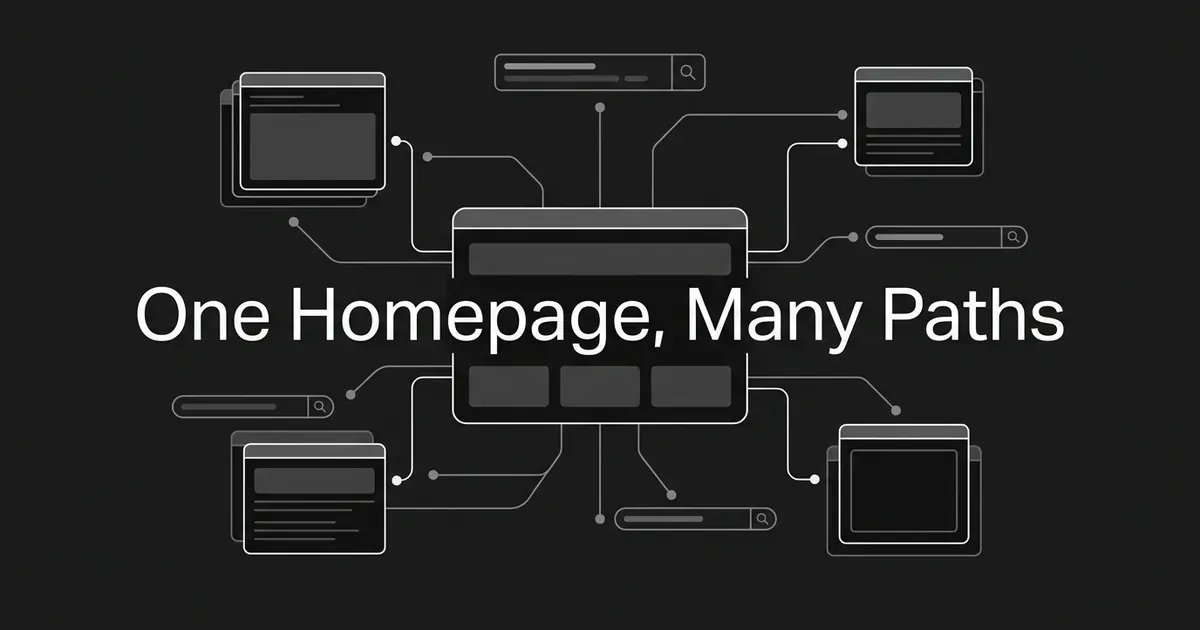
Step 5: Build the rest of the page as a selective directory
Below the hero, add short sections for the most important capabilities, use cases or audiences, and evaluation needs. For each one, say what the user gets in concrete terms and link to the page that goes deeper. Someone who needs reassurance should find real product information, pricing if you have it, documentation or integrations if they matter, and real customer evidence if you have permission to use it.
You're done when the page explains its main offer first and then branches into paths people recognize, with a useful destination behind each one. Nothing important should be reachable only through the site search box or an on-page interaction that a crawler may not follow.
The mistakes to watch for are a long, shallow list of keywords, generic claims where a real example would do, invented testimonials or logos, and putting every destination into the hero. Google has no preferred homepage word count, so length isn't the goal.
Common mistake: "We want to rank for this feature, so let's add another feature paragraph to the homepage." A better question is whether a buyer searching for that feature needs a fuller answer on its own page, with a clear route from the homepage. If they do, the paragraph on the homepage should be short and the link should be good.
Step 6: Make the homepage links do real navigation work
Your navigation should follow the choices people actually make, and the important sections should be reachable through ordinary HTML links that point to real destinations. Link each capability or use-case summary to the page that fits it best, and use short, specific labels. "Shift scheduling" tells a visitor more than "Learn more" does, provided that's really the subject of the page behind it. Look at the header, the body sections, and the footer together, so each important destination has a findable path without you repeating every link everywhere. Also make sure the pages deeper in the site lead people onward too.
You're done when a visitor can guess where each label goes, and when you can reach every important destination by following links. Inspect the rendered homepage and confirm you see standard anchor elements with href attributes, as Google's guidance on crawlable links describes. A manual click-through shouldn't depend on JavaScript-only controls or typing into site search.
People go wrong with keyword-stuffed anchors, rows of identical "Read more" links, menu labels made only of internal product terms, or the belief that an XML sitemap can stand in for useful navigation. Google uses links and how they relate to work out site structure and which pages matter more. Its example guidance for that is written for ecommerce, so take the linking idea and leave the page hierarchy behind. Sitelinks are chosen by Google's systems, so no homepage setting will guarantee them.
A homepage with inbound links can help people and crawlers find the pages it links to. That doesn't mean it should rank for the subject of each page, and adding links doesn't promise a position. If you're building the links out at scale, the guide on pillar-spoke internal linking goes into the wiring in more depth. There's also a good one on internal linking for SaaS sites. It's worth reading about anchor text before you rewrite your labels too.
When an important destination doesn't exist yet, Content Map can point out the coverage gap. From there, Content Studio can turn a planned idea into a researched article with internal and external links and publish-ready metadata, using Deep IQ for product and voice context. Those tools help you build the supporting pages. They don't decide whether a page satisfies the buyer's intent, and they don't replace a deliberate edit to your homepage navigation.
Step 7: Check the technical identity and crawlability
Confirm that the preferred homepage URL is accessible, indexable, and works on mobile. Look for duplicate entry points, such as HTTP versus HTTPS and www versus non-www, pick the one you want, and redirect the others to it. Then check your canonical signals and see which URL Google actually selected. Make sure the main explanation is readable text, and that the important links can be followed.
If you want more say in the site name Google shows, add valid WebSite structured data on the root homepage of your domain or subdomain. Include the site's name and its canonical homepage url, and use alternateName only for a genuine alternative name. Google's site names guidance is the place to check the details, and the markup should agree with the branding people see on the page.
You're done when visitors and crawlers land on the version you intended, Google can reach the main content and links, and the site name markup, if you added it, is valid and sits on the real root homepage.
The common slips here are treating a canonical tag as an order when it's only a signal, putting the site name markup on an interior page, and assuming schema will force Google to show the name you picked. A site name is also a separate thing from the title link on any one result, and Google chooses both. The last slip is hiding the essential text behind an interface that a crawler can't use.
Step 8: Measure discovery, onward movement, and conversion separately
SaaS homepage SEO is easy to misread afterward, so save a baseline before you change anything. In Search Console, filter the Performance report to the homepage and look at its queries and search metrics. Google made its branded queries filter available to all eligible sites on March 11, 2026. If you have it, compare branded and nonbranded performance, without treating either group as a stand-in for conversions. Eligibility needs a top-level property and enough query and impression data, and the filter's AI-assisted sorting can occasionally misplace a query. It changes how the data is reported and it doesn't change rankings.
Then look at your important destination pages on their own, to see whether they start picking up their own queries once the homepage links to them. In your analytics, compare homepage entrances, meaningful onward clicks, and your chosen key event, whether that's a signup or a demo request. Split the numbers by channel and device, so a lot of brand-heavy traffic doesn't cover up a problem for first-time visitors, and write down the date of each change so you can come back after Google has had time to process it.
If you link Search Console to Google Analytics, keep a few limits in mind. The Queries report can lag by about 48 hours, it only covers the 16 months that Search Console keeps, and it doesn't tie individual search queries to individual signups. AI Overviews and AI Mode appearances are counted within Search Console's Web search reporting, and there's no guaranteed separate homepage metric for them.
You're done when you have a before-and-after view of three separate things: search visibility, movement to relevant pages, and business actions. If clicks go up and signup intent goes down, look at the promise on the page and at the mix of traffic before you call it a win.
The mistakes here are reporting rankings as if they were revenue, reading a change in branded demand as proof that a homepage edit worked, and treating a small company's noisy short-term data like a controlled experiment. Please don't promise anyone a fixed percentage lift either, because nothing in the sources supports one.
If you track AI answers with DeepSmith, you can add a fourth view alongside these: which of your tracked buyer prompts now lead to a mention or citation of your brand. Read it as a separate signal, since it doesn't show that a homepage change caused anything on Google.
What to do next
Pick the homepage's primary job this week and write the positioning sentence down. Then revise the first-screen promise so it matches your title, map the three or four onward routes that matter most, and capture your baseline before you touch the page. This keeps your homepage keyword strategy tied to the page's job, and it keeps you from rewriting copy before you know what it's supposed to do.
If you'd like help building the supporting pages your homepage will link to, you can start a DeepSmith free trial. It includes 7 days with real data and real drafts before you pay.