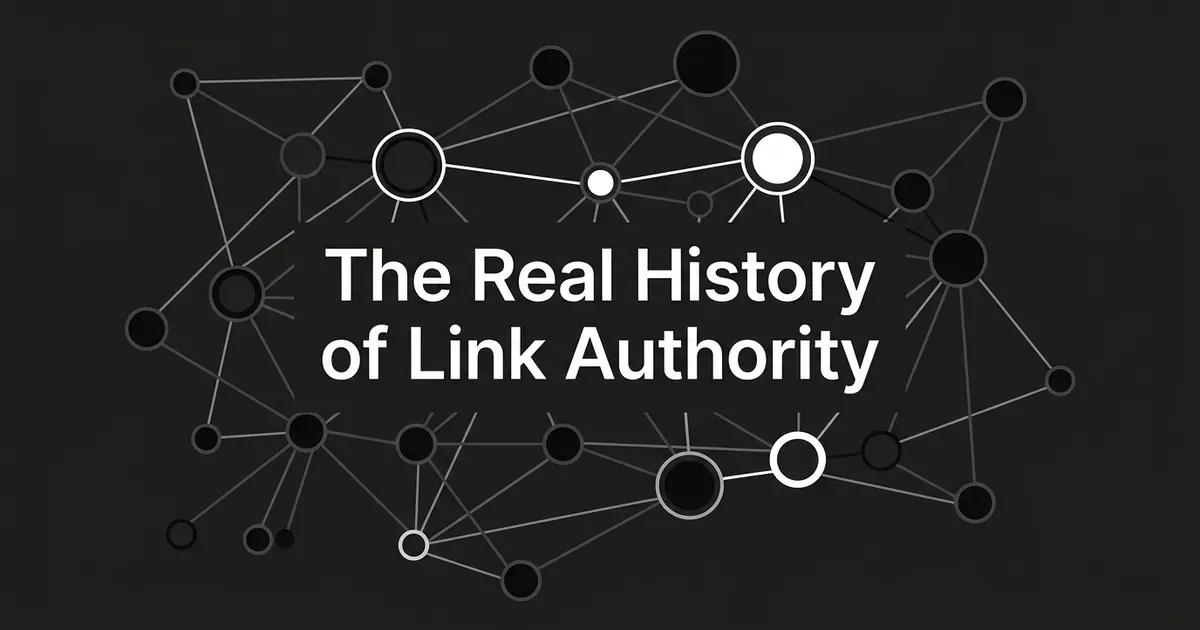
Link authority is the importance a search engine infers from the relationships between pages, and three different research ideas built that concept from three different angles. PageRank explained a page's importance as something that comes from the pages linking to it, weighted by how important those linking pages are. Hilltop asked a narrower question: which pages are authorities on this specific topic, based on independent experts who say so. TrustRank asked a different question again: which pages are probably reputable rather than spam, based on how far trust travels from a small set of human-checked seeds. Only PageRank is explicitly confirmed by Google today as part of its current core ranking systems. Hilltop and TrustRank are real, influential research, but nothing public says Google still runs either one by that name.
That distinction matters because a lot of SEO advice still treats these three names as the same thing, or as stages in one tidy replacement story: PageRank, then the Hilltop algorithm fixed its flaws, then the TrustRank algorithm fixed Hilltop's flaws, then some newer centrality measure replaced all of it. That story is clean, but it isn't what the research or Google's own public documentation actually says. Each algorithm solves a different problem, and knowing which problem is which matters more than memorizing a timeline.
What did PageRank actually measure?
PageRank is a measure of a page's importance based on the link graph around it, not a count of how many links point to it. A page gets more importance when important pages link to it, and less when unimportant pages do. That's the whole idea, and it's a bigger shift than it sounds like, because it means a link isn't a link. Ten links from ten unimportant pages do not automatically add up to more than one link from a page that matters a lot.
Larry Page and Sergey Brin described this in their 1998 paper on the original Google prototype, and they were explicit it wasn't just counting citations the way earlier search tools did. Their simplified version of the formula looks like this:
PR(A) = (1 - d) / N + d × Σ[PR(T) / L(T)]
Here, A is the page being scored, T stands for each page linking to A, PR(T) is that linking page's own importance, L(T) is how many outgoing links it has, N is the total number of pages, and d is a damping factor the authors said they usually set to 0.85. Think of d as the chance a random surfer clicking around the web keeps following links instead of jumping to a totally different page. The math is recursive: a page's score depends on the scores of the pages linking to it, which depend on the pages linking to those, until the whole system settles.
Here's a small, made-up example that shows the idea without pretending to be a real calculation. Say Page B has a score of 0.12 and six outgoing links. Its contribution to any one page it links to, before damping, is 0.12 divided by 6, or 0.02. Apply the 0.85 damping factor and that contribution becomes about 0.017. Now say Page C has a score of only 0.02 and two outgoing links, so its contribution through one link works out to about 0.0085. Page B passes along roughly twice what Page C does, even though both are "a link." That's the part a flat backlink count misses.
What PageRank did not do on its own is figure out whether a page matched what you were searching for. The basic score doesn't look at a query at all, so by itself it can't tell a page that's important across the whole web from a page that happens to be the right answer to your question. The 1998 paper is clear that the original engine combined PageRank with other signals, including anchor text (the words used in the link itself) and how closely the words on a page matched your search terms. Importance, relevance, and anchor text were separate ingredients being combined, not one score doing everything.
None of that detail is a current Google setting you can rely on. The 0.85 damping figure and the simplified formula are historical teaching tools from a 1998 paper, not a disclosure of what runs today. What the example does show, accurately, is the underlying principle: a link's weight depends on where it comes from.
What did Hilltop add to topical authority?
PageRank's blind spot was topic. A page can be generally important across the web and still have nothing useful to say about the specific thing you're searching for. The Hilltop algorithm, research published in 2000 by Krishna Bharat and George A. Mihaila, tried to answer a narrower question: out of all the pages that might be relevant, which ones are authorities on this particular topic, according to people who have no stake in the outcome?
The method starts with a special set of "expert documents," pages that link out to many non-affiliated pages on a given topic. A good mental model is a well-maintained resource page or topic directory, the kind of page whose whole purpose is pointing you toward other good pages on a subject. "Expert" here is a role the algorithm assigns based on link behavior, not a credential a person has earned, so it's worth keeping separate from how marketers now talk about expertise under E-E-A-T.
Independence does a lot of work in this model. An expert document only counts if its recommendations cover genuinely separate organizations rather than just promoting its own related properties, and a target page only earns credit if the experts endorsing it are independent of each other too. Five pages from the same company linking to the same guide are not five independent opinions just because they sit on five different URLs.
The mechanism runs in steps: build the expert collection, pick the most relevant experts for a query, find links on those expert pages whose surrounding text matches the query, follow those links to candidate pages, then rank candidates by how many independent experts endorse them. In the reported experiment, Hilltop considered roughly 200 relevant experts at query time, and the original scheme required a target page to be linked to by at least two non-affiliated expert pages before it counted at all.
The algorithm's honest limitation is that it trades coverage for accuracy. The paper says plainly that it returns no results when it can't find a suitable pool of experts for a query, which is why it's a lesson about topical endorsement, not a universal search solution for every query. And while the authorship connects to Google (Bharat later worked there), the paper only establishes the mechanism, not that Google ever deployed it in production. The honest version of this is: Hilltop demonstrated how independent, topic-relevant endorsements can identify authorities on a subject, and whether Google runs that exact algorithm today isn't something the public record settles.
What did TrustRank add to spam detection?
The TrustRank algorithm is trying to solve a different problem again: not "what's important" and not "what's an authority on this topic," but "is this page probably legitimate, or is it probably spam?" The research, published in 2004 by Zoltán Gyöngyi and Hector Garcia-Molina of Stanford along with Jan Pedersen of Yahoo, starts from a practical constraint: humans can judge whether a page is spam reasonably well, but nobody can manually review the entire web.
The workaround is to have people check a small number of carefully chosen pages, then let that judgment spread through the link graph. The researchers call the core assumption behind this "approximate isolation," meaning good pages rarely link to bad ones. It's deliberately approximate, because good pages do occasionally link to bad destinations by mistake, and the reverse doesn't hold either: a spam page can still link to a reputable one without making that reputable page less trustworthy.
Mechanically, researchers pick candidate seed pages, have an expert evaluate them, keep the ones judged reputable as trusted sources, then propagate a trust score outward through links, dividing and reducing it so distant pages get less of a boost than close ones. Under the hood, this is a biased version of the PageRank calculation, where the starting weight is concentrated on the good seeds instead of spread evenly. That's a real technical link to PageRank's machinery, but a different purpose and a different starting point, not a rename of the same score.
In the real-web experiment behind this algorithm, researchers manually evaluated 1,250 candidate sites and selected 178 as good seeds, out of an evaluation sample of 1,000 sites that was deliberately not randomly chosen. Stanford's own summary describes the result as effective spam filtering across a meaningful share of the web using fewer than 200 good seed sites, which is a real result, but not a claim that this exact system now runs inside Google.
A trust score in this model is not a universal rating of accuracy, prestige, or expertise on every topic; the paper frames it as the likelihood a page is "good" in a web-spam sense. And linking out to a trustworthy source does not make your own page trusted by some kind of automatic transfer. Trust flows from the seeds outward through links; it doesn't flow backward to whoever points at a good page.
Does Google still use PageRank?
Here's where the history gets confusing if you don't separate two things: the public score, and the internal system. For years, Google showed a visible 0 to 10 Toolbar PageRank score for any page. That public number stopped being meaningfully updated around late 2013, and the remaining feed was shut off entirely on April 15, 2016. A lot of people read that as "Google killed PageRank."
They didn't have to wait long for a correction. On February 9, 2017, Google's Gary Illyes posted publicly that after 18 years, Google was still using PageRank, along with hundreds of other signals, in ranking. That statement, reported the next day, drew a line under the distinction: the public-facing meter went away, but the underlying system didn't.
Google's current ranking systems documentation backs this up. It names PageRank as one of the systems in place when Google launched, then says plainly that how PageRank works has evolved a lot since then, and that it continues to be part of Google's core ranking systems. That page carries a late-2025 update date, a much better anchor than a nine-year-old statement alone.
None of this tells you the current formula or how it interacts with everything else Google considers. "Evolved a lot" is doing real work in that sentence, and treating the 1998 formula as a live description of today's system would be a mistake. The accurate version of this history is: Google retired a public display of a PageRank-derived score in 2016, while continuing to use some evolved form of PageRank internally. Only one of those two facts is about the algorithm actually running.
Where does harmonic centrality fit into all this?
Harmonic centrality sometimes gets lumped into this conversation as if it's the thing that quietly replaced PageRank. It's worth a short, bounded explanation, because it isn't that.
Harmonic centrality measures how close a node is to every other node in a graph, using the inverse of the shortest path distance between them, rather than PageRank's recursive, random-walk style of calculation. For an incoming version of the measure on a directed graph, a page's score is the sum of one divided by the distance from every other page that can reach it, and a page that simply can't be reached contributes nothing. A quick illustration: if a page is reachable from three other pages at distances of one, two, and four steps, its score adds up to 1 plus 0.5 plus 0.25, or 1.75. That's an unnormalized, made-up number meant to show the mechanics, not a real score from any live system.
Paolo Boldi and Sebastiano Vigna's paper "Axioms for Centrality" works through harmonic centrality as one of several ways to formalize what "important in a graph" even means, and it addresses a real technical headache in this kind of measure, which is how to handle nodes that simply can't be reached. None of that establishes that Google swapped PageRank out for this or any other centrality measure. It's a different mathematical lens for looking at a link graph, and a different lens existing somewhere in the research literature is not evidence that anyone's production system is built on it.
What should link equity mean to you now?
"Link equity" gets used as a catch-all in marketing conversations, but it isn't one disclosed Google metric bundling PageRank, Hilltop-style endorsement, TrustRank-style spam resistance, and harmonic centrality into a single number. It's practitioner shorthand for the idea that links carry some kind of value, and the history above is useful mainly because it breaks that shorthand back into the separate questions it's actually made of.
Start by asking whether a page linking to you is useful, genuinely relevant to the subject, and maintained independently of your own organization, rather than counting how many links point your way. The old two-expert minimum was a research condition in one experiment, not a backlink quota to chase today.
Treat discovery and authority as separate jobs for a link to do. Google's own documentation says links help it find pages to crawl and understand what a page is about, and that value holds even when no visible authority metric moves as a result. Google recommends that every page worth finding be reachable from another page on your site. That means using a crawlable link element, not a script-only interaction a crawler can't follow.
Inside your own content, make links useful to the person reading, not just to a crawler. Connect related explanations and supporting evidence where they actually belong in the argument, using anchor text specific enough to tell a reader, and an answer engine pulling a snippet, what they'll find on the other end. Google is explicit that there's no magic number of links a page should have, so resist the urge to hit a fixed count per article.
When you link out to sources, do it because the source genuinely backs the claim, not because you're hoping some trust rubs off automatically. Citing real sources helps a reader trust what you've written, but it isn't the same mechanism as seed propagation, and it doesn't import a trust score from the site you're citing.
Last, don't manufacture the pattern these systems were built to catch. Google's spam policies describe link spam as creating links mainly to manipulate rankings. That includes buying or selling links, excessive link exchanges, and automated link schemes. This lineage isn't an instruction manual for hiding that pattern better; it's a reminder that both algorithms exist because manufactured signals are easy to produce and worth detecting.
None of this hands you a formula for AI citations either. Search rankings, organic traffic, and getting cited inside an AI-generated answer are related outcomes, but not the same outcome, and nothing in this research establishes a conversion rate between any of these scores and your odds of showing up in a chatbot's answer.