For pulling AI visibility data into your own tools, Peec AI is the more open of the two: it offers a documented API, an MCP server and a Looker Studio connector, while the Semrush AI Visibility Toolkit has no documented AI visibility API and only partial MCP and BI paths. Peec suits teams that want to build on the data, and Semrush suits teams already inside its suite. DeepSmith offers a read-only API and MCP server too, and it also writes and publishes the content that closes the gaps the data shows.
Peec AI vs Semrush AI Visibility Toolkit for API and MCP access mostly comes down to whether your data leaves the tool complete and in a form your dashboards and AI assistants can use. Peec built several ways out. Semrush has real export and reporting options, but most of its developer access covers SEO data rather than AI visibility data. DeepSmith sits alongside both with a read-only API, an MCP server and webhooks. This page covers only that one job, and the full comparison of the two is on a separate page.
Peec AI vs Semrush AI Visibility Toolkit: the short answer
- Choose DeepSmith if you want AI visibility, Content Map and content data available through a read-only REST API and MCP server, with signed webhooks to trigger your own workflows, and you also want the same platform to write, publish and repurpose the articles that follow.
- Choose Peec AI if you want to build on tracking data with a public API, an MCP server on every brand plan and a Looker Studio connector, and you are happy to do the content work yourself or with your own AI tools.
- Choose the Semrush AI Visibility Toolkit if your team already works in Semrush and CSV exports, scheduled reports and My Reports add-ons are enough, and you do not need AI visibility data in an API.
| Criterion | DeepSmith | Peec AI | Semrush AI Visibility Toolkit |
|---|---|---|---|
| Entry price (monthly) | $99 | $95 | $99 |
| Free trial | 7-day | Yes, length not stated | No (7-day trial on Semrush One Starter and Pro+) |
| Public API | Yes, read-only | Yes, beta | Partial |
| MCP server | Yes, read-only, 23 tools | Yes | Partial |
| BI connectors | - | Yes | Partial |
| CSV export | - | Yes | Yes, 10 exports daily |
| Stored AI answers | Yes | Yes | Partial |
| CMS publishing | Yes | Not listed | Not listed |
| Content generation | Yes | No | No |
| Review rating | 4.8/5 on G2 | 4.8/5 on G2 | 4.4/5 on G2 (whole Semrush suite) |
Pricing and features as of September 2026, from each vendor's site and public reviews.
Peec AI
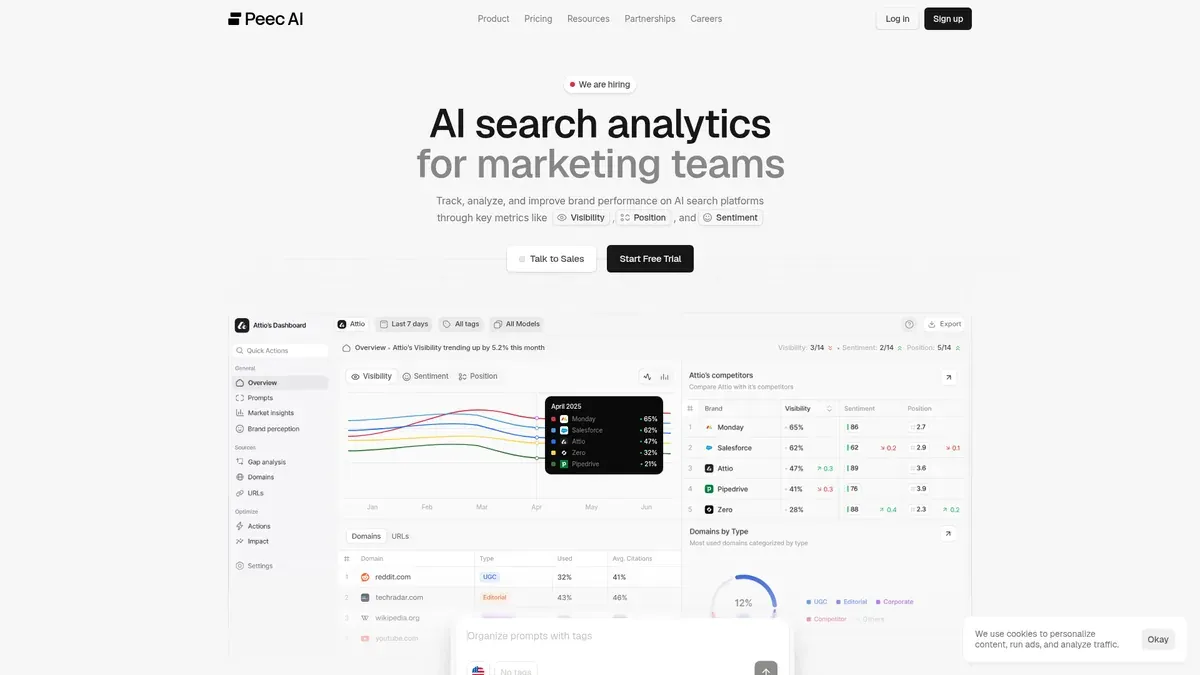
Peec AI is an AI search analytics tool from Berlin that runs your tracked prompts through engines such as ChatGPT, Google AI Overviews, AI Mode, Gemini and Copilot every day and reports visibility, position, sentiment and the sources each answer cites. Brand plans start at $95 per month for 50 prompts and unlimited users.
Data access is a clear strength for Peec. Its MCP server is checked on all four brand plans, CSV exports are on every plan, a Looker Studio connector starts at Advanced, and a documented JSON API covers reports, projects and actions. Peec says it stores the raw answers and reports cited sources at domain and URL level, which gives a BI team something detailed to work with.
The limits are mostly about gating. Peec's API docs call the API beta and limit it to Enterprise, even though the pricing grid also checks it for Pro and Advanced. It does not write content, so the data has to be turned into articles somewhere else. G2 shows 4.8/5 from 20 reviews as of 2026-09-29, with praise for ease of use and one reviewer mentioning the MCP integration. That review base is small. A separate Peec review goes deeper on pricing and reviews.
Semrush AI Visibility Toolkit

The Semrush AI Visibility Toolkit sits inside the Semrush platform. It is sold on its own at $99 per month, or bundled with the SEO Toolkit in Semrush One from $199 per month. It covers an AI Visibility Score, competitor gaps, prompt research, sentiment and daily prompt tracking, with 25 tracked prompts on the standalone plan.
On data access, the paths that are documented are narrower. Semrush's API docs list SEO, Projects, Local and Trends APIs, and no AI visibility endpoints. The Semrush MCP gives ChatGPT, Claude, Gemini and other assistants read-only access, but the data it lists is SEO, traffic and backlink data, not AI visibility data. For reporting, My Reports can add Google Analytics and Search Console with the $10 Base Report add-on, and more than 20 external integrations with the $20 Pro Report add-on. CSV export is limited to 1,000 rows per export and 10 exports per user per day.
The Semrush AI Visibility Toolkit review covers the rest of the product. Semrush's review scores cover the whole suite, so they say little about this toolkit: G2 shows 4.4/5 across more than 4,000 reviews of the suite.
DeepSmith: the alternative that reads out and writes back

Peec and Semrush both stop at the data. Peec hands you tracking data to build on, and Semrush gives you reports and exports. Neither one writes the article that closes a gap, so the data you pull out is where the work begins.
DeepSmith treats data access and production as one system. The read-only REST API returns AI visibility data (mention rate, citation rate, share of voice, per-platform results, competitor leaderboard, cited sources, your cited pages, prompts and the AI answers themselves), Content Map data and the content library, including article bodies. Keys are scoped, the limit is 120 requests per minute per workspace, reads spend no credits and an OpenAPI spec is published. The MCP server gives an assistant 23 read-only tools and works with Claude, Claude Code, Microsoft Copilot, Perplexity, Cursor, VS Code and others. Signed webhooks tell your own systems when content status changes or an Opportunity Agent run finishes.
The same data feeds the writing. Opportunity Agents turn gaps into ideas with the evidence attached, the Writer produces publish-ready articles grounded in Deep IQ, and Produced Content publishes to WordPress, Webflow, Strapi, Sanity or Contentful.

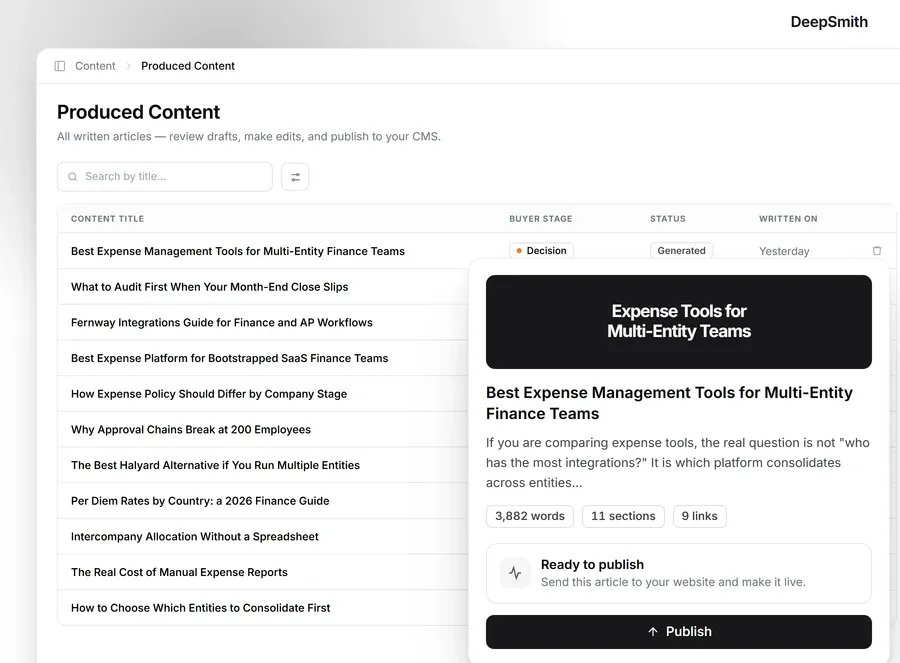
DeepSmith costs $99 per month on Pro, $199 on Grow and $399 on Scale, or $80, $160 and $299 billed annually, with a 7-day free trial and no long-term contracts. If you want the wider picture, DeepSmith vs Peec sets the two platforms side by side. DeepSmith vs Semrush AI Visibility Toolkit does the same for Semrush. Developer access is documented at docs.deepsmith.ai, and teams who want to build dashboards would start from the REST API and its OpenAPI spec.
API access
Peec AI wins on API access. On the Peec AI vs Semrush AI visibility API question, the two are not close. Peec documents a customer API that returns JSON over the same data as the platform, and it is the one of the two with documented endpoints for visibility data. The catch is that Peec labels it beta and its docs say Enterprise only, while the pricing grid lists it from Pro, so check your plan before you plan around it.
The Semrush API needs an SEO Business plan or Semrush One Advanced, plus purchased units, and the documented APIs cover SEO, Projects, Local and Trends. If you are choosing Peec AI or Semrush AI Visibility Toolkit for API and MCP access and want AI visibility rows in your warehouse through an API, the Semrush toolkit has no documented route today. A list of AEO tools with an open API is a good next stop if neither fits.
What DeepSmith does: DeepSmith's read-only REST API exposes visibility, Content Map, content library and Deep IQ data with scoped keys, and an OpenAPI spec is published. Because the API can read the article body and the AI answers behind each prompt, one pull can join what AI says with what you published.
MCP server for AI assistants
Peec AI wins here too. Its MCP server lets an assistant query visibility, sources, competitors, brand perception and shopping data in plain language, it works with Claude, Cursor, VS Code, Windsurf, n8n and Make, and it is checked on every brand plan. Peec's changelog says an external agent can turn that data into a content brief. A walkthrough on how to connect your marketing stack to an AI assistant shows what the setup involves.
Semrush has an MCP server, included with 50,000 units on Semrush One Starter and Pro+, and official apps in ChatGPT, Claude and Perplexity. The data scope it documents is SEO, traffic and backlink data, so an assistant connected to it cannot answer AI visibility questions from what is listed. If you want to know what an MCP server is before choosing, a guide to what an MCP server is for a content team covers the idea.
What DeepSmith does: DeepSmith's MCP server gives an assistant 23 read-only tools across visibility, competitors, the Content Map and the content library, with one URL and an API key per workspace. You can ask Claude or Cursor which of your pages are cited for a prompt, then keep working in the same conversation.
BI connectors and exports
Peec AI wins on BI access. The Looker Studio connector pulls data across projects and starts at the Advanced plan, and Peec lists BigQuery, Tableau and Power BI as reachable through CSV exports and the API. The connector uses a project-scoped API key, so the Enterprise-only wording in the API docs leaves some doubt about how it works on lower tiers.
Semrush covers reporting through My Reports, with white-label branding on the Pro Report add-on and scheduled PDF delivery. It documents a Looker Studio connection for SEO, Position Tracking and Site Audit data, and a native connector for AI visibility data was not verified. The Semrush AI Visibility Toolkit does give you CSV export, so a spreadsheet route works for smaller teams. If analytics integrations matter most, a roundup of AEO tools with Google Search Console and analytics integrations compares more options.
What DeepSmith does: DeepSmith does not list a native BI connector, so the route into a dashboard is the REST API and its OpenAPI spec. Signed webhooks can also push events to your own system as content status changes, which suits teams who would rather react to data than poll for it.
From insight to action
Neither tool writes content, so this one is close to a tie. Peec gives prioritized actions with a Relative Opportunity Score and leaves the writing to you, or to an assistant you connect over MCP. Semrush gives AI-generated insights and strategic opportunities in Brand Performance, and sends content work to its separately sold Content Toolkit. This is the kind of loop that agentic content workflows are built around. Peec has the edge if your plan is to hand its data to an assistant, because its MCP server covers the visibility data you would need.
What DeepSmith does: DeepSmith closes that loop inside one platform. Opportunity Agents return ideas with the data point behind each one, Autowrite can produce and schedule articles hands-off, and Produced Content publishes to your CMS. Webhooks fire on content status changes, and the same API and MCP server let your own tools see the results.
Which should you choose
- DeepSmith fits teams that want AI visibility data in their own dashboards and assistants and also want the content produced and published from the same platform, on one self-serve plan with a 7-day trial.
- Peec AI fits SEO and analytics teams that want to build their own reporting on top of tracking data, with an API, MCP and Looker Studio, and that have their own way to produce content.
- Semrush AI Visibility Toolkit fits teams already using Semrush that want AI visibility reports and CSV exports next to their SEO data, and that do not need an API for AI visibility.
Start a DeepSmith free trial to try the API, MCP server and Writer on your own data.