If you have typed your brand name into ChatGPT or Perplexity and felt a little nervous about what came back, you are the reader this Peec review is for. Peec AI is a Peec AI visibility tracker built to watch that exact thing on a schedule, and this review looks at what it actually does, what it costs, and who it fits, based on Peec's own product pages and independent write-ups of the platform.
TL;DR: Is Peec Worth It?
Peec AI is a focused AI-search visibility tracker, not a content-production platform. It watches how often your brand shows up in AI answers, where it shows up, how it is described, and which sources the AI systems lean on. For an established small marketing or SEO team that wants a clean daily read on AI visibility without a lot of setup, Peec AI is a reasonable pick. It is a weaker fit if you expect the tool to also write the content that fixes what it finds, since that part of the job stays with you, which is where something like DeepSmith covers both halves.
What Peec AI Does
Peec AI is a SaaS platform built for AI-search analytics, sometimes called generative-engine optimization. The basic job is simple to describe: it shows you how your company comes up when someone asks an AI platform a real question about your category, your product, or a use case you compete in.
The workflow runs in a few steps. You create a project and tell Peec which brand you are tracking. You add prompts, the actual questions a buyer might type, things like "what's the best CRM for marketing agencies under 50 people" rather than a bare keyword like "CRM software." You add the competitors you want measured alongside you, pick which AI models and countries to watch, and let Peec run those prompts on a recurring schedule. From there you read the dashboard for visibility, position, sentiment, and sources, and decide what to do about what you see.
Peec says it collects this data through UI scraping, meaning it interacts with the AI platforms the same way a person browsing the web interface would, rather than only calling model APIs. That matters for one practical reason: it can capture platforms with limited public APIs, and it reflects what a real user would actually see, including the sources shown alongside the answer. It also means results can shift a bit day to day, since you are watching a live product surface rather than a fixed ranking.
Peec AI was founded in Berlin in 2025 and closed a $21 million Series A in November 2025, with total funding reported around $29 million. It is worth being clear about what it is not: it is not a chatbot, not a conventional Google rank tracker, and not a full SEO suite or content-writing tool. It is closer to a dedicated visibility and source-analysis layer sitting on top of AI search.

Core Features
Prompt tracking and discovery
Prompts are the base unit of everything Peec measures. You can add them one at a time, bulk-import a list by CSV, and organize them into topics and tags so a growing prompt set does not turn into a pile of unrelated questions. Peec's suggestion engine can generate a starter set of prompts straight from your website and industry context, each carrying a relative Prompt Volume score from 1 to 5 that signals demand within your category rather than a disclosed monthly search number. Peec's own documentation describes Prompt Volume as a beta feature, and it should be read as a directional signal, not a search-volume figure the way Google Keyword Planner reports one.
Active prompts count against your plan's limit and run daily; archiving a prompt frees up that slot while keeping its history, and deleting one erases the history along with it. That distinction matters once you are close to a plan's cap and deciding what to keep tracking.
Visibility, position, sentiment, and share of voice
The core dashboard tracks four numbers: visibility (the share of relevant AI answers your brand appears in), position (how early you are mentioned when you do appear, with lower being better), sentiment (a 0 to 100 read on how positively AI describes you), and share of voice (your slice of all tracked-brand mentions against your named competitors). A useful nuance buried in Peec's documentation is that brand visibility and source visibility are two different things: your brand can get named without your website being cited, or your site can show up as a source without your brand being mentioned by name. Peec tracks both, which helps you tell whether a gap is a recognition problem or a content problem.

Source and citation analysis
Peec's Top Sources view breaks out the domains and specific URLs that AI platforms lean on when answering your tracked prompts, split by source type. It reports how often a domain gets retrieved at all, how often it shows up per chat, and how often it gets explicitly cited when used. In practice this is more actionable than a single visibility score on its own, since it points at real publications, review sites, and community threads you could pursue for outreach or content, rather than leaving you to guess where the AI's information is coming from.
Recommendations, reporting, and agency tools
Peec surfaces recommendations built off the visibility and source data, things like a publication worth approaching or a content gap worth closing. The honest limit here is that Peec identifies the gap; it does not turn that gap into a finished brief, a written article, or a publishing calendar. Data comes out through CSV export, a Looker Studio connector, an API, and MCP access on the plans that include them, and the platform also carries agency-oriented features like multi-client projects, pitch projects for prospect audits, and credit allocation across accounts. Those agency tools matter more if you run visibility work for several client brands than if you are tracking one brand in-house.
Peec AI Engine Coverage
Peec's current documentation lists six standard surfaces covered across all tiers: ChatGPT, Google AI Overviews, Google AI Mode, Microsoft Copilot, Perplexity, and Gemini. Additional models, including Claude variants, DeepSeek, Qwen, Grok, and Mistral, sit behind upgrades or enterprise arrangements rather than the standard plans. Peec's simpler homepage copy leans on naming just ChatGPT, Perplexity, and Gemini, so it is worth checking the current plan page directly if a specific model matters to your buying decision, rather than assuming every named engine ships on every tier.
Peec Pricing
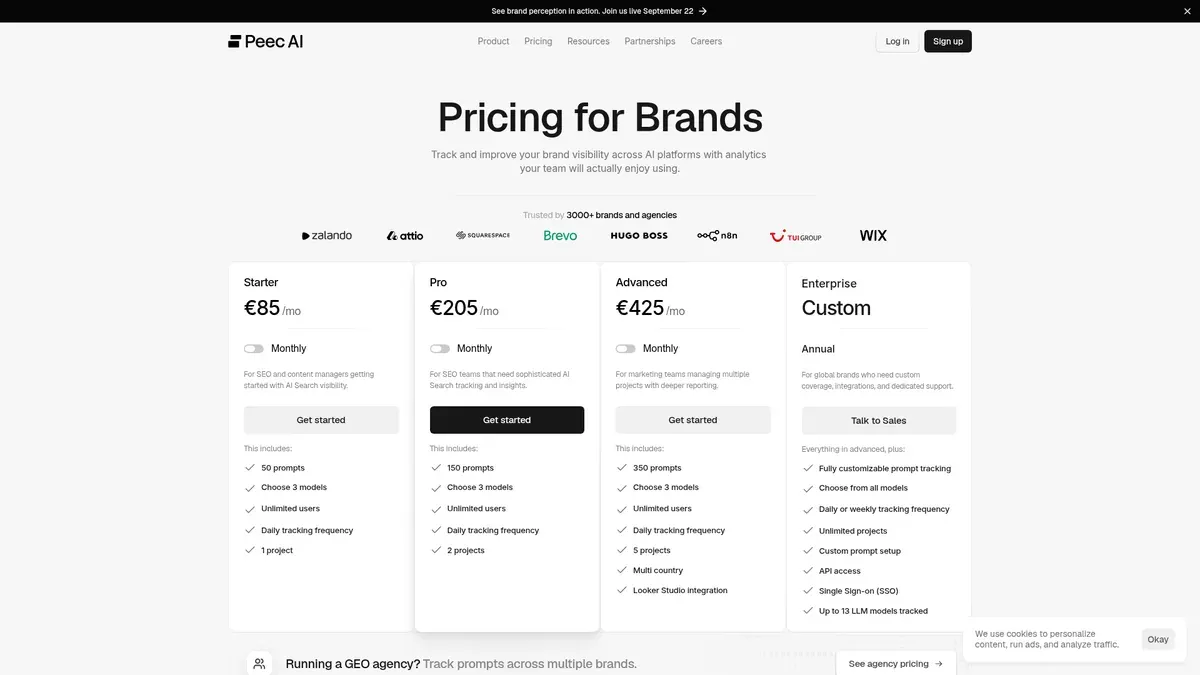
Peec pricing runs three self-serve tiers plus a custom Enterprise plan, billed monthly or annually, with annual billing advertised at 15 percent cheaper.
| Plan | Monthly | Annual (per month) | Prompts included | Models | Projects |
|---|---|---|---|---|---|
| Starter | $95 | $80 | 50 | 3 selected | 1 project, 1 country |
| Pro | $245 | $205 | 150 | 3 selected | 2 projects, 3 countries |
| Advanced | $495 | $420 | 350 | 3 selected | 5 projects, 3 countries |
| Enterprise | Custom | Custom | Custom | All or custom | Custom |
Working out price per prompt gives a rough sense of value: Starter runs close to $1.90 per prompt monthly, Pro drops to roughly $1.63, and Advanced settles near $1.41, improving further on annual billing. That comparison only goes so far, since Peec is charging for recurring daily tracking, not a one-time lookup, and the real value depends on how well you pick your prompts rather than how many you buy. All three published brand plans list unlimited users, which is a genuine plus for a small team that wants several stakeholders looking at the same dashboard without paying per seat.
A caveat worth flagging plainly on Peec pricing: Peec's public pages are not fully consistent on the price of adding extra models beyond the included three, with different current sources citing different add-on figures, so confirm that number at checkout rather than trusting a single secondary source. The homepage advertises a free trial, though the current pricing page does not spell out its exact length, so treat the trial terms as something to verify before you sign up rather than as fixed by this review.
Where Peec AI Shines
Independent reviewers consistently describe the interface as clean and easy to pick up, with a dashboard that surfaces the important numbers fast and a low learning curve for a first-time user. The prompt-suggestion feature genuinely cuts down the blank-page problem of inventing questions from scratch, even though you still have to review and prioritize what it suggests. Daily tracking builds a real trend line instead of a one-off snapshot, and the export and integration options, CSV, Looker Studio, API, and MCP, make it realistic to pull this data into a report your leadership already reads rather than asking them to log into another dashboard.
Where Peec AI Falls Short
The biggest limitation is the one built into the category: Peec measures and explains AI visibility, and it stops there. It does not replace your content strategy, briefing process, writing, editing, or publishing workflow, so a dashboard that flags a source gap still leaves the decision, and the work, of closing it to you.
Prompt limits require some discipline. Fifty, 150, or 350 prompts across three models is workable for a focused program, but it gets tight fast for a brand tracking many products, buyer stages, countries, and question variants at once. The Prompt Volume score is directional rather than precise, so it should not stand in for a real demand number when you are prioritizing which prompts to keep active. Broader model coverage, particularly Claude, Grok, or API-level model control, sits behind paid add-ons or enterprise deals, which is worth checking if a specific engine matters to your category. AI answers also vary by day, geography, and browsing context by nature, so a single week's visibility swing should be read as a data point in a series rather than proof that one action caused it, and Peec does not backfill history from before your tracking started, so an earlier baseline is not available. One independent reviewer also noted that public compliance documentation, such as SOC 2, was not clearly published, which is worth a direct question to Peec if you work somewhere with a formal security review step.
Who Should Use Peec
Peec fits an established brand that already has some website and branded-search activity and wants its first structured baseline for AI visibility measurement. It suits a marketing or SEO lead who mainly cares about ChatGPT, the Google AI surfaces, Perplexity, and Copilot, who wants competitor comparisons and real source data rather than one opaque score, and who has the capacity to turn a source gap or a sentiment dip into an actual response. Agencies running pitch audits or reporting across several client brands get real use out of the credit-based project structure too.
Who Should Skip Peec
Peec is a weaker fit for a brand-new company with little existing recognition to measure yet, since there is no meaningful baseline to track. It is also a poor match for a content lead whose actual bottleneck is producing and publishing articles rather than knowing what to write about, since Peec's recommendations end at the idea, not the finished piece. Skip it, or wait, if you need precise demand numbers instead of a relative score, if your budget cannot stretch to add-on or enterprise pricing for the models you actually need, or if a documented security certification has to exist before procurement will even consider the tool.
Alternatives to Consider
Peec is one AI visibility tracker among several, and it is worth weighing a few tools built for a similar job before committing a budget line to one.
-
DeepSmith. DeepSmith tracks the same kind of AI-search visibility data Peec does, mention rate, citation rate, share of voice, sentiment, and which competitors win the citations, and then produces the on-brand articles that close the gaps it finds. Its Content Map turns your site and your competitors' sites into one topic map so coverage gaps and untapped topics are measured rather than guessed, and Opportunity Agents hand each idea the data point that justifies it. Plans run $99, $199, and $399 a month, with engine coverage rising by tier and all ten engines on Enterprise.

-
Profound. Profound positions itself at the enterprise end of AI-search analytics, with answer and citation analysis aimed at larger teams.
-
Otterly. Otterly describes itself as a lighter monitor of brand mentions and links across AI search, closer to a simple recurring check than a full analytics suite.
-
Scrunch. Scrunch is pitched at brand-presence monitoring across AI platforms, with a dashboard-first approach similar to Peec's.
Profound, Otterly, and Scrunch all stop at measurement, so the production gap Peec leaves is a gap most of the category leaves too.
Is Peec Worth It?
Peec AI is worth it when your actual problem is measuring AI visibility: knowing whether you show up, where, and next to which competitors, on a cadence you can report on. For an established small team, the Starter plan holds up fine if 50 well-chosen prompts and three models cover your real questions, and Pro or Advanced earns its higher price once you need more prompts, more markets, or deeper reporting.
Peec is not worth it if you are hoping one subscription will both spot the gap and hand you a finished article to close it. That second half of the job, turning a visibility gap into a content plan that actually gets written, briefed, linked, and published, sits outside what Peec does. If that gap between finding the problem and shipping the fix is your real bottleneck, DeepSmith covers both halves on the same data. It tracks the same visibility signals Peec does, mention rate, citation rate, share of voice, sentiment, and competitor citations, then turns a specific gap into a planned piece and a publish-ready article, researched, linked, and pushed straight to your CMS. The prompt you are losing and the article written to win it sit in one platform instead of a dashboard on one side and a writing queue on the other. Start a free trial if that pairing is what you are missing.