You looked at Profound, saw the enterprise pricing, and paused. That is a fair reaction, and you are not alone in it. Profound is a strong, full-stack platform for large teams, but its pricing points at enterprise budgets and demo-led sales, and most of us cannot spend that this quarter. So the real question is simple. Which Profound alternatives actually track where your brand shows up in AI answers, at a price your team can approve right now?
This guide ranks nine AI visibility trackers that answer that question. Some are cheaper monitoring specialists. Some also produce the content that earns the citations you are missing. Each one is a credible substitute, and each fits a different budget, engine set, and team.
Let's find the one that fits you.
How we ranked these Profound alternatives
Every tool here had to clear four bars, in this order:
- Active in 2026 with public pricing or a named third-party pricing signal. No vapor.
- Tracks AI search visibility across at least three named engines, including ChatGPT.
- Has substantive third-party reviews, so we could name real strengths and real limits.
- Distinct positioning from every other tool, so this list has genuine spread instead of nine near-copies.
Inside those bars, we ranked by fit for a marketing lead: someone who needs visible results inside a quarter, treats content as a growth channel, and would rather not split the work across five browser tabs. Most of these tools now track the same four to ten engines. The differences that actually change your decision are three: how you are charged (per prompt, per project, or per seat), whether the tool also produces content that closes gaps, and how it feels to use every week.
One quick note on the anchor. Profound AI pricing is no longer fully public: the vendor's page emphasizes customized enterprise pricing, while third-party reviewers still surface a roughly $99 Starter and $399 Growth signal, with Enterprise custom and demo-led. Treat those as signals, not a checkout price. That opacity is exactly why so many teams start shopping for alternatives to Profound in the first place.
The 9 best Profound alternatives at a glance
| # | Tool | Best for | Tracked engines (default) | Content production? | Lowest priced plan |
|---|---|---|---|---|---|
| 1 | DeepSmith | Teams that want analytics and publish-ready content in one platform | 10 named engines, tier-gated: ChatGPT on Pro, all 10 on Enterprise | Yes, integrated end to end | $80/mo annual Pro |
| 2 | Otterly AI | Solo marketers and small teams starting on a budget | ChatGPT, Google AI Overviews, Perplexity, Microsoft Copilot | Audit and recommendations only | $29/mo Lite |
| 3 | Peec AI | Brands and agencies tracking across many countries | ChatGPT, AI Mode, AI Overviews, Copilot, Perplexity, Gemini | Insight only | ~$95/mo (reviewer signal) |
| 4 | AthenaHQ | Lean teams wanting the broadest default engine count | Up to 9 models on paid | Recommendations plus content agent | Free Essential tier |
| 5 | Semrush AI Visibility Toolkit | SEO teams already living in Semrush | ChatGPT, Google AI Mode, AI Overviews | None | $99/mo standalone |
| 6 | Writesonic | Content teams wanting tracking and drafting in one tenant | ChatGPT, Gemini, Google AI Overviews | Yes, 15 to 50 articles/mo | $79/mo annual Starter |
| 7 | Scrunch AI | Enterprise and agency teams needing content delivery to AI agents | 4 LLMs on Core, 9 on Enterprise | Content delivery layer | $250/mo Core |
| 8 | Ahrefs Brand Radar | SEO teams wanting prompt research on Ahrefs' own corpus | 6 engines | None on Brand Radar itself | $129/mo Lite |
| 9 | Frase | Content teams that want to monitor and fix in one workflow | Perplexity, Claude, Gemini, Google AI | Yes, integrated | $39/mo annual Starter |
Now let's walk through each one, what it does best, and where it stops.
1. DeepSmith: the pick when you need to track and produce in one place
Here is the gap most of this list leaves open. Almost every tool below either measures your AI visibility well and then stops, or writes content without tying that content back to the citations it needs to earn. DeepSmith is the one that connects both ends of the loop.
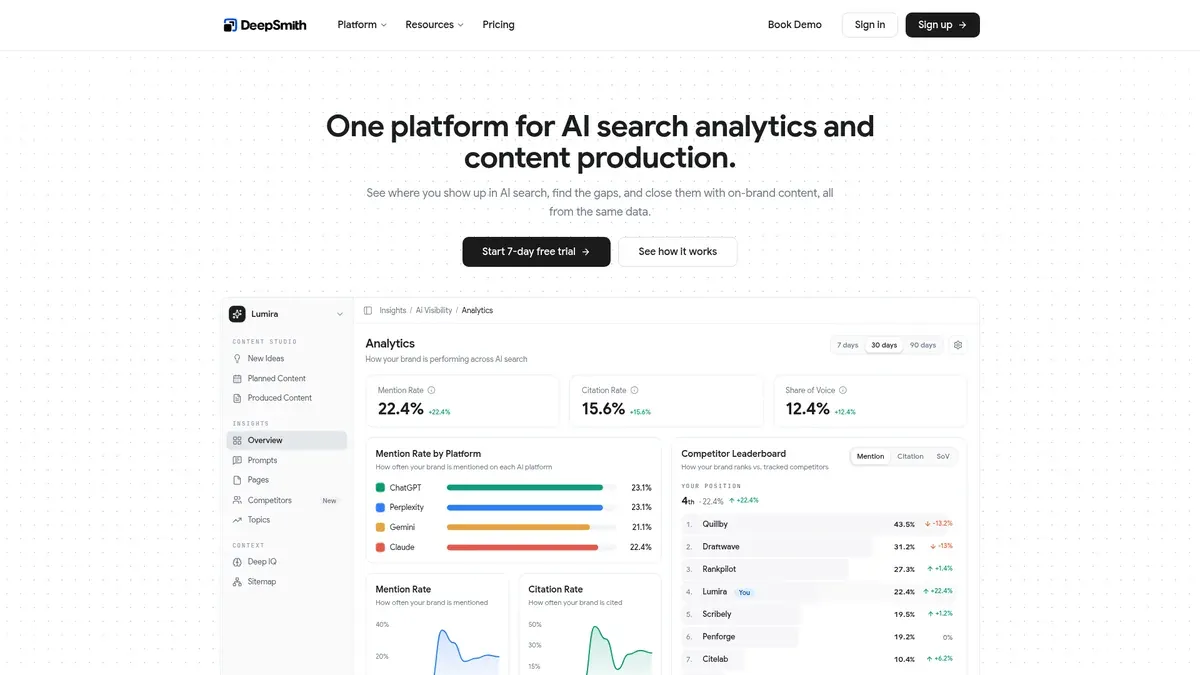
DeepSmith is one platform for AI search analytics and content production. It tracks how AI engines answer questions about your brand, finds the gaps where you are invisible or losing, and produces the on-brand content to close those gaps, all from the same data. That is the difference between knowing you have a problem and actually fixing it inside one quarter.
On the analytics side, you get AEO tracking with Mention Rate, Citation Rate, Share of Voice, Sentiment, and Visibility Trend, broken out per platform, plus a competitor view showing which of their pages win the citations you want. On the production side, the Writer turns a planned idea into a finished article with internal links pulled from your sitemap, a cover image, and publish-ready metadata. Autowrite can take an article hands-off from schedule to publish, or you can review and publish from Produced Content to WordPress, Webflow, Strapi, Sanity, Contentful, or your own webhooks. Every module runs off one Deep IQ brand context layer, so your voice, products, and personas stay consistent instead of getting re-briefed per article. When a piece is done, the Apps Library turns it into channel-native posts for LinkedIn, X, newsletters, and more, so distribution stops being the step that falls off.

Pricing is transparent and self-serve. Pro is $99 per month, or $80 per month billed annually, and covers ChatGPT with 50 tracked prompts, 20 articles, and 5 seats. Grow at $199 (or $160 annual) adds Perplexity. Scale at $399 (or $299 annual) adds Gemini and lifts you to 90 articles and 200 prompts. Enterprise and Custom are quoted and cover all ten named engines: ChatGPT, Gemini, Perplexity, Claude, Google AI Overviews, Google AI Mode, Grok, Meta AI, Microsoft Copilot, and DeepSeek. There is a 7-day free trial with real data and real drafts before you pay, and no long-term contracts.
Because every article is grounded in stored brand context rather than a fresh brief, the drafts arrive publish-ready instead of needing a rescue edit, and the prompts you track are the same prompts the writing is aimed at. That is the whole idea: less time editing, more time deciding what to publish and why, with the tracking data to show it is working.

The honest limitation? Engine coverage is tier-gated. On Pro you are tracking ChatGPT only. That still covers the single largest answer engine, and stepping up to Grow for Perplexity or Scale for Gemini is self-serve and transparent, no demo call or long-term contract in the way. The 7-day trial is short, but it puts real data and real drafts in front of you before you pay, so plan to move through your evaluation quickly.
Best for: content or marketing teams that want to see where they show up in AI, understand which competitor pages are winning, and produce the content that closes the gap, all in one tool.
2. Otterly AI: the cheapest credible on-ramp

Not ready to spend $200 a month before you have any signal? Otterly is your starting line. Its Lite plan is $29 per month (or $25 annual) for 15 tracked prompts across ChatGPT, Google AI Overviews, Perplexity, and Microsoft Copilot, with unlimited team members on every tier.
Every plan includes unlimited Brand Reports, a Brand Visibility Index, citation analysis, a GEO Audit, and multi-country support across 50-plus regions. Standard at $189 per month unlocks multiple workspaces, unlimited recommendations, a Looker Studio connector, and API access, and lets you add Claude, Google AI Mode, and Gemini as paid extras.
Best for: solo marketers and small teams who want to start paying attention to AI search without a big commitment.
The limitation: Lite is genuinely small, at 15 prompts, three recommendations per week, and one workspace. Reviewers note data refresh can lag, so daily decisions may feel a step behind. And prompt-based pricing gets expensive once you outgrow the entry tier.
3. Peec AI: best for multi-country, multi-language tracking

If your brand or your clients operate across markets, Peec is built for that. It tracks ChatGPT, Google AI Mode, AI Overviews, Copilot, Perplexity, and Gemini, with daily tracking on nearly every tier and support that reviewers cite at 115-plus languages.
Peec does not publish dollar prices on its pricing page, so treat any figure as a reviewer signal: third parties cite entry pricing around $95 to $165 per month, with agency plans higher. Unlimited users come included across paid tiers, which is unusual in this band. The tier shape runs Starter, Pro, Advanced, and Enterprise, with the Enterprise tier adding API access to more models.
Best for: brands and agencies where regional prompt behavior across EU, LATAM, or APAC actually matters.
The limitation: Peec is insight only. There is no built-in content execution, and reviewers flag limited ROI attribution and thin actionability beyond the visibility report. If you want recommendations pushed into a CMS, you will need something else alongside it.
4. AthenaHQ: the broadest default engine count

Want the most engines out of the box? AthenaHQ ships the highest default count on this list. Its paid Starter tier at $295 per month tracks up to nine named models, including ChatGPT, Perplexity, AI Overviews, AI Mode, Gemini, Claude, Copilot, and Grok. There is even a free Essential tier with $25 in credits so you can try it before paying.
Starter adds a content optimization agent, brand-voice and brand-guideline enforcement, integrations, and CSV exports. Enterprise layers on claim review, SSO, audit logs, and multi-region support. Seats are unlimited on every paid tier.
Best for: lean growth teams that want broad engine coverage from the start and a workspace that doubles for client briefs.
The limitation: AthenaHQ runs on credits (Starter ships 3,600), which reviewers flag as a constraint you should understand up front. Reviewers also call the $295 entry steep and note that AI visibility metrics are lighter than the deepest enterprise tools, with some actions still half-baked beyond recommendations.
5. Semrush AI Visibility Toolkit: best if you already live in Semrush
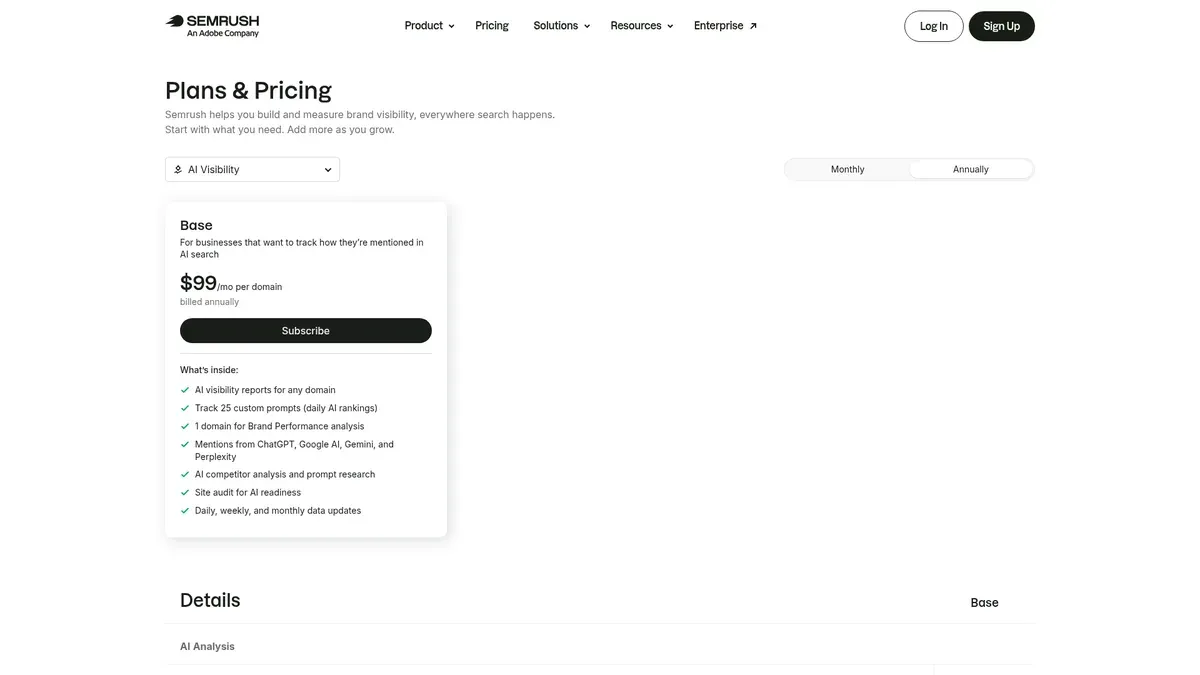
If your team has run on Semrush for years, the smartest move might be to bolt AI visibility onto the stack you already pay for. The AI Visibility Toolkit is $99 per month standalone and covers Brand Performance reporting, Prompt Tracking (25 prompts), AI Analysis, and AI Search Checks inside your existing Site Audit, tracking ChatGPT plus Google's AI Mode and AI Overviews.
The real advantage is correlation. Your AI answers layer sits next to the keyword and backlink data you already trust, so you can read them together. A Semrush One bundle lifts prompt limits to 50, 100, or 200 depending on tier.
Best for: SEO teams who want the AI layer stitched to the traditional SEO layer without adopting a whole new platform.
The limitation: reviewers are direct that this works better as an add-on than a dedicated platform. Content production is out of scope entirely, so if you need articles or agent workflows, you are pairing it with another tool. The standalone prompt cap of 25 is also low.
6. Writesonic: track and draft from the same tenant
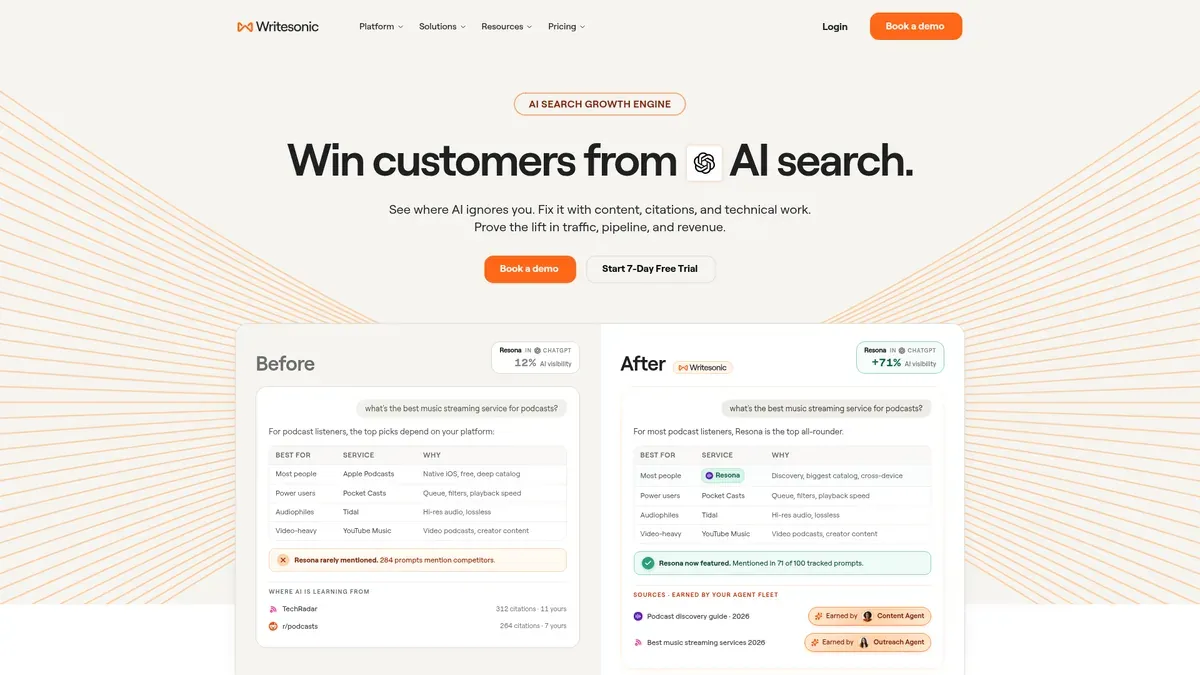
Writesonic layers AI search visibility tracking onto its existing article writer, so you can monitor and write in one place. Starter is $79 per month billed annually (or $99 monthly) for 50 prompts, 15 AI articles, and 10 site audits, tracking ChatGPT, Gemini, and Google AI Overviews. Growth at $399 annual scales you to 200 prompts and 50 articles, and Enterprise exposes the full 10-platform set.
Best for: content teams where monthly article volume matters and the three-engine default lines up with where their buyers actually ask.
The limitation: that default engine set is narrow until Enterprise, language coverage sits well behind Peec, and reviewers rate its brand-voice control and collaboration below tools built primarily around content quality. Reviewers also suggest human review on nuanced or competitive topics.
7. Scrunch AI: content delivery for enterprise and agency teams

Scrunch pairs multi-LLM monitoring with auditing, optimization, and content delivery to AI agents, which is its distinctive angle. Core is $250 per month for 125 prompts, 5 seats, and 4 LLMs (ChatGPT, Perplexity, Google AI Mode, Copilot), with a 7-day trial. Enterprise extends to 9 LLMs and an advanced delivery layer, and there is a dedicated Agency track.
Best for: enterprise and agency teams that want a wall-to-wall AEO and GEO system where content is deliverable to AI agents, not just drafted for a human to publish.
The limitation: the $250 Core entry is higher than several peers, and reviewers flag limited integration with traditional SEO metrics like keyword rankings and backlinks. If SEO is also a tracked channel, plan for a parallel tool.
8. Ahrefs Brand Radar: prompt research on a huge search corpus

If your team already pays for Ahrefs, Brand Radar keeps your AI visibility research anchored to Ahrefs' own organic data. It tracks six engines (ChatGPT, Google AI Overviews and AI Mode, Perplexity, Copilot, and Gemini) and draws on a database Ahrefs reports in the hundreds of millions of organic prompts. Lite starts at $129 per month with 5 custom prompts and 150 checks; higher tiers scale up to Enterprise at $1,499 per month.
Best for: SEO-led teams who want prompt research built on Ahrefs' corpus rather than a separate vendor's crawl, and who do not need content production in the visibility tier.
The limitation: per-plan prompt allowances are low, from 5 to 20 on the standard tiers, and each check is metered. Content is a separate Content Kit add-on. For six engines at scale, reviewers note costs climb past $699 per month, and agency use pushes you into custom pricing.
9. Frase: monitor and fix in one workflow
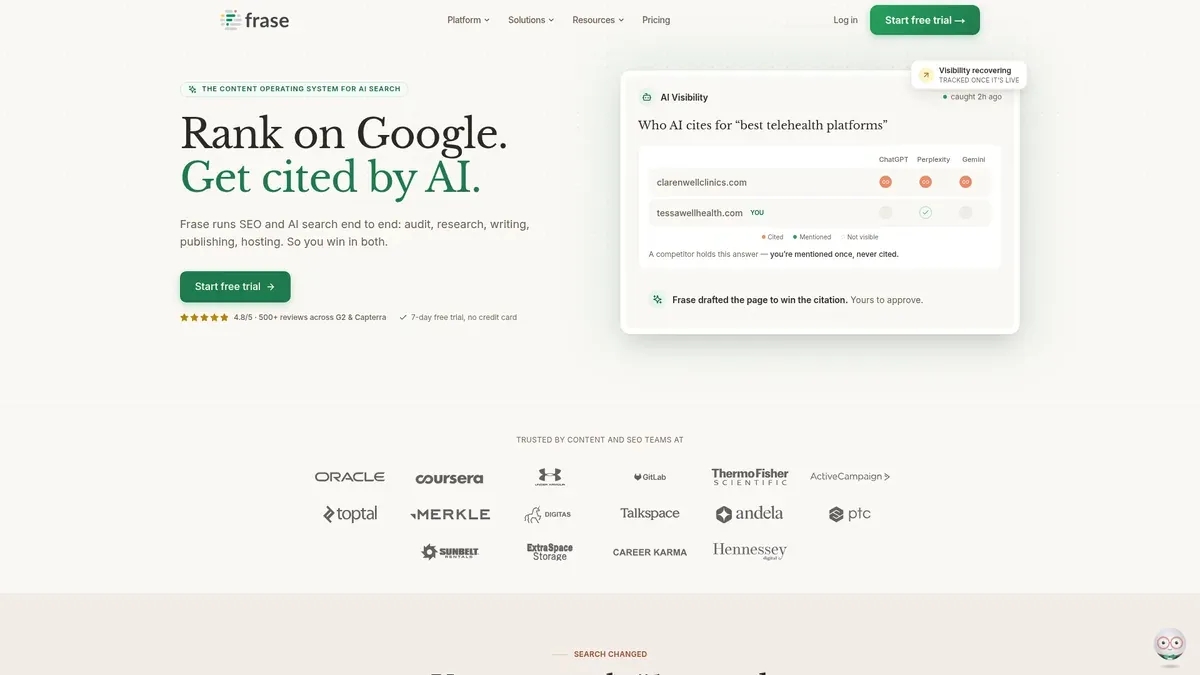
Frase is the other tool here that connects visibility data to actual drafting in a single workflow. It pairs research-to-brief generation, an AI editor, content scoring, and article-level gap analysis with AI Visibility and GEO Optimization, tracking Perplexity, Claude, Gemini, and Google AI. Starter is a friendly $39 per month billed yearly, though the AI Visibility features arrive at the Scale tier ($239 annual), with a 7-day trial across plans.
Best for: content teams where the article layer is the priority and you want briefs, writing, and scoring living next to your monitoring.
The limitation: Frase is not a full SEO suite. Reviewers note it lacks keyword discovery, backlink analysis, and technical SEO tooling, and its AI visibility coverage is narrower than peers at four named engines, delivered on the higher tiers rather than at Starter.
Honorable mentions
A few more worth knowing if a reader asks. Relixir offers an autonomous GEO agent (Rex) that sequences content, refreshes, and backlink outreach from $199 per month, best for mid-market B2B teams committed to GEO as their main acquisition motion; note that its ROI figures are vendor-reported. AIclicks (from $59 per month) and LLMrefs (from $79 per month) both track ten-plus engines with content actions attached. Surfer's AI Tracker and SE Ranking's AI module are sensible add-ons if you already pay for those platforms. And AirOps sits at the enterprise end, with meaningful visibility insights arriving at custom pricing.
How to choose your Profound alternative
Feeling clearer but not quite decided? Work it in three quick steps.
First, decide whether you need an all-in-one production system or a monitoring-only specialist. If your headline worry is "our content cannot keep up" or "I am the bottleneck," rank by content capability: DeepSmith and Frase build the article in the same tool, while Writesonic and Scrunch run content actions natively or through an agent. If you only need visibility and nothing else, rank by engine coverage: AthenaHQ and Ahrefs Brand Radar carry broad default coverage, with Otterly, Peec, and Scrunch as strong mid-band picks.
Second, map the engines you actually need against budget. ChatGPT only on the smallest budget points to Otterly Lite at $29 or the Semrush toolkit at $99. ChatGPT plus Perplexity plus Gemini in the mid-band points to DeepSmith Scale or Writesonic Growth. Full engine coverage lands in custom Enterprise territory across DeepSmith, Writesonic, Scrunch, or AthenaHQ, which is where DeepSmith's ten named engines sit.
Third, pick for your team context. Solo marketer needing an on-ramp: Otterly. Semrush or Ahrefs veteran: the matching AI module. Agency across markets: Peec or Scrunch. Content team that needs to draft and monitor from one tool: DeepSmith or Frase.
And to be fair about it: some of these Profound competitors will beat DeepSmith for you. If you are a Fortune 500 buyer with strict governance and a long procurement cycle, Profound itself remains the safest incumbent. If you never need to produce content but want extreme monitoring depth, a pure specialist will serve you better. The best profound alternatives are the ones that match your real constraints, not the loudest brand.
If your constraint is that you need to see the gaps and actually close them without adding headcount, that is the case for DeepSmith. You can start a free trial and have real data and real drafts in front of you before you pay.