Two products sit at opposite ends of the same category. Profound sells enterprise AI-search visibility and marketing intelligence, with self-serve access starting at $99 per month billed yearly. Otterly sells accessible AI-search monitoring and optimization, with a Lite plan displayed at $29 per month. The profound vs otterly decision is usually framed as an enterprise-versus-budget question, and that framing is close enough to be useful but too coarse to buy on. The two products measure overlapping things at very different depths, and each entry plan buys a different amount of room to work in.
This comparison examines both on entry price, prompt and response capacity, engine coverage, citation diagnostics, prompt research, geography, and integrations. It also places DeepSmith beside them, because an ai search visibility tracker answers a question that most content teams cannot act on without a second system.
The two trackers at a glance
| Criterion | Profound | Otterly |
|---|---|---|
| Position | Enterprise AI-search visibility and marketing intelligence platform | Accessible AI-search monitoring and optimization platform |
| Entry plan | Starter, $99 per month billed yearly, two months free | Lite, $29 per month, or $25 per month on the annual display |
| Prompts at entry | 50 unique prompts, 1,500 responses monthly | 15 search prompts |
| Engines at entry | ChatGPT only | Four included: ChatGPT, Google AI Overviews, Perplexity, Microsoft Copilot |
| Higher tiers | Growth $399 per month billed yearly, 100 prompts, 9,000 responses, three Answer Engines; Enterprise custom, up to nine | Standard $189 per month, 100 prompts; Premium $489 per month, 400 prompts; Enterprise custom |
| Seats at entry | One | Unlimited team members |
| Tracking cadence | Daily | Daily |
| Core metrics | Visibility score, share of voice, ranking, sentiment, citations, Citation Authority, FactCheck | Brand mentions, brand coverage, average position, sentiment, share of AI voice, cited links, Domain Ranking |
| Page and source diagnosis | Pages, AI citation status, bot crawl activity, page timelines, robots.txt audit, Citation Decay | Link Citations Analysis, referenced links, Domain Ranking, GEO audits |
| Data access at entry | No export and no API listed on Starter | Detailed reports and export on every listed plan |
| Best for | Large brands, agencies, and teams needing depth, custom coverage, and governance | Solo marketers, lean teams, and agencies needing daily monitoring at a predictable price |
Prompt counts do not compare cleanly on their own. Profound publishes a prompt quota and a monthly response quota; Otterly publishes prompt, audit, and API quotas without a stated response quota. The useful comparison is the monitoring workload a team intends to run.
What an AI search visibility tracker measures
A tracker of this kind answers four practical questions on a schedule: which buyer prompts were monitored, whether the brand was named in the answer, which pages or domains were used as sources, and how that performance moved against a named competitor set. Profound and Otterly weight those questions differently, so the otterly vs profound comparison only becomes clear once the terms are separated.
A mention records that the brand appeared in an AI answer. A citation records that a page or domain was used as a source for that answer. Position records where in the answer the brand tends to appear, sentiment records how favorably it was described, and share of voice compares that visibility against competitors.
Two structural points shape the rest of this comparison. Named platform support is not the same as plan-level inclusion, and both vendors publish broader engine lists in marketing copy than their entry plans include. Daily collection also does not make an answer deterministic. Profound states plainly that AI platforms do not return the same answer twice, which is why it runs every tracked prompt daily and averages the results. Both products are therefore best read as repeated observation rather than as a fixed ranking.
Profound: enterprise-grade visibility intelligence

Profound presents itself as an AI-search visibility and marketing intelligence platform. Its public product surface spans Answer Engine Insights, Prompt Volumes, Agent Analytics, Pages, Agents, integrations, and enterprise administration. The core tracker queries the front-end experiences that ordinary users see rather than relying only on answer-engine API outputs, which is a methodological choice with real consequences for how the numbers should be read.
Answer Engine Insights is the measurement product. It auto-generates prompts from brand and topic configuration, accepts manual uploads and custom prompts, pulls high-volume queries from Prompt Volumes, runs every tracked prompt daily, and reports visibility score and share of voice alongside competitor and industry-leader comparison. FactCheck surfaces how AI describes a brand and flags inaccurate claims, and Citation Authority tracks which websites influence AI answers and how much weight they carry.
The enterprise depth is clearest in the page and crawler layer. Pages auto-discovers a site through sitemap crawling and shows each page with its AI citation status and bot crawl activity, so a team can identify the exact pages earning no visibility. A robots.txt audit reveals which AI crawlers a site disallows, Pages Timeline presents discovery, alerts, health scores, bot visits, and citations as a chronological feed, and Domain Segments split site data by sub-brand, product line, or region.
Citation Decay is the most distinctive diagnostic in either product. For each cited URL it tracks the first-cited date, the rise time to peak, the peak volume, and the half-life. Pages can be filtered by domain or model, sorted by half-life, and compared across page types. A team that needs to know not merely whether a page was cited but whether its citation influence is fading has a documented reason to look at Profound and nowhere else in this comparison.
Prompt Volumes is a research layer rather than another tracking quota. It aggregates prompts from ChatGPT, Gemini, Claude, and Perplexity in one view, built on conversations Profound says it licenses from double-opt-in consumer panels of real answer-engine users. The data is described as anonymized, aggregated, and compliant with GDPR and CCPA, with a modeling pipeline estimating frequency, intent, and sentiment. Profound describes the corpus as more than 1.5 billion real AI conversations, which is a vendor-stated figure rather than an audited benchmark. An August 28, 2026 changelog entry puts Prompt Volumes at 35 countries.
The integration catalog is broad, covering bot tracking through Akamai, Cloudflare, and Fastly, content management through Adobe Experience Manager, Contentful, and WordPress, and analytics through Google Analytics and Google Search Console. Reports API v2 covers Visibility, Citations, Sentiment, Query Fan-Outs, and FactCheck in one request and response shape.
The constraints are commercial rather than technical. Starter is $99 per month only when billed yearly, and that plan covers one engine, 50 prompts, 1,500 monthly responses, and a single seat, with no export and no API listed. Growth is $399 per month billed yearly for 100 prompts, 9,000 responses, three Answer Engines, and three seats. Enterprise, where up to nine Answer Engines, multiple companies, API access, SSO and SAML, SOC 2 language, and a dedicated specialist on a 24-hour SLA arrive, is custom-priced and sales-led. The pricing page does not publish a trial duration or a cancellation policy, and the self-serve tiers show one language and one region. The 35-country Prompt Volumes dataset and that one-region tracking row are different facts and should not be merged.
Otterly: accessible daily monitoring

Otterly presents itself as an AI-search monitoring and optimization platform, and the workflow is built to be approachable. AI Prompt Research uncovers prompts, topics, and intent patterns for a category. The team builds a prompt library around the conversational questions prospects actually ask. Daily tracking runs across the included engines. The dashboard reports brand mentions, brand coverage, average position, sentiment, cited links, source domains, trends, and competitor share, with alerts when mentions change.
The Brand Visibility Index is the clearest expression of the product's design philosophy. It plots Brand Coverage on the X axis against Likelihood to Buy on the Y axis, the latter calculated from average position in AI answers, sorting brands into leaders, niche players, low-conversion brands, and low performers. A time-lapse slider replays how positions shifted day by day. The quadrant interpretation is published; the fuller composite formula is not, which is a limit on how far the index should be pushed in a board deck.
Otterly is not only a mention dashboard. Its documented flow includes Content Audit and Prediction, Content Briefs, and GEO Optimization recommendations, with audits that weigh crawlability, AI readiness, and citation potential. Those are diagnostics and optimization aids, not a publish-ready article pipeline, and the distinction matters for a team whose bottleneck is production.
Lite is $29 per month, or $25 per month on the annual display, for 15 search prompts, four included engines, one workspace, unlimited team members, daily tracking, unlimited Brand Reports, three Recommendations per week, 1,000 GEO URL audits per month, and detailed reports with export. Standard is $189 per month, or $160 annually, for 100 prompts, unlimited workspaces and recommendations, 5,000 GEO URL audits, the Looker Studio connector, and 2,000 API and MCP requests per month. Premium is $489 per month, or $422 annually, for 400 prompts and higher allowances on the same features. Annual billing is displayed as 15 percent off, and listed prices exclude tax.
Otterly opened a programmatic surface on June 1, 2026 with a public API, a Claude Skill, and a marketplace of more than 101 marketing workflows, letting teams pull brand reports, search prompts, citations, and recommendation data into Claude, n8n, and reporting stacks. Those capabilities begin at Standard. Lite does not list API, MCP, Looker Studio, or Agent Analytics access, which is narrower than saying Lite has no integrations at all: exports and detailed reports are included on every listed plan.
The trial terms are the most transparent in this comparison. Otterly's help material states a seven-day free trial with no credit card, ending automatically with no charge unless the user selects a paid plan, and a subscription can be canceled from account settings.
Engine coverage by plan, not by logo
Otterly wins accessible engine breadth outright, and no reasonable reading changes that. Four engines are included at $29 per month while Profound Starter covers ChatGPT alone. The adjacent limit is that Otterly's four are the full included set at every listed tier: Claude, Google AI Mode, and Gemini are paid add-ons on all plans, priced on Lite at $9 per month each for Google AI Mode and Gemini and $29 per month for Claude, and considerably higher on Premium. A team that needs Claude or Gemini should price the add-on into the monthly figure first.
Profound's counts rise steeply and only reach breadth at the top. Starter is one engine, Growth is three Answer Engines, and Enterprise is up to nine. The Answer Engine Insights FAQ names nine front-end experiences, including ChatGPT, Perplexity, Microsoft Copilot, Google AI Overviews, Google AI Mode, Gemini, Grok, Meta AI, and DeepSeek, but that is a platform-level list rather than a per-plan inclusion. Any profound or otterly shortlist that settles engine coverage by counting logos on a homepage will mislead on this point.
Prompt capacity against price
Otterly is the low-cost starting point at $29 per month for 15 prompts. Profound Starter is $99 per month billed yearly for 50 prompts and 1,500 monthly responses. Read per unit of coverage rather than per month, Profound Starter costs less per tracked prompt, and it adds a response quota that Otterly does not publish. Read as absolute outlay, Otterly wins by a wide margin, and absolute outlay is the number that decides a first purchase on a constrained budget.
The step up is where the two diverge most. Otterly moves from $29 to $189 for 100 prompts, then $489 for 400, and Standard can add 100 prompts for $99 up to a 300-prompt ceiling before the account moves to Premium. Profound moves from $99 to $399 for 100 prompts and 9,000 responses. Fifteen prompts is a narrow window on a category, and a team covering awareness, consideration, and decision-stage questions across a product line will exhaust it quickly, which puts the real Otterly price for a serious program closer to Standard than to Lite.
Citation monitoring versus citation diagnosis
Both products monitor citations and referenced links, and the difference is depth rather than presence. Otterly documents Link Citations Analysis, cited links and source domains, Domain Ranking, and GEO audits. Profound documents Citation Authority, exact cited pages, bot crawl activity, Pages, page timelines, robots audits, FactCheck, and Citation Decay with its first-cited, peak, and half-life fields.
That gap is real, and the Otterly material reviewed here does not expose the same page-timeline and citation half-life fields, which is a documentation difference rather than proof that Otterly cannot do it. In practice the question is what the reader intends to do with the answer. A marketing lead who needs to know which links are cited today and how that moved this week gets a sufficient answer from Otterly without paying for the enterprise diagnostic layer. A team that needs to know why a specific page gained or lost citation influence over months has one documented path, and it runs through Profound.
Prompt research, geography, and integrations
Both tools help a team avoid guessing at prompts. Otterly's AI Prompt Research is a practical discovery feature for prompts, topics, and intent patterns, and it gets a small program running quickly. Profound's Prompt Volumes is a heavier instrument, built on licensed consumer-panel conversations and modeled frequency, intent, and sentiment, and aimed at prioritizing prompts by the demand behind the topic. Prompt research and visibility tracking are separate jobs, and neither product should be credited for one on the strength of the other.
Geography is the least settled dimension in this otterly ai alternative comparison. Profound's self-serve pricing shows one region and one language while Prompt Volumes states 35-country coverage. Otterly advertises multi-country support, and its own materials disagree: the pricing page says more than 50 countries and the help page says more than 65. That discrepancy is worth naming rather than resolving, and a buyer for whom localized coverage is decisive should confirm the current figure directly with the vendor.
On operations, Profound offers the broader documented surface, including infrastructure log sources, analytics, CMS, collaboration, MCP, Reports API v2, SCIM, and SSO with SAML at Enterprise. Otterly is lighter and cheaper to run, with reports and exports on every plan and API, MCP, Looker Studio, and Agent Analytics from Standard upward. Profound is more configurable at enterprise cost; Otterly is more immediately usable at a smaller one. Absence of public documentation on either side is not evidence of absence.
The boundary both trackers share
The profound vs otterly question has a boundary neither product crosses. Otterly goes further than a dashboard through GEO audits, crawlability checks, content audits, prediction, and content briefs. Profound goes further through page diagnostics, citation decay, and agent workflows that reach into a CMS. Neither is documented as a system that researches, writes, internally links, illustrates, publishes, and repurposes a finished article.
That boundary is where most AEO programs stall. The tracker reports that a competitor owns the citations for a tracked prompt, and turning that finding into a published page returns to the same content team that was already behind. For a marketing lead whose constraint is production rather than measurement, a deeper tracker does not relieve the constraint. It documents it more precisely and more often.
DeepSmith for marketing leads

DeepSmith is one platform for AI search analytics and content production. It tracks how AI engines answer the questions that matter in a category, finds the gaps where a brand is invisible or losing, and produces the on-brand content that closes them from the same data. The stance is a production engine rather than a writing assistant: the output is a finished, publish-ready article, not a first draft to rescue.
On the measurement side, the AEO module reports Mention Rate, Citation Rate, Share of Voice, Sentiment, and Visibility Trend, with a per-platform breakdown, a competitor leaderboard, and the sources AI cites most. Tracked prompts carry their own mention and citation rates with full answer history, Pages attributes citations to specific owned URLs and names the prompts driving them, and competitor citations show which rival wins on which exact page. Discover Prompts generates a starting set from stored product, persona, and buyer-stage context, which removes the blank-page problem that makes prompt selection the slowest part of a first deployment.
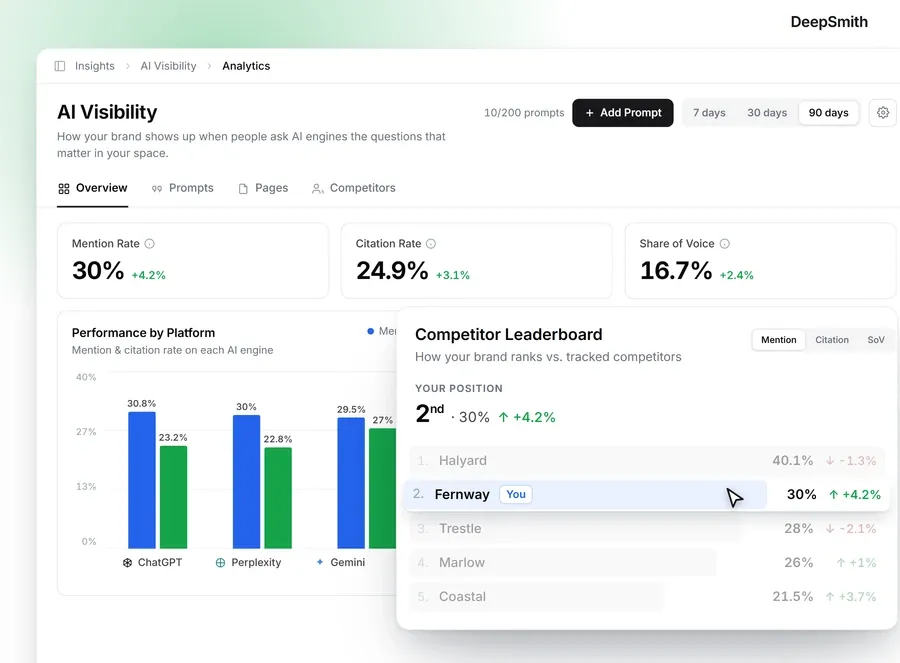
On the production side, Content Map crawls the brand and competitor sites into one topic taxonomy and funnel stage, surfacing coverage gaps, untapped topics, and topic depth, with sitemaps rechecked every 24 hours. Opportunity Agents read that data and return ideas with the justifying data point attached, covering goals such as getting cited for a tracked prompt, turning mentions into citations, and closing a stage-level gap against up to four competitors at once. Content Studio moves an idea from New Ideas to Planned Content to Produced Content, with keyword coverage, heading structure, schema markup, internal linking, and metadata built in during writing rather than added afterwards. Autowrite generates a scheduled article without anyone opening the app, and finished pieces publish to WordPress, Webflow, Strapi, Sanity, or Contentful. Deep IQ stores the company positioning, products, personas, brand voice, visual guidelines, and content types that every run is grounded in, which is what keeps voice and product claims stable at volume. Repurpose and the Apps Library turn each finished article into channel-native versions for LinkedIn, X, Substack, newsletters, and more.

Pro is $99 per month, or $80 billed annually, for 50 tracked prompts, 20 articles per month, and five seats. Grow is $199 per month for 100 prompts and 40 articles, and Scale is $399 per month for 200 prompts and 90 articles. A seven-day free trial gives real data and real drafts before payment, with no long-term contracts and no cancellation fees.
One constraint deserves stating plainly. Engine coverage is sequenced by plan: Pro tracks ChatGPT, Grow adds Perplexity, Scale adds Gemini, and Enterprise or Custom covers all ten named engines. Otterly includes four engines at $29, so a buyer whose only requirement is the widest included engine set at the lowest monitoring price should buy Otterly. That sequencing is a plan boundary rather than a product ceiling, and ChatGPT is where most buyer research starts, so the first tier still covers the surface most programs are trying to win. It matters less again when the same plan delivers 20 to 90 finished articles a month, because the work the tracking was supposed to trigger is already included.
DeepSmith is not the cheapest way to monitor AI visibility. At $99 per month it sits at the same entry point as Profound Starter while covering both the measurement and the production halves of the problem.
Start a 7-day DeepSmith free trial and see real visibility data and real drafts before paying.
Which should you choose
Choose Otterly Lite when the budget ceiling is near $30 per month, the prompt set is genuinely small, four engines are sufficient, and the immediate need is to see which links and domains AI cites and how those positions move. The seven-day no-card trial makes it the lowest-risk first purchase in the category. Choose Otterly Standard when 100 prompts, unlimited workspaces, and the API, MCP, Looker Studio, and Agent Analytics quotas justify $189 per month, and price the engine add-ons before committing.
Choose Profound Starter or Growth when a smaller number of prompts must be measured with more analytical weight, including consumer-front-end querying, source authority, and a published response quota. Choose Profound Enterprise when page and bot diagnostics, Citation Decay, custom engine coverage, SSO and SAML, SOC 2 language, dedicated support, and an API are procurement requirements rather than preferences.
Choose DeepSmith when the profound or otterly shortlist has already exposed the real constraint, which is that a tracker is only worth having if the team can act on what it finds. It fits a marketing lead who spends more time editing, structuring, linking, and publishing than deciding strategy, and who needs a lost citation or a competitor gap to become a finished article rather than another backlog row.