You checked ChatGPT on Monday and your page was cited as a source. You checked again Thursday and it was gone. Nothing on the page changed. So what happened?
Take a breath, because this is the most misread signal in AI search. What you are watching is AI citation volatility, and most of it is noise, not loss. Here is what this piece will give you: a clear picture of why AI citations change and why the same page gets cited one week and dropped the next, a simple way to tell a real problem from a bad day, and the small set of moves that actually hold a citation in place over time.
You are probably closer than you think. Let's walk through it.
Your page wasn't dropped. It was sampled.
Here is the good news first. When a citation vanishes for a week and comes back, your page almost certainly did nothing wrong. It stayed eligible. It just got sampled out of one retrieval cycle.
AI answer engines do not pull a fixed list of sources. For any question, there is a large pool of pages that could plausibly answer it, and the engine selects a small handful each time. That selection shifts. Across the major engines, roughly 40 to 60 percent of the cited URLs for a stable question change from one month to the next. Over six months, cumulative drift runs as high as 70 to 90 percent. That is the field's largest public measurement, and it describes healthy, normal behavior.
So why do AI citations change even when your content sits still? Because one prompt run is one observation, not a verdict. If you ask the same question ten times, your page might appear four times. Ask again next week and it appears five times. That difference is sampling, not a story.
This is the mental shift that lowers your blood pressure: seeing your citations drop then return across a few days is exactly what the noise floor looks like. It is not a fire. Save your energy for the swings that are real, and we will get to how you spot those.
What actually drives AI citation volatility
Once you accept that some swing is baked in, the next question is what causes it. There are five drivers worth knowing. You do not need to fix all of them today. You just need to recognize which one you are looking at.
Sampling and non-determinism
This is the biggest and most constant source of swing. Large language models are probabilistic systems, not deterministic ones. Even with the same prompt, the decoding step chooses among likely next tokens with a little built-in randomness, controlled by settings like sampling temperature. Add the fact that most engines never expose their random seed, and that the math running on GPUs is not perfectly repeatable, and you get different source mixes on identical questions.
For your page, the effect is simple. If it sits right at the edge of the inclusion threshold, one run cites it and the next drops it. That is unstable AI citations at their most ordinary. It is the price of the technology, and no amount of editing removes it entirely.
So part of the answer to why AI citations change is almost boring: the selection is random at the margins, by design. There is even research showing that the same model can give inconsistent answers to logically identical questions. When your page is a strong, clear candidate, that randomness barely touches you. When it is a marginal candidate, the randomness is the whole story. That distinction is worth holding onto, because it points straight at the fix. You want to stop being a coin-flip candidate and become an obvious one.
Model updates and rollouts
This is the second-biggest driver, and the most dramatic when it lands. When an engine ships a new model, the whole citation landscape can lurch in a day or two.
The clearest example on record is a major ChatGPT model rollout in May 2026. One controlled study of millions of responses caught the moment: citation variance jumped from its steady 1 to 2 percent baseline to 47 percent inside a 48-hour window. The average number of sources cited per answer fell. Reddit citations rose 59 percent. Whole categories of brands surged or collapsed overnight. None of those pages had changed. The engine simply rotated to a different sense of which sources to trust.
There was also a quieter, larger shift earlier that year, when ChatGPT's external citations fell sharply across several markets over a few months, with far more answers giving no external source at all. That was the platform changing how it operates, not any single brand losing its edge.
Your takeaway: when a citation drops hard, your first move is not to touch the page. It is to check whether the whole category moved on the same day.
Platform-level retrieval changes
Underneath the model sits the retrieval layer, and it can change without the model changing. The index can be re-cut on a different schedule. The set of allowed sources can shift. The number of documents pulled per question can move. Engines often fan a single question out into several sub-questions and merge the results, and changing that fan-out changes which pages surface.
You will not get a memo when this happens. You will just see a source mix wobble for reasons that have nothing to do with your writing.
Freshness decay
Most engines lean recent. There is real evidence that large language models favor recent content, and it shows up in the data: a general citation has a half-life of about a year, meaning a page loses roughly half its citation potential within twelve months. For commercial questions, like pricing and comparisons, decay is much faster, often in a matter of weeks.
Here is the part that stings and shouldn't. A page that was strong six months ago and untouched since will drift down in the citations even if its quality never dropped. It is not being punished. It is being out-aged by newer competitors entering the pool. That is fixable, and we will cover the fix.
One trap to avoid: changing only the "last updated" date without changing the content. Engines detect cosmetic freshness and discount it. Real freshness means real updates.
Competing sources and rotation
Every question you care about has hundreds of plausible answers competing for a few citation slots. When a peer publishes a sharper page on your topic, the engine may break the tie in their favor next week. That is a rotation, not a penalty. The pool is also different on every engine, and different on the same engine on different days.
Put these five together and the picture is clear. Volatility is mostly the system doing what the system does. Your job is not to eliminate it. It is to tilt the odds so your page wins more of those rotations, more consistently.
Different engines add noise, not signal
A quick note, because it matters and then we move on. The engines do not agree with each other, and that disagreement adds variance on top of everything above.
ChatGPT, Gemini, Perplexity, Claude, and Google AI Mode each draw from a different mix of sources. The overlap between ChatGPT and the Google engines sits below 7 percent, meaning fewer than one in ten sources cited by one is cited by the other. Perplexity leans heavily on community content. Claude weighs author credentials and methodology more than any other engine. Engines even disagree on whether to name your brand in the prose versus just link it, for the same question, about a fifth of the time.
There is a subtler wrinkle here too. Being linked as a source and being named in the answer are two different things, and engines split on which to do. One large ghost citations study found that most brand appearances are links without a name in the prose. Strong, recognizable brands tend to get named more than they get linked. Weaker ones get linked more than named. So some of what looks like a citation swing is really a swing in whether the engine says your name, which is a separate lever tied to how well known your brand is.
The lesson is not to chase each engine separately. It is to expect that a page holding steady on one engine may be sampled out on another, and to read your visibility across engines rather than fixating on one screenshot.
How to tell a real loss from a bad day
This is the skill that will save you the most stress. Not every drop is a loss, and not every recovery is a win. So how do you tell?
Start with the math. A single prompt sample is one data point with a wide margin of error. To get a usable read on any question, you want to sample it several times per engine and look at how often your page shows up, then watch that rate over weeks, not days. A one-week dip that recovers is noise. A decline that holds is signal.
A simple pattern test works well. Watch a small panel of your core buyer questions, maybe ten to twenty of them. A real loss shows up across several of those questions and persists for a month or more. Noise shows up on one question, for one week, while the rest hold steady. If everything moved on the same day, that is a model update, not a content problem, and the fix is to wait for the rollout to settle before you judge anything.
This is exactly where a repeatable process beats a panic refresh. When you track the same prompt panel on a schedule and aggregate the results over time, the noise averages out and the trend becomes visible. That is what DeepSmith's prompt tracking is built to do: run your buyer questions on a schedule across the engines your plan covers, so you can separate signal from noise instead of reacting to a single bad screenshot. A lean team can hold this discipline in a few hours a month.
So before you rewrite anything, ask three questions. Did the whole category move at once? Has the drop held for more than a month? Is it isolated to one or two questions? Your answers tell you whether you are looking at a bad day or a real loss. Most of the time, when citations drop then return, it is a bad day. Chasing it with a rewrite only burns time you do not have.
How to stabilize AI citations
Now the part you came for. You cannot make volatility disappear, but you can change your base rate so the swings happen around a higher, steadier line. The goal is not to be cited once by luck. It is to stabilize AI citations by being the kind of page an engine keeps reaching for.
The mental model to hold onto is citation eligibility: your page's ability to be cited at all, on any run, across any engine. Unstable AI citations usually trace back to a page that is only borderline eligible, so this is the lever that pays off most. Eligibility has three layers, and each one is in your control.
Make the page retrievable. The engine cannot cite what it cannot fetch. That means the page is crawlable, loads fast, works on mobile, and serves its content in plain HTML rather than hiding it behind scripts or tabs. This is unglamorous and it is the floor. Skip it and nothing else matters.
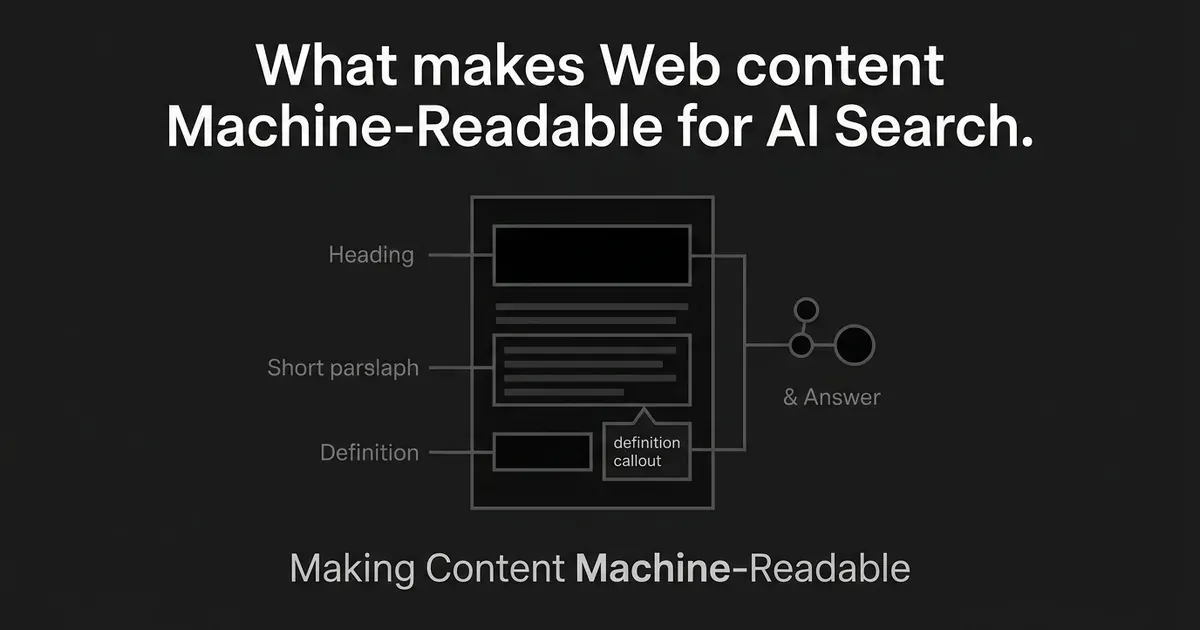
Make the page readable for a machine. Lead every section with the answer, then explain. This is not just etiquette. A consistent finding is that a large share of AI citations come from the first third of a page's text, so a buried answer is a missed citation. Use clear headings, self-contained passages, and structure that extracts cleanly. Tables get pulled far more reliably than the same facts written as prose. Lists, FAQ blocks, and schema markup all raise your odds of being selected. Match the format to the question, and the engine finds you faster.
Make the page trustworthy. This is where durable citations come from. The overwhelming majority of AI answer citations go to sources with strong experience, expertise, authority, and trust signals. In practice that means real author bylines with verifiable credentials, consistent entity information about your brand across the web, and a footprint on the third-party sources engines already trust, from review platforms to industry publications. Brands with an active, well-managed review presence get cited dramatically more often than brands with none. Show your work, too: pages that cite their own sources are more likely to be cited in turn.
Two more moves compound on top of eligibility.
Refresh on a cadence, not in a panic. Since freshness decays on a schedule, your updates should follow one. Fast-moving commercial pages, like pricing and comparisons, need frequent attention. Evergreen definitions and frameworks can go longer, since they hold their value for many months. A real refresh replaces stale references, adds a genuinely new point or data figure, and fixes what broke. That is very different from quietly touching the date, which engines see through anyway.
And publish what only you can publish. Original research, proprietary data, and a distinctive point of view are the highest-leverage content you can make, because engines prefer verifiable, attributable information and there is only one source for yours. It is more work up front, and it pays back with the most durable citations you will earn.
You do not have to do all of this at once. Pick the weakest layer first. If your pages are not even retrievable, start there. If they are technically fine but bury the answer, fix the structure. Momentum matters more than perfection.
Stop chasing single mentions
Here is the throughline. AI citation volatility is the weather, not the climate. Individual citations will come and go with sampling, model updates, and rotation, and that is normal. What you can control is your climate: whether your pages are eligible, structured, trusted, and fresh enough to win more of those rotations over time. Build that, track it on a schedule, and the noise stops running your week.
If you want the tracking and the production working from the same place, that is what DeepSmith is for. It shows you where you are cited across the engines your plan covers, finds the gaps, and helps you produce the on-brand, citation-ready content to close them, so you can watch the trend instead of the screenshots. You can see your real data on a 7-day free trial before you decide anything.
One page at a time. You've got this.