You opened a tab to compare AI search visibility tools, and now you have nine of them open. That is normal. This market got crowded fast, and every vendor's homepage sounds like the last one.
Here is the good news: the decision is smaller than it looks. Most Scrunch alternatives split into two camps. Some measure how AI engines talk about your brand. Some measure it and then help you publish the content that fixes what you found. Once you know which camp you need, the shortlist gets short.
Scrunch is a funded, serious player, and plenty of teams are happy with it. If you are here, something specific is pushing you to look around. Maybe you need more engines. Maybe you need production, not just a dashboard. Maybe the quote came back higher than your budget.
This guide covers eight credible alternatives to Scrunch, with what each one actually documents on its own pages, what it costs where the price is public, and who it fits. No hype. Just the tradeoffs, so you can pick and move on.
How we picked these Scrunch alternatives
A roundup is only useful if you know how the ranking was made. Here is ours.
Engine coverage. We count only the engines a vendor names on its own pages. "AI engine" is not a standard unit. Some vendors count Google AI, Google AI Overviews, and Google AI Mode as three things. Others fold them into one. A headline number of ten is not comparable to another headline number of ten.
Monitoring depth. Does it show prompt-level history and the actual answer text? Does it separate mention rate from citation rate? Can it tell you which of your pages earned the citation?
Competitive intelligence. The useful version is specific: which competitor won this prompt, on which exact page, and which sources shaped the answer.
Actionability. A dashboard tells you what happened. A recommendation tells you what to consider. A production system writes, schedules, publishes, and repurposes. Three very different products at similar price points.
Workflow fit. Content calendars, brand voice, structured product context, internal linking, metadata, CMS connections, API and MCP access, and multi-brand support.
Price transparency. We list exact published prices. Where a vendor does not publish a price, we say so rather than guess. If you are benchmarking Scrunch AI pricing, use the same rule on their page.
Enterprise readiness. Custom limits, SSO, audit controls, support, and multi-brand management.
One more thing before you compare anything. AI platforms do not return the same answer twice. Profound says this outright on its own pages. So treat every tool here as a monitoring system, not a rank tracker that gives you a stable number. That reframe will save you a lot of confusion in month one.
The 8 best Scrunch alternatives at a glance
| Platform | Best fit | Named engine coverage | Entry price | Production built in |
|---|---|---|---|---|
| DeepSmith | Teams that need measurement to feed publish-ready production | 10 engines at Enterprise, tiered below | $99/mo, $80/mo annual | Full: Content Studio, Autowrite, publishing, repurposing |
| Profound | Enterprise AEO and answer-engine intelligence | Up to 9 answer engines on Enterprise | $99/mo billed yearly | Partial, through Agents |
| Writesonic | Broad coverage plus SEO and content execution | 10 platforms claimed, 10 named | $79/mo billed annually | Yes: AI articles, audits, Action Center |
| Frase | Accessible SEO and GEO content workflow | Up to 5 named engines at Scale | $39/mo annual, $49/mo monthly | Yes: writer, calendar, publishing |
| OtterlyAI | Self-serve monitoring and technical diagnostics | 7 engines, some as paid add-ons | $29/mo, $25/mo annual | No |
| Surfer | SEO-led teams already inside Surfer | The Big 5 | $99/mo annual for Standard | Optimization, not production |
| Peec AI | Focused analytics and client reporting | Model list varies by plan | Not published | No |
| Semrush AI Visibility | Teams already standardized on Semrush | ChatGPT, Google AI, Gemini, Perplexity | $99/mo per domain, annual | No |
Prices here are what each vendor published in 2026. Check the checkout page or your sales quote before you buy, because pricing in this category moves.
1. DeepSmith
Best for: Marketing leads who want AI search analytics wired directly into a content operation that can research, write, optimize, schedule, publish, and repurpose on-brand articles.
Most tools here answer one question well: where does your brand show up in AI answers? That is where the work starts, not where it ends. You find fourteen prompts where a competitor gets cited and you do not, and then you are back in a spreadsheet, briefing articles by hand.
DeepSmith closes that loop. It measures your AI visibility, maps where your content is thin, turns both into evidence-backed ideas, and produces the articles.
What you get on the measurement side
The Overview reports mention rate, citation rate, share of voice, sentiment, and visibility trend, with a per-platform breakdown, a competitor leaderboard, and the sources AI cites most. Prompts stores every question you track with its per-prompt mention and citation rates and the full answer history. Discover Prompts builds you a starter set from your product, persona, and buyer-stage context, so you are not staring at a blank tracking list on day one.
Pages is the one people underuse. It shows which of your pages AI actually cites, each page's share of your total citations, and the prompts driving them. Competitor citations shows who is winning your prompts, on which exact pages, and how each competitor performs by platform.

What you get on the production side
Content Map crawls your site and unlimited competitor sites, classifies every page onto one shared topic taxonomy and funnel stage, and shows coverage gaps and untapped topics. Sitemaps re-check every 24 hours, so new pages fold in without a re-import.
Opportunity Agents read your own data and hand back ideas with the reason attached. Get cited for a tracked prompt. Turn mentions into citations. Take a competitor's citations. Close the decision-stage gap against up to four competitors at once. Every idea carries the data point that justifies it, which means you can defend your backlog in a meeting instead of guessing.
Content Studio moves an idea from New Ideas to Planned Content to the Writer to Produced Content. The Writer returns a researched, brand-grounded article with internal and external links, a cover image, and publish-ready metadata. Autowrite goes further: configure an article at planning time and it writes itself on its scheduled date, with nobody in the app.
Deep IQ is what keeps it sounding like you. Your positioning, claims to make and avoid, product profiles, personas, brand voice, visual guidelines, and content types are stored once and used by every module. Publishing goes straight to WordPress, Webflow, Strapi, Sanity, Contentful, or your own webhooks, and every finished article arrives with social posts already written.

Pricing
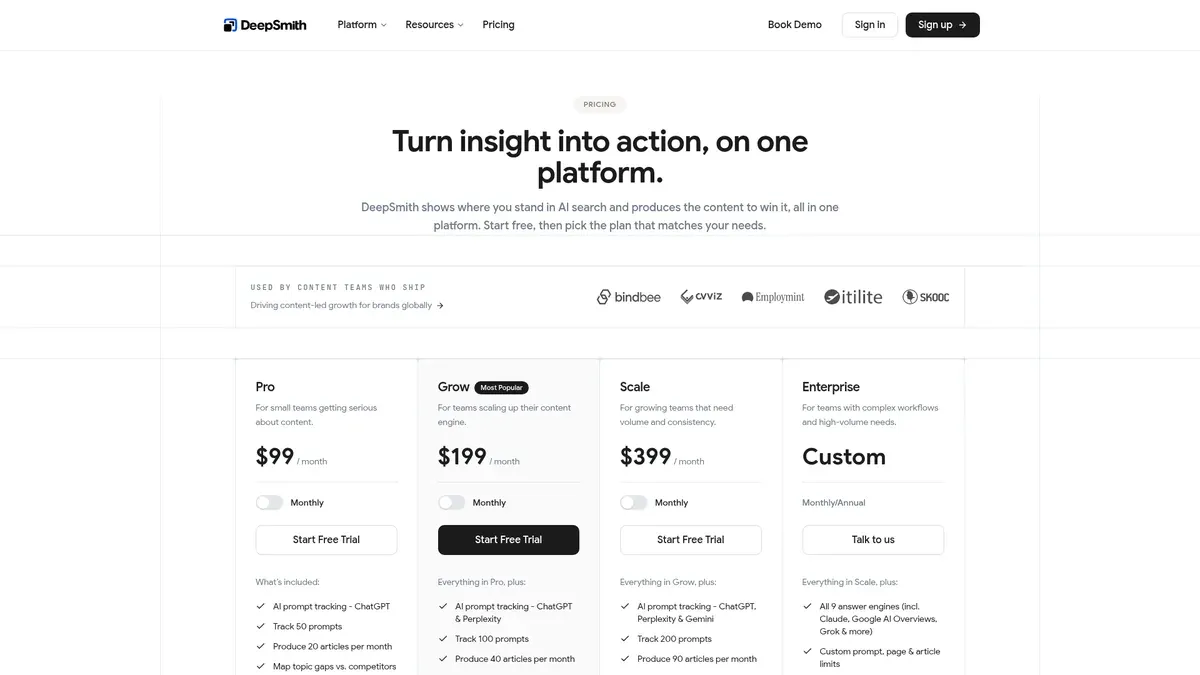
| Plan | Monthly | Annual | Articles/mo | Prompts | Seats | Engines |
|---|---|---|---|---|---|---|
| Pro | $99 | $80/mo | 20 | 50 | 5 | ChatGPT |
| Grow | $199 | $160/mo | 40 | 100 | 7 | ChatGPT, Perplexity |
| Scale | $399 | $299/mo | 90 | 200 | 10 | ChatGPT, Perplexity, Gemini |
| Enterprise | Custom | Custom | Custom | Custom | Custom | All 10 |
The ten engines are ChatGPT, Gemini, Perplexity, Claude, Google AI Overviews, Google AI Mode, Grok, Meta AI, Microsoft Copilot, and DeepSeek. There is a 7-day free trial with real data and real drafts, no long-term contracts, and no cancellation fees. Enterprise adds 1:1 onboarding and a dedicated account manager.
One honest limitation
Engine coverage is tiered. Pro tracks ChatGPT, Grow adds Perplexity, Scale adds Gemini, and all ten arrive at Enterprise and Custom. If your buyers live in Claude or Meta AI today and you need that on a self-serve plan, that is a real scope difference worth naming.
For most teams it is less of a problem than it looks. You are going to start with your highest-priority buyer prompts anyway, and those tend to run through ChatGPT and Perplexity first. The lower tiers give you a staged entry with a clean path to full coverage when you need it.
Pick DeepSmith when
Your problem is not only "where are we mentioned?" but also "what do we publish next, and can it ship without a long rescue edit?" If you only need analytics and your production is already handled, one of the measurement-first tools below will serve you better and cost you less.
2. Profound
Best for: Enterprise marketing, AEO, and insights teams that need structured answer-engine intelligence with real governance around it.
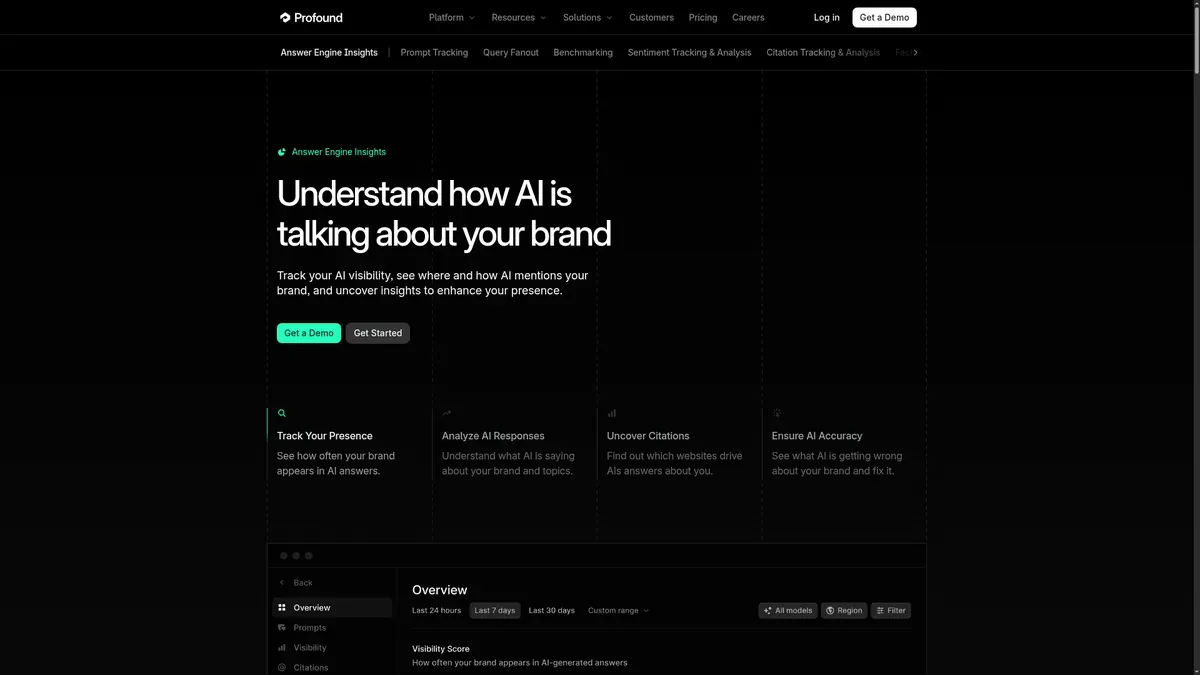
Profound is the most enterprise-shaped option among Scrunch AI competitors. Answer Engine Insights covers Prompt Tracking, Query Fanout, Benchmarking, Sentiment Tracking and Analysis, Citation Tracking and Analysis, FactCheck, and AEO dashboards. Prompts run daily.
FactCheck is the feature worth pausing on. It flags inaccurate claims about your brand and the sources behind them, so you can go correct the narrative at the source. Citation analysis identifies which websites influence AI answers and tracks their authority. Agent Analytics covers AI-sourced traffic and attribution across domains.
Named engines include ChatGPT, Perplexity, Claude, Microsoft Copilot, Google AI Overviews, Google AI Mode, Google Gemini, Grok, and DeepSeek. Enterprise controls include SSO with SAML or OIDC, role-based access control, daily backups, and SOC 2 Type II compliance.
Pricing: Starter is $99/month billed yearly with 50 unique prompts, 1,500 monthly responses, ChatGPT tracking, 100 Agent credits, and 1 seat. Growth is $399/month billed yearly with 100 prompts, 9,000 responses, 3 answer engines, 400 Agent credits, and 3 seats. Enterprise is custom and goes up to 9 answer engines. Agent credits burn faster on complex runs, and overage billing or pausing may apply.
Limitation: Starter and Growth are much narrower than Enterprise on engines, regions, projects, and prompt volume. Agents can create and optimize content, but the documented product is an intelligence and operations platform, not a full editorial workflow.
Pick Profound when enterprise governance, query fanout research, FactCheck, and citation influence matter more than a self-serve publishing system.
3. Writesonic
Best for: Teams that want wide platform coverage plus SEO, audits, and content creation in one subscription.

Writesonic is the broadest suite here. Its visibility page names ChatGPT, Claude, Gemini, Google AI, Perplexity, Grok, DeepSeek, Microsoft Copilot, Google, and Meta AI, and claims ten platforms in total. Worth a small asterisk: the page presents "Google AI" and "Google" separately, so read the named list rather than trusting the headline count.
It tracks visibility, citations, sentiment, and share of voice daily, with branded versus non-branded and commercial versus informational breakdowns. You get per-prompt performance, full answer text with your mentions highlighted, and prompt performance across locations and languages. Citation Analysis shows top cited pages, competitor citations, and source types including media, blogs, forums, and user-generated content. The Action Center prioritizes content gaps, citation opportunities, and technical issues.
Integrations are the standout. WordPress, Sanity, Contentful, Contentstack, Drupal, Vercel, Google Search Console, Ahrefs, GA4, Looker Studio, LinkedIn, YouTube, a public API, a Chrome extension, and MCP. MCP is read-only for visibility data right now, with write actions on the roadmap.
Pricing: Starter is $79/month billed annually with 50 prompts, 50 daily answers, and 15 AI articles. Basic is $199/month with 100 prompts, 300 daily answers, and 25 articles. Growth is $399/month with 200 prompts, 600 daily answers, and 50 articles. Enterprise is custom and unlocks all ten platforms. Extra users are $50/month, and Growth can add 20 articles for $100.
Limitation: Starter through Growth cover three platforms, not ten. The full set is an Enterprise feature, and the public page does not spell out every platform's inclusion by plan.
Pick Writesonic when breadth is the priority and you want visibility data plugged into your CMS, GA4, Search Console, and Looker Studio.
4. Frase
Best for: SEO and content teams that want a working writing workflow with visibility monitoring attached, at a price that does not need a business case.

Frase is the most affordable full loop on this list. Research, write, optimize, publish, monitor, fix. AI Visibility tracks your prompts across ChatGPT, Perplexity, Claude, Gemini, and Google AI and reports mentions, citations, share of voice, sentiment, alerts, and citation history, plus the sources being cited and how competitors are doing.
The content side is genuinely complete: topic research, a writer, brand voice, SEO and GEO scoring, images, content audits, internal-linking suggestions, a content calendar, repurposing, and auto-publishing to WordPress, Webflow, Sanity, Wix, and FraseCMS.
Pricing: Starter is $49/month, or $39/month billed yearly, with ChatGPT and Google AI, 50 prompts, 10 articles, and 1 seat. Professional is $129/month, or $103/month yearly, adding Perplexity, 200 prompts, 40 articles, 3 seats, the calendar, internal-linking suggestions, and AI crawler monitoring. Scale is $299/month, or $239/month yearly, with all five engines, 500 prompts, 100 articles, 5 seats, Content Guard, and client-ready reports. Annual billing saves 20%, and there is a 7-day free trial with no card.
Limitation: Coverage is tiered hard. Starter gives you two engines, and the five-engine set only shows up at Scale. Monitoring alerts you but does not change anything on its own, so someone still has to do the fixing.
Pick Frase when you want a writer, audits, publishing, and visibility monitoring in one place and you are starting well below enterprise budget.
5. OtterlyAI
Best for: Solo marketers, small teams, and agencies that want transparent pricing, daily monitoring, and technical AI-readiness checks.

Otterly is the cleanest entry point here at $29/month. It tracks seven engines: ChatGPT, Google AI Overviews, Google AI Mode, Gemini, Perplexity, Microsoft Copilot, and Claude. Read the limitation below before you get excited about that number.
AI Prompt Research finds prompts, topics, and intent patterns from a keyword, brand name, or URL. The Brand Visibility Index tracks visibility over time, and Domain Citation Tracking monitors domains and URL citations daily, including link-position changes. Sentiment analysis is unusually granular, separating enthusiastic recommendations from qualified mentions and outright dismissal. The Crawlability Checker and Content Audit tell you whether AI bots can reach and parse your pages, which is a good first stop when your visibility is zero. API, MCP, and a Looker Studio connector are documented.
Pricing: Lite is $29/month, or $25 annually, with 15 prompts. Standard is $189/month, or $160 annually, with 100 prompts, API, MCP, and the Looker Studio connector. Premium is $489/month, or $422 annually, with 400 prompts. Enterprise starts from $1,000/month. Annual billing saves 15%.
Limitation: Only four engines are included in those prices. ChatGPT, Google AI Overviews, Perplexity, and Microsoft Copilot come standard. Google AI Mode and Gemini are add-ons at $9, $59, or $149/month by tier, and Claude is $29, $109, or $439/month. Do the add-on math before you compare that $29 against anything else here.
Pick OtterlyAI when transparent pricing, prompt research, crawlability audits, and programmatic access matter more than a production system.
6. Surfer
Best for: SEO-led teams already living inside Surfer who want AI visibility in the same tab.
If your team already runs Content Editor, Content Audit, and Topical Map, a separate tracker means another login, another bill, and another dashboard nobody opens. Surfer's AI Tracker avoids that.
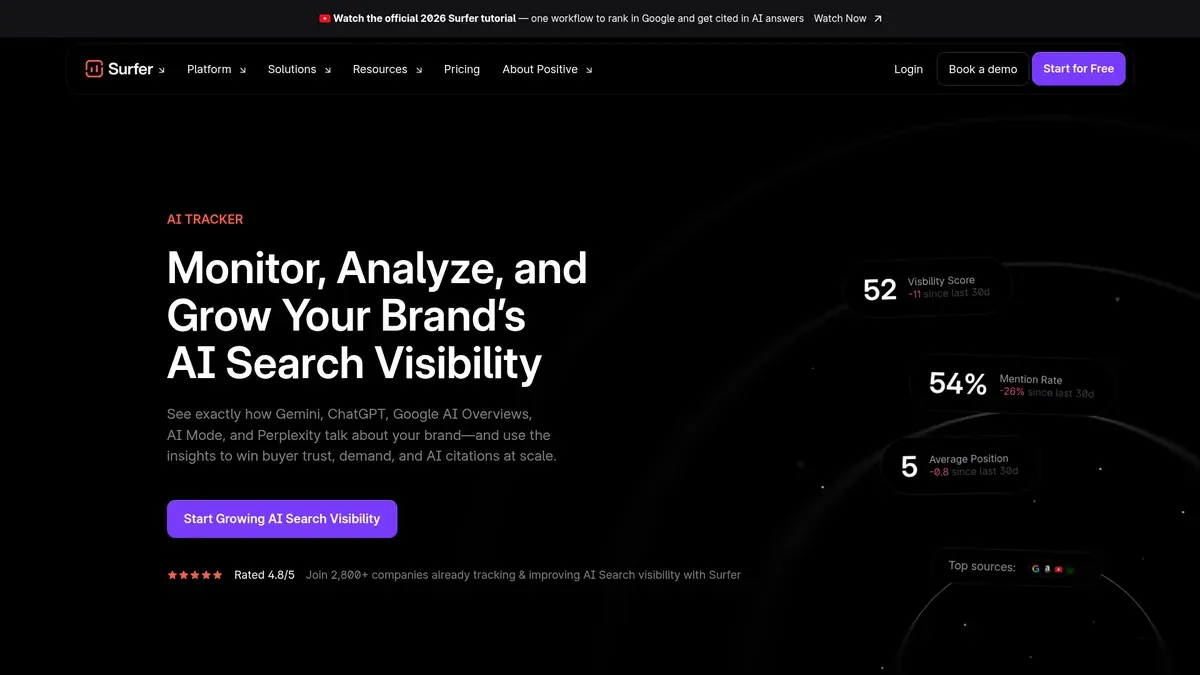
It covers what Surfer calls the Big 5: Gemini, Google AI Overviews, Google AI Mode, ChatGPT, and Perplexity. One prompt tracks your brand across all five, which is better unit economics than it first appears. Reporting covers Visibility Score, Mention Rate, Average Position, share-of-voice trends, missing mentions, cited sources, brand sentiment, and channel performance. Surfer says it captures citations, links, and live browsing data that APIs miss, and competitor benchmarking shows which models skip you in favor of someone else.
Integrations include Keyword Surfer, Contentful, ChatGPT Canvas, Jasper, Zapier, Google Docs, WordPress, and an API on Enterprise or with the add-on.
Pricing: All prices are billed yearly and charged upfront. Discovery is $49/month with zero AI Tracker prompts. Standard is $99/month with 25 prompts and a weekly refresh. Pro is $182/month with 50 prompts and daily refresh. Peace of Mind is $299/month with 100 prompts. Enterprise is $999/month. There is also a standalone AI Search Analytics plan at $158/month with 100 prompts, daily refresh, and 5 brand workspaces. Monthly billing is not shown on the pricing page.
Limitation: Discovery includes no tracker prompts at all, and Standard only refreshes weekly. Surfer's action layer is SEO optimization, not hands-off article production and distribution.
Pick Surfer when you already trust its scoring and audits and want a five-engine tracker inside that workflow.
7. Peec AI
Best for: Marketing teams and agencies that want focused analytics, prompt discovery, and client-ready reporting.

Peec keeps a tight scope and does it well. Visibility, position, and sentiment sit front and center. Prompts can be added manually, tagged, and tracked across countries, and AI-suggested prompts come with search volumes so you can prioritize by demand rather than by hunch. That angle is useful and not standard here.
Find Key Sources surfaces the websites and discussion sources showing up in AI answers. Recommendations point toward review profiles, LinkedIn discussions, communities, and digital PR. Those are recommendations, not guarantees. CSV export, a Looker Studio community connector, a REST API, and a live MCP server cover reporting, and there is an agency offering for multi-brand tracking.
Pricing: This is the catch. Peec does not publish plan prices on its current pricing page. Starter, Pro, and Advanced are described by scope: 3 models each, with 1, 2, and 5 projects respectively, daily tracking, and 3 countries on the upper two. Available models listed include ChatGPT, AI Mode, AI Overviews, Microsoft Copilot, Perplexity, and Gemini, selected during onboarding. Pricing is based on tracked prompts and models analyzed. Agency pricing uses credits, with a 900-credit minimum per project, which is 10 prompts across three models or 30 prompts on one model.
Limitation: No public prices and no published quotas means you cannot shortlist it on paper. You have to talk to someone. Model inclusion is chosen at onboarding, so confirm your required engines before you sign. Peec does not document article writing, a content calendar, CMS publishing, or repurposing.
Pick Peec when prompt intelligence, source analysis, and agency dashboards matter most and you are building your own execution workflow around them.
8. Semrush AI Visibility
Best for: Organizations where Semrush is already the system of record for SEO and reporting.
Sometimes the right tool is the one your team already logs into. Semrush AI Visibility puts AI answers next to your SEO, traffic, and competitive data, which makes it easier to show one story to leadership.
It tracks AI visibility and share of voice, monitors mentions and citations with filtering by platform, source, or intent, finds prompts where competitors appear and you do not, and compares mentions, sources, and sentiment with steps to close the gaps. AI Visibility Overview, Competitor Research, and Prompt Research are all in the base plan, alongside an AI-readiness site audit.
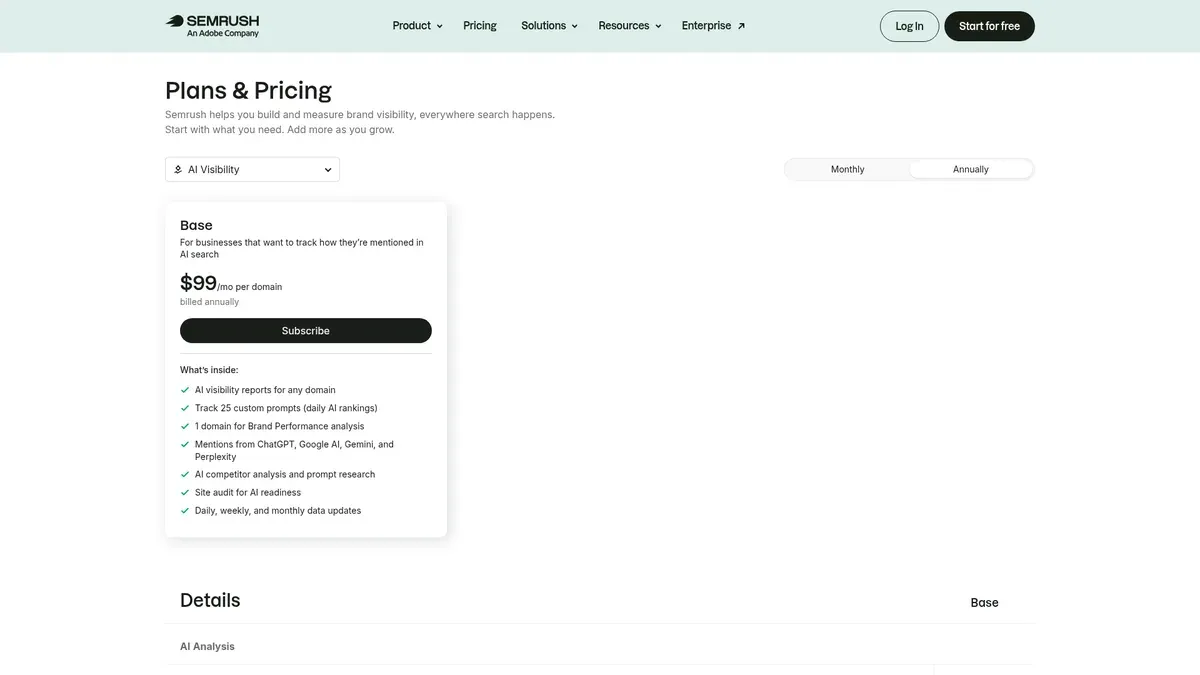
Pricing: AI Visibility Base is $99/month per domain billed annually, with AI visibility reports for any domain, one domain for Brand Performance, 300 reports per day, and mentions from ChatGPT, Google AI, Gemini, and Perplexity. Additional users start at $45/month. Report add-ons are $10 and $20/month. Enterprise is custom. There is a 7-day free trial and you can cancel anytime.
Limitation: The public page does not name a complete engine list, prompt allowance, or answer allowance, and several report and traffic-connection features are marked coming soon. CSV export is capped at 1,000 rows and 10 exports per user per day. This is a visibility layer on an SEO suite, not a production engine.
Pick Semrush when you already rely on its data and want AI visibility beside it, not a second platform to roll out.
How to choose your Scrunch alternative
Still torn? All the alternatives to Scrunch above answer one question first: do you need to see the problem, or do you need to fix it?
If you need measurement plus production in one loop, choose DeepSmith. Visibility data feeds evidence-backed ideas, ideas become on-brand articles, articles get scheduled, published, and repurposed. That is the case for putting it first here.
If you are an enterprise with governance requirements, choose Profound. SOC 2 Type II, SSO, role-based access, query fanout, and FactCheck are hard to match.
If you want the widest coverage and a big integration surface, choose Writesonic. Budget for Enterprise if you need all ten platforms.
If budget is the constraint and you still want a writer, choose Frase. At $39/month annually it is the cheapest complete loop here.
If you want diagnostics and transparent pricing, choose OtterlyAI. Price the engine add-ons first.
If your team already runs Surfer, choose Surfer. Adoption beats features when nobody opens the new tool.
If you want focused analytics and client dashboards, choose Peec AI. Be ready for a sales conversation on price.
If Semrush is already your reporting home, choose Semrush AI Visibility. One less tool to roll out is worth real money.
One last note on price. When you line up Scrunch AI pricing against these options, compare per prompt and per engine, not per month. A $29 plan with three paid add-ons is not a $29 plan, and a $99 plan covering one engine is not the same product as a $99 plan covering four.
Ready to see where you actually stand in AI answers, and to do something about it in the same week? Start a DeepSmith free trial and get real data and real drafts in seven days.