Switching tools is stressful. You already built a prompt list, you already trained your team on one dashboard, and now you are back to square one.
Take a breath. You are further along than you think.
If you are shopping for getairefs alternatives, you already know the hard part: what you want measured. You want to know when ChatGPT names your brand. You want to know when it links to your pages instead of a competitor's. You want a number you can put in a board deck.
That knowledge travels with you. The only thing left is picking the tool that reports it the way your team works.
This guide walks through eight alternatives to getairefs, what each one measures, what it costs, and who it actually suits. Prices here are a snapshot of what these vendors published while this piece was researched, so check the current page before you buy.
How we ranked these getairefs competitors
A roundup is only useful if you know how it was scored. Here are the five things we weighed when picking the best getairefs alternatives, in order.
Engine coverage. Which AI surfaces the tool watches, and whether that coverage comes with the entry plan or arrives later on a higher tier.
Monitoring depth. How many prompts or search terms you get, how many responses that buys, how often the tool checks, and whether you can look back over time.
Decision quality. Whether you get mentions, citations, share of voice, sentiment, position, cited pages, source analysis, and a real competitor view. A single visibility score is not a decision.
Reporting and activation. Dashboards, exports, APIs, integrations, and whether the insight connects to actual content work or stops at the chart.
Commercial fit. Transparent pricing, honest limits, a trial, seats, and a sane upgrade path. If getairefs pricing is part of why you are looking, this is the criterion to read twice.
One warning before the table. Vendors count things differently. A prompt is not a response. A response is not a credit. A credit is not a report. When you compare two plans, compare the same unit or you will pick wrong.
Getairefs alternatives at a glance
| Rank | Tool | Best fit | Starting public price | Engine coverage | Monitoring allowance |
|---|---|---|---|---|---|
| 1 | DeepSmith | Teams that want visibility evidence wired into content production | $99/month | Pro: ChatGPT. Grow adds Perplexity. Scale adds Gemini. Enterprise: all ten named engines | 50 prompts on Pro, 100 on Grow, 200 on Scale |
| 2 | AthenaHQ | Broad cross-platform analysis with executive and BI reporting | Free option, Starter $295/month | Free covers ChatGPT, Perplexity, Gemini, Google AI Overviews, Copilot. Paid adds AI Mode, Claude, Grok, DeepSeek, Meta AI | Starter: 3,600 credits/month, one credit is one AI response |
| 3 | Profound | Enterprise and agency AEO programs needing daily monitoring | $99/month billed yearly | Starter: ChatGPT. Growth: ChatGPT, Perplexity, Google AI Overviews. Enterprise up to nine engines | 50 prompts and 1,500 responses on Starter, 100 prompts and 9,000 responses on Growth |
| 4 | Scrunch | Visibility monitoring paired with site audits and AI readiness | $250/month Core | Core: ChatGPT, Perplexity, Google AI Overviews, Copilot. Enterprise adds Claude, Gemini, Meta AI, AI Mode, Grok | Core: 125 unique prompts and five site audits/month |
| 5 | Peec AI | A focused analytics dashboard for position, sentiment and share of voice | $95/month Starter | ChatGPT, Perplexity, Gemini, AI Mode, AI Overviews, Copilot | Starter: 50 prompts, one project, three models, daily tracking |
| 6 | OtterlyAI | Solo marketers and small teams starting cheap | $29/month Lite | ChatGPT, Google AI Overviews, Perplexity, Copilot, with Gemini and AI Mode on wider pages | Lite: 15 prompts. Standard: 100 plus up to 300 more. Premium: 400 |
| 7 | Rankscale | Wide engine coverage and credit-based flexibility | From $20/month Essentials | 17+ engines, including ChatGPT, Gemini, Perplexity, Claude, DeepSeek, Mistral, Grok, Copilot | Pro: 1,200 credits/month, up to 4,800 answers, unlimited search terms |
| 8 | Semrush AI Visibility Toolkit | Existing Semrush customers | $99/month per domain, billed annually | ChatGPT, Google AI, Gemini, Perplexity, with AI Mode and AI Overviews across wider features | 25 custom prompts, 300 AI analysis reports/day |
1. DeepSmith
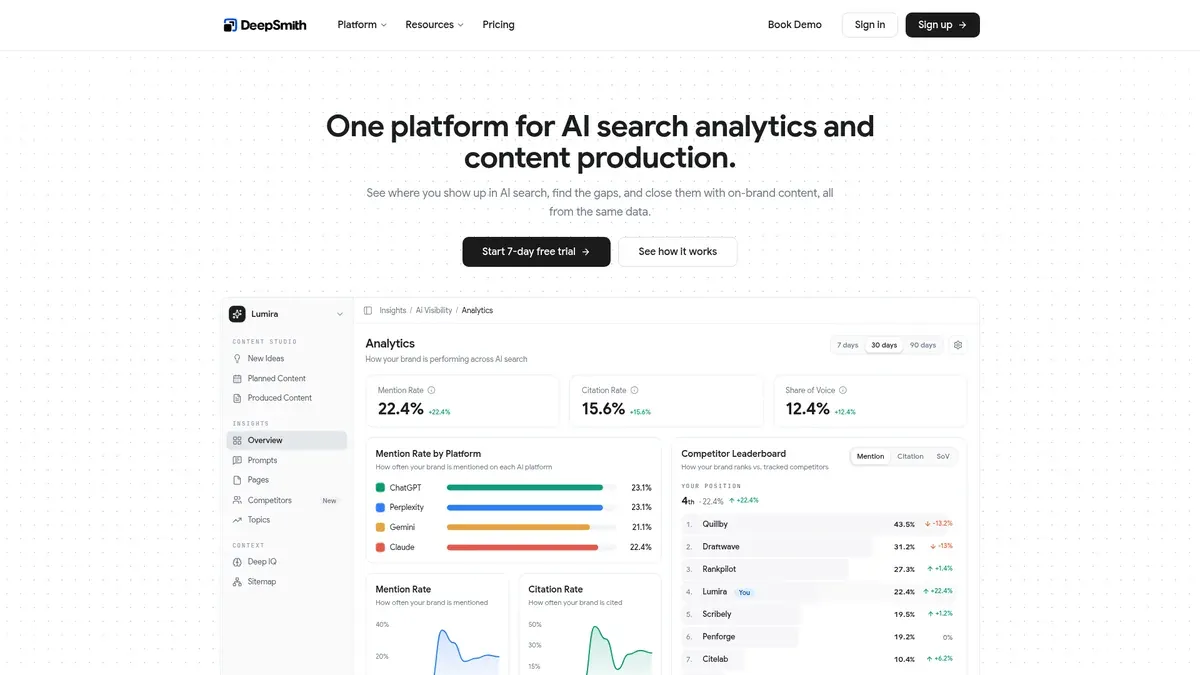
Best for: marketing leads who want to see where AI search is citing a competitor, then turn that finding into a content queue and a published article without changing tools.
Here is the gap most trackers leave you with. You learn you are invisible for eleven prompts. Now what? You still have to decide what to write, brief it, write it, link it, find an image, and publish it. The tracker handed you a problem and walked away.
DeepSmith closes that loop. It is AI search analytics and content production in one platform, so the evidence and the work live in the same place.
On the measurement side, the AEO area reports mention rate, citation rate, share of voice, sentiment, and visibility trend, broken down per engine. You get a competitor leaderboard, the sources AI cites most often, per-prompt answer history, and page-level citation attribution, so you can see exactly which of your pages is winning which prompt.

Content Map crawls your site and your competitors' sites into one shared taxonomy. Every page gets a topic and a funnel stage. That turns coverage from a hunch into a measurement, and it surfaces coverage gaps and untapped topics with the competitor pages you have no answer to.
Then Opportunity Agents read that data and hand back ideas with the reason attached. One agent goes after a tracked prompt you are not cited for. Another turns mentions into citations. Another closes the decision-stage gap against up to four competitors at once. Every idea carries the data point that justified it, so you can defend your backlog instead of guessing at it.
Content Studio takes it from there. Ideas move through New Ideas, Planned Content, and Produced Content, with the Writer in the middle. The Writer researches, drafts, links internally and externally, adds a cover image, and writes publish-ready metadata. Autowrite goes further and writes a scheduled article on its date with nobody in the app. From Produced Content you publish straight to WordPress, Webflow, Strapi, Sanity, or Contentful, or export Markdown and HTML.

Deep IQ is what keeps the output sounding like you. Your positioning, products, personas, brand voice, visual guidelines, and content types are stored once as structured context, and every run is grounded in them. No re-briefing per article. No invented product claims.
Key features
- Mention rate, citation rate, share of voice, sentiment, and visibility trend per engine
- Per-prompt answer history and page-level citation attribution
- Competitor leaderboard and the sources AI cites most for your prompts
- Content Map with coverage gaps, untapped topics, and funnel depth per topic
- Opportunity Agents that return ideas with their supporting evidence attached
- Content Studio, the Writer, and Autowrite for scheduled hands-off production
- Publishing to WordPress, Webflow, Strapi, Sanity, Contentful, or your own webhooks
- Apps Library for LinkedIn, X, newsletter, Medium, Substack, Reddit and more
Pricing: Pro is $99/month for 50 prompts, 20 articles and ChatGPT. Grow is $199/month for 100 prompts, 40 articles and adds Perplexity. Scale is $399/month for 200 prompts, 90 articles and adds Gemini. Billed yearly those land at $80, $160, and $299 a month. Enterprise is custom and covers all ten named engines. There is a seven-day free trial with real data and real drafts, no long-term contract, and no cancellation fee.
Honest limitation: engine coverage is tiered. Pro watches ChatGPT only, Grow adds Perplexity, Scale adds Gemini, and all ten engines are reserved for Enterprise. If you need eight engines on a starter budget and nothing else matters, look at Rankscale or AthenaHQ instead. For most marketing teams the decisions get made on their two or three highest-intent engines, and that is covered from Pro upward.
2. AthenaHQ

Best for: teams that want broad AI platform coverage, executive dashboards, and prescriptive recommendations, especially ecommerce and enterprise teams already living in BI tools.
AthenaHQ calls itself a command center for AEO and GEO. It tracks brand mentions across 11+ major LLMs, with prompt and response analysis, competitor share of voice, sentiment, citation tracking, citation source analysis, ROI tracking, and competitive intelligence summaries. Its recommendation and content optimization agents turn a citation gap into on-page and off-page actions.
Coverage across free and paid access includes ChatGPT, Perplexity, Gemini, Google AI Overviews, Copilot, Google AI Mode, Claude, Grok, DeepSeek, and Meta AI. Enterprise adds custom executive dashboards, multi-language and multi-region support, SSO, audit logs, and BI support for Tableau, Power BI, and Looker.
Key features
- Mentions tracked across 11+ major LLMs
- Prompt and response analysis with citation source breakdown
- Competitor share of voice, sentiment, and ROI tracking
- Recommendation agents that convert gaps into on-page and off-page actions
- Integrations with GA4, Search Console, Shopify, Webflow, and Framer
Pricing: an Essential plan is free with $25 of credit and 300 credits. Starter is $295/month for 3,600 credits, where one credit equals one AI response, with unlimited seats and a single country and language. Enterprise is custom. Annual billing is shown as 17% off, though the exact annual Starter price is not publicly stated.
Honest limitation: credit economics. Prompt cadence and exact prompt limits are not spelled out publicly, and API access and extra credits are paid add-ons on Starter. The free tier is generous for a first look, but $295/month is a real jump.
3. Profound
Best for: enterprise brands and agencies running a dedicated AEO program that needs daily structured monitoring, response volume, and governance.
Profound runs structured prompts across AI platforms every day and analyzes where and how your brand appears. Its reported areas cover citations, sentiment, ranking, competitive presence, AI-sourced traffic, attribution, and content AEO. You can edit, disable, or add prompts as your question set matures.
If your requirement is volume and rigor rather than breadth of tooling, this is a serious option. Growth analyzes up to 9,000 responses a month, which is a lot of evidence behind each trend line.
Key features
- Daily structured prompt runs across AI platforms
- Citations, sentiment, ranking, and competitive presence reporting
- AI-sourced traffic and attribution analysis
- Editable prompt sets
- SSO, SAML, and SOC 2 compliance on Enterprise
Pricing: Starter is $99/month billed yearly for 50 prompts, 1,500 responses a month, one seat and ChatGPT only. Growth is $399/month billed yearly for 100 prompts, 9,000 responses, three seats, and adds Perplexity and Google AI Overviews. Enterprise is custom with up to nine answer engines.
Honest limitation: the jump. Going from ChatGPT-only Starter to three engines means going to $399/month, and there is no API on Starter or Growth. Starter has no exports at all. For a small team that wants two engines and a CSV, that pricing shape is awkward.
4. Scrunch

Best for: teams treating AI visibility and technical AI readiness as one job, where site audits matter as much as prompt tracking.
Scrunch describes itself as an AI customer experience platform for AI search visibility and optimization. Its monitoring unit is the prompt. It tracks prompt results over time, citations surfaced in AI answers, brand performance and presence, topic share, prompt volumes, and shifts in demand. It reports weekly citation and prompt volumes and surfaces the authoritative sites shaping AI answers in your space.
The site audit angle is the real differentiator. If your suspicion is that AI engines cannot read your pages properly, a tracker that also audits the site is doing two jobs at once.
Key features
- Prompt-level tracking with results over time
- Weekly citation and prompt volume reporting
- Brand presence, topic share, and demand change analysis
- Five site audits a month on Core
- Enterprise Data API, SAML and OAuth SSO
Pricing: Core is $250/month for 125 unique prompts, five site audits a month, one brand workspace, and five user licenses, covering ChatGPT, Perplexity, Google AI Overviews, and Copilot. Enterprise is custom and expands to nine engines including Claude, Gemini, Meta AI, AI Mode, and Grok.
Honest limitation: $250/month is a high floor, and the four engines on Core are narrower than the Enterprise set. The pages reviewed here do not name a broad set of external marketing integrations or a dedicated competitor comparison feature, so confirm both if they matter to you.
5. Peec AI

Best for: marketing teams that want a clean analytics dashboard for visibility, position, sentiment, mentions, share of voice, and sources, with reporting connections that fit an existing stack.
Peec AI is built as AI search analytics for marketing teams. Prompts are the foundation of the workflow. You add them, tag them to stay organized, and review recent periods such as the last seven days. It identifies the brands competing with you, compares ranking and share of voice, and shows the sources feeding AI answers, including G2, LinkedIn, Reddit, and the New York Times.
Reporting is where it earns its place. CSV exports, a Looker Studio community connector, and an API mean the numbers can land in the dashboard your leadership already opens.
Key features
- Visibility, position, sentiment, mentions, impressions, and share of voice
- Prompt tagging and recent-period views
- Competitor ranking and share of voice comparison
- Source analysis showing which sites AI draws from
- CSV export, Looker Studio connector, and an API
Pricing: Starter is $95/month for 50 prompts, one project, three models, and daily tracking. Pro is $245/month for 150 prompts and two projects with up to three countries each. Advanced is $495/month for 350 prompts and five projects. Enterprise is a custom annual plan. Billing presentation on the public page has shifted, so confirm it at checkout.
Honest limitation: scope. In the material reviewed here, Peec is an analytics and reporting tool, not a documented end-to-end article production and publishing workflow. It will tell you where the gap is. Closing it stays your team's job in another tool.
6. OtterlyAI

Best for: solo marketers and small teams who want a low-cost way to start monitoring prompts, mentions, citations, and competitors across several AI surfaces.
Not ready to spend hundreds a month to answer one question? Start here. OtterlyAI is a content intelligence platform connecting AI search research, monitoring, and optimization. You define prompts that mirror real buyer queries, and it runs them across multiple engines. It reports brand mentions, citation share, visibility, competitor comparisons, and change over time, and it identifies which brands get cited, how often, and in what context, including the third-party pages worth pursuing.
Coverage named across its pages includes ChatGPT, Gemini, Perplexity, Microsoft Copilot, Google AI Overviews, and Google AI Mode.
Key features
- Prompt monitoring across several AI search surfaces
- Brand mentions, citation share, and visibility over time
- Competitor comparison and third-party page discovery
- GEO URL audits, from 1,000 a month on Lite
- Public API on paid tiers for brand reports, prompts, and citations
Pricing: Lite is $29/month, or $25 billed annually, for 15 prompts and one workspace. Standard is $189/month for 100 prompts plus up to 300 additional. Premium is $489/month for 400 prompts. Enterprise is custom, starting at $1,000/month.
Honest limitation: 15 prompts on Lite is a taster, not a program, and the jump to Standard is steep. The reviewed pages also do not name specific external marketing or analytics integrations. OtterlyAI is upfront that manual spot checks in ChatGPT or Perplexity can differ from its numbers, because those systems personalize answers using memory, history, and location.
7. Rankscale

Best for: buyers who want the widest engine list, unlimited search terms, regional flexibility, and a credit system that stretches from a cheap entry plan to heavy monitoring.
Rankscale tracks search terms, brand mentions, and citations across Google AI Mode and 17+ other AI engines, with examples including ChatGPT, Perplexity, Gemini, Claude, DeepSeek, Mistral, Grok, and Copilot. The dashboard shows search term, engine, region, visibility, schedule, update time, and status in one view.
Its analytics cover visibility, stability, volatility, prompt research, citation analysis, and competitive intelligence. Stability and volatility are the interesting pair here, because AI answers move around and knowing how much they move is part of reading a trend honestly.
Key features
- 17+ AI engines tracked, including several the bigger suites skip
- Unlimited search terms with all regions available
- Scheduling from hourly to monthly
- Visibility, stability, volatility, and citation analysis
- Credit rollover up to two or three times the monthly allocation
Pricing: Essentials starts at $20/month with the exact credit allocation not stated. Pro is $99/month for 1,200 credits and up to 4,800 AI engine answers, 50 page audits, and a seven-day trial. Growth is $385/month for 5,500 credits and up to 22,000 answers. Enterprise is $780/month for 12,000 credits. A typical AI engine query costs 0.25 credits per engine per prompt. Yearly billing shows 15% savings, though exact yearly prices are not published.
Honest limitation: the reviewed Rankscale pages do not state reports, exports, API access, or third-party integrations, so do not assume them. You are trading documented reporting plumbing for breadth and credit flexibility. If a scheduled PDF for your CMO is non-negotiable, confirm that before you commit.
8. Semrush AI Visibility Toolkit
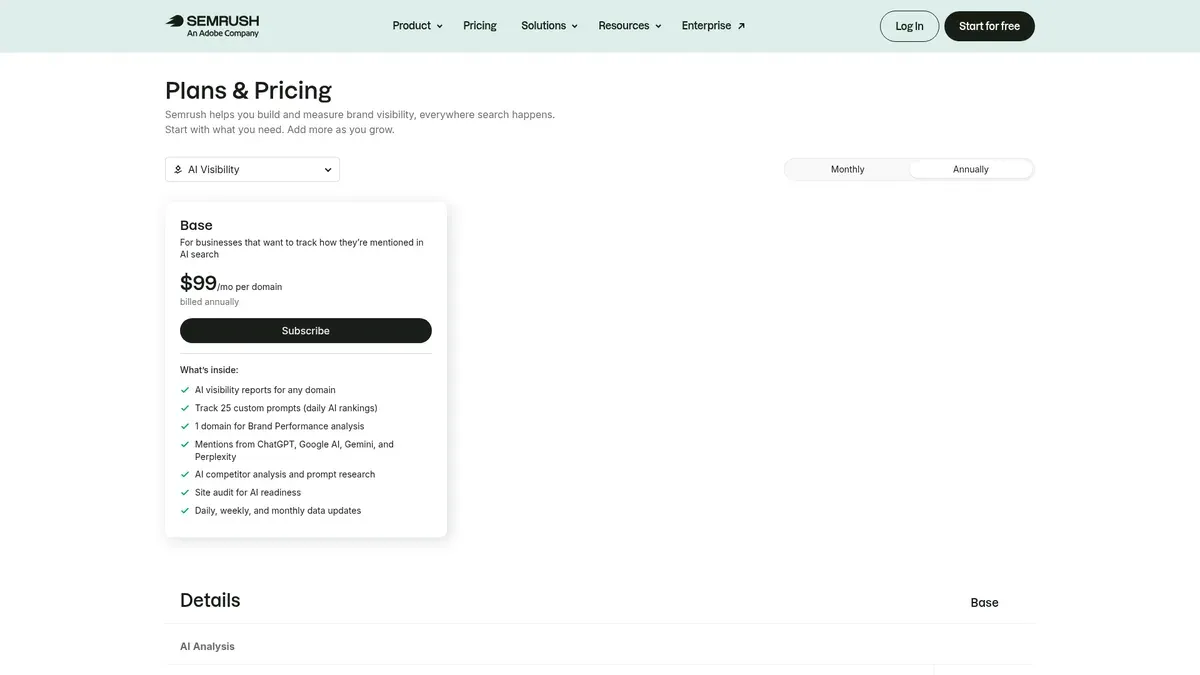
Best for: teams already paying for Semrush who want AI visibility sitting next to the SEO data, technical checks, and stakeholder reports they already use.
The AI Visibility Toolkit covers ChatGPT, Gemini, Google AI, Google AI Overviews, Google AI Mode, Perplexity, and Google Search across the broader feature set. Visibility Overview reports mentions, citations, cited pages, topics, and visibility gaps. Brand Performance covers share of voice and sentiment, including which categories you win and whether the tone is positive or neutral.
Semrush generates branded and non-branded prompts from your domain and location, so you are not starting with a blank prompt list. Prompt Research finds related industry prompts, topics, brands, and domains. Competitor Research lines up four competitors side by side on mentions, citations, and topic coverage. Site Audit checks for blocked AI crawlers and technical barriers, and the Content Toolkit scores drafts against factors correlated with getting cited.
Key features
- Visibility Overview with mentions, citations, cited pages, and gaps
- Brand Performance share of voice and sentiment by category
- Auto-generated branded and non-branded prompts
- Competitor Research across four competitors at once
- Site Audit for blocked AI crawlers, plus Content Toolkit draft scoring
Pricing: AI Visibility Base is $99/month per domain, billed annually, for one domain, 25 custom prompts, 300 AI analysis reports a day, and 1,000 Prompt Research queries a day, with a seven-day trial. Reporting add-ons are $10/month for Base and $20/month for Pro, additional users start at $45/month, and Enterprise is custom.
Honest limitation: packaging. The $99 base is per domain, and reporting and integration capabilities you might assume are included arrive as add-ons. Read the 300 reports a day figure carefully too, because it is a report quota, not a prompt or response quota. If you run three brands, the per-domain math adds up fast.
How to choose the best getairefs alternatives for your team
There is no single winner here. There is a winner for your situation. Pick the sentence below that sounds like you.
"I can see the gap but I never close it." Choose DeepSmith. When the bottleneck is production rather than measurement, a tracker that hands you evidence and stops is the wrong shape of tool.
"Our exec team lives in Power BI and we sell on Shopify." Choose AthenaHQ, if broad platform coverage and BI reporting justify the $295/month Starter.
"We need daily monitoring and our security team asks about SSO." Choose Profound, and budget for Growth if you need more than ChatGPT.
"I think AI engines cannot even read our site properly." Choose Scrunch, where site audits sit alongside prompt tracking.
"I just need clean analytics that feed Looker Studio." Choose Peec AI.
"I have thirty dollars a month and one question." Choose OtterlyAI Lite and grow into it.
"Coverage breadth is the whole point for us." Choose Rankscale, and confirm its reporting fits before you commit.
"We already pay for Semrush." Choose the AI Visibility Toolkit and keep one login.
If getairefs pricing is what pushed you to start looking, compare on the unit, not the sticker. A $99 plan with 25 prompts and a $99 plan with 50 prompts are not the same purchase.
One more piece of advice, and it is the one people skip. Whatever you pick, write down your prompt list before you start the trial. Ten to twenty questions your buyers actually ask, spread across awareness, consideration, and decision. That list is your real asset. The tool is just what runs it.
Ready to see where you stand?
You do not need a bigger team. You need to see the gap and have a way to close it.
DeepSmith gives you both: AI visibility tracking across the engines your buyers use, plus the production pipeline that turns each gap into a published, on-brand article. Start your seven-day free trial and get real data and real drafts before you pay a cent.