You typed your own brand into ChatGPT last week, didn't you? And the answer that came back described you in a way you would never have written yourself.
That feeling has a name now, and a whole tool category grew up around it. If Siftly put you on this path but isn't the right long-term fit, you're in good company. Plenty of teams start with one tracker and outgrow it once they figure out what they actually need.
Here's the good news: the shortlist is short. Most Siftly alternatives fall into two buckets, and once you know which bucket you belong in, the choice gets easy. The best Siftly alternatives are either analytics-first trackers or platforms that also produce the content, and the siftly.ai competitors worth your time all sit in one camp or the other.
This guide walks through eight tools that monitor how AI engines mention, cite, and describe your brand. Take it one section at a time. You don't need to read all eight entries to make a decision.
How we picked these Siftly alternatives
A roundup is only useful if you know the rules. Here are the ones we used to sort the siftly.ai competitors worth listing from the ones that just look similar.
To make this list, a tool had to do all four of these:
- Track multiple named AI answer engines. ChatGPT, Gemini, Perplexity, Claude, Google AI Overviews, Google AI Mode, Copilot, Grok, Meta AI, DeepSeek, or close equivalents.
- Report at the prompt level. Mention rate, citation rate, or share of voice for the specific questions you care about, not a single vanity score.
- Show competitor benchmarking on those same prompts, so you can see who is winning your questions.
- Export the data. CSV, an API, or a BI connector, so the numbers reach a real workflow instead of dying in a dashboard.
Reputation suites that only watch traditional media and review sites are out. They don't read AI answers, so they can't help you here.
Then we ranked on five things, in this order:
- End-to-end fit for a marketing lead who already knows what AI search is and wants one tool that closes the loop from visibility to published content.
- Engine breadth, and how honest the upgrade path is tier by tier.
- Sentiment and framing analysis as a first-class metric. This is the central thing Siftly is known for, so it matters most.
- What the tool turns the data into: briefs, agents, distribution, or nothing.
- Pricing transparency, and what it costs to add seats, engines, or prompts.
DeepSmith comes first by that scoring, and we're the publisher here, so read our entry with that in mind. Every other tool on this list is described from its own published pricing and product pages.
Quick comparison of the best Siftly alternatives
| # | Tool | Lowest paid entry | Engines at top tier | Sentiment analysis | Built-in content production | Free trial |
|---|---|---|---|---|---|---|
| 1 | DeepSmith | $99/mo ($80/mo annual) | 10 | Yes | Yes, publish-ready | 7-day trial |
| 2 | Profound | $99/mo ($82.50/mo annual) | Up to 9 | Yes | AEO and FAQ agents | Growth "Try for free" |
| 3 | Peec AI | $95/mo ($80/mo annual) | 6 default, more on Enterprise | Yes | Recommendations only | Yes |
| 4 | OtterlyAI | $29/mo ($25/mo annual) | 4 base, 3 paid add-ons | Yes | GEO audits, briefs | 14-day, no card |
| 5 | LLMrefs | $79/mo single plan | 10+ | Not stated | AI SEO tool set | 7-day trial |
| 6 | Scrunch | $250/mo Core | 9 on Enterprise, 4 on Core | Yes | AXP on Enterprise | 7-day trial |
| 7 | AthenaHQ | $295/mo Starter | 10+ on Starter | Yes | Content optimization agent | Free Essential plan |
| 8 | Rankscale | From $20/mo | 17+ | Yes | Recommendations, audits | 7-day trial on Pro |
1. DeepSmith
Best for: marketing leads who feel the AI-search urgency, want a system instead of another dashboard, and need to publish on-brand content the same week they spot a positioning problem.
Most tools on this list hand you a chart. You still have to write the article that fixes the problem the chart found.
DeepSmith is the one entry that carries the data all the way through. Tracking, gap analysis, and a publish-ready writer sit on one shared brand context, so the thing you learn on Monday can be live on Thursday.
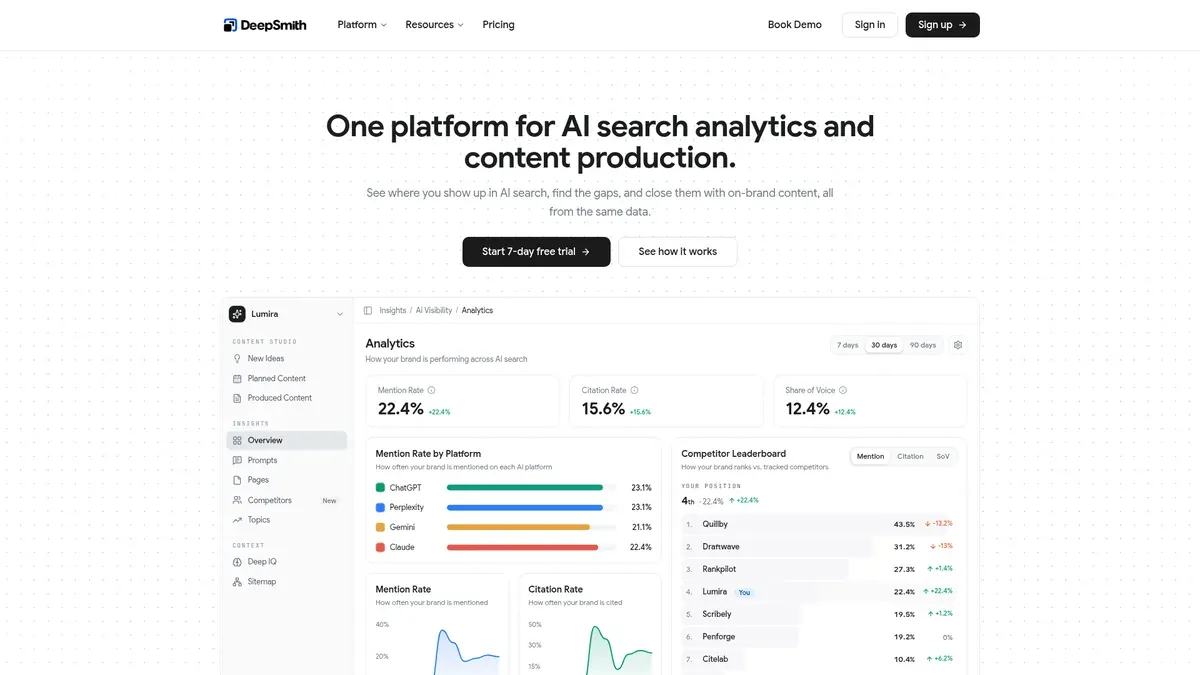
What it tracks
Ten engines: ChatGPT, Gemini, Perplexity, Claude, Google AI Overviews, Google AI Mode, Grok, Meta AI, Microsoft Copilot, and DeepSeek. Coverage rises by plan. Pro covers ChatGPT, Grow adds Perplexity, Scale adds Gemini, and Enterprise covers all ten.
Five metrics come standard: Mention Rate, Citation Rate, Share of Voice, Sentiment, and Visibility Trend. Sentiment is the one that answers your original question, the one about how AI describes you rather than whether it names you.

The figures shown are demo data from a sample workspace, not customer results.
What it does with the data
This is where the entry earns its spot.
AEO shows your mention and citation rates per prompt with full answer history, which of your pages AI actually cites, and which competitor pages win the prompts you're losing.
Content Map crawls your site and unlimited competitor sites, classifies every page onto a topic and a funnel stage, and shows you coverage gaps and untapped topics. Sitemaps refresh every 24 hours, so nothing goes stale.
Opportunity Agents read that data and return content ideas with the evidence attached. Not brainstormed ideas. Ideas you can defend in a meeting.
Content Studio takes an idea to a finished article: New Ideas as the backlog, Planned Content once you give it a date, the Writer that produces a researched, internally linked, brand-grounded piece with a cover image, and Autowrite if you want it to happen on schedule without anyone in the app.
Apps Library turns each published article into LinkedIn, X, Medium, Substack, newsletter, Reddit, and other channel-native versions, so distribution stops falling off your list.
Deep IQ stores your positioning, products, personas, brand voice, and visual guidelines once, and every module writes from it.

The figures shown are demo data from a sample workspace, not customer results.
Publishing goes straight to WordPress, Webflow, Strapi, Sanity, or Contentful, with Markdown, HTML, and webhooks as fallbacks.
Pricing
| Plan | Monthly | Annual | Articles/mo | Prompts | Seats | Engines |
|---|---|---|---|---|---|---|
| Pro | $99 | $80 | 20 | 50 | 5 | ChatGPT |
| Grow | $199 | $160 | 40 | 100 | 7 | ChatGPT, Perplexity |
| Scale | $399 | $299 | 90 | 200 | 10 | + Gemini |
| Enterprise | Custom | Custom | Custom | Custom | Custom | All ten |
A 7-day free trial gets you real data and real drafts. No long-term contracts, no cancellation fees.
One honest limitation
Engine breadth is tier-gated. If you need Google AI Overviews plus Claude from day one, Pro and Grow won't get you there.
The upgrade is a billing change, though, not a rebuild. Your tracked prompts, brand context, and Opportunity Agents all carry over to Scale or Enterprise, so growing into ten-engine coverage costs you money and not a migration.
2. Profound
Best for: mid-market and enterprise brand marketers who want AI-reported sentiment and source-citation analysis, plus agents that run on credits.
Profound treats agent credits as the usage unit. Every plan includes a monthly allowance you spend on built-in AEO agents, which means you can expand what you do without jumping a whole tier.
What it tracks: Perplexity, ChatGPT, Claude, Gemini, Grok, Microsoft Copilot, DeepSeek, and Google AI Overviews on the home page list. Enterprise expands to nine answer engines and adds ChatGPT Shopping.
Key features. The AEO Report covers Source Citations, Brand Sentiment, AI Visibility, and Content AEO in one place. Agent Analytics watches how agent crawlers read your site. Aim ranks the highest-impact next actions for you.
 Growth and Enterprise integrate with Akamai, AWS, Cloudflare, Fastly, Google Analytics, Google Cloud Platform, Netlify, Vercel, and WordPress.
Pricing. Starter is $99/mo billed yearly for 50 prompts, 1,500 responses, ChatGPT only, 100 agent credits, and one seat. Growth is $399/mo billed yearly for 100 prompts, 9,000 responses, three answer engines, 400 credits, three seats, and CSV and JSON export. Agency Growth and Enterprise are custom, and both add API access.
One honest limitation. The gating is real. Starter is ChatGPT-only, the $399 Growth plan covers three engines, and the API sits behind Enterprise. The credit model softens it a little, since you can buy more prompts and responses without a full tier jump, and Agency and Enterprise add SAML SSO and SOC 2.
Pick Profound when agent credits and a content agent are your deciding factors, and ChatGPT and Perplexity are the engines that matter most to your buyers.
3. Peec AI
Best for: marketing leads who want fast setup, daily tracking, and clean share-of-voice comparisons, plus agencies that need credit-based billing across clients.
Peec is the tidiest of the analytics-first options. You get visibility, position, sentiment, and share of voice against your competitors, refreshed daily, without much setup work.
What it tracks: a default set of six engines, ChatGPT, Google AI Overviews, Google AI Mode, Microsoft Copilot, Perplexity, and Gemini. Brand plans let you pick three of them. Enterprise adds Claude Sonnet 4, GPT-5 Search, Deepseek, Qwen, and Mistral through the API.
Key features. Visibility, position, sentiment, share of voice, sources, citations, query fanouts, chat features, crawlability, crawl insights, product visibility, and recommendations. CSV export, a Looker Studio community connector, API, and MCP access are all available depending on tier.

Pricing. Brand Starter is $95/mo ($80 annual) for 50 prompts, three models, one project. Brand Pro is $245/mo ($205 annual) for 150 prompts and two projects. Brand Advanced is $495/mo ($420 annual) for 350 prompts, five projects, and Looker Studio. Enterprise is custom. Extra tracked models cost $35, $85, or $165/mo depending on tier. Annual billing saves roughly 15% across the board.
Agencies get a separate credit-based track: Essential $245/mo for 10,000 credits, Growth $495/mo for 25,000, Scale $795/mo for 65,000, and a custom Comprehensive tier. One prompt on one model for one day equals one credit, with a 900-credit project minimum.
One honest limitation. Brand plans cap you at three models unless you pay per extra one, and API, MCP, SSO, and extended models sit on the Comprehensive agency tier only.
Pick Peec when you bill multiple clients and want credit-based pricing, or when unlimited users on a brand plan solves a seat-count problem for you.
4. OtterlyAI
Best for: solo marketers, small in-house teams, and agency operators who want the lowest cost per tracked prompt.
If budget is the thing standing between you and starting, this is your entry point. Lite runs $29/mo, and you can be tracking by this afternoon without a procurement conversation.
What it tracks: ChatGPT, Google AI Overviews, Perplexity, and Microsoft Copilot at base on every tier. Claude, Google AI Mode, and Gemini are paid add-ons.
Key features. Brand Visibility Index, Domain Ranking, Link Citations Analysis, citation frequency and context, brand coverage rate, share of AI voice, average position, platform-by-platform visibility, sentiment, source links, and trends over time. GEO audits run from 1,000/mo on Lite to 10,000/mo on Premium. Standard and above add a Looker Studio connector, API and MCP requests, and Agent Analytics events.
Pricing. Lite $29/mo ($25 annual) for 15 prompts. Standard $189/mo ($160 annual) for 100 prompts. Premium $489/mo ($422 annual) for 400 prompts. Enterprise starts from $1,000/mo. Every paid tier includes unlimited team members. Add-ons are published: AI Mode and Gemini combined run $9, $59, or $149/mo by tier, and Claude runs $29, $109, or $439/mo. Another 100 prompts costs $99/mo on Standard and Premium.

One honest limitation. Four engines at base means the rest are add-ons, and those add-ons climb fast at the Premium tier. The saving grace is that every price is published, so you can total your real bill before you buy.
Pick OtterlyAI when you want the cheapest way in and you're happy to pay per engine as you grow. The 14-day no-credit-card trial is the most generous on this list.
5. LLMrefs
Best for: brands that want broad engine coverage on one flat price and would rather not think about tiers at all.
One plan. One price. That's the whole pitch, and for some teams it's the right one.
What it tracks: ChatGPT, AI Overviews, AI Mode, Gemini, Perplexity, Claude, Copilot, and Meta, with GPT-5, Grok, and DeepSeek also listed in the engine set. All of it at the same price.
Key features. 500 tracked prompts for brand mentions, sources, and fan-out queries. Weekly visibility reports that refresh automatically. Geo-targeting across 50+ countries and 20+ languages. Citation tracking to find which sources are shaping AI answers about you. Unlimited team members and unlimited projects. CSV export and API access. A few extras come bundled: an AI crawlability checker, a Reddit threads finder, and an LLMs.txt generator.
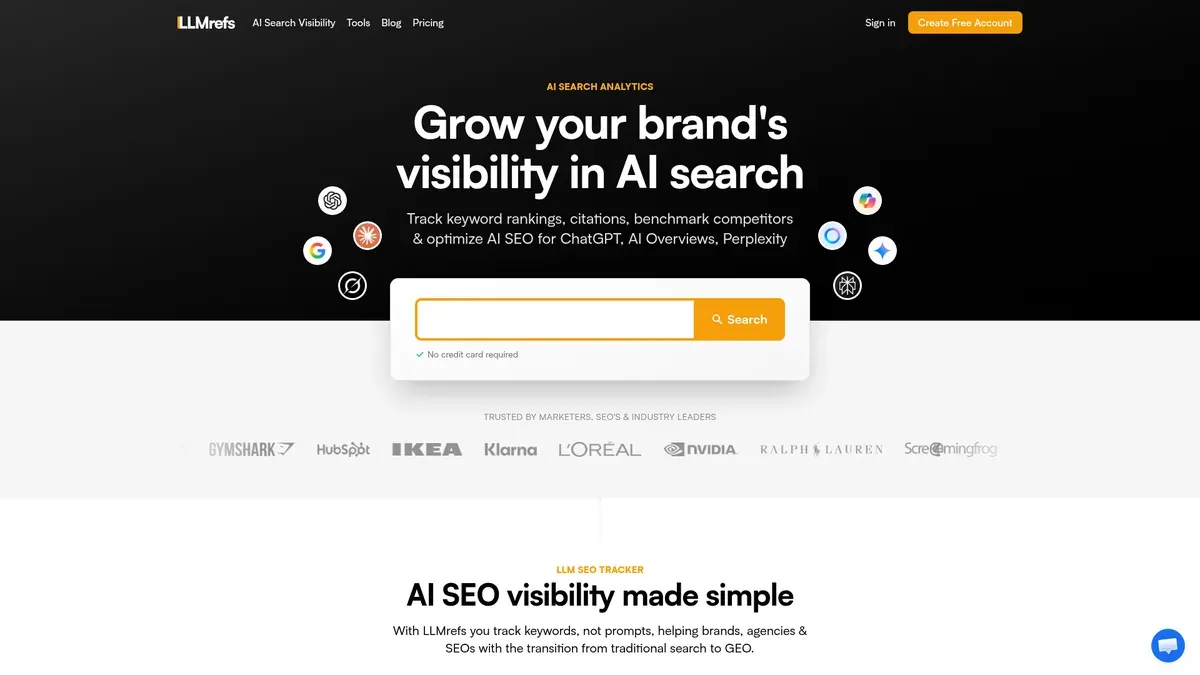
Pricing. The All-in-One plan is $79/month billed monthly, with a 7-day free trial.
One honest limitation. Sentiment isn't published as a first-class metric here. The rankings run on share of voice, position, and citations. If "how does AI describe us" is your main question, this is the wrong tool. Fan-out data and source concentration can hint at sentiment shifts, but hints aren't a metric.
Pick LLMrefs when you track several domains across several countries and want one flat bill that doesn't move.
6. Scrunch
Best for: organizations planning for the shift where AI agents, not people, do most of the visiting.
Scrunch sits at the expensive end and pairs visibility tracking with AXP, its Agent Experience Platform, on Enterprise.
What it tracks: four engines on Core (ChatGPT, Perplexity, Google AI Overviews, Copilot) and nine on Enterprise, adding Claude, Gemini, Meta AI, Google AI Mode, and Grok.
Key features. Sentiment is included at both tiers. Core gives you 125 unique prompts, five site audits a month, one brand workspace, five user licenses, one page optimization a month, AI-agent and bot traffic data, funnel stages, citations and sources, prompt management, and a reporting dashboard. Enterprise adds full site audits, Looker Studio, a Query API, MCP, CLI, and AXP.

Pricing. Core is $250/mo with a 7-day free trial. Enterprise is custom.
One honest limitation. Core has a tight ceiling: 25 pages in the site map, one country, three personas, two languages, five competitors, and no API or Looker Studio. It reads as a benchmarking tier designed to hand you off to Enterprise. If you plan to live on Core, price that ceiling first.
Pick Scrunch when agent-delivered content is a real 2026 priority for you and you want AXP on the same contract.
7. AthenaHQ
Best for: commerce and DTC teams who want AI visibility tied to actual revenue, with multi-region and multi-language needs.
Most tools on this list stop at visibility. AthenaHQ pushes toward attribution, which is a different and harder question.
What it tracks: ten models on Starter, including ChatGPT, Perplexity, Google AI Overviews, AI Mode, Gemini, Claude, Copilot, Grok, DeepSeek, and Meta AI, with more on request. The free Essential plan covers five.
Key features. Native Shopify and Google Analytics integrations for revenue attribution. Side-by-side SEO and AEO comparison through Google Search Console. A content optimization agent, self-learning content improvement, and Ask Athena, an agentic copilot. AthenaHQ Content maps each recommendation back to the exact passages and source URLs AI models pulled from in your category, which is unusually specific.

Pricing. Essential is free with $25 in credit and 300 credits at signup. Starter is $295/mo, which includes $300/mo in free credit plus 3,600 credits, where one credit equals one AI response. Enterprise is custom and adds multi-region, persona targeting, BI tool support, SSO, audit logs, and a 2-hour SLA. API access and extra credits are paid add-ons, and that add-on pricing isn't published.
One honest limitation. Starter at $295/mo is a big first paid step, and API access needs a "contact us" conversation on top. The free Essential plan is generous enough to prove value first, which takes some of the sting out.
Pick AthenaHQ when you have a Shopify revenue line and need to connect AI visibility to it.
8. Rankscale
Best for: agencies and multi-brand teams who want the widest engine list at the lowest entry price, plus a published sentiment engine.
Of everything here, Rankscale's published spec sits closest to what Siftly is known for. If sentiment and framing are the whole reason you're looking, start here.
What it tracks: 17+ engines, including ChatGPT, Perplexity, Claude, Gemini, Google AI Overviews, Google AI Mode, DeepSeek, Mistral, Grok, and Copilot.
Key features. The Brand Perception Engine classifies each LLM response as positive, neutral, or negative, groups keyword associations per brand to show how models describe you versus competitors, maps perception across your five most-mentioned keywords, surfaces "Citation Kings" and unique descriptors, and produces sentiment trends plus a five-dimension radar. On top of that: 94+ technical checkpoints for AI-readiness audits, 240+ countries, all languages, a Looker Studio connector, an authenticated REST API, and shareable public dashboards.
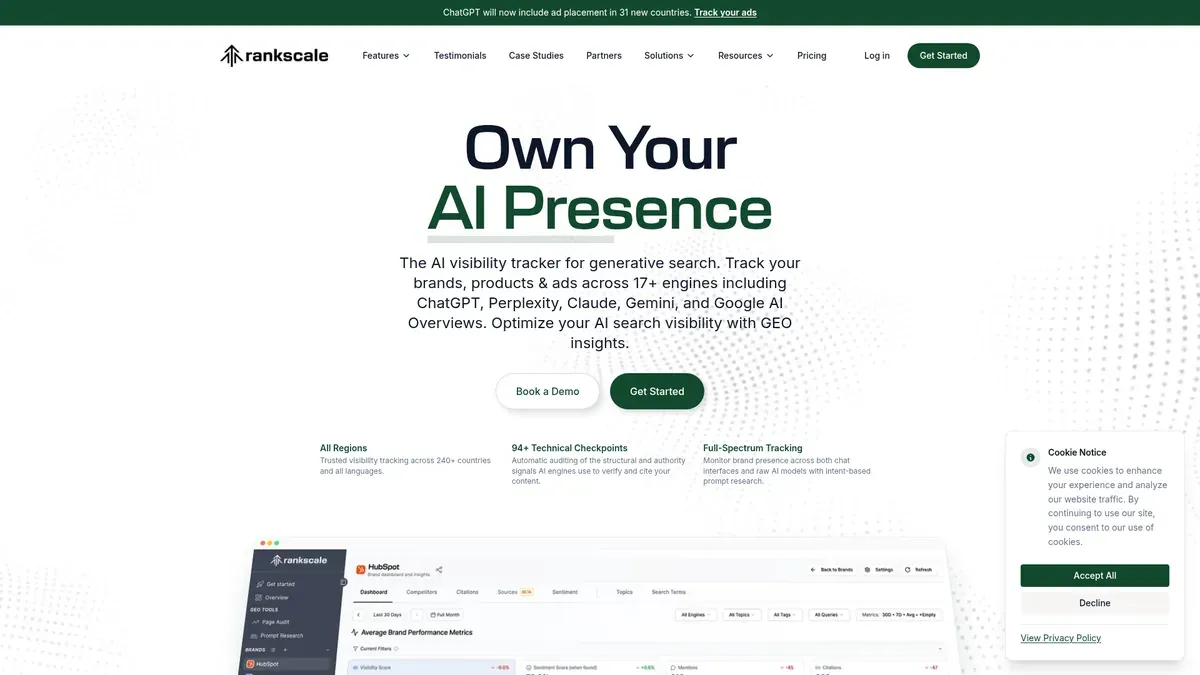
Pricing. Essentials starts from $20/mo. Pro is $99/mo for 1,200 credits and up to 4,800 AI-engine answers, 10 brand dashboards, and 50 page audits. Growth is $385/mo for 5,500 credits. Enterprise is $780/mo for 12,000 credits. Each engine query uses a fraction of a credit, typically 0.25. Unused credits roll over up to 2x or 3x by plan, and yearly billing saves 15%.
One honest limitation. The Essentials tier lists its allocations as zero on the current public pricing page, so real monitoring probably starts at Pro. The 7-day Pro trial lets you find that out for free.
Pick Rankscale when you run multiple brands, need 17+ engines, and want a published brand-perception spec rather than a sentiment checkbox.
How to choose your Siftly alternative
Take a breath. Comparing alternatives to Siftly gets a lot simpler once you answer one question honestly.
Is your bottleneck knowing, or is it doing?
If you genuinely don't know where you stand yet, buy an analytics-first tool and give it 60 days. Peec AI, LLMrefs, and Rankscale all do this well at different price points.
If you already know you're losing prompts and the real problem is that nothing gets published, a dashboard will just tell you the same thing more precisely. That's where DeepSmith fits.
A few more situations where someone else is the better call:
- You're a solo marketer with almost no budget. OtterlyAI Lite at $29/mo or Rankscale Essentials from $20/mo will get you tracking this week.
- You want to test before paying anything. AthenaHQ's free Essential plan with $25 in credit is the only ongoing free tier here.
- You need all ten engines immediately at the lowest price. LLMrefs at $79/mo or Rankscale Pro at $99/mo beat our tier structure on that specific requirement.
- You bill clients per project. Peec AI's agency credits are built for exactly that.
- You're planning for agent traffic at enterprise scale. Scrunch's AXP is the only thing here aimed at it.
- Revenue attribution is the whole ask. AthenaHQ's Shopify and GA4 wiring is the shortest path.
And a note on cost. When you compare Siftly pricing against these tools, count the full bill, not the sticker price. Engine add-ons, extra prompts, seats, and API access are where these plans quietly diverge.
Ready to close the loop, not just watch it?
If your list of things AI gets wrong about you is longer than your list of published articles, tracking alone won't move it.
Start a 7-day DeepSmith free trial and see real visibility data and real publish-ready drafts before you pay a cent. No contract, no cancellation fee.