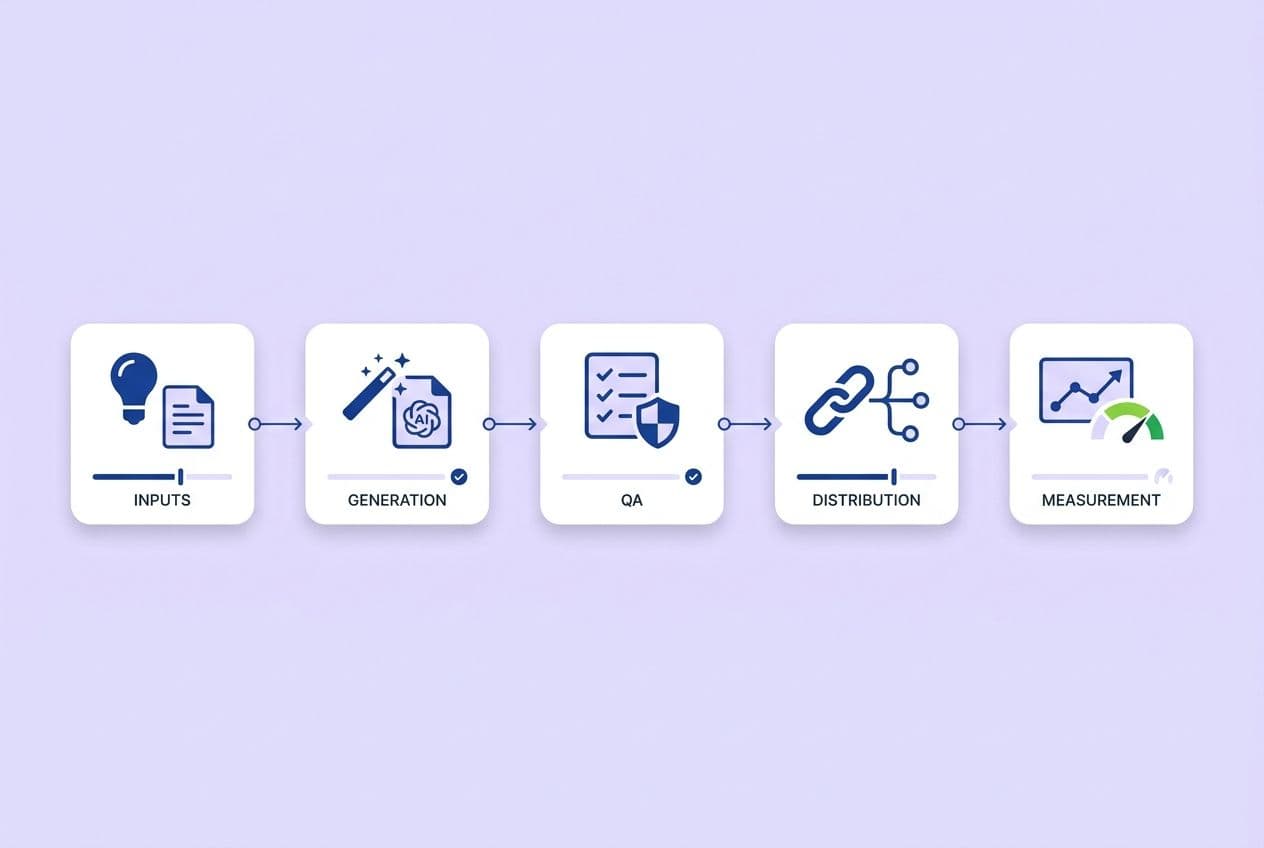
If you're using AI for content, you get reliable gains when you treat it like a pipeline: better inputs, solid briefs, a real QA process, and a system for linking and repurposing. That’s the whole game.
Skip a step, and you get a fast draft that still takes three hours to make publishable. I see most startup teams stuck right here, drowning in that "last 40%" of manual work.
You know the ChatGPT problem. The first draft lands in minutes, but it reads like a robot wrote it. Generic opener, no point of view, and zero internal links. The hard part, like SEO, examples, and getting it into your CMS, is still all on you.
That isn't an AI problem. It’s a workflow problem. And when it's just you and maybe one other person, that bottleneck is painful.
So, this isn't another list of 10 magic prompts. These are 10 tips for the real work of getting content out the door. I’ll walk you through what to do, why it works, and the mistakes I’ve made so you can avoid them.
What Should AI Content Generation Really Mean for a Startup Team?
Let's be real. For a startup, AI content generation only works if it cuts your total time from idea to a published, distributed article, all while keeping your voice and being accurate. If it just moves the bottleneck from "writing" to "endless editing," you haven't won anything.
Most people define AI content generation too narrowly: prompt, draft, edit. But that’s a tiny slice of the work. The full scope includes ideation, briefing, drafting, optimizing, repurposing, and distribution. If you only automate the draft, you’ve saved maybe 30% of your time and created a massive new review job for yourself.
I call this the "draft speed vs. publish speed" gap, and it's a killer. Your first draft time drops from 4 hours to 20 minutes, which feels amazing. But your total time-to-publish barely budges. Why? Because all the downstream work (SEO rewrites, internal linking, image sourcing, CMS formatting) didn't change at all.
This is especially hard for startups because of three constraints:
-
Limited SMEs. You’re the expert, and you're busy. You can't add expert context to every single draft.
-
Small editorial team. With one or two reviewers, every bottleneck is a person, not a process. I’ve been that person. It’s not fun.
-
High brand risk. As a startup, generic or wrong content can damage your credibility fast.
The model to keep in your head is this: Inputs → Generation → QA → Distribution → Measurement. Each tip I'm sharing maps to one of these stages.
Quick gut-check, AI is actually helping your team if:
-
Time-to-publish (not time-to-draft) is going down.
-
You’re doing fewer revision cycles per article, not more.
-
Internal linking and distribution are actually happening.
-
Your content sounds like you, no matter who writes it.
-
You're learning from what works and updating your process.
Where Teams Lose Time After the AI Draft
The post-draft slog is where your time savings go to die. It's a familiar list: rewriting headers for search intent, adding keywords, inserting internal links, finding or making images, formatting for the CMS, writing meta descriptions, and maybe, if you’re disciplined, repurposing it for social media.
Internal linking and distribution are the two steps that get skipped most. Both feel optional when the article is "done," and both have a huge compounding cost. You end up with orphaned content and zero reach.
How to Get Non-Generic AI Output by Fixing Your Inputs (Not Your Prompts)
The fastest way to stop getting generic AI writing is to feed the model specific context. Give it your positioning, your persona's pain points, real examples, and a content map. Better inputs beat fancier prompts every time.
The common mistake is thinking you can just tell the AI to "sound professional but approachable" and it'll get your voice. It won't. That's just noise to the model. It needs concrete examples and hard rules, not brand poetry.
Get these five inputs ready once, and reuse them for every article:
-
Positioning + what you don't do. Your category, what makes you different, and what you explicitly don't claim. ("We don't use buzzwords like 'synergy'.")
-
Primary persona + their actual questions. Not their demographics. What are the real, painful questions they're asking when they find your content?
-
Voice traits + banned phrases + formatting rules. Things like: Use short sentences. No "leverage." No "in today's fast-paced world." No 400-word intros. Write it down.
-
Proof assets. Your own customer stories, metrics, screenshots, and examples. This stops the model from inventing nonsense.
-
A content map. For each page, just add one sentence: "Link here when the article discusses [topic/intent]." That's all the AI needs to make decent suggestions.
Once you have these, your prompt template becomes much more powerful:
Audience = [persona], their pain = [specific frustration], desired outcome = [clear win]Angle = We believe [our position] because [our experience]Must include: 3 real examples, 1 comparison table, 5 internal link suggestions from our [content map]
This simple setup cuts editing time way more than any prompt trick because you’ve narrowed the AI's sandbox before it even starts writing.
What to Include in a Brand Voice "Example Pack"
Don't write a brand voice guide from scratch. Just build an "example pack." It's faster and much more useful for an AI.
Your pack should have:
-
3–5 links or snippets from your best posts, the ones that sound exactly like you.
-
A "how we explain X" block. Take a paragraph from your best article explaining your core concept, and add a note on why it works.
-
A "how we DO NOT explain X" example. A generic version of that same paragraph to show the contrast.
-
A banned phrases list: "in today's fast-paced world," "leverage synergies," "holistic approach," "it's no secret that," "game-changer."
That last list is more important than you think. Banned phrases force the model out of its default, lazy patterns.
How to Write Prompts for Usable Briefs, Not Just Wordy Drafts
Before you ask an AI to write a single paragraph, have it generate a brief and an outline first. This is where you get both quality and speed. The brief should include your audience, angle, things to exclude, and internal link ideas.
"Write me a blog post about X" is a recipe for failure. It gives the AI no stance, no structure, and no way to be different. The model just gives you the average of everything it's ever read on the topic, which is the generic mush we all hate.
Try this 3-step prompting sequence instead:
-
Ask for angles + counter-angles. "Give me 5 editorial angles for [topic] targeting [persona]. For each, tell me the counter-argument a skeptic would make." Pick the angle that's hardest to argue against. That’s usually your winner.
-
Ask for a brief. "Write a content brief for this angle. Include the target audience, the core promise, 3 objections to address, 2 proof points I should add, and 3 questions this article has to answer."
-
Ask for an outline with answers first. "Create an outline where each H2 section starts with a 1-sentence direct answer, followed by supporting points. Each section should mention a trade-off."
Then, add constraints that force it to be original:
-
"Include 2 edge cases where this advice doesn't apply."
-
"Add one trade-off for every recommendation."
-
"Ban these phrases: [your list]."
-
"Include 1 comparison table."
-
"Flag 3 places where I should add a real customer example."
Finally, be honest about the work split. Ask for a 60% draft and tell it what you (the human) will add. "Leave placeholders for: one SME quote, product screenshots, and any stat that needs verification." This stops the AI from making things up.
Prompt Snippet: "Brief-First" Generator
Here's a prompt you can copy and adapt:
You are a B2B content strategist. Create a content brief for the following:Topic: [topic]Target audience: [persona + their specific pain]Desired outcome: [what they leave knowing or able to do]Angle: [your position — don't just describe the topic, take a side]
Include in the brief:1. Core promise (one sentence)2. Three objections to address3. Required proof points (I'll fill these in)4. What to skip — topics that seem related but dilute the argument5. What would make this generic — and how we'll avoid it6. Suggested outline with section-level direct answers
That "what to skip" instruction alone will save you an entire revision cycle. Trust me.
How to Build a QA Loop That Doesn't Kill Your Speed
A lightweight QA loop is your best defense against reputational damage. It might cost you 15 extra minutes per article, but it saves you from hours of rework and protects your brand. The speed gains from AI don't disappear; you just apply them to the right kind of work.
Remember, humans are for judgment, specific examples, and credibility. AI is for structure and coverage. It will reliably mess up subtle facts, your company’s unique claims, and the kind of real-world examples that make content stick.
Run your QA through three simple gates:
Gate 1: Structure + intent. Does each section answer the header in the first couple of sentences? If someone scans your H2s and the first line of each section, do they get the core message? If not, rewrite the top of that section.
Gate 2: Facts + claims. Flag every single statistic, study, and confident claim. Verify it or delete it. Replace vague authority ("studies show…") with a real source or just frame it as a common pattern ("teams often find that..."). Add quotes or your own experience wherever the draft sounds too generic.
Gate 3: Voice + originality. Read five random sentences out loud. Could they have been written by any of your competitors? If so, rewrite them. Swap filler transitions ("Additionally...") with a concrete example or a direct command.
Red-flag AI "tells" to delete on sight:
-
Repeating the same phrases between sections
-
Vague benefits without any specifics ("helps you scale faster")
-
Overconfident claims with zero evidence
-
Starting three paragraphs in a row with the same word ("This means...")
A quick word on transparency: sometimes it makes sense to disclose you used AI, especially for thought leadership pieces where your personal expertise is the selling point. It depends on the context. There's no universal rule, but if your name is on it as the authority, be upfront.
A Simple Rubric for Deciding Whether to Keep an AI Draft
Before you commit to a full edit, score the draft from 1–5 on these points:
| Dimension | What "5" looks like |
|---|---|
| Accuracy | All claims are verifiable; no hallucinations. |
| Distinctiveness | Couldn't have been written by a competitor. |
| Usefulness | Reader leaves knowing how to do something specific. |
| Persona alignment | Addresses this reader's exact frustration. |
| Conversion readiness | Credible enough to build trust at this stage. |
If the "Distinctiveness" score is below a 3, don't just edit. Go back and rewrite the intro, add two real examples, and insert a comparison table. That kind of intervention can change the feel of the entire piece.
How to Automate Internal Linking So It Actually Gets Done
You can semi-automate internal linking. The trick is to keep a simple content map and make the AI suggest links while it's drafting. The goal is to turn a 45-minute chore into a 5-minute review.
We all know internal linking is painful, especially on a small team. It burns up two things you don't have: time (spent digging through your own site) and brainpower (trying to figure out what link goes where while your mind is still on editing). So what happens? It gets skipped. Every single time.
Build a minimum viable content map. You don't need a massive site taxonomy. All you need is:
-
Your top money pages (pricing, product, use cases)
-
Your comparison pages (vs. competitors)
-
Your cornerstone guides (pillar content)
-
Key sales resources (case studies, demos)
For each page, just add one sentence: "Link here when the article discusses [topic/intent]." That's all the AI needs to make decent suggestions.
Then, add this to every drafting prompt: "Suggest 3–5 internal links. For each, provide the target page, the recommended anchor text, and the specific sentence where it should go."
Common failure modes to watch for:
-
Forcing irrelevant links into sentences.
-
Awkward, over-optimized anchor text ("best AI content generation platform for startups").
-
Too many links in the first two paragraphs before the reader even knows what's going on.
Tools like DeepSmith can handle this by scanning your site during the writing process and suggesting links right in the draft. You still need a human to approve the final choices, but the soul-crushing manual work is gone.
What "Good" AI-Suggested Internal Links Look Like
Here are three examples of link suggestions you'd actually want to keep:
-
"Link to your guide on content briefs in the paragraph about briefing, using anchor text 'content brief template.' It adds value without derailing the topic." This is great. It's relevant, the anchor text is natural, and the placement makes sense.
-
"Link to your comparison page where you discuss evaluating AI tools, using 'AI content platforms compared.' The reader is in evaluation mode." Perfect. It matches the reader's intent.
-
"Link to your internal linking case study in the closing section, using 'how one team cut internal linking time by 70%.' It adds proof to your claim." This is smart. It backs up a specific claim with real evidence.
My quick rule for approval: if the anchor text sounds like something a person would actually say, and the page it links to answers the reader's next logical question, approve it.
How to Keep Your Brand Voice Consistent (Even with AI and Freelancers)
Voice consistency comes from repeatable rules, good examples, and a QA step. It doesn't come from hoping every writer (or AI) magically understands your 20-page style guide. The PDF that everyone ignores isn't the problem; lack of enforcement is.
Here's why voice drifts with AI: every prompt starts with a blank slate. Your freelancer's ChatGPT session has no memory of the 47 other articles you’ve published. Without a structured way to provide context, every draft defaults to the internet's average, generic voice.
A practical voice enforcement stack:
-
One short source-of-truth voice doc. Not 20 pages. Just three sections: what we sound like, what we don't sound like, and 10 banned phrases. If it takes more than 10 minutes to read, nobody will use it.
-
An example pack. Three to five snippets from your best posts, included in every single brief.
-
A humanization checklist. After every AI draft, run a quick check: Is sentence length varied? Is the persona's pain mentioned in the first 200 words? Is there at least one concrete scenario? Are there zero filler transitions?
A fast QA method for voice: Pick five random sentences from the draft. If they could all appear on a competitor's blog, your voice has drifted. Fix it by replacing abstractions with specifics. Instead of "this helps teams move faster," write "this is for when your editor is out and a freelancer submits a draft that needs three passes. That's a system problem, not a people problem."
Platforms like DeepSmith use a structured context layer (we call it Deep IQ) that stores your positioning, voice rules, and claim boundaries, applying them to every output. This reduces drift without relying on individual writers to be perfect every time. It’s not a replacement for good editing, but it solves the blank-slate problem.
A good starter list of banned phrases:
-
"In today's fast-paced world…"
-
"It's no secret that…"
-
"Game-changer"
-
"Leverage [anything]"
-
"Holistic approach"
-
"Seamless"
Replace them with direct claims and concrete steps. Every time.
How to Repurpose Content Without Creating a Second Job for Yourself
Distribution only happens consistently when you treat repurposing as a standard part of your article workflow. It has to be planned during production, not tackled as a separate project after you hit publish. The articles on your blog that nobody reads aren't bad articles; they're just articles that never got distributed.
Let’s be honest about why distribution gets skipped. By the time you hit "publish," you're already stressed about the next article. Creating a LinkedIn post feels like a whole new project. The same goes for the newsletter. It's not hard, but it takes time and focus that you just don't have.
For every blog post, your standard output set should include:
-
2–3 LinkedIn variants (with different hooks: a contrarian take, a checklist, a story).
-
1 newsletter blurb (3–5 sentences) + a couple of subject line ideas.
-
1 thread outline (3–5 key steps or claims).
-
3 short pull-quotes (a strong claim, a data point, a counter-argument).
How to avoid sounding like a broken record:
-
Vary the hook. One post leads with the common mistake. Another leads with your framework. A third leads with a surprising stat from the article.
-
Vary the excerpt. Don't just quote your intro over and over. Pull a single row from a table, a step from a list, or a contrarian point.
-
Add one channel-native sentence each time. This is the secret sauce. It makes the post feel like it was written for that platform, not just copied and pasted.
DeepSmith's Agent Library is built for this. It has specialized agents that turn a finished article into LinkedIn posts, newsletter blurbs, and X threads in your brand voice. You still need a human to review and schedule them, but the heavy creative lift is done.
Scheduling habit: Block 30 minutes every week to queue up your distribution assets. Treat it as part of publishing, not an optional extra.
Repurposing Guardrails So It Doesn't Sound Copy-Pasted
Set channel-specific rules to avoid the "same post everywhere" problem:
-
LinkedIn: One core idea, a strong point of view, and a first line that grabs attention without needing a "see more" click. No blog-style intros.
-
Newsletter: Frame it as "here's why this matters to you right now" and then drop the link. Your subscribers already know you; don't re-explain the whole thing.
-
Thread: Each post in the thread should make sense on its own. Assume people won't read the whole thing in order.
The "one new sentence" rule: For every repurposed asset, add at least one sentence written just for that channel. It could be a question for the audience or a reference to something happening in that community. That one sentence is what makes it feel original.
How to Track if Your AI Content Is Actually Working
If you don't measure, your AI content process will never get better. You need to set KPIs for your production workflow and create a monthly feedback loop to update your briefs, prompts, and topic choices. This is what turns a one-off improvement into a compounding system.
Core SEO KPIs (the basics): impressions, clicks, keyword rankings, and any pipeline influence you can track (like lead source attribution in your CRM). If you're not tracking these, start now.
Content production KPIs: time-to-publish, revision cycles per article, internal links added per piece, and distribution assets shipped per article. These tell you if your workflow is getting better, not just if the content is performing.
AEO/AI visibility starter metrics: Think of these as early signals, not hard numbers.
-
AI Overviews: For your top 5–10 buyer prompts, how often do you get mentioned in ChatGPT, Gemini, Perplexity, and Google's AI Overviews?
-
Brand mention rate: For your top 5–10 buyer prompts, how often do you get mentioned in ChatGPT, Gemini, Perplexity, and Google's AI Overviews?
-
Citation presence: Are you just mentioned, or are you cited as a source?
-
Which pages get cited: Look for patterns. Are they all direct-answer formats? Do they have tables or lists?
Platforms like DeepSmith's AI Visibility module can track this, turning the "I searched ChatGPT and didn't see us" gut feeling into a real metric. But remember, AI outputs change constantly. Use this as a trend signal to spot gaps, not as an absolute score.
Your monthly feedback loop:
-
Find your top 5 performing pages or sections (by traffic, engagement, or citations).
-
Figure out what worked structurally. Did it have a table? A direct answer at the top? A strong claim in the intro?
-
Update your brief templates and prompts to replicate those patterns.
-
Look at your 5 lowest performers. What's missing? Use that to inform what topics and angles you choose next.
KPI Table: What to Track Weekly vs. Monthly
| Metric | Cadence | Why It Matters |
|---|---|---|
| Keyword rankings (target pages) | Weekly | Catches ranking drops before they become traffic drops. |
| Organic clicks + impressions | Weekly | A pacing check against your publishing volume. |
| Time-to-publish per article | Weekly | Measures if your workflow is actually getting faster. |
| Revision cycles per draft | Monthly | Measures the quality of your inputs, not just your edits. |
| Internal links per article | Monthly | Checks if you're distributing link equity across your site. |
| Distribution assets shipped | Monthly | Tells you if repurposing is actually happening. |
| AI brand mention rate | Monthly | A trend signal for your AEO progress. |
| Competitor citation gaps | Monthly | Helps you find content opportunities from what competitors are doing. |
Keep this simple. A spreadsheet or a Notion table is all you need.
The Most Common AI Content Mistakes (And How to Avoid Them)
Most AI content failures come from the same places: automating too much, using weak inputs, skipping QA, and publishing stuff that sounds like everyone else. If you fix the process, the output gets better.
Mistake 1: Using AI only for drafting.
-
Why it happens: Drafting feels like the biggest time sink.
-
The fix: Automate your briefing, internal linking, and repurposing first. That's where the real bottlenecks are.
Mistake 2: No editorial stance.
-
Why it happens: "Write a post about X" gives you coverage, not an argument.
-
The fix: Require a specific angle or position for every article before you start drafting.
Mistake 3: Publishing unverified claims.
-
Why it happens: AI states things with unearned confidence.
-
The fix: Run every draft through the 3-gate QA loop. Flag every claim and verify it or remove it.
Mistake 4: Treating SEO as a final step.
-
Why it happens: Teams write first, then try to "optimize" with a tool like Clearscope.
-
The fix: Build your keywords, heading structure, and link requirements into the brief from the very beginning.
Mistake 5: Skipping internal linking and distribution.
-
Why it happens: They feel like extra work after the article is "done."
-
The fix: Make them required outputs on your production checklist, not optional add-ons.
Mistake 6: No measurement loop.
-
Why it happens: Teams get obsessed with shipping volume.
-
The fix: Review what's working every month and update your process based on the data.
Your minimum checklist before publishing any AI-assisted post:
-
Direct answer at the top of each section
-
All claims verified or removed
-
Voice check: Five sentences that couldn't appear on a competitor's blog
-
3–5 internal links placed and reviewed
-
Meta description and title are written
-
Distribution assets are queued (at least one LinkedIn post and a newsletter mention)