You’ve tried using AI for first drafts, and you know the feeling. The draft shows up fast, but it sounds like a robot wrote it. It has no internal links, it gets your product’s positioning all wrong, and it still needs two hours of editing before you’d even consider publishing it.
After all that fixing, you’ve saved maybe 20 minutes. Your distribution backlog is three weeks deep, your boss is asking about AI search visibility, and you’re still the bottleneck in a process you built to free yourself up. I’ve been there. It’s a frustrating place to be.
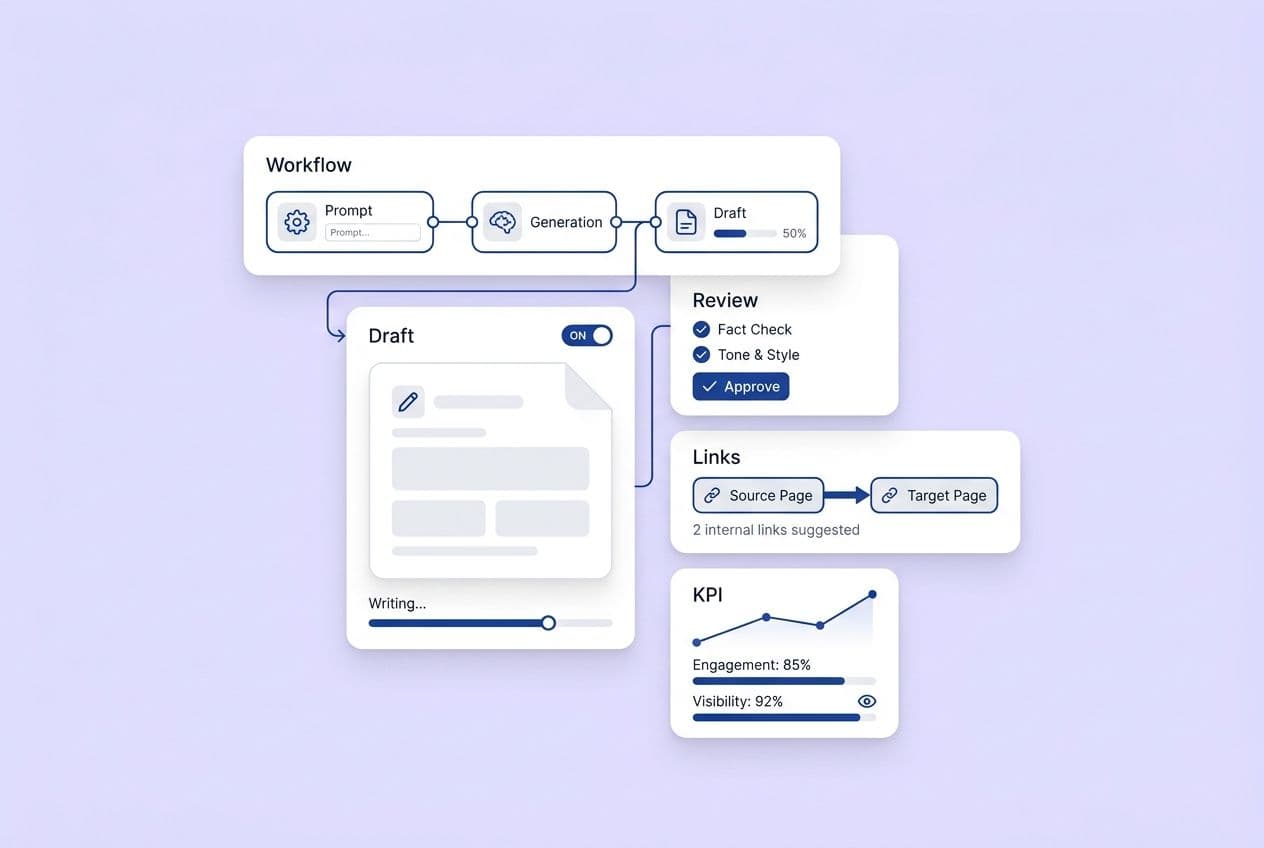
But what if you treated AI like a production system instead of a slightly faster typist?
That’s when things change. Here's the playbook that got me out of that cycle. It’s built on seven advanced tactics that go beyond drafting and start eliminating the real work.
-
Multi-step prompt workflows
-
Hallucination control through grounding
-
Embedded governance that scales with freelancers
-
Internal linking automation
-
Distribution automation
-
A KPI framework for quality, operations, and pipeline
-
An AEO visibility loop with citation tracking
Why does AI "speed up drafting" but not reduce your workload — and what changes when you use advanced tactics?
Because the first draft was never the bottleneck. It’s everything that comes after it.
I learned this the hard way. When my team first started using LLMs, we celebrated cutting draft time by 30–50%. Then we realized that drafting was the easy part. The real time suck, the soul-crushing part, is the "last 40%": writing the brief, building the outline, doing the SEO edit, finding and inserting internal links, sourcing images, formatting for the CMS, writing metadata, and (if you have any energy left) repurposing for social media.
Your average AI tool doesn't touch any of that. It doesn’t know your content library, your governance rules, or how to push a finished article to WordPress. So you get a faster first draft that creates the exact same downstream workload, but with a new problem: it sounds generic and needs a complete voice overhaul.
"Advanced" just means designing the workflow around the whole content production cycle, not just the writing part. This means:
-
Chained, role-based prompt workflows (think strategist to SEO to editor).
-
Retrieval-based grounding so the AI uses your data, not its own.
-
Governance that’s embedded in the tools, not buried in a style guide.
-
Automation for the grunt work that always gets skipped: linking, repurposing, etc.
-
A measurement system that tracks business value, not just word count.
Quick self-diagnostic. This playbook is for you if:
-
Your AI drafts take more than an hour of editing to be publishable.
-
You do internal linking manually (or just… don’t do it).
-
You create distribution assets "when you have time" (which is never).
-
You have no real data on whether your brand shows up in ChatGPT answers.
-
Your style guide is a beautifully formatted Google Doc that no one ever opens.
A multi-step AI pipeline that moves from research to publish in one flow is a world away from running a single prompt and copying the text into a doc. Building that system is what we're about to cover.
How do you design multi-step prompt workflows that produce publishable drafts (not generic ones)?
Advanced prompting isn’t about writing one perfect, magical prompt. It’s about chaining simple prompts together so the AI has to take a stance, follow rules, and critique its own work.
A single prompt asking for "a 1,500-word article about X" gives you the most average, middle-of-the-road answer possible. That's why so much AI content sounds the same. You asked for the average, and you got it.
A workflow prompt chain is different. It forces the AI to wear different hats, follow specific constraints, and review its output before it ever lands in your lap.
What does a "content workflow prompt chain" look like for one article?
Instead of one prompt, think of it as a five-step assembly line. Each step creates a deliverable that feeds the next.
-
The Strategist Prompt: "Given this target keyword and audience pain, what's a specific angle that stands out from the top 5 SERP results? Tell me the counterintuitive claim we should make."
-
The SEO Editor Prompt: "Now, build an H2/H3 outline where every header answers a real reader question. Plan for one table and one comparison block. Mark where internal links should go."
-
The Managing Editor Prompt: "You have the angle and the outline. Write the draft, but follow these rules: use the banned phrases list, include at least two named scenarios, no stats without sources, and include trade-offs for every recommendation."
-
The Skeptic Prompt: "Review this draft. Flag any vague claims, unsourced stats, or any sentence that sounds like it could be in any other article on this topic."
-
The Snippet-Writer Prompt: "Write three, 2-3 sentence answer blocks for an FAQ section that directly answer the most likely questions someone would ask an AI about this topic."
By the time a draft from this process reaches a human editor, it's already structurally sound and on-point.
How do you force specificity and avoid "AI content voice"?
Generic output is a failure of prompt design, not a limitation of the model. You have to build a cage of constraints for the AI to write inside.
Here's a constraint set I build into every draft prompt:
-
Banned phrases: A list of words that make my skin crawl. "In today's landscape," "It's important to note," "leverage," "dive into," "game-changing," "robust." Ban them.
-
Required specificity: Every recommendation needs a real-world scenario. For example, "when your freelancer submits a draft that ignores the H2 structure…"
-
Required edge cases: For every major point, include at least one "what to do if this doesn't work" condition.
-
Required counterargument: Add one paragraph that voices the most legitimate objection to your article's main point and addresses it head-on.
When you start enforcing constraints like these, you'll find your editing time plummets. The draft arrives with substance, not just filler you have to cut and replace.
How do you keep AI output accurate and reduce hallucinations without slowing everything down?
Hallucination control is an input problem, not a proofreading problem. If you're catching fabricated stats and wrong product claims during the final review, you've already lost. The fix is upstream, in what you feed the model before it even starts writing.
In marketing content, the AI tends to lie in predictable ways:
-
Invented stats with official-sounding sources ("a 2023 study found...").
-
Incorrect product features or pricing.
-
Made-up competitor comparisons.
-
Regulatory or compliance claims your legal team would never approve.
The first step is deciding if a simple prompt is good enough, or if you need to ground the AI in facts.
| Task type | Prompts sufficient? | Needs grounding |
|---|---|---|
| Reformatting, rewriting, outlines | Yes | No |
| Thought leadership angles | Yes | No |
| Product capabilities, pricing, security | No | Yes |
| Statistics, research citations | No | Yes |
| Competitor feature comparisons | No | Yes |
| Regulated claims (legal, medical, financial) | No | Yes |
Retrieval-augmented generation (RAG) sounds complicated, but it’s a simple concept. Instead of letting the AI pull from its vast, messy training data, you connect it to your own curated knowledge base. You then require it to only pull answers from those sources. The AI cites your data instead of inventing its own.
For teams who aren't ready for a full RAG setup, you can use a lightweight verification pass that catches most of the risk:
-
List every factual claim in the draft. Every stat, product feature, and competitor statement.
-
Check each claim against its approved source.
-
Revise only the claims that fail verification. Don't rewrite the whole draft.
-
Where you don't have hard data, use softer language like "teams commonly find..." instead of inventing a percentage.
-
Flag any claim that needs a human to confirm it before publishing.
The honest trade-off here is that this adds 15–20 minutes per article. Trust me, it's worth it. A single published hallucination in a B2B article can destroy trust in ways that take years to repair.
The first step is deciding if a simple prompt is good enough, or if you need to ground the AI in facts.
How do you operationalize AI governance so quality holds up with freelancers and higher volume?
Governance that lives in a style guide is where good intentions go to die. Governance that’s embedded in your workflow inputs gets followed every single time.
Voice drift and invented product claims happen because the context needed to get it right isn't there when the writing is happening. This is true for freelancers, and it's true for AI. Without structured context, they both fill in the gaps with their best guess.
Here is the minimum viable governance stack:
-
Voice rules: Don't just use adjectives like "friendly but professional." Provide actual examples: one "this is our voice" sentence and one "this is not our voice" sentence for each major content type.
-
Claim boundaries: A dead-simple list of what is and isn't true about your product. What features exist, what's been announced, and what comparisons you're allowed to make.
-
Persona framing: Who are you writing to? Define their sophistication level, vocabulary, and top three pains. Inject this into every prompt so the AI writes for that person, not a generic "B2B buyer."
-
Structural templates: Define the required structure for each content type. A how-to post needs these five sections. A comparison post must have a feature table. A thought leadership piece must not include a sales pitch.
A structured context layer, like DeepSmith's Deep IQ, stores all of this and injects it automatically into every prompt. The rules travel with the work, so you don't have to depend on a human remembering to add them.
You also need QA gates that don't depend on you being the only reviewer:
-
Strategic edit: Does this article have a clear point of view? Is it for the right audience?
-
Trust edit: Is every fact checkable? Are any claims exaggerated?
-
Search edit: Does every H2 answer a question? Are there snippet blocks for AI answers?
For freelancers specifically, the key is to reduce their degrees of freedom. Give them a mandatory outline, a required evidence list (e.g., two customer examples, one data point), and a "what not to write" list. The fewer gaps you leave, the less you'll have to fix later.
How do you automate the two tasks that silently kill output: internal linking and distribution?
Internal linking takes at least 30 minutes per article. Distribution is the first thing to get dropped when you're busy. Both are automatable, and the value they create compounds over time.
These aren't sexy problems to solve, but for a bootstrapped team, this is where the real leverage is. Every article you publish without internal links is organic authority left on the table. Every article that doesn't get repurposed gets a tiny fraction of its possible reach. I used to skip these all the time, and it was a huge mistake.
Internal linking automation playbook:
-
First, you need an enriched content inventory. A simple spreadsheet works. List every article's URL, primary topic, keyword, and funnel stage.
-
When generating a new article, pass the relevant parts of that inventory into the prompt. Something like: "Insert 3–5 contextual internal links from this list where they support the reader's next step."
-
Set a QA rule: anchor text must be descriptive (no "click here"), and links must be genuinely helpful.
-
A tool like DeepSmith's Content Studio automates this by scanning your sitemap and inserting the links during the writing process, which saves a ton of manual cross-referencing.
Distribution automation playbook:
Make this a standard step in your definition of "done." For every article you publish, automatically generate these assets:
-
2 LinkedIn posts (one insight-forward, one story-forward).
-
1 newsletter block (summary + link + hook).
-
1 short thread (5–7 posts, each a standalone point).
-
3 short social snippets (pull-quotes or single claims).
"Done" means these assets are generated, reviewed, and scheduled within 24 hours of the article going live. Not "we'll get to it later." Scheduled. The goal isn't to auto-publish junk; it's to generate the raw material instantly so a quick human review is the only remaining step.
What should you measure to prove AI content is working (quality, efficiency, and pipeline) — not just output?
Stop measuring how many articles you publish. Volume is not a KPI. The only way to know if your AI content system is actually working is to measure quality, operations, adoption, and business value.
The most common failure I see is teams measuring volume and calling it success. Volume just tells you the machine is running. It doesn't tell you if the machine is producing anything valuable.
Track these four KPI buckets:
| KPI | What it tells you | How to measure | "Good" looks like |
|---|---|---|---|
| Quality: coherence + groundedness | If outputs meet your editorial bar | Revision rounds per article; editor acceptance rate | < 1.5 revision rounds average |
| Quality: brand consistency | If voice and claims are accurate | QA pass/fail rate on trust + voice edit | > 90% pass on first trust edit |
| Operational: cycle time | Total hours from brief to publish | Time-tracked across all steps | 30–50% reduction vs pre-AI baseline |
| Operational: throughput | If articles are published on schedule | On-time publish rate | > 85% of planned articles published on time |
| Adoption: team usage | If the system is actually being used | Active users; tasks completed in AI pipeline | Consistent weekly usage across team |
| Business: organic performance | If the content is earning traffic | Organic sessions, CTR, time on page per article cohort | Upward trend in 90-day cohort comparison |
| Business: pipeline contribution | If the content is driving revenue | Assisted conversions, content-influenced pipeline | Track with UTM + CRM tagging |
A little measurement discipline goes a long way:
-
First, establish a pre-AI baseline. Track 10 articles the old way: hours per article, revision rounds, and organic performance at 90 days.
-
Then, run your first AI-assisted cohort on similar topics.
-
Compare the time saved and the quality metrics, not just the word count.
Pipeline attribution takes time (at least 60–90 days). Use organic performance as your leading indicator, but be disciplined about tagging everything so the data is there when you need it.
The first step is deciding if a simple prompt is good enough, or if you need to ground the AI in facts.
How do you build an AEO-ready content loop: earn AI citations, track visibility, and iterate?
AEO (AI Engine Optimization) feels like a dark art, but it’s manageable if you run it like SEO.
Most teams are approaching AEO sporadically and without a system. That won't work. The teams who build an early lead are the ones with a repeatable loop, not the ones who perfectly optimize a single article.
Key terms, simply defined:
-
Mention rate: How often your brand name appears in an AI answer.
-
Citation rate: How often a specific page of yours is linked as a source.
-
Prompt-level visibility: Which AI prompts bring up your brand.
-
Page-level visibility: Which of your pages are earning the citations.
The AEO loop looks like this:
-
Collect 20–50 buyer prompts. These are questions your actual target buyers type into ChatGPT, Perplexity, etc. Think problem-aware ("how do I..."), comparison ("X vs Y"), and alternatives ("alternatives to [competitor]").
-
Check who gets cited. Run each prompt and log which brands and pages appear.
-
Find the winning patterns. What do the cited pages have in common? Usually, it's a direct answer in the first sentence, structured lists or tables, and clear subheadings.
-
Produce or refresh your content to have that citation-friendly structure. Lead with the answer. Use tables. Format headers as questions.
-
Re-check every month. Citation rankings change. You need to track the trend lines.
DeepSmith's AI Visibility module automates this tracking across platforms. It shows you which competitor pages are winning citations, which helps you spot the content gaps that are actually worth closing.
When you see a competitor getting cited, use it as a signal that the topic is important, not as a template to copy. Your version needs a better point of view and more specific claims. That’s what wins.
Your 30-day starting plan:
-
Week 1: Collect 30 buyer prompts. Run them in ChatGPT and Perplexity. Log who appears.
-
Week 2: Find the 5 biggest gaps where your competitors show up and you don't. Add them to your content plan.
-
Week 3: Publish or refresh two articles with citation-friendly formatting.
-
Week 4: Review what changed. See what patterns are working in your space and adjust your templates.