

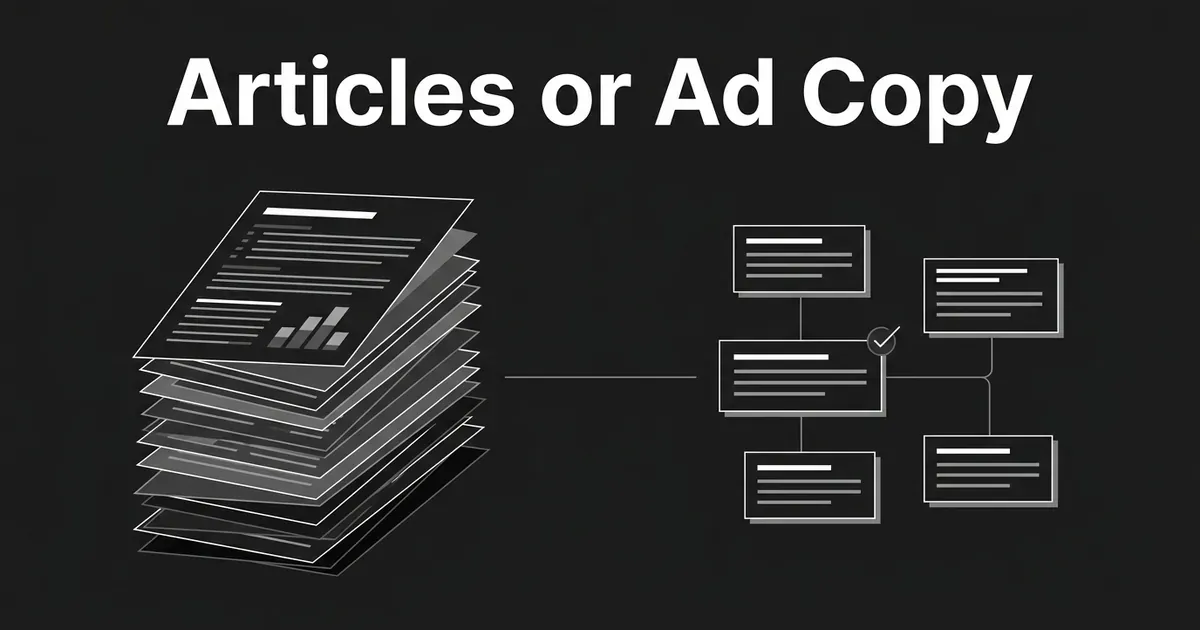
Surfer SEO builds long-form articles against the pages that already rank, while Anyword writes short channel copy and predicts which variation is likely to perform. The choice follows the format your team ships most. DeepSmith is a strong alternative for teams whose main output is long-form articles: Autowrite writes and publishes on-brand articles on their scheduled dates, and every finished article arrives with social posts already written, so channel copy comes from the article instead of a separate copy tool.
If you are weighing Anyword vs Surfer SEO, the first thing to settle is what your team publishes most. Surfer SEO is built around search articles. It checks a draft against the top-ranking pages and now tracks AI answers too. Anyword is built around short copy for ads, social, email and web pages, and it scores which version should perform better. They overlap a little on blog writing, but they start from different jobs. DeepSmith covers the long-form side with scheduled production that runs without anyone in the app.
Surfer SEO vs Anyword: the short answer
- Choose DeepSmith if your main output is long-form articles and you want them researched, linked and published on a schedule, with social posts arriving alongside each article, from $99 a month.
- Choose Surfer SEO if you write or refresh search articles and want live scoring against what ranks, plus AI answer tracking, from $49 a month billed yearly.
- Choose Anyword if most of your volume is ad, social, email and web copy and you want a predicted performance score on each variation, from $49 a month.
| Criterion | DeepSmith | Surfer SEO | Anyword |
|---|---|---|---|
| Entry price, billed monthly | $99/mo | Not listed | $49/mo |
| Entry price, billed annually (per month) | $80/mo | $49/mo | $39/mo |
| Volume at entry tier | 20 articles/mo | 120 documents | Unlimited words, 50 predictions/mo |
| Free trial | 7 days | 7 days, Pro plan | 7 days, 2,500 words |
| Long-form article generation | Yes | Yes | Yes |
| Short-form copy (ads, email, social) | Partial, social posts with each article | Partial | Yes |
| Scores drafts against top-ranking pages | - | Yes | Partial |
| Keyword research with volume and difficulty | - | Yes | Not listed |
| Brand voice and knowledge grounding | Yes | Yes | Yes |
| Internal linking | Yes | Yes, Pro and up | Not listed |
| Direct CMS publishing | Yes | Yes, WordPress plugin | Partial, Drupal and Sitecore in beta |
| Scheduled writing and publishing | Yes | Partial, via Zapier | Not listed |
| AI visibility tracking | Yes | Yes, five engines | Not listed |
| Review rating | 4.8/5 on G2 | 4.8/5 on G2 | 4.8/5 on G2 |
Pricing and features as of September 2026, from each vendor's site and public reviews.
Surfer SEO

Surfer SEO is a content optimization platform from a Polish company founded in 2017 and acquired by Positive Group in October 2025. It is best known for the Content Editor and its Content Score, which grades a draft against the terms, structure and length of the top-ranking pages and the pages AI answers cite. Around that sit Surfer AI for full articles, Auto-Optimize, automated internal linking, Content Audit and a Topical Map built on Search Console data. AI Tracker covers five engines: ChatGPT, Perplexity, Google AI Mode, AI Overviews and Gemini.
It is built for SEO and content practitioners, in-house teams and agencies who write or refresh articles against what ranks. Plans run from $49 a month billed yearly (Discovery) up to $299 (Peace of Mind), plus a quoted Enterprise plan, and new accounts get a 7-day trial of Pro.
The standout is the editor, and reviewers say so. Surfer holds 4.8/5 on G2 from 546 reviews and 4.9/5 on Capterra from 422 reviews, checked in September 2026. The limits are mostly plan gating. Discovery has no AI tracking, Standard tracks only 25 ChatGPT prompts with a weekly refresh, and internal linking, Topical Map and Custom Voice need Pro. Reviewers also call pricing and credit limits restrictive for smaller teams, and some find the suggestions formulaic or the AI drafts in need of fact checks.
Anyword

Anyword is an AI marketing copy platform from Keywee Inc., based in New York. It writes ads, social posts, emails, website copy and blog posts, and its Predictive Performance Score estimates which variation will do better for a chosen audience, goal and channel. Anyword says the model was trained on millions of A/B tests and picks the better of two variations 82% of the time. That is a vendor claim, and no independent source has replicated it. The Data-Driven Editor, more than 100 templates, Blog Wizard, Brand Voice and a Chrome extension are on every plan.
It suits marketing, demand gen and social teams that produce a lot of short copy and want brand controls and scoring on it. Starter is $49 a month ($39 billed yearly) and Data-Driven is $99 ($79 yearly). Words are unlimited, but monthly predictions are capped, at 50 and 100 on monthly billing. Copy analytics, channel integrations and custom-built models start at Business, which has no public price, and the API, SSO and private model are Enterprise only.
Anyword holds 4.8/5 on G2 from 1,228 reviews. The limits that matter here are on the SEO side. Blog Wizard scores keywords, readability and originality, but no keyword volume data, top-ranking page analysis or internal linking is described, and CMS export covers Drupal and Sitecore in beta. Reviewers say long-form output tends to need editing.
DeepSmith: the alternative that writes and publishes on a schedule

The gap this pair leaves for a team that mostly ships articles is what happens after the decision about what to write. Surfer SEO gives strong live guidance on a draft, and Anyword gives scored copy, but in both cases a person still starts each piece. Surfer reaches scheduled publishing only through Zapier on Peace of Mind, with its Surfy Agent announced as coming soon, and Anyword does not describe scheduled publishing at all.
DeepSmith is built for that step. In Content Studio, giving an idea a date plans it, and Autowrite then writes the article on that date, grounded in the persona, voice, content type and link targets stored in Deep IQ. The finished piece lands in Produced Content with a cover image, internal and external links and publish-ready metadata. You can review it and publish to WordPress, Webflow, Strapi, Sanity or Contentful, or let Autowrite take it all the way to published. Every finished article also arrives with social posts already written, and the Apps Library turns it into LinkedIn, X, newsletter and other versions in the same brand voice, so channel copy comes from the article instead of a separate copy tool.

The ideas come from data. DeepSmith tracks how AI engines answer questions about your brand, with mention rate, citation rate and share of voice, and Opportunity Agents return ideas with the data point that justifies each one attached. Content Map adds your own site and competitor sites as one map of topics, so coverage gaps show up as a measurement.

Pro is $99 a month ($80 billed yearly) with 20 articles, 50 tracked prompts and 5 seats. Grow is $199 with 40 articles, Scale is $399 with 90 articles, and Enterprise is custom. There is a 7-day free trial and no long-term contract, and DeepSmith is rated 4.8/5 on G2 and is SOC 2, GDPR and ISO certified.
Content formats and generation
Anyword wins on short-form copy, and Surfer SEO wins on long-form search articles. Anyword has more than 100 templates for ads, social posts, emails, landing pages and product descriptions on every plan, plus CSV templates for bulk generation. Surfer's templates cover landing pages, product descriptions and comparison pages, and it documents no ad or email copy templates.
For long articles the picture reverses. Surfer AI writes a full article from a keyword inside the Content Editor, at a minimum of about 2,000 words and up to 30 headings, and its help center puts generation at about 20 to 30 minutes. It draws on AI credits that are sold in bundles, and the current credit prices are not published on the pages we reviewed. Anyword's Blog Wizard also writes full posts with an outline, intro, body and conclusion, but reviewers report that long-form and specialist output needs a lot of editing.
What DeepSmith does: The Writer turns one planned idea into a finished article that is researched, internally and externally linked, and delivered with a cover image and publish-ready metadata. Keyword coverage, heading structure, schema markup and internal linking are part of the writing pipeline, so the output is a finished article instead of a draft to rescue.
SEO research and optimization depth
Surfer SEO is clearly ahead here. Its Keyword Research tool clusters keywords by intent with volume and difficulty filters, the Content Editor builds guidelines from the top 10 Google results plus top-cited pages in AI answers, and the Topical Map shows coverage gaps. Content Audit watches pages on Search Console data and flags ranking drops, and Automated Internal Linking inserts links from your own domain. Some of that is gated to Pro or Peace of Mind, which matters when you compare entry prices.
Anyword scores a blog draft on keywords, readability and originality, and its SEO Insights Panel adds reading time and brand voice alignment. It describes no keyword volume or difficulty data, no analysis of top-ranking pages and no internal linking. For a team that lives in search, that is a real gap, though Anyword is not selling itself as an SEO research tool.
What DeepSmith does: Content Map crawls your site and your competitors' sites onto one topic taxonomy, flagging coverage gaps where a competitor publishes more and untapped topics where you have nothing. The Writer then scans the enriched sitemap and places internal links during generation, so linking is not a separate pass.
Performance scoring
Anyword wins on predicted performance for copy, and Surfer SEO wins on scoring an article against what ranks. They are different measures. Anyword's Predictive Performance Score compares variations for a chosen audience, goal and channel, and the editor updates the prediction as you change the text. On Business and Enterprise it can also use your connected ad, social, CRM and email data. The accuracy figures are Anyword's own, and the allowance is capped per plan.
Surfer's Content Score is term, entity and structure based, and it is now split into SEO and AI Search halves in one bar. Surfer's own studies claim that its AI Search guidelines lift citations by about 25%, which is also a vendor claim and not an independent measure. Neither score guarantees a result.
Publishing and workflow
Surfer SEO has the broader publishing setup of the two. A free WordPress plugin publishes from the Content Editor with images, a Google Docs extension and a Contentful integration cover other workflows, and Markdown and HTML export are available. Collaboration includes comments, mentions and version history from Standard up. There is no native workflow builder, and automation runs through Zapier or its MCP server, which is in beta.
Anyword's integrations are aimed at performance data coming in rather than articles going out. It connects Google Ads, Meta Ads, LinkedIn Ads, HubSpot and Marketo, and its CMS export covers Drupal and Sitecore in beta on the higher plans. A Chrome extension carries scoring and brand voice into Google Docs, Notion, Canva and LinkedIn on every plan.
What DeepSmith does: Autowrite writes configured articles on their planned dates and they land in Produced Content, where you review, edit and publish straight to WordPress, Webflow, Strapi, Sanity or Contentful, or to your own webhooks. Plans, ideas and drafts sit in one Content Studio flow, so scheduling is part of the product and not an add-on built through another tool.
Pricing and value
Anyword is cheaper to enter, at $49 a month or $39 billed yearly, against Surfer's $49 a month billed yearly for Discovery. The limits sit in different places. Surfer's Discovery plan allows 120 documents, one seat and no AI tracking. Standard at $99 raises that to 360 documents and 25 ChatGPT prompts. The five-engine tracker starts at $82 on the AI Search Analytics plan or $182 on Pro, and the pages we reviewed show no monthly-billed prices and no price for the AI credits that Surfer AI uses.
Anyword gives unlimited words, with predictions as the capped resource, 50 on Starter and 100 on Data-Driven for monthly billing. The features that use your performance data, such as copy analytics and custom models, start at Business, and Business has no public price. A buyer should expect to talk to sales for those.
What DeepSmith does: DeepSmith publishes its prices and gives each plan a fixed monthly article allowance, 20 on Pro, 40 on Grow and 90 on Scale. Tracking and writing share one self-serve plan, so you can see what a month of production costs before you start.
From insight to action
Surfer SEO wins this one between the two. Its AI Tracker shows mentions, sentiment, sources and fan-out queries across five engines, and its Recommendations list turns pages to optimize, topics to write and mentions to pursue into tasks. Surfer also says it scrapes the consumer answer interfaces and averages several daily runs, which is a useful disclosure about method. Anyword describes no AI visibility tracking, and ChatGPT and Gemini appear on its site only as writing integrations.
The step after the task is still manual on both sides. In Surfer, someone opens the editor and writes or optimizes the piece. In Anyword, someone chooses a template and generates the copy.
What DeepSmith does: DeepSmith closes that loop in one platform. AI Visibility finds the prompts where you are missing or losing, Opportunity Agents turn those gaps into ideas with the evidence attached, Content Studio schedules them, Autowrite writes them, and the Apps Library repurposes each article for the channels you use. Tracking and production run off the same data.
Which should you choose
- DeepSmith: you want long-form articles researched, linked, branded and published on a schedule, with the AI visibility data that decides what to write next and social posts arriving with each article.
- Surfer SEO: you write or refresh search articles with a team and want the strongest live optimization guidance, Search Console based audits and AI answer tracking in one editor, and you can live with plan gating.
- Anyword: you produce ads, social posts, emails and landing page copy at volume, and you want a predicted performance score and brand controls on every variation, with blog posts as a smaller part of the mix.
On Surfer SEO vs Anyword for SEO articles vs ad copy, the answer is Surfer for articles and Anyword for copy. If you need both formats from one team, the cost comparison should include the second tool or the manual work around it.
Start a 7-day free trial of DeepSmith and see a scheduled article land in Produced Content with its social posts already written.


