

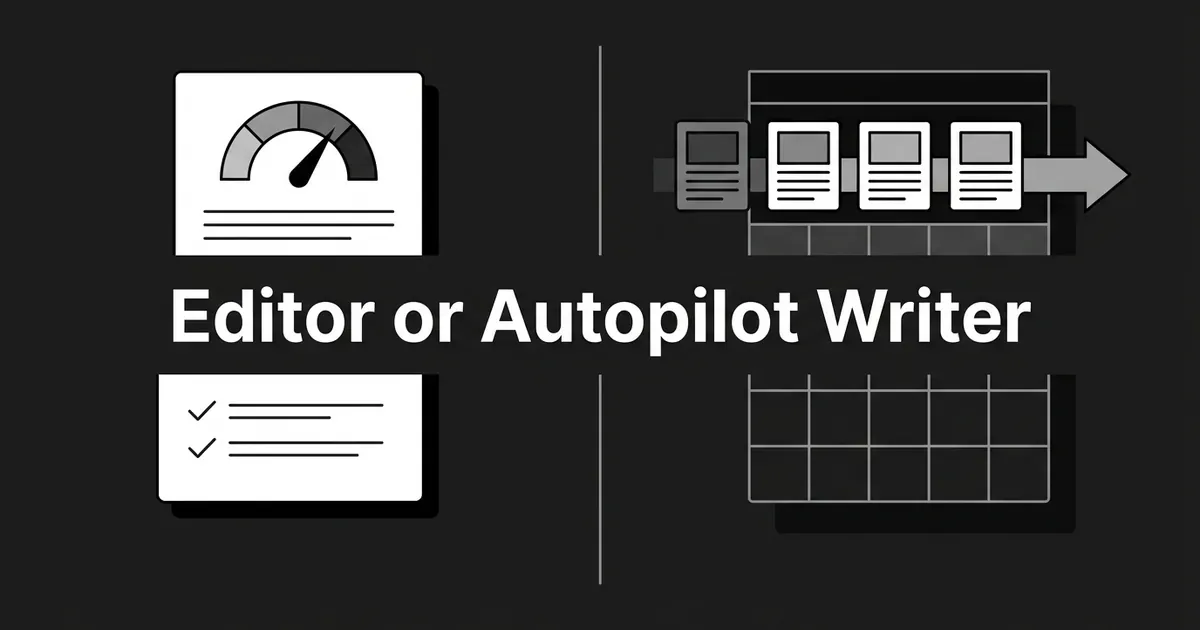
Surfer SEO helps writers improve drafts with a Content Editor and a live score, while Koala runs an SEO agent that plans from Search Console, writes, and publishes on a schedule. Surfer suits teams who write and want better drafts, and Koala suits publishers who want the calendar handled for them. DeepSmith is a strong alternative when the question is what the calendar should contain, because its Autowrite is fed by AI answer tracking and competitor gaps from the Content Map, with the evidence attached to every idea.
If you are comparing Surfer SEO vs Koala AI, you are really choosing between two jobs. One tool equips the people who write, and the other takes over a good share of the writing and publishing itself. This page goes through pricing, features, and a buying verdict for both, with the facts checked on September 30, 2026. It also places DeepSmith next to them, since it answers a third version of the question: how you decide what to publish in the first place.
Surfer SEO vs Koala: the short answer
- Choose DeepSmith if you want the calendar itself to come from data, with AI answer tracking and competitor gaps feeding ideas that Autowrite writes and publishes from $99 a month ($80 billed yearly) with a 7-day free trial.
- Choose Surfer SEO if your team writes its own articles and you want a Content Editor and Content Score to grade drafts against what ranks, plus AI Tracker on five engines, from $49 a month billed yearly.
- Choose Koala if you want an agent to plan from Search Console, bulk generate articles and publish them to your CMS, from $25 a month with a no-card free account.
Surfer SEO vs Koala AI at a glance
| Criterion | DeepSmith | Surfer SEO | Koala |
|---|---|---|---|
| Entry price, billed monthly | $99/mo (Pro) | Not listed | $25/mo (Starter) |
| Entry price, billed yearly | $80/mo (Pro) | $49/mo (Discovery) | Not listed |
| Entry allowance | 20 articles/mo | 120 documents (create or optimize) | 45,000 words and 500 credits/mo |
| Free trial | 7-day free trial | 7-day trial of Pro | Free account, 5,000 words and 25 credits, no card |
| Brand and knowledge grounding | Yes | Yes | Yes |
| SERP-based content scoring | - | Yes | Yes, Professional and above |
| Internal linking | Yes | Yes, Pro and above | Yes |
| CMS publishing | Yes | Yes | Yes |
| Scheduled auto-publishing | Yes | Partial | Yes, Boost and above |
| Bulk article generation | Yes | Partial | Yes |
| AI visibility tracking | Yes, up to 10 engines | Yes, 5 engines | Partial, Google AI Overviews on demand |
| Security certifications | SOC 2, GDPR and ISO certified | Not listed | Not listed |
| Review rating | 4.8/5 on G2 | 4.8/5 on G2 | 4.5/5 on G2 |
Pricing and features as of September 2026, from each vendor's site and public reviews.
Surfer SEO

Surfer is an SEO content optimization platform built around the Content Editor and a real-time Content Score. You type or paste a draft, and the editor grades it against the top-ranking pages and the pages that AI answers cite, then suggests terms, headings, structure and length. Around that core it has Surfer AI for full articles, Auto-Optimize for one-click rewrites, Content Audit and Topical Map on Search Console data, and AI Tracker, which checks answers on ChatGPT, Perplexity, Google AI Mode, Google AI Overviews and Gemini.
It is built for SEO and content people, in-house teams and agencies who write or refresh articles against what ranks. Pricing is public, from Discovery at $49 a month billed yearly up to Peace of Mind at $299, with Enterprise quoted.
The standout is the editor. Reviewers rate Surfer 4.8/5 on G2 from 546 reviews and 4.9/5 on Capterra from 422, and the praise is mostly about actionable, real-time guidance. The real limitation is plan gating. Discovery has no AI tracking, Standard tracks only 25 ChatGPT prompts weekly, and internal linking, Topical Map and Custom Voice need Pro. Reviewers also mention credit limits and suggestions that can feel formulaic, and Surfer's own docs warn that auto-inserted external links may be wrong.
Koala

Koala is a self-serve AI SEO platform sold as one subscription. Brand DNA builds a knowledge base from your website or Google Maps listing and runs an SEO agent that reads Search Console and Analytics. KoalaWriter generates long-form articles in eight types, KoalaLinks adds internal links across a site, and drafts publish to WordPress, Shopify, Webflow and Ghost. Every paid plan includes an API and a 62-tool MCP server.
It is built for bloggers, affiliate and niche publishers, local and service businesses, and agencies that manage several brands. Pricing is public and runs across nine tiers, from Starter at $25 a month to Scale III at $2,000 for 75 brands.
The standout is hands-off volume. Content Calendar Autopilot writes and publishes an approved calendar on a cadence you choose, and bulk mode generates articles from a keyword list. The real limitation is that the useful parts sit above the entry tier: the SEO scoring editor and Deep Research start at Professional ($49), and Autopilot starts at Boost ($99). Capterra shows 4.5/5 from 70 reviews, while Trustpilot shows a 3/5 TrustScore from 22, with complaints about support speed, credit expiry and refunds. Reviewers also say drafts need editing and fact-checking.
DeepSmith: the alternative that tracks AI answers and writes from the evidence

Koala and DeepSmith both write and publish on a schedule, so the difference is in what decides the calendar. Koala's agent plans from your own Search Console data, which tells it what already works on your site. Surfer's tools tell you how to improve a draft once you have chosen the topic. Neither one starts from how AI engines answer your buyers' questions or from which competitor pages are taking those citations. Koala checks whether Google AI Overviews cite your domain when you ask it to, and Surfer's AI Tracker watches five engines, but the tracking in both sits beside the writing and does not set the plan.
DeepSmith puts the two in one loop. AI Visibility tracks the prompts your buyers ask, with mention rate, citation rate and share of voice, and shows which of your pages get cited and which competitor pages win. The Content Map turns your site and any number of competitor sites into one topic map, so coverage gaps and untapped topics become a measurement. Opportunity Agents read that data and return content ideas, each carrying the specific data point that justifies it, so you can defend the backlog instead of guessing at it.

From there the ideas move into Content Studio. You give an idea a date and it becomes planned content. The Writer turns it into a finished article grounded in Deep IQ, which holds your company, products, personas, voice and content types, with internal and external links, a cover image and publish-ready metadata. Autowrite can run the whole thing on the scheduled date, and you can publish to WordPress, Webflow, Strapi, Sanity or Contentful, or to your own webhooks. DeepSmith has no live content score editor for drafts you write yourself, so it fits teams who want finished articles more than a grading tool.

Plans are Pro at $99 a month ($80 billed yearly) with 20 articles and 50 tracked prompts on ChatGPT, Grow at $199 with 40 articles and Perplexity added, and Scale at $399 with 90 articles and Gemini added. Enterprise covers all ten engines, and there is a 7-day free trial with no long-term contracts. DeepSmith is rated 4.8/5 on G2 and is SOC 2, GDPR and ISO certified.
Drafting and optimization
Surfer wins on helping a person write a better draft. The Content Editor scores a draft in real time against ranking and AI-cited pages, Auto-Optimize rewrites toward a higher score, and Surfy assists with editing. Koala has a comparable scoring editor, but it starts at Professional and grades by weighted entity coverage against the ranking pages, so it reads as an add-on to a writer that is built to produce the draft itself.
Koala wins on producing the first draft. KoalaWriter's Automatic SEO Optimization works the ranking pages' entities and structure into the article while it is written, and Deep Research gathers sources first on Professional and above. Surfer AI can write a full article too, but it draws on separately sold credits whose current prices Surfer does not publish, and its docs put generation at about 20 to 30 minutes per article. Both vendors' drafts still need review: reviewers of each report factual slips.
What DeepSmith does: DeepSmith applies keyword coverage, heading structure, schema, internal links and metadata during writing, so the article arrives publish-ready and the review is about editorial judgment. Deep IQ keeps brand voice and product facts stored once, so each draft starts with the same grounding.
Planning and publishing automation
In the Surfer SEO vs Koala autopilot writer question, Koala wins here. Its agent builds a content calendar from Search Console and keyword data, you approve it, and Content Calendar Autopilot writes and publishes on schedule through WordPress, Shopify, Webflow or Ghost. Bulk mode runs from a keyword list and is faster on higher tiers.
Surfer plans well but publishes by hand. Topical Map shows clusters and gaps from Search Console, and Content Audit ranks refresh opportunities with weekly emails. Scheduled publishing is not native, though the Zapier integration, which needs Peace of Mind, can create Surfer AI content and publish it to a CMS. The Surfy Agent that would write and publish at scale is listed as coming soon.
What DeepSmith does: Autowrite writes each planned article on its date, using the stored persona, voice, content type and link targets, and the finished piece lands in Produced Content or goes live straight away. The plan feeding it comes from tracked prompts and competitor gaps rather than a single Search Console view.
AI visibility
Surfer wins this one clearly. AI Tracker covers ChatGPT, Perplexity, Google AI Mode, Google AI Overviews and Gemini, with mention gap, sentiment, sources and fan-out queries. Pro tracks 50 prompts daily across all five engines. Surfer says it scrapes consumer answer interfaces and averages several runs a day, which is more method detail than most trackers give. Claude appears in its marketing but is not a tracked engine.
Koala's AI search features are narrower. Its agent and MCP tools can check, on demand, whether a Google AI Overview cites your domain for a keyword and compare competitor citations. There is no recurring tracking and no answer history, and ChatGPT, Perplexity and Claude are optimization targets rather than measured surfaces.
What DeepSmith does: DeepSmith checks your tracked prompts on a schedule and keeps the full answer history, with per-prompt mention and citation rates. It also shows which of your pages are cited and which competitor pages win, and those findings go straight into Opportunity Agents instead of staying in a dashboard.
Team workflow and collaboration
Surfer wins on working together. Standard and above include live collaboration, comments, mentions, version history, shareable links and workspace permissions, and Peace of Mind adds unlimited brand workspaces. No formal approval step is documented, so approvals still happen outside the tool.
Koala has no team model that its documentation describes. The FAQ allows sharing one account within an organization, and calendar plans are approved before writing, but there are no seats, roles or comments. That suits a solo publisher and is a real constraint for a team with a reviewer.
Pricing and value
On Koala AI vs Surfer SEO pricing, Koala is the cheaper way to start. Starter is $25 a month for 45,000 words and 500 credits, and a free account gives you 5,000 words and 25 credits with no card. The cost is in how it is metered: article words, a shared credit pool for chat, images, links, the agent and MCP research, premium models that use two or three times the words, and monthly credits that expire. Annual prices were not shown at checkout when we checked, though the site advertises 20% off.
Surfer is priced by plan, with documents, tracked pages, prompts and seats published for each. Discovery is $49 a month billed yearly for 120 documents and no AI tracking, Standard is $99 for 360 documents and ChatGPT only, Pro is $182 and Peace of Mind is $299. Monthly-billed prices were not captured. Reviewers call the credit and document limits restrictive for smaller teams.
For a team that wants both a writer and a planner, the combined spend matters. Surfer's AI tracking starts at $82 a month billed yearly on its own plan, while a Koala plan with Autopilot starts at $99 a month.
What DeepSmith does: DeepSmith publishes three self-serve plans with a fixed article allowance, tracked prompts and seats, so tracking and writing sit on one bill. Pro is $99 a month, or $80 billed yearly, for 20 articles, and there is no contract to cancel.
From insight to action
The choice between Surfer and Koala comes down to where you want the work to happen. Surfer helps with the step after you pick a topic, and Koala handles the steps from the plan to the published post. Both leave the earlier question to you, which is why a topic is worth publishing and what evidence says it will be cited.
Surfer's own Recommendations feed tasks from AI Tracker into a to-do list, and Koala's agent reads Search Console to find ranking drops and striking-distance queries. Those are useful signals, and both are built from your own site's data or a single engine.
What DeepSmith does: DeepSmith connects the whole path. Tracked prompts show where you are missing from AI answers, the Content Map shows where competitors cover topics you do not, Opportunity Agents turn both into ideas with the evidence attached, and Autowrite produces and publishes them. A marketer reviewing the backlog sees why each idea is there, and the article that comes out is already linked, formatted and on brand.
Which should you choose
- DeepSmith: you want a content program where AI answer tracking and competitor gaps decide what gets written, and where the article arrives publish-ready and can go live on its own date. It fits content and marketing teams and agencies who treat content as a growth channel and want one plan for both measurement and production.
- Surfer SEO: you have writers or freelancers who draft the articles and you want a score and live guidance to improve them, with AI Tracker across five engines in the same account. It fits in-house SEO teams and agencies that want to improve drafts and refresh existing pages.
- Koala: you publish at volume and want an agent to plan from Search Console, generate in bulk and post to your CMS on a schedule, on a low entry price. It fits bloggers, affiliate and niche publishers, local businesses and agencies with several small brands.
If you are weighing Surfer SEO or Koala AI mainly on the question of who does the writing, the table and sections above answer it. If the harder question is what to write and why, start a DeepSmith free trial and see the tracking and the first batch of ideas for your own site.


