Surfer SEO and Semrush Content Toolkit (ContentShake AI) both turn a keyword into a written article, but they start from different jobs. Surfer centers on its Content Editor and Content Score, and has added AI answer tracking across five engines. The Content Toolkit walks one marketer from topic to brief to published WordPress post on Semrush data, at a single fixed price, with no AI answer tracking at all. DeepSmith does the two things neither of them does together: it researches the live web while drafting and produces publish-ready articles that Autowrite can put out on a schedule, with AI answer tracking on the same plan.
Choosing between Surfer SEO and Semrush Content Toolkit (ContentShake AI) usually comes down to what you already have and what you are trying to fix. Surfer suits a team that wants a real-time editor grading drafts against ranking pages, plus AI Tracker watching ChatGPT, Perplexity and Gemini for brand mentions. The Content Toolkit suits someone who wants one guided path from a topic idea to a published post, without learning a second tool, using the keyword data Semrush already has. Whether you land on Surfer SEO or Semrush Content Toolkit, you are still buying a content editor, not a hands-off production system.
Surfer SEO vs Semrush Content Toolkit: the short answer
- Choose DeepSmith if you want articles that research the live web while drafting and go out publish-ready, on a schedule, with AI answer tracking across ten engines on the same plan.
- Choose Surfer SEO if you want the deepest real-time draft-grading against top-ranking and AI-cited pages, plus AI Tracker checking five engines, and you can absorb its plan gating.
- Choose Semrush Content Toolkit (ContentShake AI) if you are a solo marketer or small team who wants one guided workflow from topic to published post at a single fixed price, and you do not need AI answer tracking in the same tool.
Surfer SEO vs Semrush Content Toolkit (ContentShake AI) comparison table
| Criterion | DeepSmith | Surfer SEO | Semrush Content Toolkit |
|---|---|---|---|
| Entry price (monthly) | $99/mo (Pro) | $49/mo (Discovery, no AI tracking) | $60/mo (Base, billed annually) |
| Annual price | $80/mo (Pro) | Same as monthly display; billed yearly is the only published rate | $60/mo, billed annually |
| Articles or content included at entry | 20 articles/mo | 120 documents/mo (Discovery) | 10,000 articles/mo (pricing page; help article says unlimited) |
| Free trial | 7-day free trial | 7-day trial of the Pro plan | 7-day free trial |
| Long-form article generation | Yes, publish-ready | Yes, Surfer AI, about 20 to 30 minutes per article | Yes, AI Article Generator |
| Researches the live web while drafting | Yes | Partial, SERP competitors and optional facts | Partial, real-time SERP data only |
| Brand voice or knowledge grounding | Yes, Deep IQ | Yes, Custom Voice plus Brand Knowledge | Yes, up to 50 Brand Voices |
| Internal linking | Yes, from the Content Map | Yes, Automated Internal Linking (Pro and up) | Not listed |
| CMS publishing | WordPress, Webflow, Strapi, Sanity, Contentful | WordPress plugin, Contentful, Zapier | WordPress plugin |
| Writes and publishes on a schedule (Autowrite) | Yes | Partial, only through Zapier | Not listed |
| AI answer visibility tracking | Yes, 10 engines, same plan | Yes, 5 engines, on AI Search Analytics and up | No, sold separately as AI Visibility Toolkit |
| API and MCP access | Read-only API and MCP server | API (Peace of Mind) and MCP (beta) | Not listed |
| Security certifications | SOC 2, GDPR, ISO certified | GDPR; SOC 2 and ISO unverified for Surfer itself | PCI DSS Level 1, GDPR (company level) |
| Review rating | 4.8/5 on G2 | 4.8/5 on G2 | 4.4/5 on G2 (Semrush suite, not product-specific) |
Pricing and features as of September 2026, from each vendor's site and public reviews.
Surfer SEO in brief
Surfer SEO is a Wroclaw-based SEO content optimization platform, founded in 2017 and acquired by Positive Group in October 2025. It is built for SEO and content practitioners, in-house teams and agencies who write or refresh articles against what already ranks. Its core is the Content Editor and its real-time Content Score, which grade a draft's terms, entities and structure against the top-ranking and top-cited pages for a query. Surfer added AI Tracker on top of that, scraping answers from ChatGPT, Perplexity, Google AI Mode, AI Overviews and Gemini and reporting mention gaps, sentiment and sources.
The standout is that one account carries you from keyword research through writing, Content Score, refresh alerts and AI visibility tracking, all feeding each other through Recommendations. The real limitation is how much of that sits behind higher tiers. Discovery has no AI Tracker prompts at all, Standard tracks ChatGPT only on a weekly refresh, and Topical Map, internal linking and Custom Voice all need Pro. Reviewers rate it 4.8/5 on G2 from 546 reviews and 4.9/5 on Capterra from 422 reviews, and praise the Content Editor's actionable guidance, while pricing and credit limits are the most common complaint. Weigh those ratings against the plan-gating limits above before you commit to a tier.

Semrush Content Toolkit (ContentShake AI) in brief
The Semrush Content Toolkit is the product formerly sold as ContentShake AI, renamed when Semrush split its platform into separate toolkits in May 2025. It is built for individual marketers, small content teams and SEO beginners who want one guided workflow from topic idea to published WordPress post without switching tools, and who already use or are open to using Semrush's keyword data. Its dashboard offers three entry points: create a new article, optimize an existing one, or repurpose one into other formats, all reachable through a chat interface that routes the request.
The standout is how few decisions the workflow asks of you: Topic Finder suggests topics with Semrush search volume attached, SEO Brief Generator turns a topic into an outline with competitor links and secondary keywords, and the AI Article Generator writes the draft, all at one fixed monthly price. The real limitation is what that simplicity leaves out. Base includes only 5 SERP-informed SEO boosts a month, there is no internal linking tool, no knowledge base beyond a brand voice sample, and the product does not track AI answer visibility at all. The only product-specific review count found is 7.2/10 from 7 reviews on Info-Tech SoftwareReviews; broader Semrush-suite ratings (4.4/5 on G2 from 4,046 reviews) describe the whole platform, not this product alone. Those broader Semrush numbers are useful context, but they say little about the Content Toolkit specifically.

DeepSmith: the alternative that tracks and writes
Surfer's Content Editor tells you what a top-ranking page contains, and its Surfer AI writer generates a draft from a keyword, but the research behind that draft is anchored in SERP competitors, and Surfer's own docs warn that auto-inserted external links can be hallucinated. The Content Toolkit's SEO Booster pulls in real-time SERP data too, but neither product researches the open web for facts, statistics or sources while it writes, and neither one publishes on a schedule without someone opening the tool that day. Surfer's Zapier integration and the Content Toolkit's manual publish step both still need a person or a workaround in the loop.
DeepSmith's Writer researches each article while drafting, links it internally from the Content Map and externally to real sources, and hands back a publish-ready piece, not a draft to rescue. Autowrite takes that a step further: configure an article once at planning time, and it writes itself on its scheduled date and lands in Produced Content with no one opening the app that day, something neither Surfer's workflow tools nor the Content Toolkit's chat interface do natively. The same workspace tracks brand mentions and citations across ten AI engines (Pro starts with ChatGPT, Grow adds Perplexity, Scale adds Gemini, Enterprise covers all ten), on the same plan that writes the content, so a gap AI Visibility finds becomes an assignment in New Ideas without exporting anything to a second tool. Deep IQ stores the brand voice, personas and product facts that every article draws from, and Opportunity Agents turn visibility gaps and competitor coverage into a backlog with the evidence attached to each idea.
Plans run $99 to $399 a month (Pro, Grow, Scale), or $80 to $299 billed annually, plus a custom Enterprise tier, all with a 7-day free trial and no long-term contract.


Content editor depth and Content Score
Surfer SEO wins this axis. Its Content Score grades term coverage, entities and structure against the top-10 Google results and top-cited AI pages, split into separate SEO and AI Search halves, and updates as you type inside the Content Editor. The Content Toolkit's Content Optimizer works on demand rather than live: import a draft or URL, set targets, and it returns a score plus a list of SEO and AI SEO fixes to apply, with a one-click rewrite. Both approaches work from competitor analysis, but Surfer's live feedback loop inside the writing surface is the more granular of the two, and it is the feature reviewers name most often when they praise the product.
What DeepSmith does: DeepSmith does not offer a live-scoring editor because the Writer's job is different: keyword coverage, heading structure, schema markup, internal linking and metadata are built into the article during generation, so there is no separate scoring pass to run afterward. The output is meant to arrive already optimized, not to be graded and reworked by hand.
AI answer tracking
Surfer SEO wins this axis between the two, and it is not close. AI Tracker checks ChatGPT, Perplexity, Google AI Mode, AI Overviews and Gemini simultaneously, refreshing daily on AI Search Analytics, Pro and Peace of Mind, and reports mention gaps, sentiment, sources and fan-out queries. The Semrush Content Toolkit has none of this: it optimizes content for AI-search criteria such as authorship signals and clear Q&A structure, but it does not monitor whether your brand actually gets mentioned or cited anywhere. Semrush sells that separately as its AI Visibility Toolkit, a different product from the one covered here.
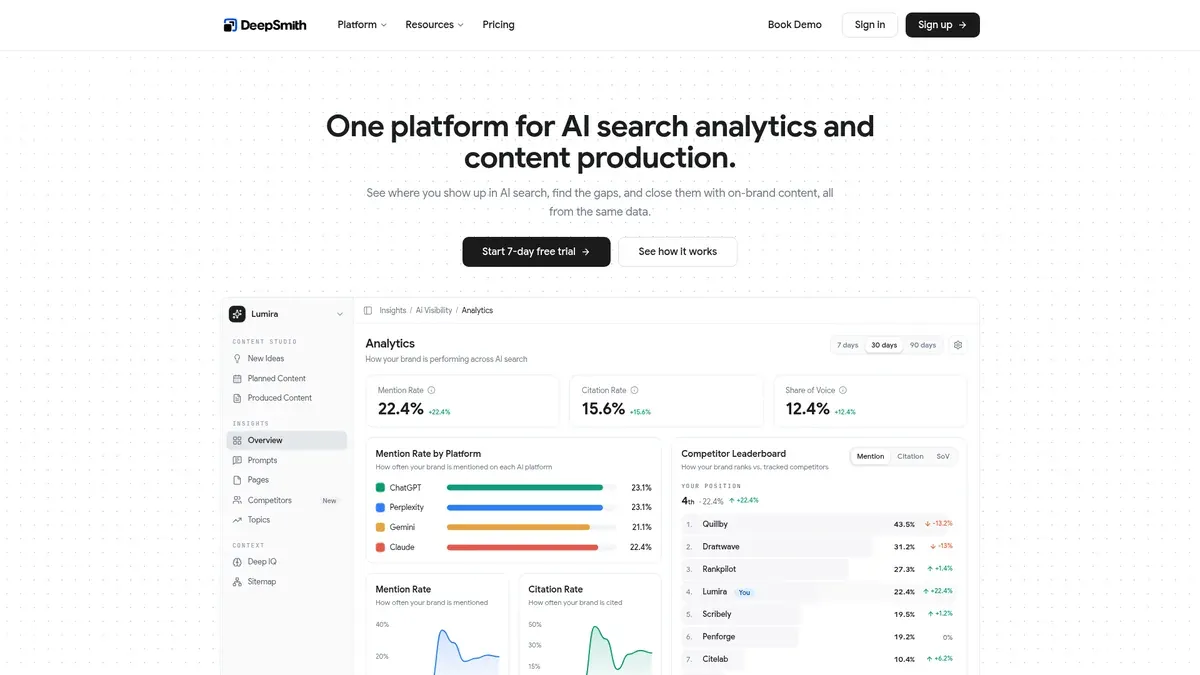
What DeepSmith does: DeepSmith tracks mention rate, citation rate, share of voice and sentiment across ten AI engines, more than Surfer's five, with a competitor leaderboard and a per-page breakdown of which of your own pages AI engines actually cite. Every tracked prompt keeps its full answer history, and the tracking sits in the same workspace, on the same plan, as the content that closes the gaps it finds.
Guided workflow and who each is built for
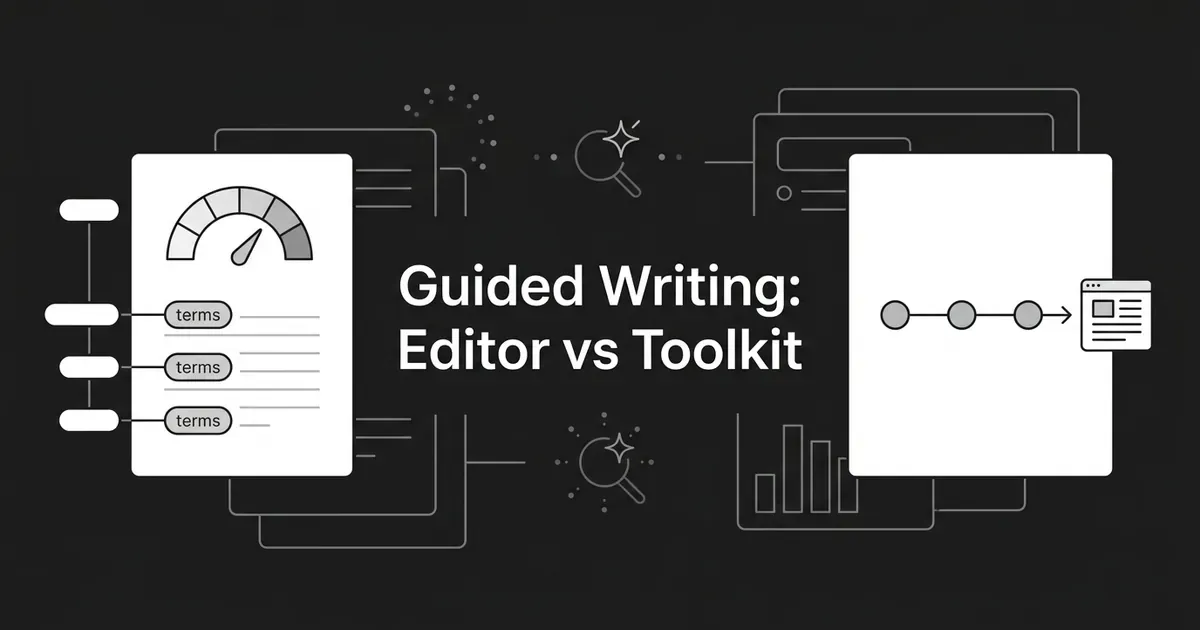
Framed as Semrush Content Toolkit vs Surfer SEO for guided writing, the Content Toolkit wins this axis for the reader it is built for. Its dashboard has exactly three entry points (create, optimize, repurpose), a chat interface routes the request, and a beginner can go from a blank topic field to a WordPress draft without learning a second concept. Surfer's workflow is wider and more capable (Keyword Research, Topical Map, Content Editor, Content Audit, AI Tracker) but that breadth means more surfaces to learn, and several of them, like Topical Map and Automated Internal Linking, sit behind the Pro tier rather than the entry plan.
What DeepSmith does: DeepSmith's guided step is different in kind: Opportunity Agents read your own visibility and coverage data and return content ideas with the evidence attached, so the planning decision is "which idea to schedule" rather than "which topic to type into a blank field." New Ideas moves to Planned Content, and Autowrite can carry it the rest of the way without a session at the keyboard.
Pricing and what you get at each tier
Semrush Content Toolkit wins this axis on simplicity. One public plan, Base, at $60 a month billed annually, covers everything the product does except AI-boosted SEO articles beyond the included five a month. Surfer spreads the same set of capabilities across five tiers from $49 to $299 a month, and the AI Tracker, Topical Map, internal linking and API each require a specific tier, so the effective price for the full feature set is closer to Pro or Peace of Mind than to the $49 headline. Neither vendor's monthly, non-annual pricing was published on the pages captured for this comparison, so treat both figures as the billed-yearly rate.
What DeepSmith does: DeepSmith's four plans, Pro at $99, Grow at $199, Scale at $399, and a custom Enterprise tier, scale article volume, tracked prompts and AI-engine coverage together rather than gating features separately, so a team moving up a tier gets more of everything at once, with the same 7-day trial and no long-term contract at any level.
From insight to action
Neither Surfer nor the Content Toolkit closes the loop from what AI engines say about a brand to what gets published next, because only Surfer tracks that at all, and even there, AI Tracker's Recommendations surface tasks rather than draft articles automatically. The Content Toolkit has no visibility data to act on in the first place. Both products can produce a finished article once you tell them what to write.
What DeepSmith does: This is the axis DeepSmith is built around. AI Visibility finds where a brand is missing or losing in AI answers, Opportunity Agents turn that gap into an idea with the citation data attached, and the Writer, or Autowrite on a schedule, turns the idea into a publish-ready article, researched, linked and grounded in Deep IQ's stored brand context, without the idea leaving the platform at any step.
Which should you choose
- Choose DeepSmith if you want tracking and writing in one system, articles that research while drafting and arrive publish-ready, and the option to schedule production hands-off with Autowrite.
- Choose Surfer SEO if your priority is the deepest live content-scoring editor available, you also want AI answer tracking across five engines, and your team is large enough to justify Pro or Peace of Mind.
- Choose Semrush Content Toolkit if you are a solo marketer or a very small team who wants one guided path from topic to published post at a single price, and AI answer tracking is not something you need from this tool.
Try DeepSmith free for 7 days at app.deepsmith.ai and see what it finds in your own AI answers before you commit to a plan.