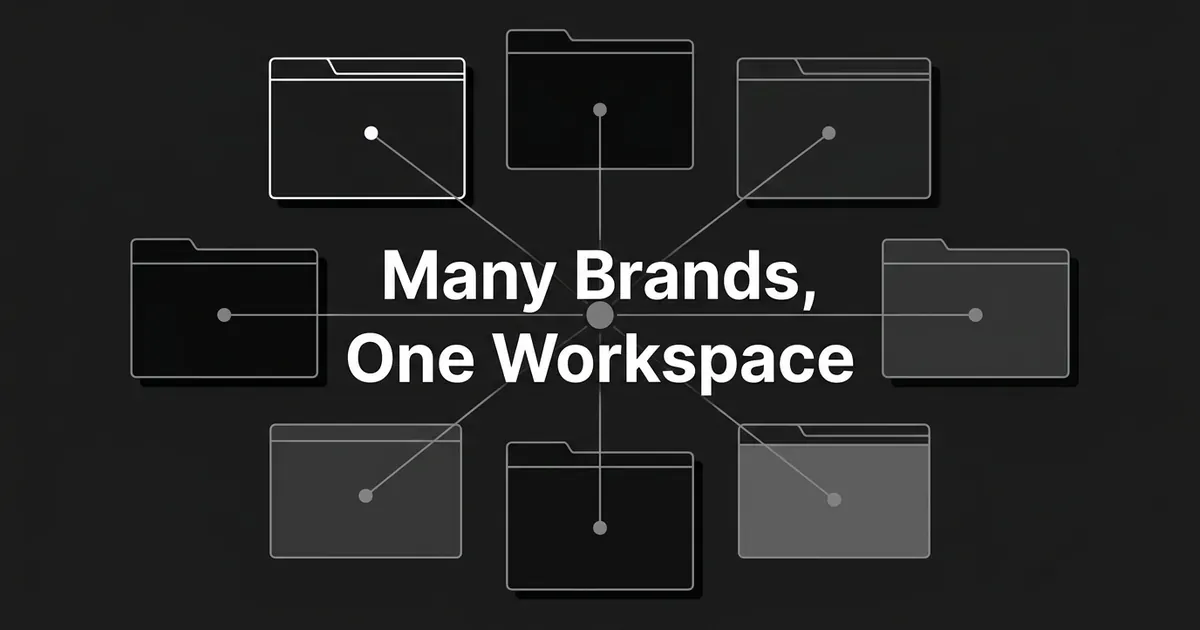
Surfer SEO gives agencies real multi-brand support: brand workspaces from the AI Search Analytics tier up, unlimited (fair use) on its top plan, plus collaboration and a public API. Semrush Content Toolkit (ContentShake AI) is built for one brand at a time, with up to 50 brand voices and 100 WordPress sites in a single account rather than separate client workspaces. DeepSmith runs each client in its own Multi-Workspace, with its own Deep IQ context, content and plan, billed independently, and Autowrite that produces each client's publish-ready articles on schedule.
An agency choosing surfer seo vs semrush content toolkit for agencies running several client brands is really asking one question: does the tool treat each client as its own account, or as one voice inside a shared one. Surfer answers with brand workspaces built into its plans. Semrush's Content Toolkit answers with brand voices, a lighter answer built for one company writing in a few tones, not several clients kept apart. DeepSmith runs each client in its own isolated workspace, with its own content pipeline and billing. The full comparison between these two tools lives in Surfer SEO vs Semrush Content Toolkit (ContentShake AI): Key Differences in Guided Writing; this piece covers only the multi-brand agency question.
Surfer SEO or Semrush Content Toolkit for agencies: the short answer
- Choose DeepSmith if you run several client brands and want each one isolated, its own Deep IQ context, its own content and plan, billed independently, with Autowrite producing publish-ready articles for each client on its own schedule.
- Choose Surfer SEO if you want brand workspaces built into the plan itself, from 5 on AI Search Analytics and Pro up to unlimited (fair use) on Peace of Mind, plus collaboration and, on the top plans, a public API.
- Choose Semrush Content Toolkit if you serve one brand (or a handful of very similar voices) and want a single guided workflow, at one fixed price, without paying for separate client workspaces you won't use.
| Criterion | DeepSmith | Surfer SEO | Semrush Content Toolkit |
|---|---|---|---|
| Entry price (billed annually) | $80/mo (Pro, $99/mo monthly) | $49/mo (Discovery) | $60/mo (Base, only plan) |
| Free trial | 7 days | 7-day trial of the Pro plan | 7 days |
| Multiple brands or clients in one account | Yes, each in its own isolated workspace | Yes, 1 on Discovery and Standard, 5 on AI Search Analytics and Pro, unlimited (fair use) on Peace of Mind | Partial, up to 50 brand voices and 100 WordPress sites, no separate client workspaces |
| Team collaboration and approval steps | Partial, review before publish in Produced Content | Yes, live collaboration and comments from Standard up; no formal approval step | Yes, shared Boards and approve-and-publish; extra seats a $20/mo add-on |
| Public API | Yes, read-only | Yes, Peace of Mind and Enterprise | Not listed |
| SSO / SAML | - | Yes, Enterprise only | Partial, Semrush account level on request |
| Team seats at entry tier | 5 | 1 | Not listed |
| Review rating | 4.8/5 on G2 | 4.8/5 on G2 | 4.4/5 on G2, suite-wide |
Pricing and features as of September 2026, from each vendor's site and public reviews.
Surfer SEO

Surfer is an SEO content platform built around the Content Editor and its real-time Content Score, which grades a draft against the pages that already rank and get cited by AI. It has since added AI Tracker, which checks brand mentions across ChatGPT, Perplexity, Google AI Mode, AI Overviews and Gemini. For an agency, the standout is the brand workspace: one domain per workspace, with counts that scale by plan, from a single workspace on the cheaper tiers up to unlimited on Peace of Mind, subject to fair use. Collaboration comes built in too, with shared folders, comments and permission controls from Standard up.
The real limitation is plan gating. An agency running several clients has to be on AI Search Analytics or Pro just to get more than one workspace, and the public API sits behind Peace of Mind or Enterprise. Reviewers on G2 and Capterra rate Surfer highly (4.8/5 and 4.9/5), and mostly praise the Content Editor's guidance, but they also call the pricing and document limits restrictive for smaller teams, which matters more once you multiply by client count.
Semrush Content Toolkit (ContentShake AI)

The Content Toolkit, formerly sold as ContentShake AI, is Semrush's guided content-production workflow: find a topic, build a brief from Semrush's own keyword data, generate a draft, optimize it, then repurpose it into social and email posts. It's built for one brand doing a lot of writing, not many brands run apart. Up to 50 brand voices can live in the single Base plan, and WordPress publishing reaches up to 100 sites, but there's no documented separate workspace per client, no per-client billing, and multi-brand management is marketed only under the custom Semrush for Enterprise tier.
At $60 a month for the only public plan, it's simple to buy and includes shared Boards for team collaboration and an approve-and-publish step. What it doesn't give an agency is isolation. If one client's brand voice, content and access need to stay walled off from another's, one Base account holding 50 brand voices is a different arrangement than 50 separate accounts, and it shows in the review base too: the only Content Toolkit-specific rating found is 7.2/10 from just 7 reviews, well short of the volume behind Surfer's or the wider Semrush suite's scores.
DeepSmith: the alternative that keeps each client's brand isolated

Neither Surfer nor Semrush's Content Toolkit was built around the specific problem an agency has: several client brands, each with its own facts, voice and publishing calendar, that can't leak into each other. Surfer gets close with brand workspaces, but they're gated by plan tier, capped until the top plan, and priced per workspace inside one contract. Semrush's Content Toolkit doesn't separate clients into workspaces at all; it separates voices inside one shared account.
DeepSmith's Multi-Workspace runs each client brand in a fully isolated workspace, with its own Deep IQ context (products, personas, voice, visual guidelines, content types), its own content library, and its own plan, billed independently. An agency onboarding a new client sets up that client's own workspace from their website in minutes, with brand brief, competitors, starter tracking prompts and a first batch of ideas populated before anyone pays. From there, Autowrite takes over: configure an article at planning time and it writes itself on the scheduled date and lands in Produced Content, publish-ready, with no one in the app. That's what an agency actually needs at volume: not one shared account juggling many voices, but a set of separate, billable client operations that each run themselves.


Teammates are invited into a workspace as owners or members, and Produced Content is where a draft gets reviewed before it publishes straight to WordPress, Webflow, Strapi, Sanity or Contentful. The read-only REST API and MCP server give an agency's own tools programmatic access to each workspace's visibility data, Content Map and content library, scoped by API key per workspace. Plans run $99, $199 and $399 a month (or $80, $160 and $299 billed annually), each with a fixed monthly article allowance, seat count and engine coverage, with a 7-day free trial and no long-term contract to get started.
Running multiple brands in one account
Surfer wins this one on paper: brand workspaces are a named, counted feature across its plans, scaling from 1 up to unlimited (fair use). Semrush's Content Toolkit doesn't have an equivalent; its multi-brand answer is 50 brand voices inside a single account, which is closer to writing in different tones than running separate client operations.
What DeepSmith does: Multi-Workspace treats each client as its own account from the start, not a voice profile bolted onto a shared one. Each workspace carries its own Deep IQ brand context, its own content library and its own plan, so a client's data, drafts and billing never sit next to another client's inside the same account.
Collaboration and approval workflow
Semrush's Content Toolkit has the more concrete approval step: shared Boards for team review and an explicit approve-and-publish action inside My Content, though extra seats cost a $20 a month add-on each. Surfer offers live collaboration, comments and version history from its Standard plan up, but it doesn't document a formal approval gate the way Semrush does; work simply gets edited and published from the Content Editor.
What DeepSmith does: teammates are invited into a workspace as owners or members, and every Autowrite draft lands in Produced Content for review before it goes live, where you can revise the body, edit metadata and regenerate the cover image before publishing.
Developer and API access
Surfer publishes a Peace of Mind or Enterprise API on its higher plans. It also ships an MCP server, useful for an agency that wants to pull data or automate steps outside the app. Semrush's Content Toolkit has no documented API of its own; the wider Semrush platform has one, but nothing tying it specifically to this content product.
What DeepSmith does: every plan includes a read-only REST API, scoped by workspace, covering AI visibility, Content Map, the content library and Deep IQ data. It also ships an MCP server with 23 read-only tools that works with Claude, Claude Code, Cursor and other AI assistants. An agency can pull a client's citation and content data into its own reporting without leaving that client's workspace.
Some agencies still search this as Surfer SEO vs ContentShake for agencies, since Semrush sold the Content Toolkit under the ContentShake AI name until its 2025 rebrand. The product and the multi-brand answer are the same either way.
Which should you choose
The Surfer SEO vs Semrush Content Toolkit for agencies question comes down to how much isolation your clients need and what you're willing to pay for it.
- DeepSmith suits an agency that wants each client run as its own operation, isolated context, content and billing, with production that runs itself on a schedule once it's set up.
- Surfer SEO suits an agency already committed to its Content Editor workflow that's willing to pay up into the higher plans for enough brand workspaces and collaboration.
- Semrush Content Toolkit suits a single brand, or an agency writing for one client under one Semrush account, rather than several clients that need to be kept apart.
Try DeepSmith free for 7 days and set up your first client workspace at deepsmith.ai.