You wrote a clean list. It reads well. Then you ask ChatGPT or Google the exact question your list answers, and a competitor's list shows up instead. Frustrating, right?
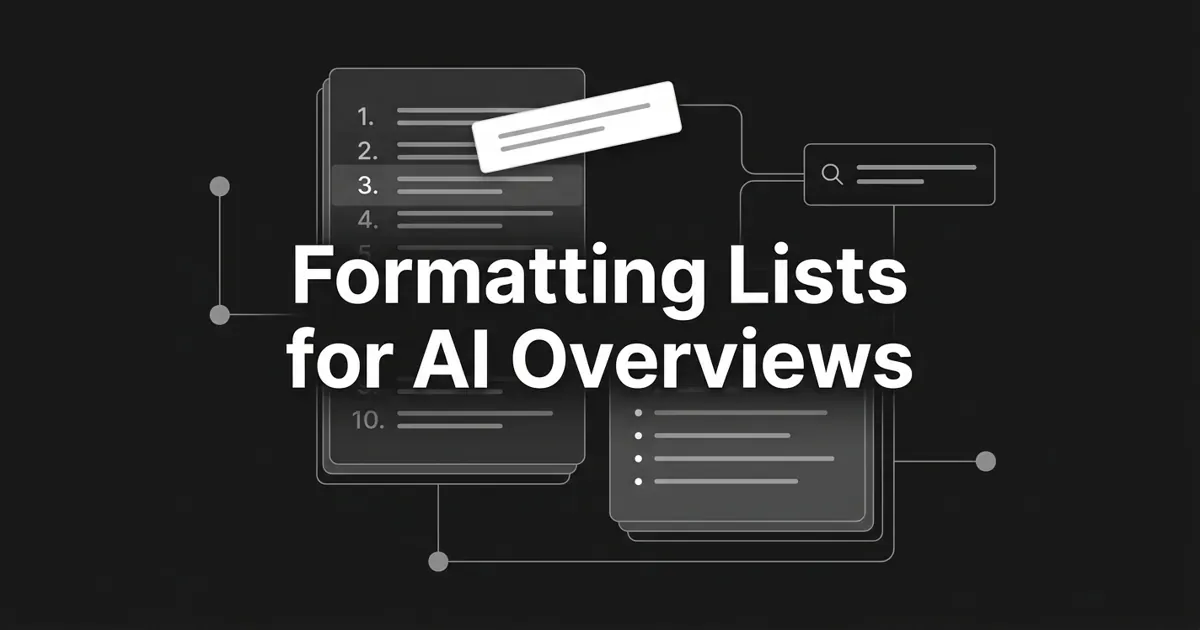
Here's the good news: the fix is almost always formatting, not writing. This guide shows you how to format lists for AI Overviews and AI answers so the engine lifts your list intact instead of skipping it or quietly paraphrasing someone else's.
You don't need to rewrite your content. You need to reshape a few lists. We'll start with the question everyone asks first, numbered or bulleted, and then walk through the small structural choices that decide whether your list gets quoted. Take it one step at a time. By the end, you'll have a repeatable checklist you can run on any list you publish.
Step 1: Match numbered or bulleted to what the reader actually wants
Let's answer the question you came here for, first thing.
Use a numbered list when the query implies sequence, ranking, or steps. Think "how to set up X," "top 10 tools," or "most important factors." Use a bulleted list when the items are parallel options with no natural order. Think "features," "benefits," "tips," or "examples."
That's the whole rule. The numbered vs bulleted list SEO debate isn't really about the HTML tag. It's about matching the structure to the intent behind the question. A numbered list signals "these come in order, follow them." A bulleted list signals "these are equal-weight options, pick what fits." When your list type matches the reader's intent, the model reads it the way you meant it.
How do you tell you got it right? Read your heading and ask one question: does it imply an order the reader has to follow? If yes, number it. If the reader could start anywhere and get the same value, use bullets.
Where people go wrong: bulleting a ranking, so item one and item five look equally important, or numbering a set of parallel features, which fakes an order that doesn't exist. Both send a mixed signal, and mixed signals are exactly what make a model paraphrase your list instead of quoting it.
Step 2: Put a question-shaped heading right above the list
A list floating under a vague heading has nothing to anchor to. The model needs to know what question this list answers before it can hand your list to someone who asked that question.
So give every important list a heading that mirrors how a real person types the query. "How should I format lists for AI Overviews?" beats "List formatting." "What tools track AI citations?" beats "Tools." You're not writing for a clever headline here. You're writing the label the model uses to file your list.
How do you tell it's working? Say the heading out loud. If it sounds like something a person would type into a search box, you're close. If it sounds like a folder name, rewrite it.
Where people go wrong: they spend real effort on the list and give it a one-word heading. That one word decides whether the model can connect your list to a question at all. Don't skip it.
This is also the cheapest fix on this whole list. You already wrote the list. Adding a question-shaped heading above it takes thirty seconds and does a surprising amount of work.
Step 3: Write a lead-in that scopes the list
The single most valuable sentence in the block is the one directly above your list. It gets quoted alongside your items more often than any other line, and it tells the model exactly what the list contains. Waste it and you waste the whole block.
A strong lead-in does three things. It names what the list contains, not "things to consider" but the actual topic. It states how many items there are, like "the 6 formatting rules" or "these 4 mistakes." And it names the basis for inclusion when that matters, like "ranked by citation frequency" or "based on Google's own guidance." Then it ends with a colon, right before the list.
Compare these. Weak: "Here are some tips:" Strong: "Here are the 6 formatting rules that decide whether AI Overviews lift your list intact:" One gives the model nothing. The other hands it a clean, quotable frame.
Getting list formatting AEO right at this level is fiddly, and it's the kind of consistency that slips when you're writing fast across dozens of pages. This is one of the places a production system earns its keep. DeepSmith's writing pipeline builds this structure in during creation, scoping each list with a specific lead-in rather than leaving you to bolt it on in a later editing pass.
Where people go wrong: "Here are some tips" or "Consider these things." Vague lead-ins get dropped or replaced, and they take your list's best shot at being quoted down with them.
Step 4: Make every item stand on its own, answer first
Here's a mindset shift that changes everything: assume the model will pull exactly one item out of your list and show it alone. Would that single item still make sense? Would it still answer the question?
That's the test for every item you write. Each one has to be self-contained. Replace every pronoun that leans on context, "this," "it," "the above," "as mentioned," "the previous step," with the actual noun. An item that says "This will help" is invisible to extraction. An item that says "Numbered lists help AI engines read rank and sequence" can stand on its own anywhere.
Then lead with the answer. The first five to ten words of every item carry the most weight, so put the conclusion or the key noun at the front, not the buildup.
Compare these two. Weak: "When you're trying to increase citations, you should think about using numbered lists because they signal rank." Strong: "Numbered lists increase AI citations by signaling rank and sequence." Same fact. The strong one leads with it.
Pro tip: after you draft a list, copy one item out of context and paste it into a blank line. If it still answers the implied question by itself, you're good. If it needs its neighbors to make sense, rewrite it. This one habit does more to get lists cited by AI than any other single move.
Where people go wrong: pronoun-heavy items and slow buildup. Both bury the answer where the model can't grab it cleanly.
Step 5: Keep items parallel and roughly the same size
Models reward predictability across siblings. When every item in a list follows the same pattern, the whole thing reads as one clean, liftable unit. When items clash, the extraction signal weakens.
So make every item start with the same grammatical form. All imperative verbs, or all noun phrases, or all gerunds. Pick one and hold it across the entire list. Keep punctuation consistent too: either every item ends with a period because they're all full sentences, or none of them do because they're all fragments. Don't mix.
Size matters as well. Keep items within roughly a two-times range of each other. One paragraph-long item sitting next to six one-line items parses unevenly and reads as sloppy. For a "top N" or listicle-style list, five to ten items is the sweet spot. Fewer than three usually reads better as a sentence. More than about fifteen dilutes the authority of each item.
This kind of consistency is exactly the work that's tedious to do by hand across a whole content library. DeepSmith enforces parallel structure and even item depth as it writes, so the lists come out uniform instead of needing a cleanup pass later.
How do you tell it's done? Scan just the first word of every item. If they're all the same part of speech, you're parallel. If one is a verb and the next is a noun, fix it.
Where people go wrong: mixing imperative items ("Write a lead-in") with fragment items ("Parallel structure") in the same list. It looks small. It reads as inconsistent, and it costs you.
Step 6: Use real list markup, not typed characters
This one is invisible on the page and decisive under the hood. A list has to be a real list in the code, not a paragraph dressed up to look like one.
Use genuine ordered-list markup for numbered lists and genuine unordered-list markup for bulleted ones, with each item as its own list element. Do not fake a list by typing "1." "2." "3." into a paragraph, and do not hand-type dashes at the start of lines. To a reader those look like lists. To a parser they're just prose, and prose doesn't get lifted as a list.
The way you structure lists for AI search here is a technical choice as much as a writing one. If your CMS or your drafting tool outputs clean semantic markup, you're fine. If it flattens everything into styled paragraphs, your lists are invisible as lists no matter how good the words are.
A few more traps to avoid. Lists built inside images can't be read at all, because extraction can't see text in a picture. Lists hidden inside collapsed accordions or tabs may never get parsed, because the text is behind a click. And skipped numbers, "1, 2, 4, 5," make a parser assume an item went missing. Keep the sequence clean.
Where people go wrong: trusting how a list looks in the editor. Looks right and parses right are two different things. When in doubt, check that the published page uses real list elements.
Step 7: Place your strongest list in the top third
Position is a lever most people ignore. In one 100-page study of AI Overview sources, about 55 percent of citations came from the top 30 percent of the page. A further chunk came from the middle. The pattern holds elsewhere too: roughly 44 percent of ChatGPT citations in one analysis came from the first 30 percent of the document.
The takeaway is simple. Your most citation-worthy list belongs high on the page, not buried at the bottom. Put it right after its heading and lead-in, not under five paragraphs of throat-clearing. For a long article, get your first meaningful list, often a summary or an at-a-glance rundown, into the first few hundred words.
This is also why the best lists for AI Overviews tend to double as the article's answer up top. You're not saving your best material for a big finish. You're leading with it.
How do you tell it's done? Scroll to where your key list sits. If a reader has to pass a lot of preamble to reach it, move it up.
Where people go wrong: burying the one list that best answers the query under a long warm-up. Lists near the very end still get cited, just at a lower rate. Give your best one the best real estate.
Step 8: Close the list with one summarizing sentence
Don't let your list dangle. The sentence directly below it does quiet, important work: it gives the model a single line to attribute to the list as a whole, and it often shows up as the final quoted sentence in an AI answer.
Keep it to one sentence. Name the takeaway, tie the list back to the article's main point, or bridge to the next section. Something like "Together, these four choices decide whether an AI Overview quotes your list or skips it" does the job. It's short, it summarizes, and it hands the model a clean closing line.
How do you tell it's done? Read the list plus its close-out as a unit. If it feels finished and self-contained, you're there. If the list just stops, add the sentence.
Where people go wrong: ending on the last bullet and jumping straight to a new heading. The list works. It just has nothing to be summarized by, so the model has to improvise a summary or skip yours.
See all eight steps in one example
It's easier to feel the difference than to describe it. Here's a weak list first:
List formatting tips
- make them good
- use bullets
- add headings
- keep it short
There's no question-shaped heading, no lead-in, no self-contained items, and the type doesn't match any clear intent. A model has almost nothing to grab. Now here's the same idea, reshaped:
How should I format a list so AI Overviews cite it?
These 4 choices most strongly decide whether an AI Overview lifts your list intact:
- Use a question-shaped heading directly above the list, so the model can anchor it to a query.
- Write a specific lead-in that ends with a colon and names what the list contains.
- Match the list type to intent, numbered for steps or ranks, bulleted for parallel options.
- Make every item self-contained and lead with its answer, so any single item stands alone.
Together, these four choices are the core of list formatting AEO, and they decide whether an answer engine quotes your list or writes around it.
See the difference? The second version has the heading, the scoping lead-in, the right list type, parallel self-contained items, and a close-out sentence. That's the full recipe to get lists cited by AI, applied to one small block. You can run the same reshape on any list you've already published.
The mistakes that quietly cost you citations
Most lists that get skipped aren't badly written. They're badly shaped. Watch for these:
- Mixed list types, where numbered and bulleted signals fight inside one list.
- Pronoun-heavy items that only make sense next to their neighbors.
- No heading above the list, so the model has nothing to anchor it to.
- A vague lead-in that burns the block's most quotable sentence.
- A key list buried under paragraphs of preamble.
- Wildly uneven item lengths within a single list.
- Lists trapped inside images, accordions, or anything that needs a click or a script to appear.
None of these are hard to fix. That's the encouraging part. You're usually one small reshape away from a list that gets picked up.
What to do next
You don't have to overhaul your whole site. Start with one page: the one that answers a question you most want to be cited for. Run these eight steps on its main list. Then do the next page next week. Momentum matters more than perfection here.
If reshaping every list by hand across a growing library sounds like a lot, that's fair, because it is. This is the kind of structural discipline that's easy to know and hard to keep up manually. DeepSmith's writing pipeline produces publish-ready, AEO-formatted drafts with this structure built in during creation, so citation-ready lists become the default output rather than a formatting chore you run afterward. If you want to see it work on your own topics, you can start a free trial and watch it shape the lists for you.
You already know what a good list says. Now you know how to shape it so an AI answer will actually use it. Go fix one list today.