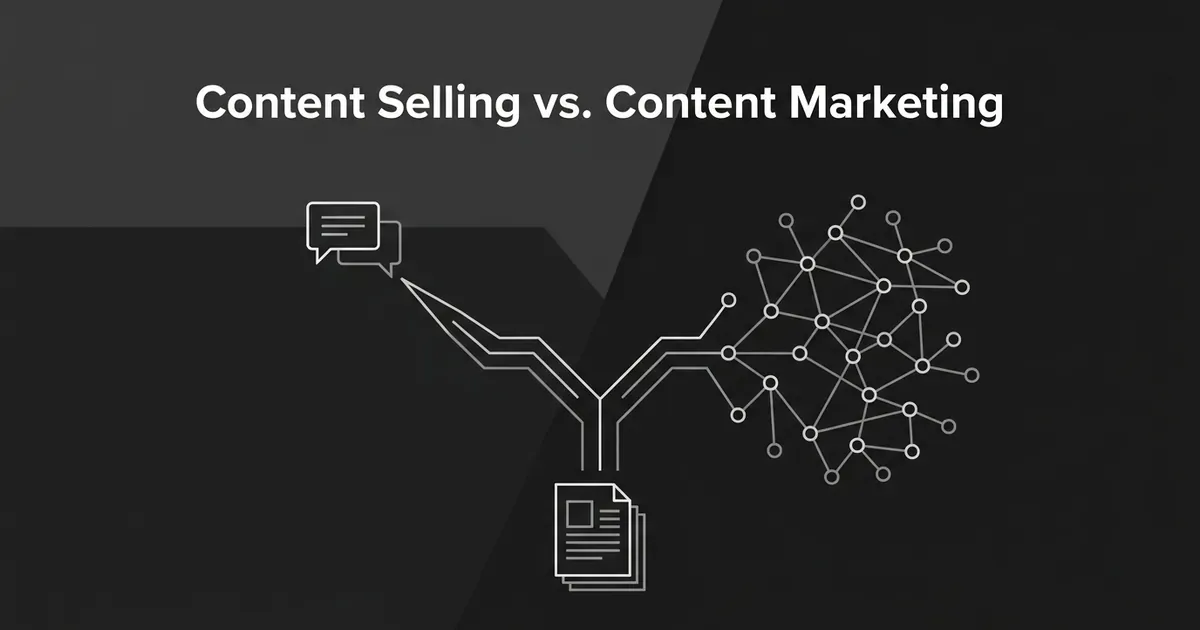
Content selling is content a salesperson uses directly in an active deal, to answer a buyer's question, handle an objection, prove value, or move things to the next step. Content marketing is different. It is built to attract and educate a broader audience, before anyone is in a live sales conversation at all. The two get mixed up a lot, and the mix-up causes real problems: marketing teams get asked to produce "sales content" without knowing what that actually means, and sales teams end up building their own materials from scratch because nothing marketing made fits the deal in front of them.
This piece is about the definitional line, not about how to build a sales enablement library. If you've ever typed "sales enablement content vs marketing content" into a search bar while trying to sort out who should own what, or why a blog post that works great for marketing falls flat in a sales call, start here.
What is content selling?
Content selling is content a salesperson selects, adapts, or creates for a specific opportunity, and uses directly with a buyer during that deal. The test isn't the file type or the word count. It's the role the content plays: does it help one buyer, in one active conversation, get closer to a decision?
A tailored case study sent to a prospect after a discovery call is content selling. A demo recording built to answer a specific technical question from one buying committee is content selling. A one-page ROI model, built around a prospect's own numbers, is content selling. None of these have to be short or polished to count. A detailed proposal or a security questionnaire is still content selling when it's used inside a live deal, even if it runs to twenty pages.
Here's where it gets confusing: not everything sales touches is content selling. A battlecard a rep reads before a call, to prepare for a likely objection, is sales enablement content. The buyer never sees it. It only becomes content selling if the rep turns around and uses it to shape something the buyer actually receives, like a tailored comparison or a specific proof point. The line is whether the content reaches the buyer and does work inside that one conversation, not whether sales has it in a folder somewhere.
Worth saying plainly: the phrase "content selling" isn't used the same way everywhere. Some writers use it more broadly, to mean any content aimed at people once they're in a sales funnel. This piece uses the narrower, more useful version: content used directly by a salesperson with a prospect or customer, during an active sales conversation or opportunity.
What is content marketing?
Content marketing is a different job entirely. The Content Marketing Institute defines it as creating and distributing valuable, relevant, and consistent content to attract and retain a clearly defined audience, with the goal of eventually driving profitable customer action. The audience is a market, a segment, or a persona, not one named buyer in one active deal.
A blog post explaining a category concept, a guide that ranks well in search, a newsletter that goes to the whole subscriber list: these are content marketing. They're built to work at scale, for people who may not be talking to a salesperson yet, or may never talk to one directly at all. The goal is usually to build understanding, trust, and demand over time, and the calls to action match that: read more, subscribe, download, attend, come back next week.
Content marketing isn't defined by being non-commercial. It absolutely supports revenue, often a lot of it. What makes it marketing rather than selling is where it operates: broad audience, public distribution, no specific deal attached.
How do content selling and content marketing actually differ?
| Axis | Content marketing | Content selling |
|---|---|---|
| Primary job | Attract, educate, and retain an audience | Help a specific buyer evaluate or justify a decision |
| Audience | A market, segment, or persona | A named prospect or buying group in an active deal |
| Timing | Before or outside a live sales conversation | During or right around sales conversations |
| Personalization | Usually built for a segment | Often adapted to one company, role, or objection |
| Typical next step | Read, subscribe, download, learn more | Validate, approve, schedule, involve another stakeholder |
| Distribution | Website, search, social, email, events | Sales calls, demos, proposals, deal rooms, follow-ups |
| Common owner | Usually marketing or content teams | Often sales, sales enablement, or product marketing |
The table describes patterns, not fixed rules. A public case study is content marketing when it sits on the website drawing search traffic. The same case study becomes content selling the moment a rep picks it out and sends it to a prospect because the story matches that prospect's exact problem. The asset doesn't change. Its use does.
A good way to hold the distinction: content marketing earns attention across an audience. Content selling helps one buyer answer the question they actually have, right now, in the deal they're actually in.
What does content selling look like in a real deal?
Following one opportunity through its stages makes the difference concrete.
Before the first real conversation, a rep might send a one-page overview built around the prospect's stated problem, or a case study from a company with a similar setup. This is content selling if it's picked specifically for this prospect, and sales enablement if it's just the standard deck every rep sends to everyone regardless of fit.
During the call itself, content selling can show up as a short demo walking through the exact workflow the buyer asked about, or a calculator that plugs in the buyer's own numbers instead of a generic example. The content isn't replacing the conversation. It gives the conversation something concrete to look at and respond to.
After the call, follow-up content is often the clearest example of content selling there is. A generic newsletter blasted to the whole list is content marketing. An email that recaps the specific priorities this one prospect raised, answers the two questions that came up, and attaches the exact proof point they asked for, that's content selling. Same format, completely different job.
Where does sales enablement fit into this?
Sales enablement is the broadest term of the three, and it's worth placing correctly so the other two make sense. Sales enablement is the whole discipline: content, training, coaching, technology, and process, all aimed at helping a sales team sell more effectively.
Sales enablement content is the resource category inside that discipline. It includes buyer-facing material and internal-only material both. Battlecards, playbooks, coaching guides, and training decks are sales enablement content that a buyer typically never sees. Case studies, one-pagers, and comparison documents can also be sales enablement content, right up until a rep actually uses one with a buyer in a live conversation, at which point that specific use becomes content selling.
So the hierarchy runs: sales enablement is the system. Sales enablement content is the material the system produces and organizes. Content selling is what happens when a piece of that material (or something built fresh for the deal) actually reaches a buyer inside an active conversation. Not every piece of sales enablement content becomes content selling. Battlecards usually don't, because they're built for the rep's own preparation, not for the buyer's hands. This is the heart of the sales enablement content vs marketing content confusion: enablement content can sit on either side of the buyer-facing line, while marketing content is built for the audience side by default.
Who owns content selling?
There's no single answer here, and it's worth saying that plainly rather than pretending there's one correct org chart. Ownership varies a lot from company to company, and it usually splits across more than one team.
Marketing tends to build the core, reusable material: case studies, product narratives, presentations, and the proof points that get used again and again across many deals. Product marketing often sits right next to that work, translating what the product actually does into positioning, competitive context, and buyer-facing arguments that sales can pick up and use. Sales enablement, where it exists as its own function, focuses on organizing all of that material, training reps to use it, and measuring whether it's actually getting used. Sales itself supplies the one thing none of the other teams have: the specific deal context. A rep knows which objection just came up, which stakeholder is stuck, and which proof point would actually land, and that's usually where the final personalization happens.
An Allego research report found that marketing owns sales enablement at 23% of companies surveyed, while sales owns it at 42% of companies. Treat that as one report's finding rather than a universal rule. It's a useful data point for showing how unevenly this gets organized, not a benchmark to hit.
What matters more than who owns it is agreeing on the split: marketing supplies scale and consistency, sales supplies context and personalization, and content selling happens in the handoff between the two. A team that argues over whose logo goes on the document is missing the point. The document's job is to move one buyer forward, and that job doesn't change based on which department built it.
Can the same content be both marketing and sales content?
Yes, and this is where a lot of the confusion comes from. The same asset can genuinely play both roles, just not at the same time and not for the same reason.
A blog post can educate a broad search audience for months, doing pure content marketing work. Then a rep, mid-deal, notices it directly answers a question their prospect just asked, and sends the link. In that moment, the post is doing content selling work, because it was selected and framed to move one specific conversation forward. The content didn't change. What changed is that someone picked it out for one buyer's exact situation instead of letting it sit in front of an anonymous audience.
The stronger test isn't "was this ever seen by a salesperson," because that would make almost everything content selling and the distinction would stop meaning anything. The test is whether the content was selected, adapted, or created specifically to advance a particular buyer's decision. A rep forwarding a generic company overview to check a box isn't really doing content selling. A rep forwarding a specific case study because it mirrors the prospect's exact problem is.
It also isn't about polish. A plain, unformatted email can be excellent content selling if it lands on the buyer's actual concern and gives them what they need to move forward. A beautifully designed sales deck can be weak content selling if it's generic and could be sent to anyone.
The distinction, in short
Content marketing attracts and educates an audience at scale, and it does that job well before or entirely outside any specific sales conversation. Content selling helps one buyer, inside one active deal, get the specific proof, clarity, or answer they need to move forward. The same piece of content can sometimes serve both jobs, but never at the same time: the role comes from the audience, the timing, and how directly it was aimed at one buyer's actual question, not from the format or how it was made.
If you're deciding how to classify something you're building or reviewing, ask who the immediate reader is, what specific question it answers, and what's supposed to happen right after someone reads it. A named buyer with a deal-specific question, followed by a next deal step, points to content selling. Everything else, built for a broader audience with a broader next step, is content marketing.