
Summary
Highspot drives 85,765 monthly organic visits by running an editorial-first content library: 4,752 indexable pages anchored by a 2,530-post blog, a 208-episode interview podcast, and a first-party research franchise headlined by the State of Sales Enablement report. 55.7% of its 5,988 ranking positions sit in the top 10 across 94 indexed (location, language) combinations, the strongest top-10 share among the sales-enablement peers tracked here. The architecture treats content as a long-running publication for sales and enablement leaders, not a documentation channel. There is no public technical documentation in Highspot's main www sitemap.
Key facts:
- Library size: 4,752 indexable pages organized into 7 topic clusters; 53.2% Blog / Editorial
- Largest cluster: Sales Enablement Strategy & Leadership (1,669 URLs, 35.1% of library)
- Flagship content asset: Win-Win Sales Enablement Podcast, a 208-episode interview series with sales and enablement leaders organized into five recurring themes
- Search performance: 85.8K monthly visits across 5,988 ranking positions; 55.7% in top 10 (~18 visits per page)
- Notable gap: Only 20 Glossary / Definitions URLs and 16 Free Tools URLs across the 4,752-page library, below the threshold for a category-leading definitional and utility footprint
Company Overview
Highspot at a Glance
| Company | Highspot, Inc. |
| Founded | 2012 · Seattle, WA, USA |
| Category | Sales Enablement / Revenue Enablement |
| What They Do | An AI-powered sales enablement platform that unifies content management, sales training and coaching, buyer engagement, and analytics in a single system. Sold to enterprise and mid-market go-to-market teams across sales, enablement, RevOps, and marketing leadership. Named customers include DocuSign, General Motors, Nestle, Siemens, Verizon Media, and Visa, with strong adoption in technology, manufacturing, financial services, healthcare, and life sciences. |
| Funding | $644.9M raised across 10 rounds; last round Series F (Jan 2022, $248M, led by B Capital Group and D1 Capital Partners alongside ICONIQ Growth and Salesforce Ventures) |
| Headcount | 1,001-5,000 (LinkedIn band) |
| Monthly Organic Visits | Traffic Value (PPC equiv.) | Ranking Positions |
|---|---|---|
| 85.8K | $647K | 6.0K |
Ranking positions reflect total positions across 94 indexed (location, language) combinations, not unique keywords. A keyword ranking in en-US and en-GB counts twice.
Highspot's content operation is dense and editorially-led: 4,752 indexable pages, of which 53.2% are Blog / Editorial. Unlike developer-first peers in adjacent categories, Highspot has no Documentation URLs in its main www sitemap, a structural choice rather than an oversight (developer-facing docs live on a separate subdomain). The library combines a 2,530-post blog, a 208-episode Win-Win podcast, a 343-URL customer success story library, and 198 Research / Reports pages anchored by the multi-year State of Sales Enablement franchise, all distributed across five locales.
Content Architecture
What Does Highspot's Content Engine Look Like?
Highspot's main website hosts 4,752 indexable pages organized into seven topic clusters. The architecture reveals a company that treats content as a long-running editorial publication for sales and enablement practitioners, supplemented by a podcast, an annual research franchise, and a deep customer-story library.
Content Type Distribution
| Content Type | Count | Share | Notes |
|---|---|---|---|
| Blog / Editorial | 2,530 | 53.2% | The bulk of the library; spans 2014-2026 publication footprint |
| Guides & Resources | 604 | 12.7% | Pillar guides, the Resource Library, downloadable templates |
| Case Studies / Customer Stories | 338 | 7.1% | Highspot leads the peer set on this category in absolute count |
| Other | 323 | 6.8% | Careers, contact, legal, locale roots, /author/ archives |
| Product & Feature Pages | 307 | 6.5% | Product, solutions by role and industry, integrations |
| Podcast / Audio Series | 208 | 4.4% | Win-Win Sales Enablement Podcast episodes |
| Research / Reports | 198 | 4.2% | Including the State of Sales Enablement franchise |
| Events / Webinars / Sessions | 178 | 3.7% | Live and recorded sessions; leads the peer set in absolute count |
| Comparison Pages | 30 | 0.6% | Highspot-vs-competitor pages and locale variants |
| Glossary / Definitions | 20 | 0.4% | "What is X" definitional entries; small library for a category leader |
| Free Tools | 16 | 0.3% | Templates and calculators |
| Documentation | 0 | 0.0% | Absent from www sitemap; developer docs on a separate subdomain |
Key finding: Blog / Editorial accounts for 53.2% of every page Highspot publishes. This is a fundamentally different architecture from documentation-led peers. Highspot treats content as a publication for buyers and operators, not a reference manual for builders. The absence of Documentation in the main sitemap is structural, not accidental, and is consistent with a category-leading sales-tech platform whose audience is GTM leaders rather than engineers.
Content Strategy Archetype
Highspot operates an editorial-led practitioner authority model. The primary content asset is a long-running blog targeting sales, enablement, and revenue leaders, supported by a structured customer-story library, a multi-year interview podcast, and an annual research report (State of Sales Enablement). Editorial dominance is significant but not extreme: top-two clusters together account for 51.6% of the library, which the brief classifies as a balanced concentration rather than a flagship-only library. This combination of cluster breadth plus deep editorial cadence sits at the high end of the sales-enablement category.
Locale & Translation Strategy
How Highspot Publishes Across Markets
Highspot publishes content across five locales: three English variants and two European languages. The split materially shapes the URL count and skews per-locale traffic interpretations.
| Locale | URLs | Share |
|---|---|---|
| en-US (root) | 1,799 | 37.9% |
| en-GB | 1,172 | 24.7% |
| en-AU | 1,041 | 21.9% |
| de | 392 | 8.2% |
| fr | 348 | 7.3% |
The three English locales largely mirror each other: most en-US blog posts and case studies have direct en-GB and en-AU counterparts. The German and French libraries are smaller and selectively curated, suggesting Highspot prioritizes content translation for its anchor commercial markets rather than full library localization for DACH and France. Locale duplication produces a 2.64x inflation multiplier on the library size, meaning only 38% of URLs are unique en-US content.
DataForSEO's 94 indexed (location, language) combinations confirm the wide footprint. The 5,988 ranking-positions count reflects total positions across those combinations, not unique keywords. The same article ranking in 10 locales contributes 10 positions to the headline number.
Strategy insight: Locale duplication is a significant architectural choice that compounds apparent library size. Of the 4,752 total pages, only 1,799 are unique en-US root URLs; the rest are translations or regional variants. For benchmarking against single-locale peers like Trainual (2,414 URLs, 1 locale) or Dock (1,203 URLs, 1 locale), the practical comparison base is closer to the en-US figure. The strategic question for Highspot is whether en-GB and en-AU 1:1 mirroring justifies the production overhead, or whether the secondary English markets are ranking well enough on en-US content that the duplicates aren't compounding visibility.
Search Performance Quality
Where Highspot Ranks
The DataForSEO domain rank overview shows Highspot ranking in 5,988 positions across 94 indexed (location, language) combinations. The position distribution skews favorably toward top-of-page results.
| Position | Count | Share |
|---|---|---|
| #1 | 520 | 8.7% |
| #2-3 | 793 | 13.2% |
| #4-10 | 2,025 | 33.8% |
| #11-20 | 839 | 14.0% |
| #21-50 | 1,066 | 17.8% |
| #51-100 | 745 | 12.4% |
55.7% of Highspot's ranking positions are in the top 10, the highest top-10 share among the sales-enablement peers tracked here (Showpad sits at 41.7%, Allego at 35.2%, Dock at 17.4%, Guru at 5.5%). Another 14.0% of positions sit in the 11-20 range, the most actionable optimization slot: content already on Google's first or second page that focused work could push into top-10 visibility. The 1,066 positions in 21-50 represent a deeper recovery opportunity, content drifting below page 2 that may need refresh, consolidation, or retirement.
Per-URL traffic efficiency is moderate at 18 visits per page across 4,752 URLs, consistent with category-leader-scale libraries where total traffic comes from volume more than from per-page authority. Single-locale challengers in the peer set show higher efficiency (Dock at 37 visits/page, Trainual at 34), reflecting tighter libraries rather than weaker domain authority on Highspot's side.
Content Deep Dive
What Is Highspot Actually Publishing, and How?
Highspot's content organizes around seven primary topic clusters. Each cluster is described below with content-type composition, the micro-topics inside it, and concrete example URLs. Cluster and micro-topic groupings reflect a per-URL classification of the full sitemap; counts are exact, not approximate.
1. Sales Enablement Strategy & Leadership
Pages: 1,669 (all locales) · Share of library: 35.1%
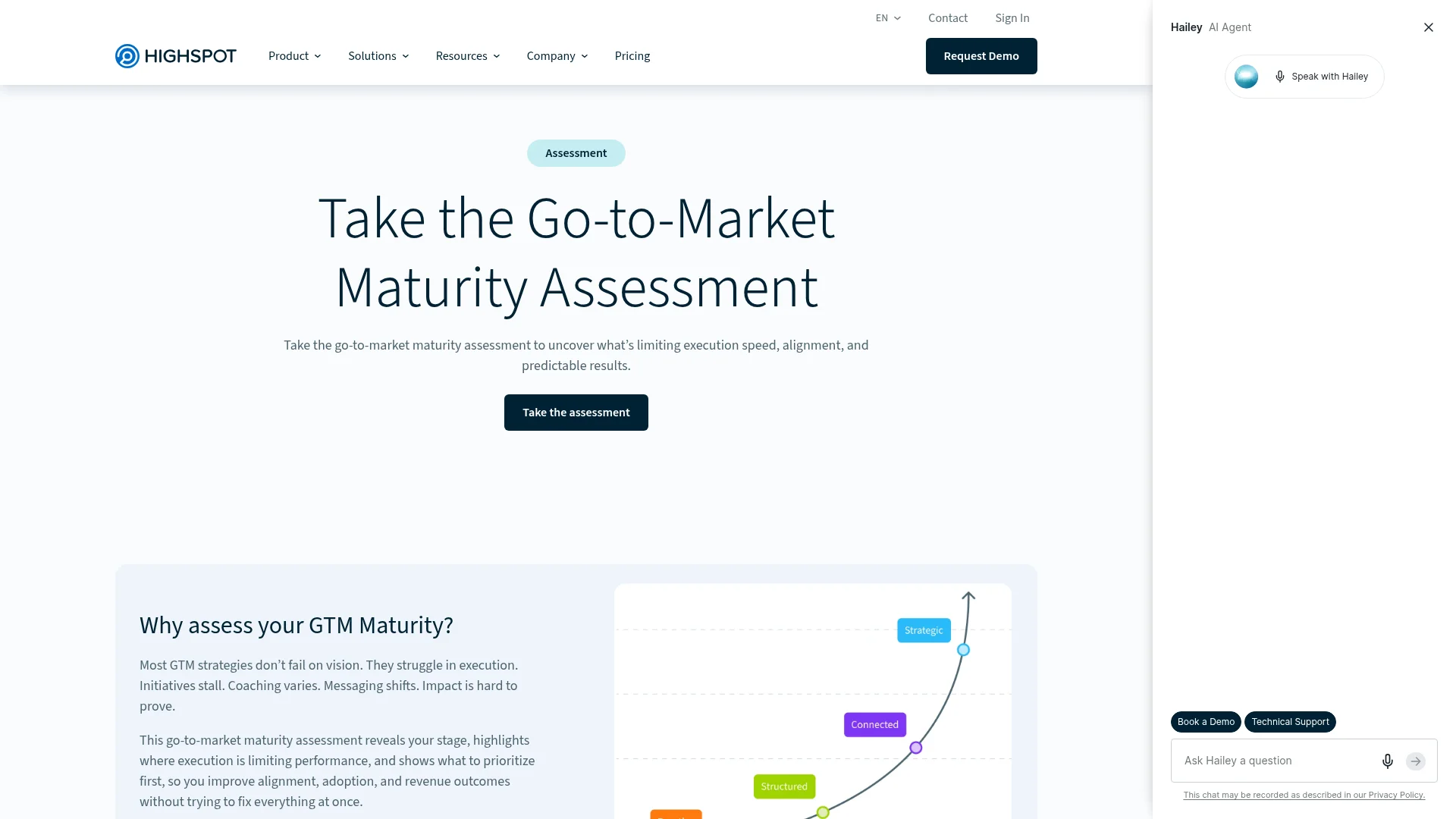
Strategic guidance for enablement, sales, and revenue leaders: foundational definitions, frameworks for behavior change, maturity models, ROI of enablement, the Definitive Guide to Sales Enablement hub, the annual State of Sales Enablement research, GTM transformation, leadership perspectives, careers in enablement, sales-marketing alignment, and Highspot's own news, events, and culture editorial. The largest cluster by a wide margin, and the cluster that anchors Highspot's brand authority in the category.
Content-type mix: Blog / Editorial 66.7% · Guides & Resources 15.6% · Research / Reports 7.6% · Events / Webinars 5.4% · Other 3.4% · Free Tools 1.0% · Glossary 0.4%
Micro-topics within this cluster
Enablement Strategy, Frameworks & Research (~923 Pages) The strategic backbone of the cluster: foundational "what is sales enablement" definitions, strategy design and operating models, maturity models and ROI proof points, the Definitive Guide to Sales Enablement, and findings from the multi-year State of Sales Enablement research series. This volume gives Highspot one of the deepest strategic-content libraries in the category, and the vocabulary ("operating model," "strategic enablement," "behavior change") matches the language Gartner and Forrester use for the category's buyer journey. Branded research compounding across years is the single hardest content asset for a competitor to replicate, which is why Highspot keeps extending the franchise rather than refreshing it.
Sample pages:
- Go-to-Market Maturity Assessment: Accelerate GTM Performance
/go-to-market-maturity-assessment/ - How to close your go-to-market performance gap in 2025
/go-to-market-performance-gap-2025/ - GTM Maturity Assessment - Highspot
/gtm-maturity-assessment-survey/ - How Mature is Your Sales Enablement Program - Highspot
/how-mature-enablement-strategy/
Highspot Company News & Events (~307 Pages) Company announcements, executive appointments, funding and award news, brand updates, Spark conference coverage, and recap posts from Highspot-hosted events. A surprisingly large sub-theme for a B2B SaaS library, but it makes architectural sense: every press release, award announcement, and event recap doubles as a search surface for branded queries and as a credibility signal for procurement-stage buyers. The volume also reflects multi-year accumulation rather than current cadence.
Sample pages:
- Bhrighu Sareen - Highspot
/author/bhrighu-sareen/ - Cassandra Tenorio - Highspot
/author/cassandra-tenorio/ - David Wortendyke - Highspot
/author/david-wortendyke/ - Jennifer Palecki - Highspot
/author/jennifer-palecki/
GTM Transformation & Execution (~233 Pages)
Highspot's GTM reframing of enablement: the 2026 Go-to-Market Execution Blueprint hub, agentic AI for GTM, and revenue execution strategy. This is the company's most active editorial reframing move, repositioning "sales enablement" as "GTM execution" with its own dedicated pillar (/go-to-market-guide/). The branded-hub structure pulls together blog posts, guides, and integration pieces under one navigational umbrella, signaling category-shaping intent rather than commodity content publication.
Sample pages:
- The 2026 Go-to-Market Execution Blueprint for GTM
/go-to-market-guide/ - Why You Need an AI Sales Enablement Platform
/why-you-need-sales-enablement/ - Annie Lizenbergs - Highspot
/author/annie-lizenbergs/ - Bradley Stern - Highspot
/author/bradley-stern/
Enablement Leadership, Careers & Alignment (~206 Pages) The "people and organization" side of enablement strategy: leadership perspectives, role-evolution pieces for enablement leaders, hiring guidance, careers in enablement, sales-marketing alignment patterns, and industry-specific framings across financial services, manufacturing, and healthcare. The recurring symmetrical alignment format ("3 things sales reps can teach marketing" / "3 things marketing can teach sales reps") signals editorial planning rather than ad-hoc publishing. The industry-vertical work is thinner on its own, but Highspot is consistent about treating regulated-industry content as a strategic lane rather than a generic backwater.
Sample pages:
- Brittan Wilkey - Highspot
/author/brittan-wilkey/ - Elyse Fox - Highspot
/author/elyse-fox/ - Jeff Day - Highspot
/author/jeff-day/ - Lucas Welch - Highspot
/author/lucas-welch/
Strategy insight: This cluster does triple duty. The pillar pages chase category-defining keywords, the editorial cadence builds practitioner brand familiarity, and the company-news plus events sub-themes function as procurement-stage credibility signals. The State of Sales Enablement franchise is the asset that ties together a multi-year research narrative. For competitors trying to displace Highspot here, the moat isn't content volume; it's the multi-year accumulation of analyst recognition, branded research, and the named maturity-model framework that buyers reference even when they're not actively evaluating the platform. The thinnest spot inside the strategy bucket is definitional content, where a competitor publishing 50 structured "what is X" pages could win the AEO answer-engine layer that the single Definitive Guide pillar can't cover alone.
2. Buyer Engagement & Revenue Execution
Pages: 781 (all locales) · Share of library: 16.4%
Content management, sales playbooks, methodology, deal execution, pipeline, buyer engagement, ABM, digital sales rooms, and the analytics that measure all of it. The cluster sits at the intersection of sales execution and marketing: practitioner content for buyers evaluating exactly what Highspot's product surfaces support.
Content-type mix: Blog / Editorial 68.4% · Guides & Resources 20.2% · Research / Reports 5.5% · Events / Webinars 3.7% · Glossary 1.5% · Other 0.6%
Micro-topics within this cluster
Pipeline, Deals & Analytics (~248 Pages) The measurement-and-execution backbone of revenue work: pipeline strategy, account-based selling, prospecting and territory planning, deal acceleration, win/loss analysis, sales analytics, revenue intelligence, KPIs for enablement, and partner-channel motions. This is where the proprietary-named methodology plays show up too, with branded terms like Content Genomics creating their own search surface. Analytics content is the most explicit ROI bridge in the cluster: it teaches buyers how to measure enablement, which is the conversation that converts strategic interest into procurement. The thinner channel-and-partner slice signals a deliberate positioning choice, leaving dedicated platforms (Allbound, Impartner) to fight for that niche.
Sample pages:
- 2016 Sales Enablement Practitioner survey report and findings
/blog/2016-sales-enablement-practitioner-survey/ - 5 Simple But Highly Effective Lead Nurturing Tactics | Highspot
/blog/5-simple-but-highly-effective-lead-nurturing-tactics/ - 5 Traits of Great Sales Leaders in Successful Organizations.
/blog/5-traits-of-great-sales-leaders/ - 6 Key Components of B2B Pipeline Generation | Highspot
/blog/6-key-components-of-b2b-pipeline-generation/
Sales Content Management (~169 Pages) Highspot's namesake category: content findability, governance, marketing-to-sales workflows, and asset hygiene. Mix of how-to ("4 best practices that turn your playbook into action") and analytical pieces ("3 ways marketers can measure the impact of sales content"). This is the only sub-theme in the cluster that maps directly to Highspot's category-leading reputation rather than to a buyer-execution problem, making it the most defensive content area on the page: the place competitors can't out-rank without first out-authority-ing the category. The asset-hygiene framing also surfaces a recurring content audit discipline that compounds across the editorial cadence.
Sample pages:
- Marissa Gbenro - Highspot
/author/marissa-gbenro/ - 3 Ways Marketers Can Measure the Impact of Sales Content | Highspot
/blog/3-ways-marketers-can-measure-the-impact-of-sales-content/ - 9 Things All Viral Content Has In Common - Highspot
/blog/9-things-all-viral-content-has-in-common/ - Best Practices in Sales Enablement: Content Mapping Made Easy
/blog/best-practices-in-sales-enablement-content-mapping-made-easy/
Sales Playbooks & Plays (~158 Pages) Sales playbook design, sales play execution, guided selling, just-in-time enablement, and the buyer-engagement framings that travel with reps into the deal. Pieces tend to be longer-form and framework-driven, which makes them strong evergreen rankers. The "5 keys to a powerful sales playbook" format is a search-intent magnet that ages well. The sub-theme also doubles as product positioning: Highspot's product surfaces playbook execution, so deep editorial here reinforces both category authority and product fit.
Sample pages:
- Sales Enablement, Sales, and Marketing News Blog - Highspot
/blog/ - 3 Trends Transforming Sales and Marketing | Highspot
/blog/3-trends-transforming-sales-and-marketing/ - 4 Sales Playbook Best Practices to Turn Plays into Action | Highspot
/blog/4-best-practices-that-will-turn-your-sales-playbook-into-sales-action/ - 7 Essential Elements of a Winning Sales Playbook Template | Highspot
/blog/7-essential-elements-of-a-winning-sales-playbook-template/
Buyer Journey & Digital Sales Rooms (~117 Pages) The buyer-facing surface of revenue execution: modern buyer behaviors, customer engagement frameworks, digital sales rooms, buyer microsites, and AI-fueled mutual action plan experiences. Titles like "8 ways to make every sales conversation count" target individual reps as much as enablement leaders, broadening the cluster's intent surface. The DSR slice is smaller than Dock's DSR-heavy library, which fits Highspot's positioning: DSRs are one product surface inside a unified platform, not a standalone category. The same capability gets reframed as "AI-powered buyer engagement" inside the AI cluster, giving Highspot two content lanes for one product surface.
Sample pages:
- Nima Abtahi - Highspot
/author/nima-abtahi/ - Thomas Hellweg - Highspot
/author/thomas-hellweg/ - 4 Steps to Sales Pitches That Engage Your Buyers | Highspot
/blog/4-steps-to-sales-pitches-that-engage-your-buyers/ - 8 Ways to Make Every Sales Conversation Count in 2020 - Highspot
/blog/8-ways-to-make-every-sales-conversation-count-in-2020/
Sales Methodology & Process (~89 Pages) Sales methodology frameworks (Challenger, BANT-adjacent, MEDDIC, SPIN), sales process design, and methodology adoption. The methodology sub-theme is where Highspot demonstrates fluency in the vocabulary buyers use during evaluation: a buyer who's already chosen Challenger or MEDDIC inside their org searches the methodology name first, then evaluates platforms that support it. Publishing into the methodology keyword surface positions the platform inside a procurement conversation that already has gravity, and the recurring frameworks-as-vocabulary play maps cleanly onto search intent at the consideration stage.
Sample pages:
- Chrissy Koskovich - Highspot
/author/chrissy-koskovich/ - Clare Hegg - Highspot
/author/clare-hegg/ - 5 Fast Ways Sales Enablement Leaders Can Modernize for 2018
/blog/5-fast-ways-for-sales-enablement-leaders-to-modernize-for-2018/ - Challenger Shares Two Elements for Winning Critical Customer Moments
/blog/challenger-sales-critical-customer-moments/
Strategy insight: This cluster maps almost 1:1 to Highspot's product surface area: content management, playbooks, analytics, deal execution, buyer engagement. Content Management plus Playbooks plus Methodology together cover more than 400 URLs, the most defensive practitioner-content footprint in the category. The combined Pipeline, Deals & Analytics bucket bundles ABM, deal mechanics, and the channel-partner conversation into a single execution surface, which trades some keyword sharpness for a clearer "we cover the full revenue motion" narrative. Buyer-side and seller-side framings now sit in the same architectural neighborhood, making it easier for editorial to argue that the same platform supports both ends of the deal.
3. AI for GTM & Sales Automation
Pages: 587 (all locales) · Share of library: 12.4%
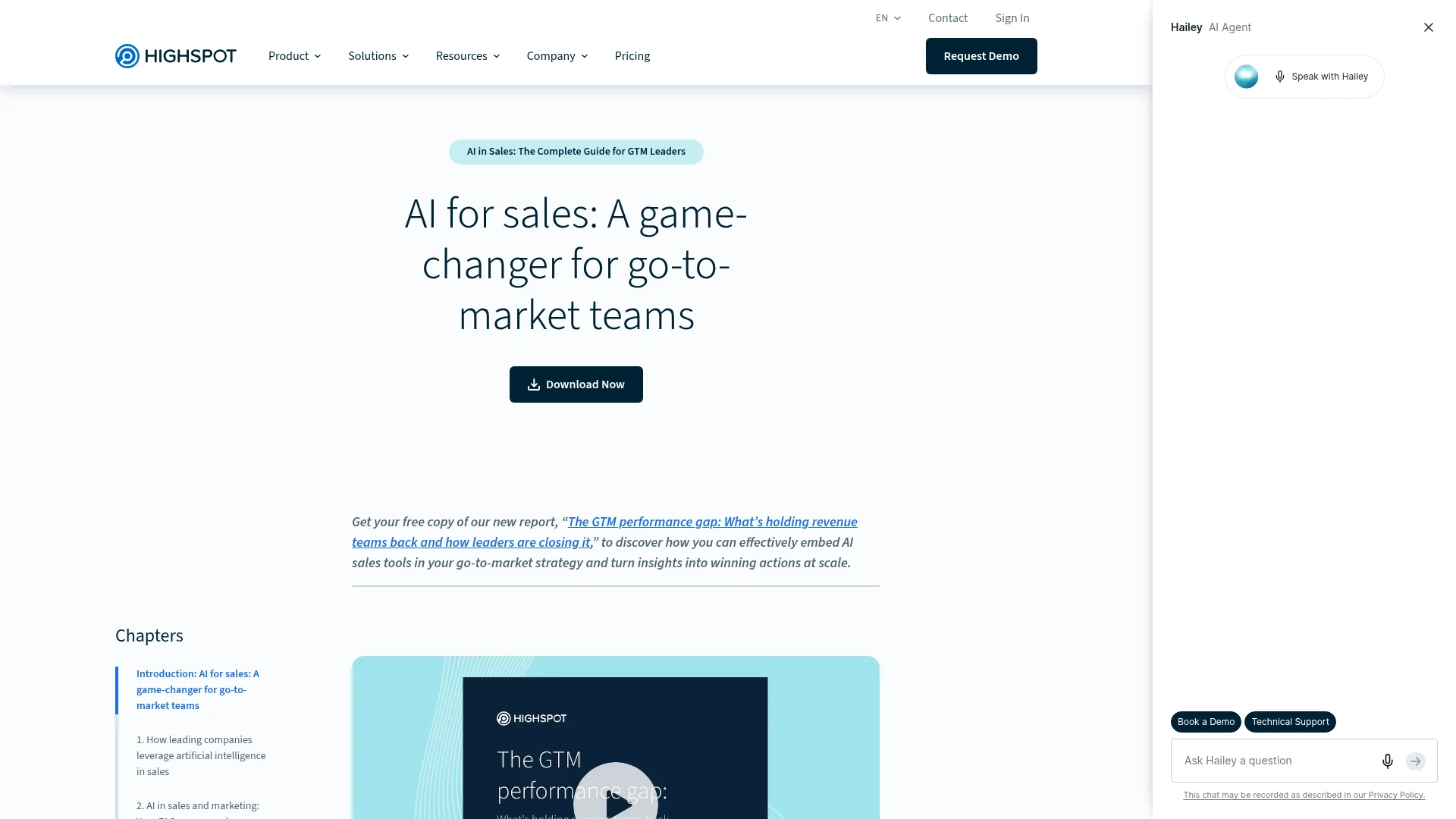
AI agents for sales, generative AI in sales, conversation intelligence, AI-driven buyer engagement, AI coaching, Autodocs, agentic enablement, and AI-driven GTM execution. The most product-adjacent and most editorially-concentrated cluster on the page: 83.0% Blog / Editorial.
Content-type mix: Blog / Editorial 83.0% · Guides & Resources 12.1% · Events / Webinars 3.1% · Research / Reports 1.2% · Other 0.5% · Glossary 0.2%
Micro-topics within this cluster
AI Strategy & Adoption (~353 Pages)
The cluster's largest sub-theme and the most senior-leader-facing slice of AI content: AI adoption strategies, AI readiness frameworks, change management for AI rollouts, generative AI applications in selling, content generation use cases, and executive AI playbooks. The volume here is the strategic signal: Highspot is publishing into the AI strategy keyword surface at a scale that signals the company wants to be the platform CROs and CEOs reach for first when they start an AI-adoption conversation. The pillar (/ai-for-sales/) anchors the navigational story; the 353 supporting URLs scaffold it. The strategic-AI framing also absorbs the broader "generative AI in sales" conversation, treating gen AI as the previous wave and agentic AI as where the next wave of platform value lives.
Sample pages:
- AI for sales: A game-changer for go-to-market teams - Highspot
/ai-for-sales/ - AI in sales and marketing: Your FAQs, answered - Highspot
/ai-for-sales/ai-in-sales-and-marketing/ - How leading companies leverage artificial intelligence in sales - Highspot
/ai-for-sales/artificial-intelligence-in-sales/ - Dan Behrman - Highspot
/author/dan-behrman/
AI Agents for Sales (~138 Pages) Highspot AI agents, agentic AI in GTM, autonomous sales workflows, agent use cases, and Autodocs-style content automation built on the agent platform. The second-largest sub-theme and the conceptual frontier: Highspot is using volume to claim category vocabulary before competitors settle on it. "Agentic GTM" appears in URL slugs, product announcements, and pillar copy in the same window competitors started using "AI sales agents" generically. The move (AI as autonomous workflow operator, not assistant) is the wedge into a different procurement conversation, and Autodocs is the named product surface that gives that argument a concrete artifact to point at.
Sample pages:
- 5 ways that AI sales agents boost GTM productivity - Highspot
/ai-for-sales/ai-sales-agents/ - 2026 Sales Qualification Framework for B2B GTM Teams
/blog/a-sales-qualification-framework-for-any-business/ - Account-Based Marketing: Strategy Advice for GTM
/blog/account-based-marketing-in-the-age-of-authenticity/ - The Agentic AI Opportunity for Go-To-Market Teams
/blog/agentic-ai-for-go-to-market/
AI Coaching & Conversation Intelligence (~57 Pages) Where AI meets coaching and call analytics: AI-powered coaching, conversation-intelligence-driven feedback, AI role play, call recording and analysis at scale, and signal detection across sales conversations. AI coaching content lives here, not in the Coaching cluster, and that architectural split is deliberate: it keeps the AI keyword surface dense for AI-buyer searches while leaving the Coaching cluster's vocabulary available for traditional coaching-buyer intent. The conversation-intelligence slice is intentionally light. Highspot frames the capability as embedded inside a unified-platform argument rather than fighting Gong and Clari on category-defining vocabulary.
Sample pages:
- How to Choose the Right AI Sales Tools for Your Team
/blog/ai-sales-tools/ - AI Workflows for GTM: Automation, Coaching and Deal Insights
/blog/ai-workflows-for-gtm-teams/ - Dreamforce 2025 Recap: Conversations Redefining Enablement
/blog/dreamforce-2025-recap/ - Highspot Winter Launch 2026 Supercharges Deal Execution
/blog/highspot-winter-launch-2026/
AI Sales Tool Roundups (~39 Pages) Best-of-AI-tool roundups, AI sales tool evaluations, comparisons across the AI sales tech stack, and editorial guides to choosing AI tooling. Highspot publishes its own "best AI sales tools" lists, which is unusual for a vendor in the category being evaluated: the bet is that ranking on "best AI sales tools" with a piece that mentions Highspot prominently is more valuable than ceding the term to neutral third-party content. The architecture makes the bet defensible: Highspot's domain authority on the topic is strong enough that the roundup is competitive on first-page rankings.
Sample pages:
- AI for sales prospecting: A transformative difference-maker - Highspot
/ai-for-sales/ai-for-sales-prospecting/ - 10 of the best AI sales tools: 2026 edition - Highspot
/ai-for-sales/best-ai-sales-tools/ - Accelerating Your GTM Teams' AI Adoption Journey
/blog/ai-adoption-challenges/ - AI-Powered Selling: A New Era of Sales Efficiency
/blog/ai-powered-selling-a-new-era-of-sales-efficiency/
Strategy insight: AI is being treated as a content category and a market-shaping play, not just product messaging. The 587 pages here represent 12.4% of the library, and the editorial concentration (83%) is the densest in any cluster. The AI Agents for Sales sub-theme (138 pages) is the conceptual frontier where Highspot is trying to own "agentic GTM" as the next framing before competitors stake the term. The thinnest spot is definitional content: only one Glossary URL across 587 AI pages. "What is an AI sales agent," "what is agentic enablement," and "what is conversation intelligence" are high-volume queries that Highspot has the authority to win but hasn't structured around.
4. Sales Coaching, Training & Rep Development
Pages: 570 (all locales) · Share of library: 12.0%
A practitioner-execution cluster: content for enablement managers and sales trainers running onboarding, coaching, kickoff, certification, and role-play programs. Maps closely to Highspot's training and coaching product modules.
Content-type mix: Blog / Editorial 69.1% · Guides & Resources 20.0% · Events / Webinars 6.3% · Research / Reports 3.9% · Other 0.7%
Micro-topics within this cluster
Sales Training Programs (~185 Pages) The cluster's largest sub-theme: training design, training methodologies, certifications, eLearning, and curriculum design. The volume gives Highspot a strong head-of-search position on training-related queries that historically belonged to specialist training vendors. The breadth (185 pages across multi-year publication windows) compounds back-link equity that newer entrants can't match quickly, and the editorial focus stays on structured programs rather than one-off tips, which is the right altitude for an enablement leader audience.
Sample pages:
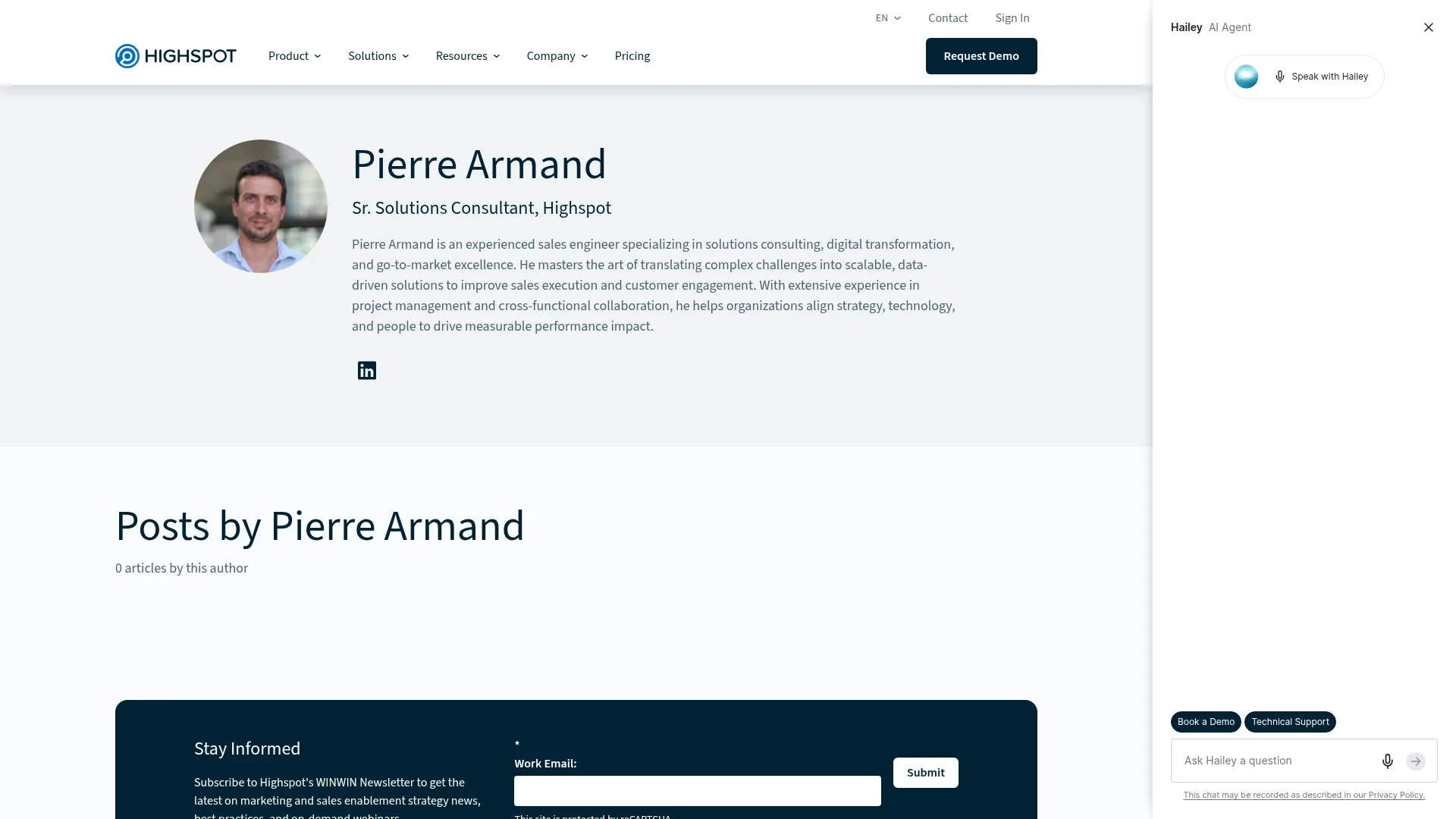
- Pierre Armand - Highspot
/author/pierre-armand/ - Richard Langham - Highspot
/author/richard-langham/ - 3 Easy Ways to Develop Self-Accountability and Achieve More | Highspot
/blog/3-easy-ways-to-develop-self-accountability-and-achieve-more/ - 3 Reasons to Add a Sales Enablement Platform to Your Sales Strategy
/blog/3-reasons-to-add-a-sales-enablement-platform-to-your-2015-plan/
Rep Productivity, SKO & Practice (~161 Pages) The cluster's second-largest sub-theme bundles seller productivity, skill-development frameworks, competency models, rep performance management, sales kickoff planning, post-SKO reinforcement, role-play scenarios, and deliberate practice environments. The grouping reflects a shared goal: lifting day-to-day rep performance once formal training and onboarding finish. The SKO slice runs on a predictable seasonal cycle, which makes annual republishes one of the most efficient evergreen surfaces in the library, while the AI-mediated role-play pieces ("AI sales role play: how managers coach smarter") signal that the next wave of training content will travel through AI agents rather than static guides.
Sample pages:
- 36 Tips to Stay Productive While Working from Home | Highspot
/blog/36-tips-to-stay-productive-while-working-from-home/ - How to Get Started in Sales: Advice from a Sales Executive
/blog/advice-for-women-getting-started-in-sales-part-1/ - How AI Coaching Is Redefining Readiness
/blog/ai-coaching-redefining-readiness/ - AI Sales Role Play: How Managers Coach Smarter
/blog/ai-role-play-sales-manager-training/
Sales Coaching Practices (~155 Pages) Coaching frameworks, manager coaching habits, conversation review practices, and coaching at scale across distributed teams. Highspot positions coaching as a major product pillar, and the editorial cadence backs that positioning: 155 pages dedicated to coaching practice gives the company a near-canonical surface on coaching-related searches. The recent introduction of AI Sales Coaching as a product surface ("a smarter future: how AI coaching secures big wins") is being woven into the coaching content cadence rather than confined to the AI cluster, which lets the same product narrative reach two distinct buyer intents.
Sample pages:
- Britta Lorenz - Highspot
/author/britta-lorenz/ - Highspot Team - Highspot
/author/highspot-team/ - A smarter future: How AI coaching secures big wins - Highspot
/blog/ai-coaching-secures-big-wins/ - AI Sales Coaching: Your Always-on Coaching Assistant
/blog/ai-sales-coaching/
Sales Onboarding & Ramp (~69 Pages) New-hire sales onboarding programs, time-to-productivity tactics, ramp acceleration, and onboarding playbooks for sales organizations. Highspot publishes named-customer onboarding stories as editorial posts inside this sub-theme rather than only in the customer-stories cluster, which surfaces the same proof point in two architectural locations. The framing language ("conversation mastery is key to fast onboarding") consistently emphasizes time-to-ramp, which is the metric procurement teams reach for when justifying enablement spend.
Sample pages:
- Conversation Mastery Is Key to Fast & Successful Onboarding
/blog/conversation-mastery-is-key-to-fast-successful-onboarding/ - How to Design High-Impact Sales Onboarding Experiences
/blog/designing-high-impact-onboarding-experiences/ - 6 Steps for Creating an Effective Sales Enablement Plan - Highspot
/blog/effective-sales-enablement-plan/ - Sales Onboarding: The Ultimate Guide for GTM Teams
/blog/effective-sales-onboarding/
Strategy insight: Coaching content sits adjacent to AI content in subject matter, and the editorial bridge is already forming: AI-coaching pieces appear in both clusters, and role-play content is migrating toward AI-mediated formats. Worth watching whether these two clusters consolidate as the product positioning matures. The Sales Training Programs sub-theme (185 pages) is the cluster's top-of-funnel anchor: it captures non-branded "sales training" searches that flow into more product-adjacent training content. Folding role-play, SKO, and productivity into one combined Rep Productivity bucket also lets the cluster argue for a continuous "lift over time" narrative rather than presenting each motion as a separate program.
5. Product, Company & Marketplace
Pages: 594 (all locales) · Share of library: 12.5%
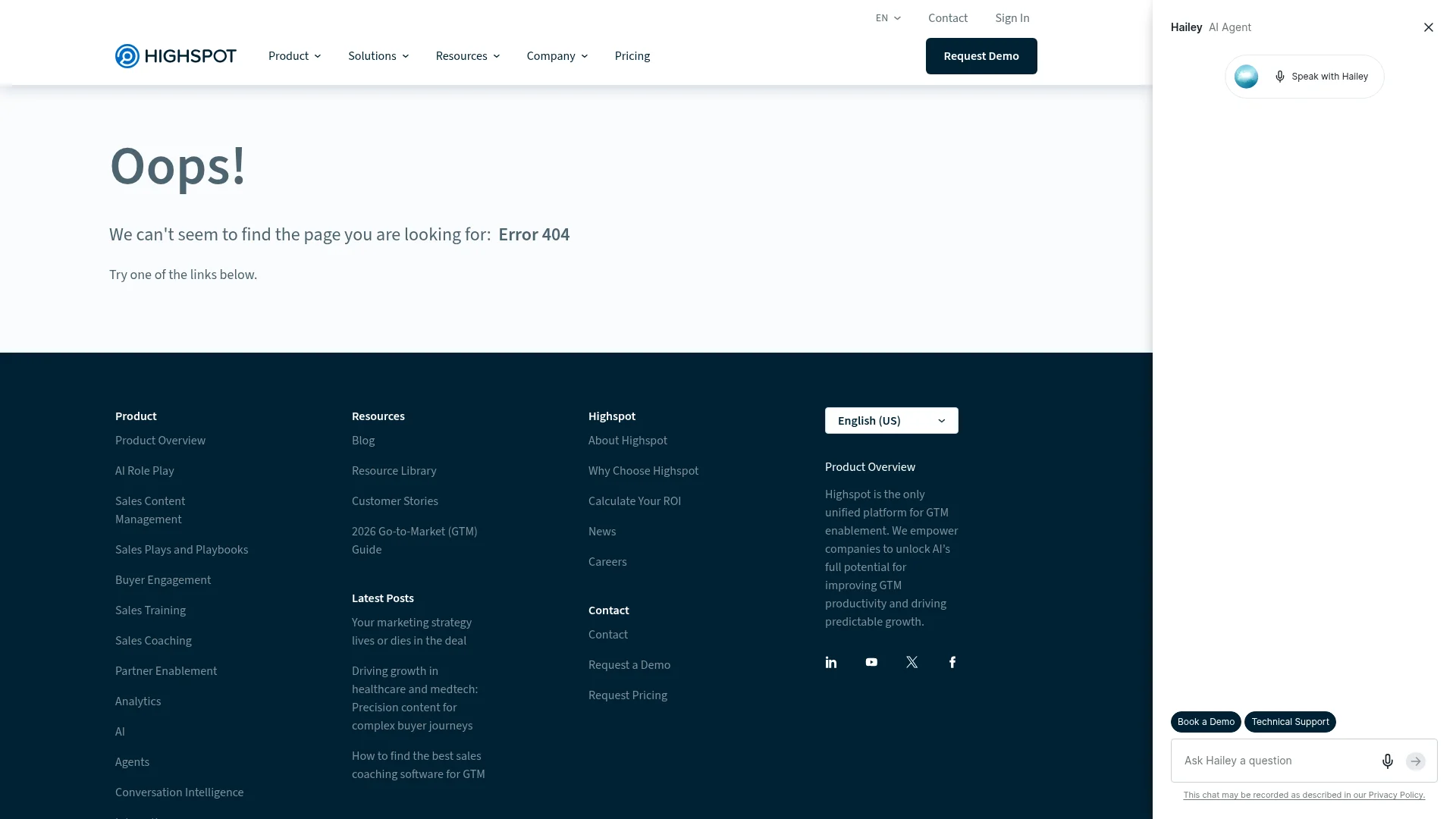
The conversion-and-utility surface: product pages, solutions by role and industry, the partner marketplace, competitor comparison pages, product tours, careers, legal, locale roots, and the WordPress author archives.
Content-type mix: Product & Feature Pages 51.7% · Other 42.1% · Comparison Pages 5.1% · Events 0.8% · Blog / Editorial 0.3%
Micro-topics within this cluster
Author Archive Pages (~168 Pages)
WordPress /author/[name]/ archive pages auto-generated by the blog CMS for each contributor. At 168 URLs (3.5% of the indexable footprint), the archive set is sitemap noise rather than content: thin templates with no editorial value, surfaced because the CMS publishes them by default. Worth flagging as a hygiene candidate, since pruning them would reduce the indexable footprint without losing anything discoverable.
Sample pages:
- Aaliyah Patel author archive
/author/aaliyah-patel/ - Adam Payne author archive
/author/adam-payne/ - Alexa Barden author archive
/author/alexa-barden/ - Alexia Wilkinson author archive
/author/alexia-wilkinson/
Solutions, Tours & Comparison Pages (~144 Pages) The buyer-facing conversion layer: industry pages (financial services, manufacturing), role pages (marketing teams, onboarding teams), persona-routed product tours (tour for reps, managers, content ops, training admins), demo and request-demo pages, and Highspot-vs-competitor landing pages (Seismic, Showpad, Allego, Mindtickle). Every comparison page uses the same title template ("Highspot vs X: Compare AI Sales Enablement Software"), templatable to scale, and the cross-locale duplication gives each comparison surface a per-market URL. Six canonical comparisons across five locales is light for a market leader, particularly with challengers running aggressive "Highspot alternatives" displacement campaigns on a wider long-tail surface.
Sample pages:
- Highspot vs Allego: Compare AI Sales Enablement Software
/allego-competitor/ - Highspot vs Mindtickle: Compare AI Sales Enablement Software
/mindtickle-competitor/ - Request a Demo of Highspot Sales Enablement Platform | Highspot
/request-demo/ - Highspot vs Seismic: Compare AI Sales Enablement Software
/seismic-competitor/
Product & Feature Pages (~123 Pages) Product and capability pages covering the sales enablement platform, AI agents, analytics, digital sales rooms, security, Autodocs, plus the pillar-guide and hub landing pages (resource library, blog, podcast index, sales-enablement-events-webinars index) that organize them across locales. The notable framing choice: page titles consistently lead with "AI" ("AI Sales Analytics," "Secure, Enterprise-Grade AI for Enablement," "AI Sales Enablement for Financial Services") rather than the underlying capability. That's a deliberate front-loading of AI vocabulary onto product surfaces, the same renaming move visible across the AI cluster's editorial content, applied to conversion-stage pages.
Sample pages:
- Highspot AI Sales Enablement Platform Integrations
/integrations/ - Sales Enablement Resources, Guides, and Templates - Highspot
/library/ - About Highspot: Your Trusted Partner in GTM Productivity
/overview/ - Discover How Highspot Use Cases Help Teams Perform at Scale
/product/
Corporate, Careers, Pricing & Legal (~106 Pages) About, leadership, investors, news, careers, partners hub, services-and-support, Spark community, contact pages, pricing, demo-request and thanks pages, legal terms, privacy, trust and security pages, and the locale-variant utility pages that mirror them. Standard B2B SaaS company-page footprint, plus a couple of distinctive entries: the fraudulent-employment-offer notices, which double as a trust signal (Highspot is well-known enough to be impersonated) and a defensive search-result move, and the dedicated "why choose Highspot" plus "Highspot Reviews" pages, which keep the competitive-evaluation conversation on Highspot-owned URLs rather than ceding it to G2 or third-party comparison content.
Sample pages:
- The Best AI Sales Enablement Platform for GTM Teams
/ - Come Join Highspot and Invent the Future | Highspot
/careers/ - Contact Us - Highspot
/contact/ - Beste KI-basierte Sales Enablement-Plattform für GTM-Teams
/de/
Partner Marketplace Directory (~53 Pages) The Highspot Marketplace hub and category pages (assessment, hiring, methodology, industry learning, training) plus individual partner solution listings. Each integration and partner gets its own URL rather than being collapsed into a single page, which gives every partner-name search term its own ranking surface and signals ecosystem depth to buyers comparing platforms. The 53-URL footprint exceeds the 30-URL competitor-comparison surface by an order of magnitude, a deliberate choice to lead with ecosystem rather than competitive defense.
Sample pages:
- Marketplace - Highspot
/marketplace/ - Marketplace - Highspot
/marketplace/category/assessment/ - Marketplace - Highspot
/marketplace/category/hiring/ - Marketplace - Highspot
/marketplace/category/industry-learning/
Strategy insight: The Partner Marketplace footprint (53 named-partner URLs, plus locale variants) is materially larger than the comparison-page footprint (30 across all locales). Highspot has chosen to position itself as a platform with an ecosystem (discoverable named integrations) rather than as a market leader who defends primarily against alternatives. Pulling solutions, tours, and competitor comparisons into one buyer-facing sub-theme also tells a cleaner conversion story: industry, role, and competitive context all sit together as the answer to "is this platform a fit." The 168 author-archive URLs remain the most visible hygiene candidate; pruning them would reduce indexable noise without losing any reader-facing content.
6. Customer Success Stories
Pages: 343 (all locales) · Share of library: 7.2%
Named customer case studies and success stories across all locales. The most format-pure cluster on the page: 98.5% Case Studies / Customer Stories. At 343 URLs, Highspot leads the sales-enablement peer set in absolute customer-story count, ahead of Seismic at 267 and Guru at 153.
Content-type mix: Case Studies / Customer Stories 98.5% · Other 1.5%
Micro-topics within this cluster
Customer Stories: Locale Variants (~184 Pages)
Translated or locale-variant versions of customer success stories across /de/erfolgsgeschichten/, /fr/reussites/, /en-gb/success-stories/, and /en-au/success-stories/. The localization commitment for customer proof is meaningful: 184 translated case-study URLs is more than most peers' entire case-study library. The pattern signals that Highspot treats named-customer proof as a per-locale conversion asset, not just an English-language artifact, and supports the wider locale-mirroring posture visible across the rest of the library.
Sample pages:
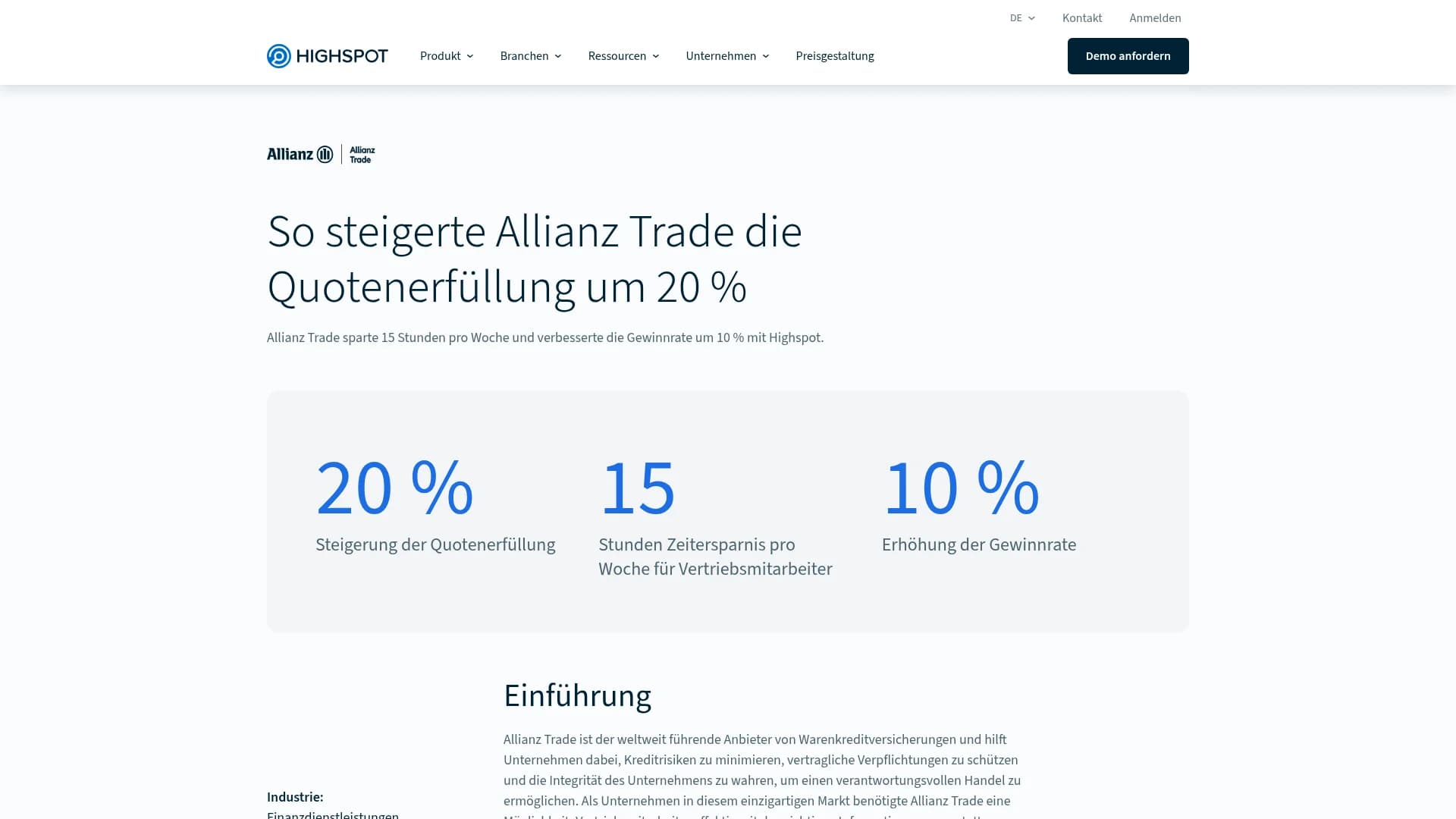
- Allianz Trade Erfolgsgeschichte: Höhere Quotenerfüllung - Highspot
/de/erfolgsgeschichten/allianz-trade/ - Criteo Erfolgsgeschichte: Vertriebsengagement erhöhen - Highspot
/de/erfolgsgeschichten/criteo/ - Erfolgsgeschichte Elsevier: Käuferengagement erhöhen - Highspot
/de/erfolgsgeschichten/elsevier/ - Erfolgsgeschichte FedEx Office: Käuferengagemen erhöhen - Highspot
/de/erfolgsgeschichten/fedex/
US-English Customer Stories (~121 Pages)
Named success stories on the primary US-English path (/success-stories/<customer>/), plus the top-level success-stories landing pages and their locale variants. The canonical English-language case-study set: Aetna, Alight, Allianz Trade, American Woodmark, and 100+ others. Individual case studies are titled by outcome rather than by customer name ("Aetna Case Study: Improve Content Governance"), which makes the library filterable by ROI category and signals a templated production process behind the scenes.
Sample pages:
- Highspot Case Studies & Customer Stories - Highspot
/success-stories/ - Highspot Fallstudien und Erfolgsgeschichten - Highspot
/de/erfolgsgeschichten/ - Highspot Case Studies & Customer Stories - Highspot
/en-au/success-stories/ - Highspot Case Studies & Customer Stories - Highspot
/en-gb/success-stories/
Customer Stories: Outcome-Themed (~38 Pages) A subset of case studies whose titles foreground a specific outcome theme (productivity, ramp time, alignment, growth) rather than the customer name. A coherent stylistic group that surfaces the most ROI-bearing stories: when a buyer searches "sales productivity case study," these are the pages that surface, with the customer name as a credibility add-on rather than the entry point.
Sample pages:
- Acosta Case Study: Boost Quota Attainment and Sales Efficiency
/success-stories/acosta/ - Ansell Case Study: Influence $998k in Won Revenue - Highspot
/success-stories/ansell/ - Arm Case Study: Increase Sales Efficiency - Highspot
/success-stories/arm/ - Attentive Case Study: Boosted Win Rates - Highspot
/success-stories/attentive/
Strategy insight: 343 named-customer case studies is a deep customer-proof library and a compounding evidence asset: every new customer story adds to the moat, and new entrants without comparable enterprise customer relationships cannot match this footprint in a short timeframe. The outcome-led titling pattern is unusual and analytically useful: Highspot has standardized how case studies map to metrics, which makes them easier to filter by buyer intent. The 184 locale-variant URLs more than half the cluster's total, an unusually high translation commitment for case-study content that most peers leave English-only. The opportunity left on the table is heavier internal linking from editorial clusters into the relevant outcome-themed cases, which the current architecture does sparingly.
7. Win-Win Sales Enablement Podcast
Pages: 208 (all locales) · Share of library: 4.4%
Episodes of Highspot's Win-Win sales enablement podcast, an interview-format series with sales and enablement leaders. The cluster is 100% Podcast / Audio Series. Different format and editorial voice from the blog, with its own episode numbering and host structure.
Content-type mix: Podcast / Audio Series 100.0%
Micro-topics within this cluster
Enablement Leader Interviews (~66 Pages) The largest sub-theme: episodes featuring heads of enablement, enablement program owners, and other sales enablement practitioners describing how they build and run their programs. The recurring guest profile (practitioner leaders, not industry analysts or Highspot executives) does double duty: each episode is an editorial asset and a relationship asset, since the guest becomes a known supporter once their conversation is published. Over 208 episodes, that compounds into a substantial guest-alumni network and a self-renewing source of new interview subjects.
Sample pages:
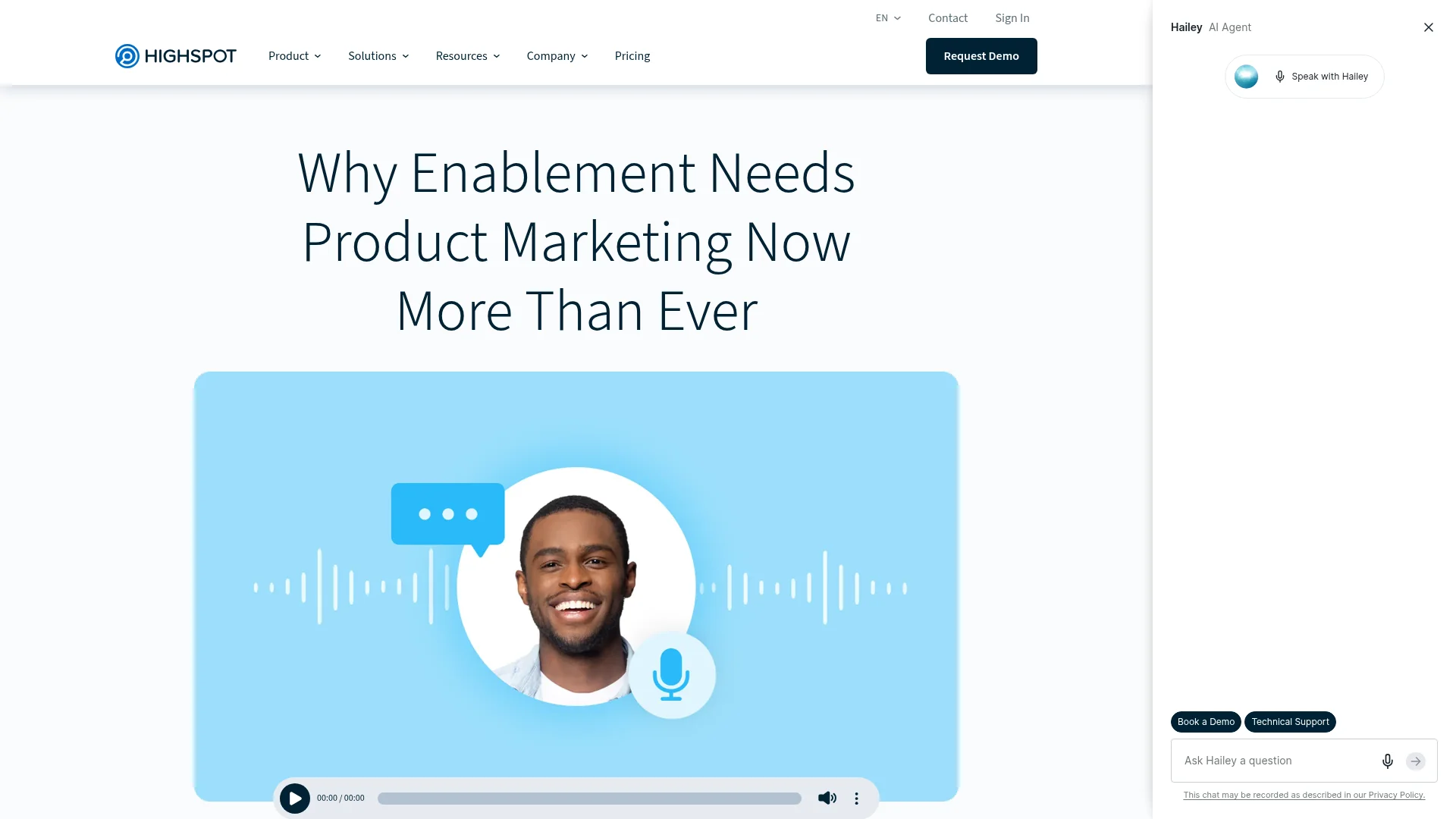
- Podcast: Why Enablement Needs Product Marketing - Highspot
/podcast/enablement-needs-product-marketing-podcast/ - Episode 1: What Is the Strategic Enablement Framework? | Highspot
/podcast/episode-1-what-is-the-strategic-enablement-framework/ - Episode 113: Driving Adoption of a New Enablement Platform - Highspot
/podcast/episode-113-driving-adoption-of-a-new-enablement-platform/ - E114: Strengthening Partner Engagement With Enablement - Highspot
/podcast/episode-114-strengthening-partner-engagement-with-effective-enablement/
Strategy, Leadership & Sales Episodes (~44 Pages) Episodes on enablement strategy, organizational change, leadership perspectives, sales-leader (CRO and VP of Sales) conversations, and the podcast hub pages that organize the series across locales. The recurring frame is consistent with the editorial Strategy cluster's vocabulary, particularly around "unified platform" framing that appears in episode after episode. Sales-leader interviews remain a small slice on their own, which is itself a strategic signal: the podcast's editorial center of gravity is the enablement-leader audience, with sales leaders treated as adjacent rather than primary.
Sample pages:
- Sales Enablement Podcast: Accelerate Deals & Upskill Reps - Highspot
/podcast/ - Sales Enablement Podcast: Accelerate Deals & Upskill Reps - Highspot
/en-au/podcast/ - Sales Enablement Podcast: Accelerate Deals & Upskill Reps - Highspot
/en-gb/podcast/ - E106: Boosting Sales Velocity With a High-Performance Culture
/podcast/episode-106-boosting-sales-velocity-high-performance-culture/
Coaching & Training Episodes (~43 Pages) Episodes focused on coaching frameworks, training program design, onboarding tactics, and rep-development practices. Topic-focused episodes around rep development form a coherent sub-theme that overlaps almost exactly with the Coaching cluster's editorial structure. The mirroring is intentional: the podcast functions as a guest-validated reflection of Highspot's own editorial argument, with practitioner guests independently making the case Highspot's blog content is also making.
Sample pages:
- Episode 105: Unlocking Seller Potential Through Training - Highspot
/podcast/e105/ - Episode 10: Best Practices to Reinforce Behavior Change
/podcast/episode-10-best-practices-to-reinforce-behavior-change/ - E103: Boosting Rep Confidence Through Effective Coaching
/podcast/episode-103-boosting-rep-confidence-through-effective-coaching/ - Episode 11: Understanding the Science of Behavior Change
/podcast/episode-11-understanding-the-science-of-behavior-change/
AI & GTM Tech Episodes (~29 Pages) Episodes covering AI in enablement, GTM tech stack decisions, automation adoption, and how technology is reshaping selling. A growing share of episodes covers AI and tech topics, which surfaces a tech-themed sub-theme. The pattern mirrors the editorial AI cluster: as AI moved from emerging category to product-roadmap centerpiece, the podcast cadence kept pace, giving Highspot a steady drumbeat of AI-themed guest conversations that compound on the editorial argument.
Sample pages:
- Episode 102: Building a Tech Stack for Maximum Productivity - Highspot
/podcast/episode-102-building-a-tech-stack-for-maximum-productivity/ - E115: Maximizing Enablement Impact With the Right Tech Stack
/podcast/episode-115maximizing-enablement-impact-with-the-right-tech-stack/ - Episode 116: Leading Sales Transformation Through Collaboration - Highspot
/podcast/episode-116-leading-sales-transformation-through-collaboration/ - Episode 124: Transforming GTM Productivity With AI - Highspot
/podcast/episode-124-transforming-gtm-productivity-with-ai/
Buyer Engagement & Revenue Episodes (~26 Pages) Episodes about buyer engagement, deal execution, sales-marketing alignment, and revenue performance from a practitioner lens. The demand-side and revenue-execution episodes form a coherent sub-theme that maps to the Buyer Engagement & Revenue Execution editorial cluster. The thematic symmetry across podcast and blog is the structural feature worth noting: Highspot has built editorial and audio content that argue for the same set of category vocabulary terms in parallel, doubling the surface area available to both Google and AI-citation systems.
Sample pages:
- Episode 100: Enable the Impossible to Unlock Revenue Growth - Highspot
/podcast/episode-100-enable-the-impossible-unlock-revenue-growth/ - Episode 101: Breaking Down Silos With a Unified Platform - Highspot
/podcast/episode-101-breaking-down-silos-with-a-unified-platform/ - E109: Streamlining the Sales Process to Boost Operational Efficiency
/podcast/episode-109-streamlining-sales-process-boost-operational-efficiency/ - E112: Accelerating Deal Velocity With Enablement
/podcast/episode-112-accelerating-deal-velocity-unified-enablement-platform/
Strategy insight: 208 episodes is a multi-year compounding investment that competitors cannot replicate quickly. The episode themes mirror Highspot's editorial clusters almost exactly: enablement leadership, coaching/training, strategy, AI/tech, buyer engagement. The podcast functions as a guest-validated mirror of the company's editorial argument. The structural feature most worth noting is the parallel publication of editorial and audio content arguing for the same category vocabulary, which doubles the surface area available to both search engines and AI-citation systems and builds a guest-alumni network that becomes self-renewing across years.
Key Observations
What Stands Out About Highspot's Content Strategy
The library is editorial-first, not docs-first
53.2% of every page Highspot publishes is Blog / Editorial content. The absence of Documentation in the main www sitemap is structural rather than accidental: developer docs live on a separate subdomain, and the main site is built for GTM practitioners and leaders, not for builders. For a category-leading sales enablement platform whose buyer is a head of enablement or a CRO, this is the right architecture. It would be the wrong architecture for a developer-facing platform, which is why the editorial-led pattern signals strategic posture as much as content choice.
Locale strategy roughly 2.64x's the apparent library size
Only 1,799 URLs (37.9%) are unique en-US root content. The en-GB (1,172 URLs) and en-AU (1,041) libraries mirror most en-US content, while German (392) and French (348) are smaller curated subsets. Whether the en-GB and en-AU 1:1 mirroring is justified depends on whether the secondary English markets benefit from locale-specific URLs versus ranking on en-US content. The DataForSEO data alone cannot resolve that question, but the inflation multiplier itself is the takeaway: any peer comparison should normalize against the 1,799 en-US base, not the 4,752 total.
AI is being treated as a dedicated content category, not just product messaging
587 pages (12.4% of library, 83.0% editorial) make AI for GTM Highspot's third-largest topic cluster. The 138-URL AI Agents for Sales sub-theme is the conceptual frontier: Highspot is using volume to claim "agentic GTM" vocabulary before competitors settle on it. A deliberate land-grab on a topic where the broader market is still figuring out terminology. The under-investment in definitional Glossary content for AI terms (one Glossary URL across 587 AI pages) is the most actionable gap inside the play.
The Win-Win Podcast and Customer Success libraries are durable competitive assets
208 podcast episodes and 343 named-customer case studies represent multi-year compounding investments. New entrants cannot replicate them quickly: a podcast requires sustained guest sourcing across years, and an enterprise case-study library requires actual enterprise customers willing to publicize their results. These are structural barriers that buy Highspot time on competing fronts where pure content velocity could close gaps faster.
Comparison-page investment is light for a category leader
30 comparison pages (six canonical Highspot-vs matchups: Seismic, Showpad, Allego, Mindtickle, with locale variants) is modest for a company of Highspot's footprint. Direct competitors run displacement campaigns against Highspot on long-tail "Highspot alternatives" and "Highspot vs X" terms; owning the canonical comparison page surface is a low-effort defensive move that Highspot has chosen to under-invest in via Content Studio or any equivalent production system. The 53-URL Partner Marketplace footprint, by contrast, signals a deliberate positioning choice: lead with ecosystem and integrations, not with competitive defense.
Definitional content is structurally under-invested
Only 20 Glossary / Definitions URLs across a 4,752-page library (0.4% share, below the 30-URL / 2% threshold for a category-leading library). Sales enablement is a category with dozens of high-volume definitional searches: "what is sales enablement," "what is a sales playbook," "what is buyer enablement," "what is revenue enablement," "what is an AI sales agent." A library of 100+ structured "what is X" pages would be both a traditional-SEO and AEO play that Highspot has the authority to win but hasn't structured around. Free Tools shows the same pattern at 16 URLs: enough to surface the category, not enough to dominate searches in it.
Per-URL efficiency is moderate, and the next growth lever is content quality
Per-URL traffic efficiency lands at ~18 visits per page across 4,752 URLs, consistent with category-leader-scale libraries where total traffic comes from volume more than from per-page authority. The 55.7% top-10 share is strong, but the 839 positions in 11-20 are the most actionable content gap: content already on the first or second page that focused work could push into top-10 visibility. Combined with the 1,066 positions in 21-50, the growth lever here looks more like content quality than fresh page volume.
No second research franchise outside the State of Sales Enablement series
198 URLs sit in the Research / Reports bucket, but the recurring branded research franchise is the State of Sales Enablement series and the GTM Performance Gap report, both of which anchor the strategy cluster. There is no second, standalone "State of X" research line covering an adjacent topic like coaching, AI adoption, or buyer engagement. Peers running multiple annual franchises (one per cluster) tend to generate independent backlink waves from each. For a company positioned as a category-shaping voice across coaching, AI, and buyer engagement as well as enablement strategy, a second research franchise would be a natural extension.
More analyses in Sales Enablement
Mindtickle
How Mindtickle uses 457 blog posts and a 102-URL AI Role Play franchise to drive 15K monthly visits in sales enablement. 787 pages, 6 clusters.
SalesHood
How SalesHood uses 176 blog posts, 100 webinars, and a cross-format MEDDICC franchise to drive 3K monthly visits in sales enablement. 440 pages, 3 clusters.
Seismic
How Seismic uses 1,483 blog posts, a 492-term glossary, and 281 research reports to drive 76K monthly visits in sales enablement. 3,954 pages, 10 clusters.
Showpad
How Showpad uses 398 blog posts, 457 expert profiles, and 61 case studies to drive 25K monthly visits in sales enablement. 1,511 pages, 7 clusters.
Methodology: This analysis is based on Highspot's full public sitemap (4,752 URLs, sourced from robots.txt), enriched with each URL's title and meta description via lightweight HTTPS fetches. URLs were classified into a 12-bucket content type taxonomy and grouped into 7 topic clusters with 30 micro-topics using LLM-assisted classification. Company facts came from public web research across Crunchbase, LinkedIn, and the company's own About and blog pages. Traffic metrics (monthly organic visits, traffic value, ranking positions, position distribution) came from DataForSEO's domain rank overview, aggregated globally across 94 locale combinations. All counts reflect the Highspot sitemap as of 2026-05-20.