
Summary
Dock drives 44,780 monthly organic visits from a franchise-led content engine, not a traditional blog. The 533-URL Grow & Tell Podcast alone accounts for 44.3% of every page in the library, and the 258-URL Revenue Archives third-party collateral library adds another 21.5% on top of that. The remaining content splits across editorial guides, product release notes, free templates, customer stories, and a 38-page competitor comparison surface that is heavy for a company at Dock's stage. Per-URL traffic efficiency is the highest in the sales-enablement peer set at roughly 37 visits per page, signaling a smaller library working harder than the category leaders.
Key facts:
- Library size: 1,203 indexable pages organized into 6 topic clusters; 42.7% Podcast / Audio Series
- Largest cluster: Grow & Tell Podcast (533 URLs, 44.3% of library)
- Flagship content asset: Grow & Tell Podcast, an interview show with revenue, sales, CS, enablement, and marketing leaders from Notion, Gong, Lattice, Loom, Flexport, and Shopify, broken out into named-guest clip pages
- Search performance: 44.8K monthly visits across 3,084 ranking positions; 17.4% in top 10, meaningfully lower than category leader Highspot at 55.7%, but per-URL efficiency leads the peer set at ~37 visits per page
- Notable gap: Zero URLs classified as Research / Reports, no first-party annual research franchise to anchor the editorial cluster
Company Overview
Dock at a Glance
| Company | Dock |
| Founded | 2021 · San Francisco, CA |
| Category | Revenue Enablement / Digital Sales Rooms |
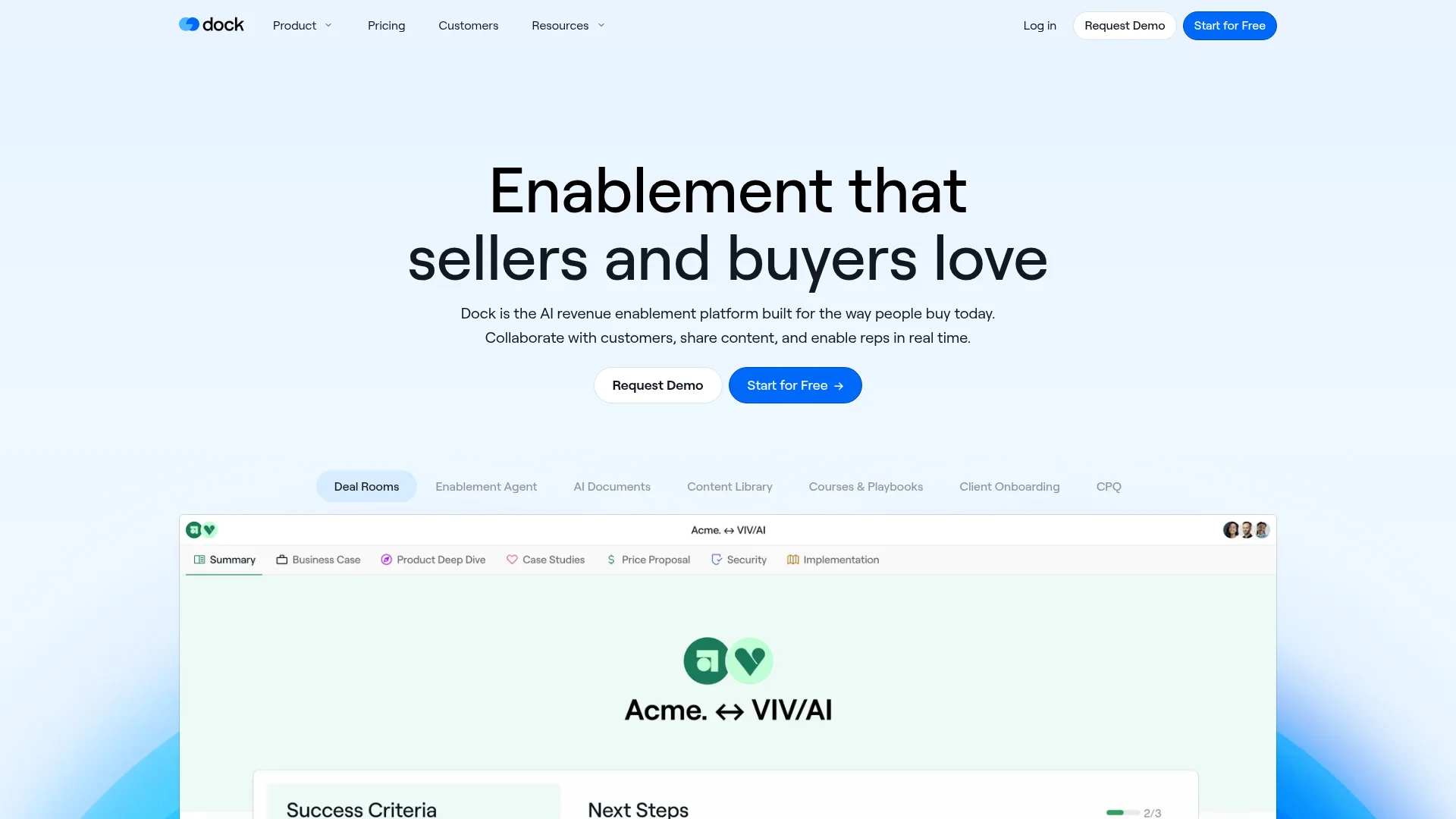
| What They Do | Dock is a B2B revenue enablement platform that gives sales and customer success teams branded digital workspaces, including digital sales rooms, mutual action plans, client portals, and onboarding hubs, to share content with buyers and customers in one trackable space. The product combines deal rooms with content management, sales enablement, and AI-assisted workflows for the full revenue lifecycle. Named customers include Lattice, Loom, BrightHire, Postscript, Zip, and Writer. |
| Funding | $6.5M raised total; last round Seed extension (June 2023, $3.5M, led by Craft Ventures with Altman Capital and Operator Collective) |
| Headcount | 11-50 (LinkedIn band) |
| Monthly Organic Visits | Traffic Value (PPC equiv.) | Ranking Positions |
|---|---|---|
| 44.8K | $126.7K | 3.1K |
Ranking positions reflect total positions across 83 indexed (location, language) combinations, not unique keywords. A keyword ranking in multiple locales is counted multiple times.
Dock's content operation is structurally concentrated. 1,203 indexable pages sit on a single en-US locale, organized into 6 topic clusters. The Grow & Tell Podcast alone accounts for 44.3% of every page in the library, and the two halves of the Revenue Archives collateral collection (visual collateral plus written collateral) add another 21.5% on top of that. Where Highspot, Seismic, and other enterprise peers run editorial-first libraries built around 2,000-plus post blogs, Dock's library is anchored by a podcast franchise and a curated third-party asset collection. The editorial library cluster (Sales, Buyer & CS Editorial Library) sits in second place by URL count at 169 URLs, well below the Revenue Archives' combined 258. The architecture reads as a Series A challenger using a smaller library harder than larger peers, supported by the per-URL traffic numbers.
Content Architecture
What Does Dock's Content Engine Look Like?
Dock's main website hosts 1,203 indexable pages organized into 6 topic clusters. The dominant content format is Podcast / Audio Series at 42.7% of pages, an unusual distribution for a B2B SaaS library and the clearest signal that Dock's content strategy is built around named editorial franchises rather than a sustained blog cadence.
Content Type Distribution
| Content Type | Count | Share | Notes |
|---|---|---|---|
| Podcast / Audio Series | 514 | 42.7% | Grow & Tell episodes and clip pages, the single largest content type |
| Guides & Resources | 258 | 21.4% | Almost entirely the Revenue Archives curated collateral library |
| Blog / Editorial | 236 | 19.6% | Editorial guides, glossary content, product updates, customer stories |
| Free Tools | 54 | 4.5% | Dock templates (sales rooms, action plans, QBR, proposals) |
| Comparison Pages | 38 | 3.2% | Heavy for a Series A challenger; sales-collateral roundups + /compare/* pages |
| Other | 34 | 2.8% | Legal, locale roots, taxonomy/category pages |
| Product & Feature Pages | 30 | 2.5% | Product, solution, feature, integration pages |
| Case Studies / Customer Stories | 14 | 1.2% | First-party Dock customer stories (Lattice, Loom, BrightHire) |
| Events / Webinars / Sessions | 13 | 1.1% | Dock Live webinars and event replays |
| Glossary / Definitions | 12 | 1.0% | Definitional "what is X" content; thin for the category |
| Research / Reports | 0 | 0.0% | No first-party research franchise |
| Documentation | 0 | 0.0% | No public technical documentation in main sitemap |
Key finding: Two content types (Podcast and Guides & Resources) account for 64.2% of every page Dock publishes. This is a franchise-led structure, not a traditional blog play. The absence of Research / Reports and Documentation is structural rather than accidental: Dock's category-shaping content is housed in a podcast, and product reference material lives inside the app, not on the marketing site.
Content Strategy Archetype
Dock operates a franchise-led two-pillar model. Both pillars are named, recognizable assets in their own right. Grow & Tell is the brand layer for revenue practitioners. The Revenue Archives is a category-shaping curation of how other SaaS companies sell, split here into two sibling clusters along the visual-versus-written collateral axis. Around the pillars sit smaller editorial, product-update, template, and conversion clusters that play conventional SEO and product-marketing roles. The archetype is rare at Dock's stage, where most Series A startups default to a blog-heavy library. Choosing named franchises instead trades breadth for repeatability: each pillar has a recognizable identity that compounds with every new URL added.
Search Performance Quality
Where Dock Ranks
The DataForSEO domain rank overview shows Dock ranking in 3,084 positions across 83 locales. The position distribution is bottom-heavy: most rankings sit in positions 11-50 rather than the top 10, a pattern consistent with a younger domain still building authority.
| Position | Count | Share |
|---|---|---|
| #1 | 35 | 1.1% |
| #2–3 | 76 | 2.5% |
| #4–10 | 427 | 13.8% |
| #11–20 | 469 | 15.2% |
| #21–50 | 1,222 | 39.6% |
| #51–100 | 855 | 27.7% |
17.4% of Dock's ranking positions are in the top 10, meaningfully lower than category leader Highspot at 55.7% and below editorially mature peers like Showpad at 41.7%. The shape is what an earlier-stage challenger's distribution typically looks like. Limited top-10 footprint. A substantial 11-20 band (469 positions, 15.2% of total) that represents the most actionable optimization slot. And a long tail across 21-100 where the bulk of the library currently sits.
Per-URL traffic efficiency tells the other half of the story. At ~37 visits per page across 1,203 URLs, Dock leads the entire sales-enablement peer set, ahead of Trainual (34), Mindtickle (19), Seismic (19), Highspot (18), and Showpad (17). Dock's smaller library is working harder per page than competitors with three to five times the URL count. The risk built into the next stage of growth is preserving that per-page bar as the library scales.
Content Deep Dive
What Is Dock Actually Publishing, and How?
Dock's content organizes around 6 primary topic clusters. Each cluster is described below with content-type composition, the micro-topics inside it, and concrete example URLs. Cluster and micro-topic groupings reflect a per-URL classification of the full sitemap, so counts are exact rather than approximate.
1. Grow & Tell Podcast
Pages: 533 · Share of library: 44.3%
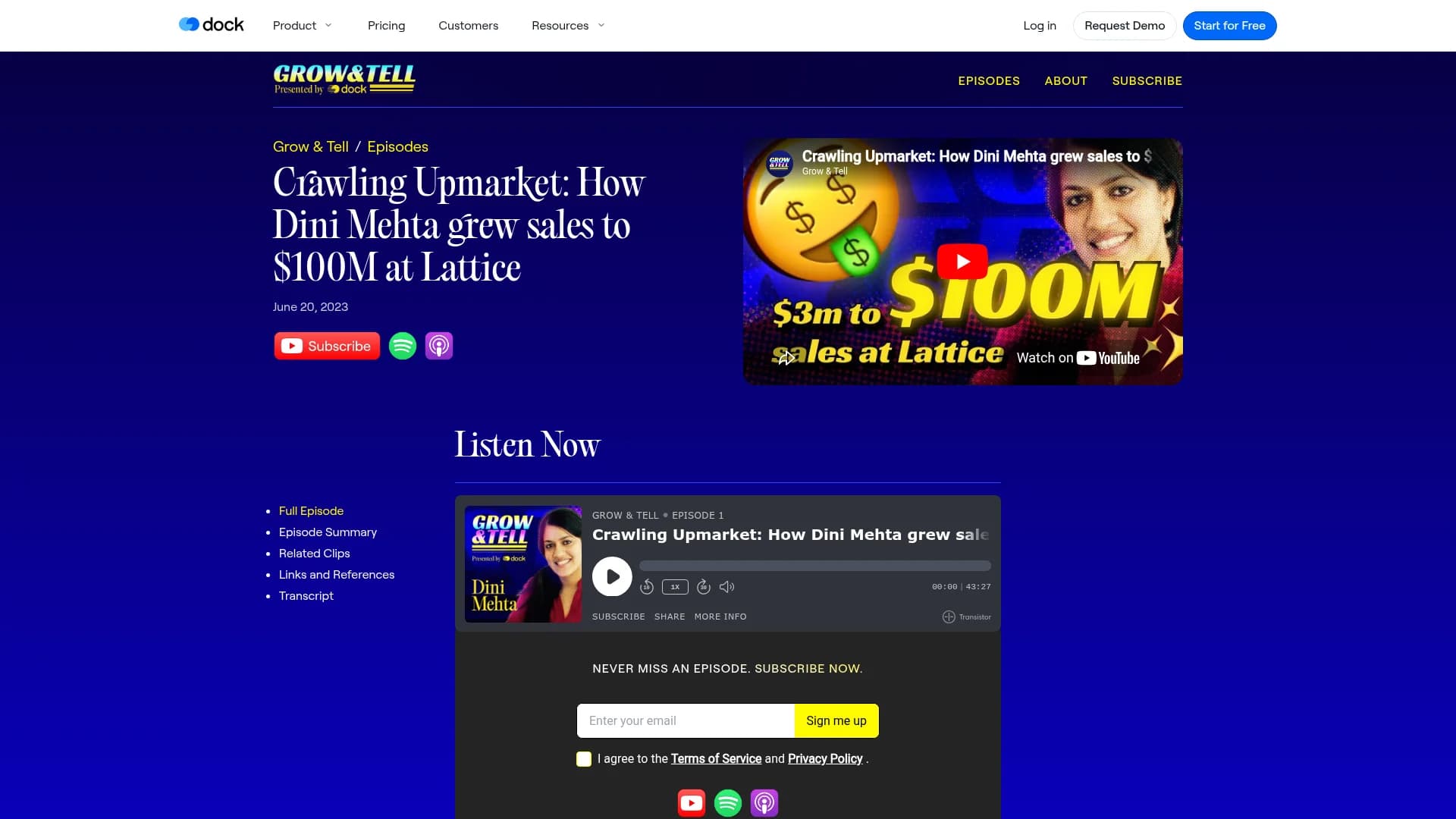
Long-form interview episodes and clip-format videos with revenue, sales, customer success, enablement, marketing, and founder voices from Notion, Gong, Lattice, Loom, Flexport, and Shopify. Structurally distinct from written content: 96% Podcast / Audio Series, with the remaining 4% short companion editorial posts. The cluster is by far the largest content asset in Dock's library, alone holding more than four out of every ten pages on the site.
Content-type mix: Podcast / Audio Series 96.1% · Blog / Editorial 3.9%
Micro-topics within this cluster
Full Episodes & Flagship Conversations (~75 Pages)
The numbered episode spine of the show: roughly 50 long-form interviews plus the named flagship conversations around them. Each episode sits at its own slug under /grow-and-tell/ep-N-guest, which makes the series individually rankable rather than buried in a single feed page. Anchoring Episode 1 with Dini Mehta on "Crawling Upmarket" reads like a deliberate positioning choice: a recognizable Lattice growth story matches Dock's own customer roster.
Sample pages:
- Crawling Upmarket: How Dini Mehta grew sales to $100M at Lattice | Grow & Tell
/grow-and-tell/ep-1-dini-mehta - Selling to Engineers: Ben Solari on leading sales at DataRobot & Jellyfish | Grow & Tell
/grow-and-tell/ep-10-ben-solari - Brand Campaigns: Maya Spivak's marketing campaigns at Wealthfront & Segment | Grow & Tell
/grow-and-tell/ep-11-maya-spivak - Customer Experience Teams: Gillian Heltai on building Lattice's CX program | Grow & Tell
/grow-and-tell/ep-12-gillian-heltai
Sales Leadership & Career Stories (~119 Pages)
The largest sales-side editorial theme inside the podcast by URL count. Clips and full episodes cover how guests became sales leaders, how they hire and coach reps, IC-to-management transitions, and the cultural decisions that scale teams. Treating each clip as its own indexable page is the mechanic that makes the URL count this large. The framing is practitioner-to-practitioner, fitting Dock's positioning as a tool built by people who have done revenue jobs themselves.
Sample pages:
- 2 Crucial Skills Today's Sales Teams Are Missing | Grow & Tell
/grow-and-tell/2-crucial-skills-todays-sales-teams-are-missing - Advice for First-Time VPs of Sales | Grow & Tell
/grow-and-tell/advice-for-first-time-vps-of-sales - AI in the Legal Industry | Grow & Tell
/grow-and-tell/ai-in-the-legal-industry - Building a Remote Sales Culture | Grow & Tell
/grow-and-tell/building-a-remote-sales-culture
GTM, Enablement & Product Marketing (~87 Pages)
Episodes on building enablement programs, sales content management, training, certifications, and onboarding sellers, plus clips on go-to-market motions (PLG, ABM, inbound, outbound, founder-led, moving upmarket) and product marketing operations (positioning, messaging, pricing, launches). The lineup pulls in named voices like Lish Barber, Trafford Judd, and Sheevaun Thatcher on enablement alongside Derek Osgood, Peep Laja, Chris Orlob, and Alex Kracov on PMM. The volume signals that Dock treats GTM and enablement as a single conversation rather than separating them, the same way the product itself blends sales enablement with deal-room workflows.
Sample pages:
- Characteristics of Successful Enablement People | Grow & Tell
/grow-and-tell/characteristics-of-successful-enablement-people - How Flexport Moved Upmarket | Grow & Tell
/grow-and-tell/how-flexport-moved-upmarket - How LaunchDarkly Sold to CFOs | Grow & Tell
/grow-and-tell/how-launchdarkly-sold-to-cfos - Gong's Early Marketing Strategy | Grow & Tell
/grow-and-tell/gongs-early-marketing-strategy
Customer Success, Brand & Marketing (~134 Pages)
The largest single micro-topic in the podcast, combining episodes on CS team building, segmentation, renewals, churn, and onboarding (Brittany Soinski, Monica Perez, Gillian Heltai, Joseph Schmitt) with marketing leadership clips on brand campaigns, content marketing, podcasts, billboards, and community-led growth (Casey Armstrong, Camille Ricketts, Maya Spivak, Devin Bramhall, Nico Dato). The pairing is what gives the show its breadth: a sales-enablement vendor whose podcast also reaches CS leaders and marketing leaders extends well beyond the immediate buyer persona. The Loom onboarding clip doubles as a referenced customer in the first-party case-study library.
Sample pages:
- #1 Loom Tip from Loom's Onboarding Lead | Grow & Tell
/grow-and-tell/1-loom-tip-from-looms-onboarding-lead - 3Xing Revenue at a Content Agency | Grow & Tell
/grow-and-tell/3xing-revenue-at-a-content-agency - AI for Customer Success | Grow & Tell
/grow-and-tell/ai-for-customer-success - Animalz's Agency Marketing Tactics | Grow & Tell
/grow-and-tell/animalzs-agency-marketing-tactics
Founders, RevOps & Show Snippets (~118 Pages)
Founder-led sales clips, early-stage startup advice, RevOps and data-driven selling episodes, and shorter clips that span personal advice and industry takes. Pete Kazanjy, Todd Busler, Alexa Grabell, Don Otvos, Jen Igartua, and Justin Driesse anchor the founder and RevOps voices. The clip-format chunk of this micro-topic is the most TOF-aligned content in the podcast: founder and operator advice travels well across LinkedIn and Twitter algorithms, which puts the show in front of audiences that overlap with Dock's own ICP of early-stage GTM teams.
Sample pages:
- A Simple LinkedIn Networking Trick | Grow & Tell
/grow-and-tell/a-simple-linkedin-networking-trick - Advice for Aspiring CMOs | Grow & Tell
/grow-and-tell/advice-for-aspiring-cmos - AI for Sales Metrics with Atrium | Grow & Tell
/grow-and-tell/ai-for-sales-metrics-with-atrium - Are Point Solutions Dying? | Grow & Tell
/grow-and-tell/are-point-solutions-dying
Strategy insight: Grow & Tell is the largest single asset in Dock's library and a multi-year compounding investment no competitor can replicate quickly. The cluster's 533 URLs combine an interview show with a credibility-transfer mechanism: revenue, sales, CS, and marketing leaders from named SaaS companies become brand-aligned guests by the time their episode publishes. Breaking individual clips out as their own URLs (rather than burying them inside episode pages) is what makes the cluster this large and gives the podcast its scaled SEO presence. For competitors trying to displace Dock here, the moat is the relationship base, not the URL count.
2. Revenue Archives: Visual & Interactive Collateral
Pages: 144 · Share of library: 12.0%
The visual and interactive half of the Revenue Archives library: battlecards, one-pagers, calculators, sales decks, and product demo videos curated from third-party companies and organized by asset type. The cluster is 100% Guides & Resources because each example page presents the external collateral inside Dock's branded environment with editorial framing. Split from its written-collateral sibling cluster to keep each half at a size where the analysis can resolve individual asset categories.
Content-type mix: Guides & Resources 100%
Micro-topics within this cluster
Battlecards & Competitive Examples (~25 Pages)
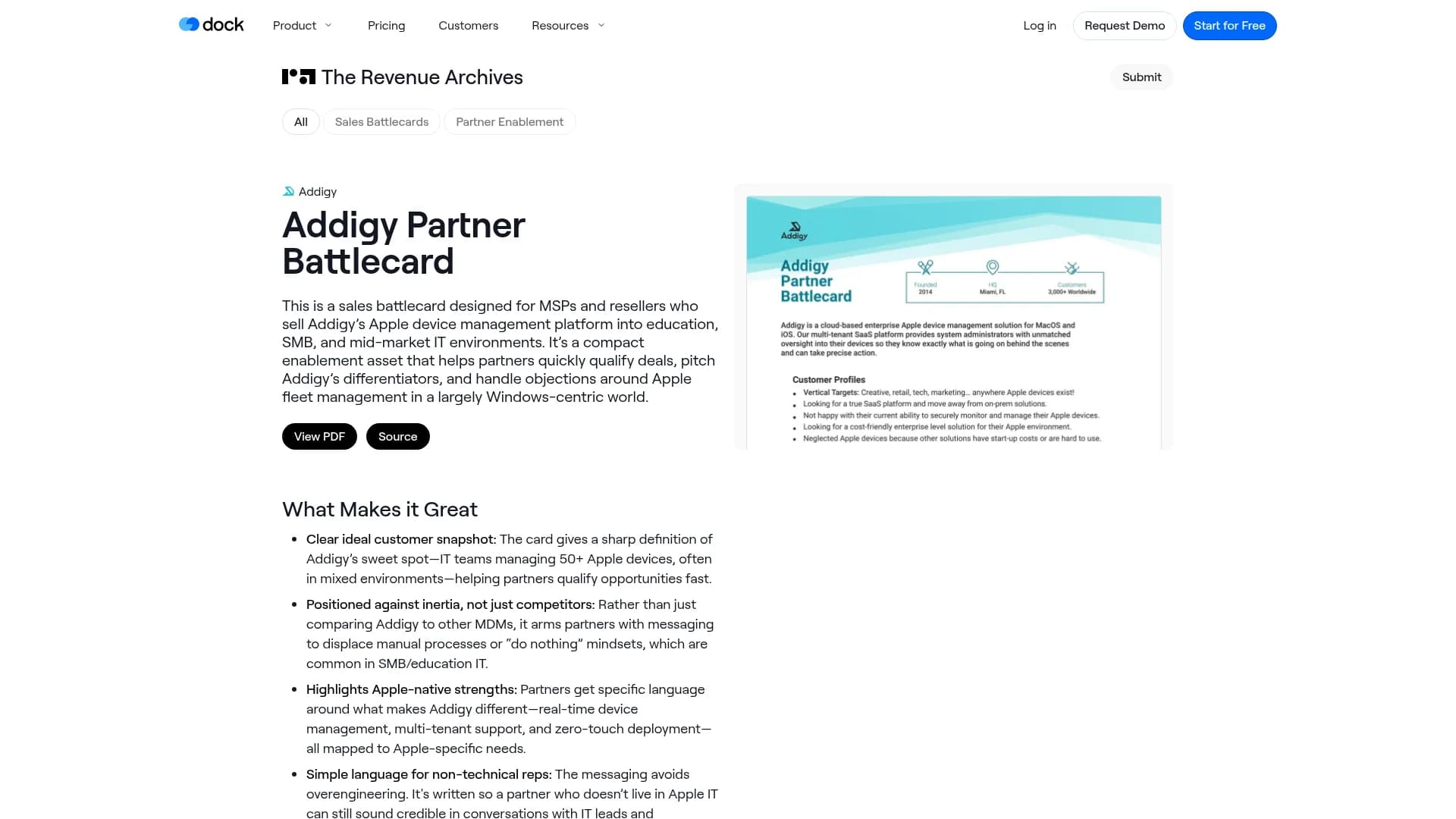
Sales, competitive, and partner battlecards from AWS, DocuSign, Salesforce, and Lenovo, indexed under /revenue-archives/battlecards. The asset format is rep-facing, but the library pages target enablement leaders evaluating how other companies structure their competitive content. Hosting examples from named enterprise vendors (Salesforce in particular) is a credibility play: the implicit message is that Dock has visibility into how category leaders build their internal sales arsenal.
Sample pages:
- Addigy Partner Battlecard | Revenue Archives
/revenue-archives-asset/addigy-partner-battlecard - ATTO 360 Partner Battlecard | Revenue Archives
/revenue-archives-asset/atto-360-partner-battlecard - AWS Battlecard | Revenue Archives
/revenue-archives-asset/aws-battlecard - Broadvoice Battlecard | Revenue Archives
/revenue-archives-asset/broadvoice-battlecard-
One-Pagers & Sell Sheets (~29 Pages)
Single-page collateral examples from 1Password, 6sense, ActivePipe, AgentSync, and others, indexed at /revenue-archives/one-pagers. One-pagers are a high-volume request in real sales-enablement work, so a 29-URL example library aimed at "what does a good one-pager look like" search intent maps directly to how enablement managers actually spend their time. The asset type has natural overlap with Dock's product (Dock workspaces present one-pager-style summaries), making this micro-topic both editorial discovery and soft product positioning.
Sample pages:
- 1Password Culture of Security One-Pager | Revenue Archives
/revenue-archives-asset/1password-culture-of-security-one-pager - 6sense One-Pager | Revenue Archives
/revenue-archives-asset/6sense-one-pager - ActivePipe One-Pager | Revenue Archives
/revenue-archives-asset/activepipe-one-pager - AgentSync One-Pager | Revenue Archives
/revenue-archives-asset/agentsync-one-pager
Calculators & Diagnostic Tools (~42 Pages)
ROI calculators, pricing calculators, pricing-comparison calculators, and diagnostic and assessment tools, covered by /revenue-archives/calculators, /roi-calculators, /pricing-calculators, and /diagnostic-tools. At 42 URLs this is the largest micro-topic in the cluster, a deliberate bet on a format with high evaluation-stage search intent. Someone searching for "saas roi calculator examples" is typically building one themselves, often for a deal Dock would be inside.
Sample pages:
- Alloy Embedded ROI Calculator | Revenue Archives
/revenue-archives-asset/alloy-embedded-roi-calculator - Atlassian Pricing Calculator | Revenue Archives
/revenue-archives-asset/atlassian-pricing-calculator - Blameless ROI Calculator | Revenue Archives
/revenue-archives-asset/blameless-roi-calculator - Circle Community ROI Calculator | Revenue Archives
/revenue-archives-asset/circle-community-roi-calculator
Sales Decks (~20 Pages)
Full-length sales decks from Asana, Canva, Folk, Linear, Pocus, Snapchat, Zuora, and Spendesk, indexed at /revenue-archives/sales-decks. Sales-deck examples are one of the highest-volume "show me what good looks like" categories in B2B, and the recognizable named decks here form a discovery surface that pulls in enablement, PMM, and sales-leader audiences. Breadth of company stages (Series B SaaS through public companies) makes the library defensible against narrower aggregators.
Sample pages:
- Asana Sales Deck | Revenue Archives
/revenue-archives-asset/asana-sales-deck - Canva Enterprise Sales Deck | Revenue Archives
/revenue-archives-asset/canva-enterprise-sales-deck - ChartMogul Sales Deck | Revenue Archives
/revenue-archives-asset/chartmogul-sales-deck - Chatlayer Sales Deck | Revenue Archives
/revenue-archives-asset/chatlayer-sales-deck
Product Demos & Explainer Videos (~28 Pages)
Product demo videos and product explainer videos from Airtable, Amplitude, and Atlassian, indexed at /demo-videos and /product-explainer-videos. Video collateral is harder to aggregate than written examples (each needs hosting or embed handling), so a 28-URL video micro-topic is the cluster's clearest "we did the work" signal. Demo-video benchmark searches typically come from PMM teams preparing their own demos, an audience that intersects with the Customer Success, Brand & Marketing micro-topic in the Grow & Tell cluster.
Sample pages:
- Airtable AI Demo Video | Revenue Archives
/revenue-archives-asset/airtable-ai-demo-video - Airtable Product Explainer Video | Revenue Archives
/revenue-archives-asset/airtable-product-explainer-video - Amplitude Product Explainer Video | Revenue Archives
/revenue-archives-asset/amplitude-product-explainer-video - Atlassian Product Explainer Video | Revenue Archives
/revenue-archives-asset/atlassian-product-explainer-video
Strategy insight: The visual half of the Revenue Archives gives Dock the rare position of being the index for how other companies build short-form, presentation-style sales collateral. The five micro-topics align almost perfectly with the asset formats enablement teams produce most often, and the curated examples convert TOF search demand into discovery of Dock's adjacent product surface. The cluster's most strategic micro-topic is Calculators & Diagnostic Tools (42 URLs): calculator examples carry the highest evaluation-stage intent of any collateral type, and Dock owns one of the cleaner aggregated libraries on the web for them.
3. Revenue Archives: Written & Customer Enablement Collateral
Pages: 114 · Share of library: 9.5%
The written and customer-facing half of the Revenue Archives library: case studies, video testimonials, datasheets, whitepapers, research reports, buyer and customer enablement assets, and partner and CS collateral curated from third-party companies. Like its sibling cluster, this is 100% Guides & Resources because Dock wraps every external asset in editorial framing inside its own /revenue-archives-asset/ environment.
Content-type mix: Guides & Resources 100%
Micro-topics within this cluster
Case Studies & Testimonial Videos (~22 Pages)
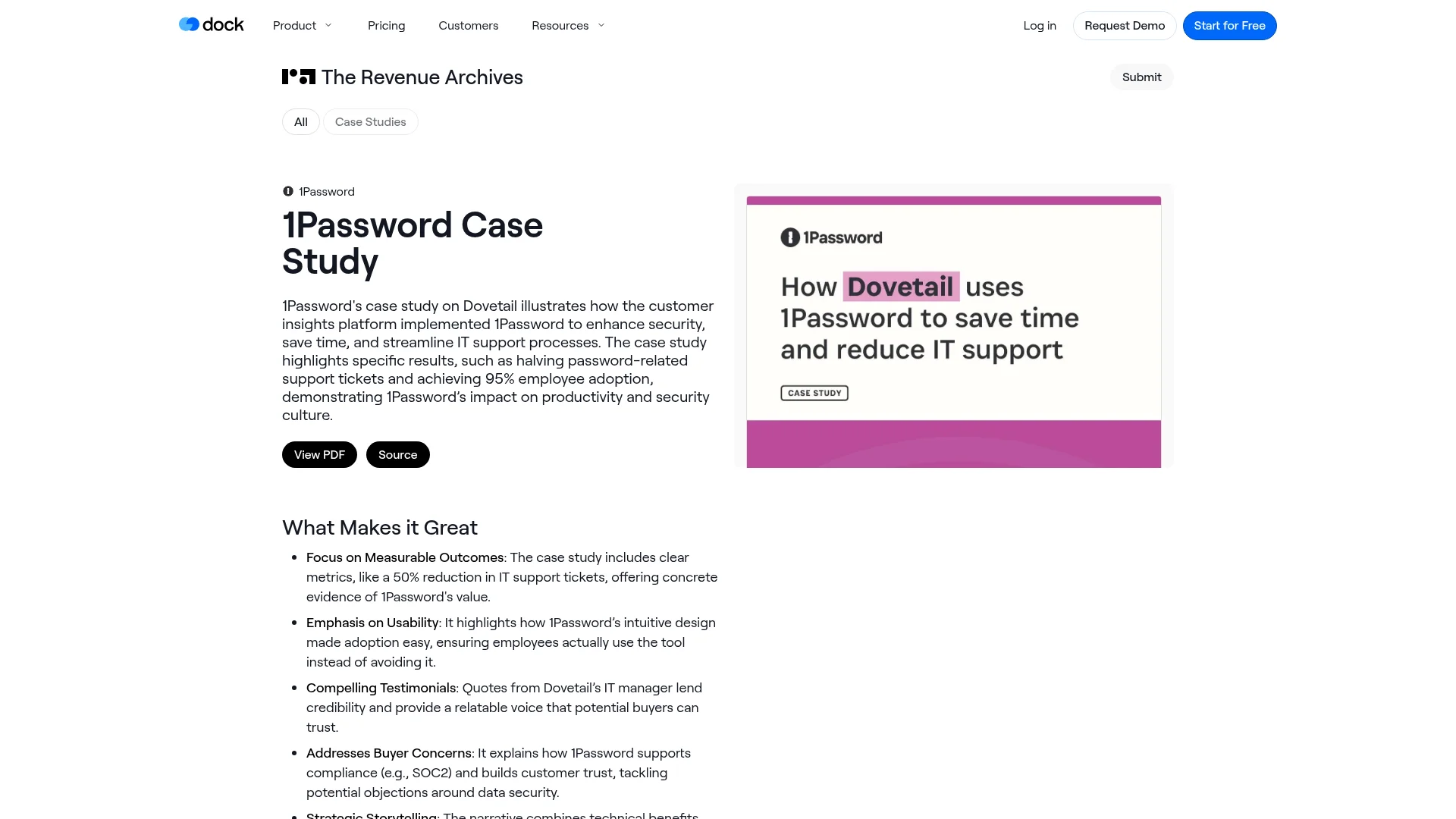
Customer case studies and video testimonials used as proof points, combining /revenue-archives/case-studies and /testimonial-videos. Two formats sit in one micro-topic because they serve the same sales-motion purpose: customer-validated proof at the bottom of the funnel. Hosting third-party examples lets Dock discuss customer-story construction in editorial form without needing to over-invest in its own case-study library, where it has only 14 first-party stories.
Sample pages:
- 1Password Case Study | Revenue Archives
/revenue-archives-asset/1password-case-study - 1Password Video Case Study | Revenue Archives
/revenue-archives-asset/1password-video-case-study - Alloy Case Study | Revenue Archives
/revenue-archives-asset/alloy-case-study - Amplitude Video Case Study | Revenue Archives
/revenue-archives-asset/amplitude-video-case-study
Datasheets, Whitepapers & Research Reports (~46 Pages)
Long-form written collateral grouped by evidence and depth role, covered by /datasheets, /research-reports, /roi-reports, and /whitepapers. The largest written-collateral micro-topic in the cluster, reflecting how often enablement teams reuse these formats. A datasheet-template request is a recurring inbound for any enablement leader, and 46 examples serve as a reference library for that workflow. The cluster's most utilitarian micro-topic, giving repeat visitors a reason to return.
Sample pages:
- 1Password Data Breach Whitepaper | Revenue Archives
/revenue-archives-asset/1password-data-breach-whitepaper - 1Password Economic Impact Study | Revenue Archives
/revenue-archives-asset/1password-economic-impact-study - 1Password Enterprise Datasheet | Revenue Archives
/revenue-archives-asset/1password-enterprise-datasheet - 1Password Passwordless Future Research Report | Revenue Archives
/revenue-archives-asset/1password-passwordless-future-research-report
Buyer & Customer Enablement Assets (~23 Pages)
Buying checklists, buyer enablement examples, customer enablement collateral, and onboarding assets, indexed under /buyer-enablement, /buying-checklists, /customer-enablement, and /onboarding. The most direct product alignment in the cluster. Dock's positioning explicitly includes buyer enablement and customer onboarding, and the third-party examples here show the artifacts the Dock workspace is designed to host. The dual role is unusual: each library page is editorial reference and implicit product demo at once.
Sample pages:
- 1Password Access Management Buyer's Checklist | Revenue Archives
/revenue-archives-asset/1password-access-management-buyers-checklist - 1Password Password Management Buyer's Checklist | Revenue Archives
/revenue-archives-asset/1password-password-management-buyers-checklist - Amplitude Product Demo Video | Revenue Archives
/revenue-archives-asset/amplitude-product-demo-video - Appian Enterprise Buyer's Checklist | Revenue Archives
/revenue-archives-asset/appian-enterprise-buyers-checklist
Partner & Customer Success Collateral (~23 Pages)
Partner enablement guides, partner battlecards, customer success program pages, SLAs, and trust-center assets, combining /partner-enablement, /customer-success, and /security-trust. Partner and CS collateral are commonly underserved on competitor sites because they sit between sales and ops. A 23-URL micro-topic dedicated to them gives Dock differentiation in a topic mature competitors have not consolidated.
Sample pages:
- Agentforce Partner Guidebook | Revenue Archives
/revenue-archives-asset/agentforce-partner-guidebook - Asana Customer Success Offerings Page | Revenue Archives
/revenue-archives-asset/asana-customer-success-offerings-page - ClickUp Partner Program One-Pager | Revenue Archives
/revenue-archives-asset/clickup-partner-program-one-pager - Databricks Support Policy Page | Revenue Archives
/revenue-archives-asset/databricks-support-policy-page
Strategy insight: The written half of the Revenue Archives is where Dock's editorial bet looks most counter-intuitive for a Series A challenger. Hosting 46 examples of other companies' datasheets and research reports has no obvious near-term commercial mechanic, but it gives the franchise long-tail durability: searches like "saas whitepaper examples" and "B2B research report examples" pull buyers into Dock's environment at a research stage that precedes evaluation by months. Combined with its sibling visual-collateral cluster, the 258-URL Revenue Archives is structurally hard to replicate because the value is the curation, not the underlying assets, and the curation itself takes years of editorial work to assemble.
4. Sales, Buyer & CS Editorial Library
Pages: 169 · Share of library: 14.0%
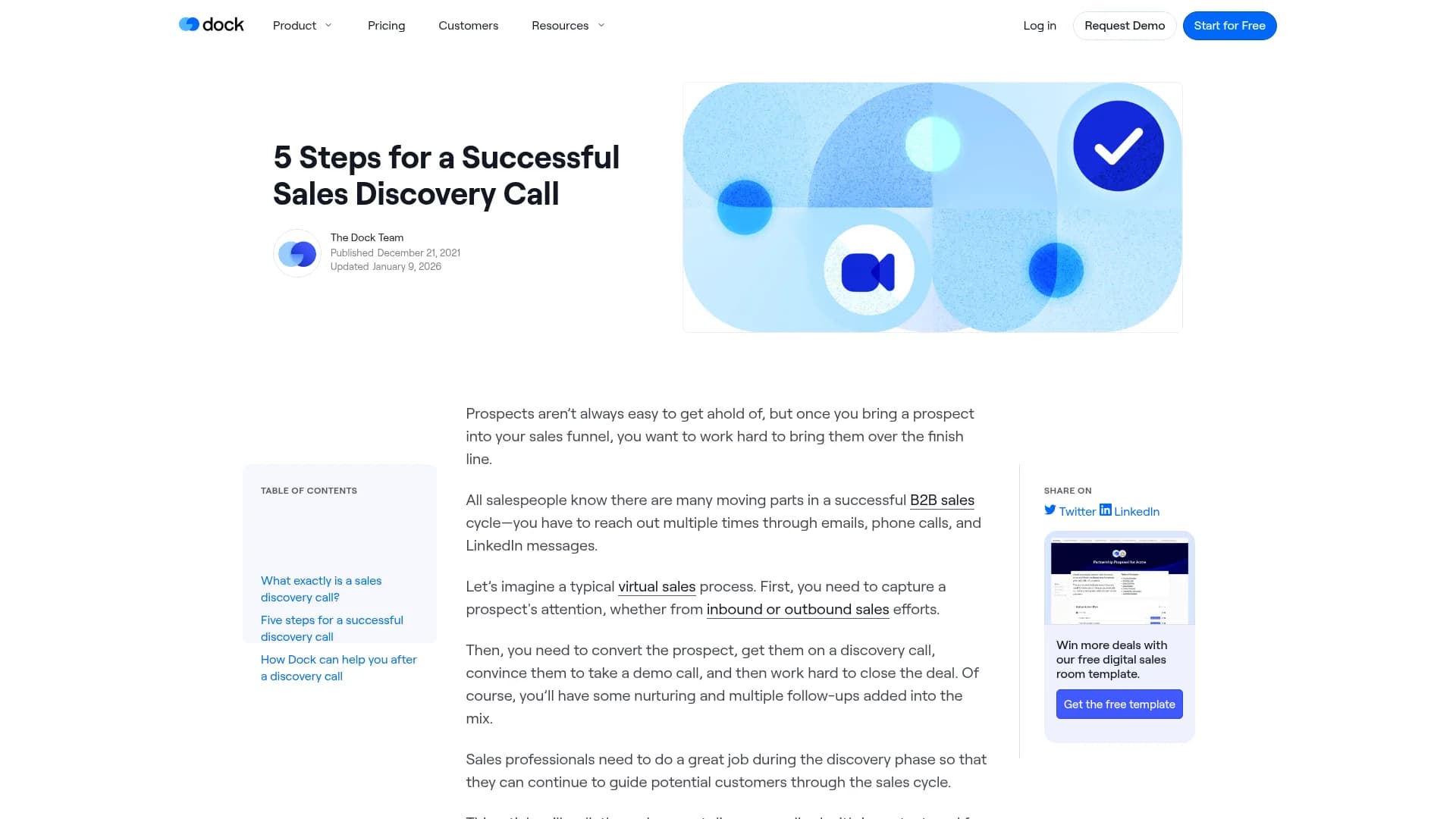
Editorial guides, definitional "what is" pages, comparison-roundup adjacent posts, and how-to articles covering the B2B sales cycle, sales enablement, buyer enablement, deal mechanics, sales tools, methodologies, customer onboarding, customer success operations, and CS metrics. The closest analog Dock has to a traditional sales-enablement blog and the SEO/AEO workhorse of the library. Sales-side and CS-side editorial sit in one cluster because each individually would land below the size threshold needed to support its own cluster.
Content-type mix: Blog / Editorial 89.4% · Glossary / Definitions 7.1% · Comparison Pages 3.6%
Micro-topics within this cluster
Sales Process & Deal Execution (~38 Pages)
The largest tactical micro-topic in the cluster, covering discovery calls, close plans, sales cycle stages, sales follow-up, multithreading, deal management, and sales velocity. How-to content aimed at reps and frontline sales managers rather than enablement leaders, which makes it the cluster's long-tail SEO floor. The volume here is what gives the editorial cluster its rankings shape: ranking-position counts in 11-20 and 21-50 are dominated by long-tail tactical queries that map to this content.
Sample pages:
- 5 Steps for a Successful Sales Discovery Call
/library/5-steps-for-a-successful-discovery-call - Account-Based Sales: Tips & tools for scaling ABS
/library/account-based-sales - What is sales account mapping? Tools & tips for getting it right
/library/account-mapping - The 6 Types of B2B Buyers (and how to sell to them)
/library/b2b-buyer-types
Sales Enablement, Methodology & Collateral (~31 Pages)
Dock's head-term pillar pages on Sales Enablement, Revenue Enablement, AI Revenue Enablement, AI-Guided Selling, and GTM Enablement, alongside methodology explainers (MEDDIC, Sandler, value-based selling, solution selling, consensus sales) and editorial roundups of sales-collateral examples that sit alongside the deeper Revenue Archives library. The vocabulary choices are notable: Dock leans on "revenue enablement" and "AI revenue enablement" in pillar titles where larger peers still use "sales enablement," matching the category-renaming move Dock has been pushing across its product positioning.
Sample pages:
- What is AI-guided selling? A guide for enablement leaders
/library/ai-guided-selling - What is AI Revenue Enablement? The complete guide
/library/ai-revenue-enablement - Asynchronous Sales Guide: Sell more by meeting less
/library/asynchronous-sales - Consensus Sales: 9 tips for building buying consensus
/library/consensus-sales
Buyer Enablement, Pricing & Leadership (~52 Pages)
The largest micro-topic in the cluster and its strategic core. Combines buyer enablement guides, buyer journey and decision-maker explainers, sales leadership advice, hiring and team building, pricing strategy across SaaS and channel motions, and proposal and quote-to-cash content. Buyer enablement is the topic Dock arguably has the strongest commercial right to own as a digital-sales-room vendor: the asset class exists because of the modern buying committee, and Dock's product is one of the primary ways teams operationalize the workflow. Pricing and proposals sit in the same micro-topic because each editorial guide doubles as soft product positioning for Dock's Order Forms, Pricing Quotes, and Proposals surfaces.
Sample pages:
- The B2B buyer journey has changed. Have you?
/library/b2b-buyer-journey - Happy Paths: How to design the ideal B2B buying process
/library/b2b-buying-process - 5 types of B2B decision makers (& how to sell to each one)
/library/b2b-decision-makers - How to empower your buyer champion (to win you the sale)
/library/buyer-champions
Customer Onboarding & Success (~48 Pages)
Editorial guides on SaaS customer onboarding, CS programs, renewals, expansion, churn, change management, CS metrics, and CS tooling. Bundled into one micro-topic because the individual sub-themes (onboarding playbooks, retention, QBR cadence, implementation) each share a single CS-leader audience. The strongest commercial overlap is the onboarding playbook content, which maps directly to workflows Dock's client portal and action plan surfaces support. The retention-focused content (renewals, churn, NRR) targets the searches that convert most reliably: someone reading about how to calculate renewal rates is by definition a CS leader trying to improve their own.
Sample pages:
- AI for Customer Onboarding: 6 real ways teams are using it
/library/ai-for-customer-onboarding - AI for Customer Success: 7 tools that actually deliver value
/library/ai-for-customer-success - Asynchronous Customer Onboarding: A guide for CS leaders
/library/asynchronous-customer-onboarding - How to identify churn risk (and save at-risk customers)
/library/at-risk-customers
Strategy insight: This is Dock's most SEO-deliberate cluster, competing most directly with category leaders for written-form search demand across both sales and CS topics. The structure mirrors what mature sales-enablement libraries do (pillar pages, tactical how-to, methodology explainers, retention content), but at 169 URLs the cluster is meaningfully smaller than peer editorial libraries. The trade-off is intentional: Dock has accepted a smaller written-library footprint in exchange for editorial volume going into Grow & Tell and the Revenue Archives. The pillar coverage on "AI revenue enablement" and "GTM enablement" is the bet that category-renaming language now pays off as the vocabulary takes hold, and the CS-side micro-topic gives the same library a second audience without spinning up a parallel section.
5. Dock Releases, Templates & Customer Stories
Pages: 136 · Share of library: 11.3%
Dock's first-party product surface: release notes and "New in Dock" posts, quarterly digest roundups, fundraising and brand milestone announcements, free downloadable templates across sales, CS, agency, and proposal use cases, and the named-customer story library covering Lattice, Loom, BrightHire, and others. Grouped into one cluster because release notes, templates, and customer stories share a single audience: people already evaluating or using Dock.
Content-type mix: Blog / Editorial 47.1% · Free Tools 39.7% · Case Studies / Customer Stories 9.6% · Other 3.7%
Micro-topics within this cluster
Product Release Notes & AI Updates (~47 Pages)
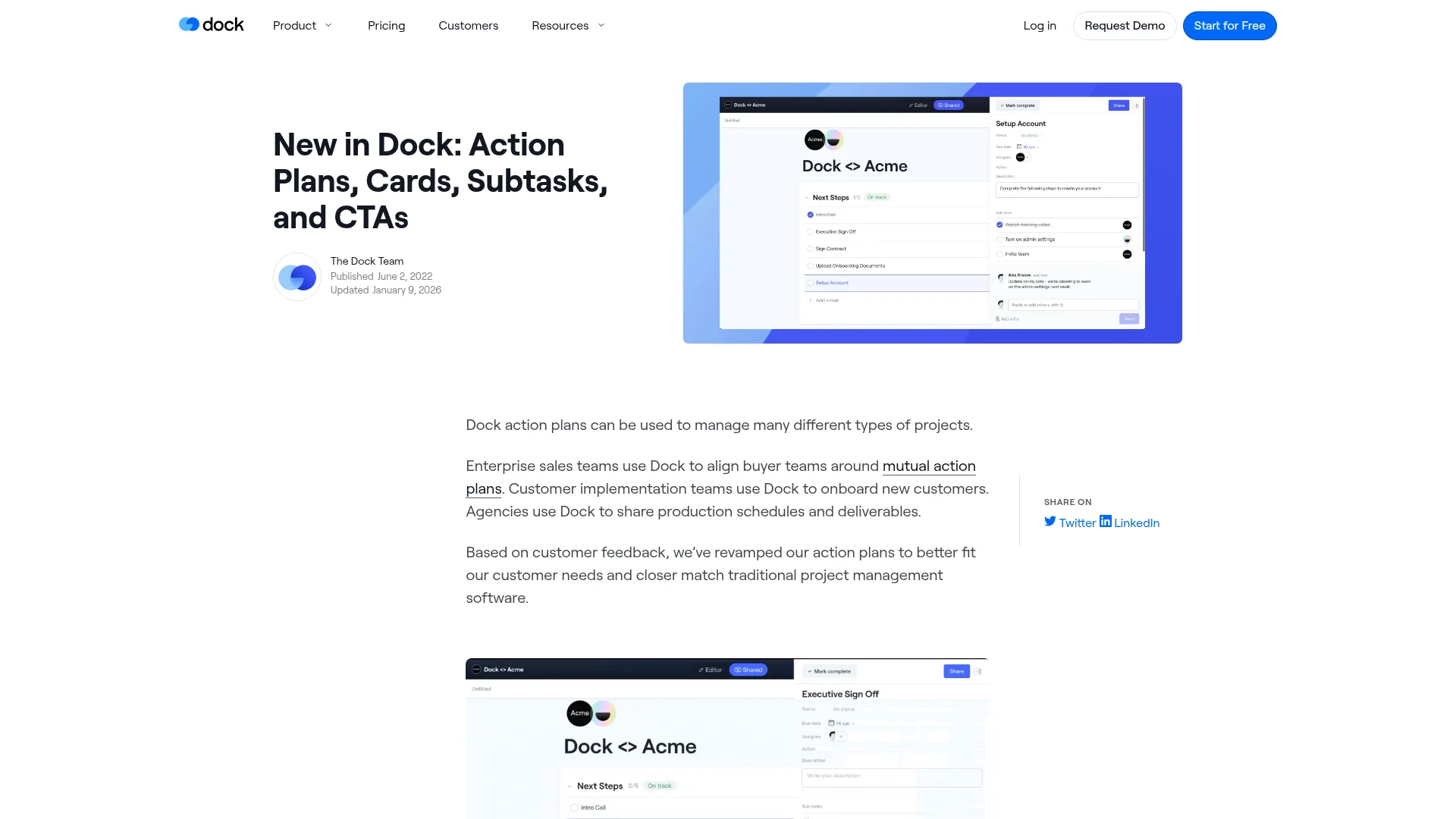
Posts announcing significant new features (Action Plans, Order Forms 2.0, Pricing Quotes, Global Task Management), AI and automation updates (Dock AI, AI Documents, AI Suggestions, AI Enablement Agent), integration releases (Salesforce, HubSpot, Gong, Slack, API and webhooks), and workspace and content management updates, all under the "New in Dock" prefix. Treating each launch as its own post (versus burying it inside a quarterly digest) gives each release its own SEO surface for feature-name searches and makes the product log itself a discoverable signal for buyers evaluating release cadence. The AI-focused stream within the micro-topic is the most strategically loaded sub-flow: each release adds another keyword surface to a topic where the category is still settling on terminology.
Sample pages:
- New in Dock: Action Plans, Cards, Subtasks, and CTAs
/library/action-plan-update-cards-subtasks-and-ctas - New in Dock: AI Documents
/library/ai-documents - New in Dock: AI Enablement Agent
/library/ai-enablement-agent - New in Dock: AI Suggestions
/library/ai-suggestions
Quarterly Roundups & Company Milestones (~17 Pages)
Quarterly "Little Things You'll Love" digests covering many small updates at once, plus brand and positioning launches ("Meet Dock", "It's Time for Revenue Enablement"), fundraising announcements, and Dock-the-business posts. A recurring named format with a predictable cadence, signaling to readers (and LinkedIn audiences where these get reshared) that Dock is shipping continuously. The "It's Time for Revenue Enablement" post is the company explicitly arguing for the category shift its editorial pillar pages assume. The $3.5M Craft Ventures fundraising post is the cluster's canonical citation for Dock's funding history.
Sample pages:
- The Business Impact of Dock
/library/business-impact-of-dock - Dock raises $3.5m from Craft Ventures
/library/craft-ventures-fundraising-announcement - 10 ways to keep buyers coming back to your Dock deal rooms
/library/dock-engagement-tips - How Dock Makes Sharing Workspaces Frictionless and Secure
/library/how-dock-makes-sharing-workspaces-frictionless-and-secure
Sales Workflow Templates (~21 Pages)
Free templates for sales rooms, proposals, action plans, close plans, order forms, demo follow-ups, and other sales deliverables. The largest template sub-group in the cluster and the most directly tied to Dock's sales-room positioning. Each template works as both a free-tool lead magnet and a low-friction product preview: the template lives inside Dock's workspace, so trying one means experiencing the product.
Sample pages:
- B2B Sales Template | Get our free sales room template
/templates/b2b-sales - Business Case Template | Free sales business case template
/templates/business-case - Demo Follow-Up Template | Get the free template
/templates/demo-follow-up - Digital Sales Room Template | Free Dock template
/templates/digital-sales-room
CS, Agency & Proposal Templates (~38 Pages)
Templates for onboarding, QBR and EBR, success plans, kickoff calls, renewal proposals, account management, agency engagements, branding and design proposals, change-order forms, and the template-category landing pages that organize them. The agency template sub-flow is the cluster's most informative architectural choice: Dock allocates meaningful free-tool inventory to an audience adjacent to its primary ICP (sales and CS teams), signaling a deliberate expansion bet into agencies running client portals that the editorial library has not yet matched in volume.
Sample pages:
- Account Management Template | Free account management plan
/templates/account-management - Brand Design Project Plan Template | Free template
/templates/brand-design-project - Branding Proposal Template | Get the free template
/templates/branding-proposal-template - Dock Agency Templates | Proposals, client portals & more
/template-category/agency
Dock Customer Stories (~13 Pages)
First-party Dock customer success stories from Lattice, Loom, Robin, Spotnana, BrightHire, Nectar, August, Champify, Marqii, Assignar, Assistantly, Merge, and Two Front. Split roughly evenly between sales-side outcomes (win-rate, sales cycle compression, deal-room outcomes) and CS-side outcomes (onboarding speedups, CS handoff, implementation). The Lattice headline ("How Lattice increased win rates by 25% with Dock AI") is the cluster's most quoted proof point, reused in product-page copy and pitch decks. The Loom story ("saves 2 hours onboarding each customer") and the Assistantly story ("saves 5 hours of customer follow-up") quantify CS-side ROI in time-saved terms, the easiest proof language for an onboarding-software buyer to verify against their own team.
Sample pages:
- How August sells to multiple buyer personas with Dock
/library/customer-story-august - How Champify empowers buyer champions with Dock
/library/customer-story-champify - How Lattice increased win rates by 25% with Dock AI
/library/customer-story-lattice - How Loom saves 2 hours onboarding each customer with Dock
/library/customer-story-loom
Strategy insight: This cluster is Dock's first-party proof and product-marketing surface in one place. 47 release-note posts is substantial for an 11-50 person company and signals release cadence to evaluators in a way no product page can. 54 free templates is one of the cluster's clearest commercial mechanics because each template lives inside the Dock workspace, so downloads function as both lead capture and product trial. The thinnest element of the cluster is the first-party customer story library at 13 URLs, which is appropriate volume for a Series A challenger but well below what category leaders like Highspot (338) and Seismic (267) carry. That gap is the cluster's most actionable content gap for the next two years of growth.
6. Product, Comparison & Company Pages
Pages: 107 · Share of library: 8.9%
The conversion-and-utility cluster of the library, holding bottom-of-funnel evaluation pages, comparison surfaces, navigational hubs, live events, and standard company and legal pages in one structural group. Five micro-topics carve up the cluster by job-to-be-done rather than by URL path.
Content-type mix: Comparison Pages 29.9% · Product & Feature Pages 28.0% · Other 27.1% · Events / Webinars / Sessions 12.1% · Podcast / Audio Series 1.9% · Case Studies 0.9%
Micro-topics within this cluster
Product, Solutions & Feature Pages (~26 Pages)
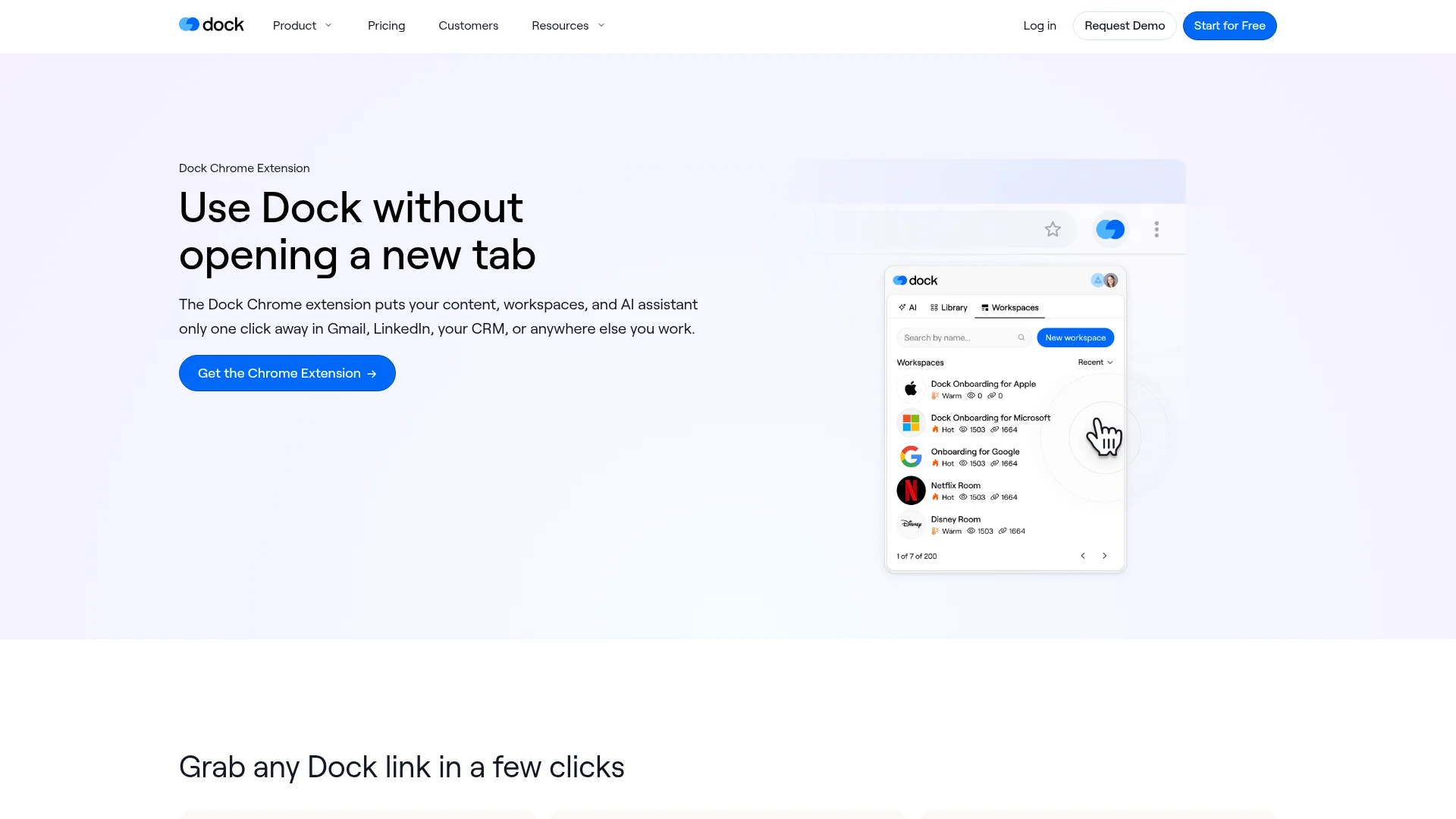
Top-level product pages under /product/* covering Dock AI, AI Enablement Agent, AI Documents, Content Management, Project Plans, Order Forms, Slides, LMS, Playbooks, and Integrations. Use-case landing pages under /solutions/* covering sales, onboarding, client portal, sales enablement, buyer enablement, white-label, and project management. Feature and integration pages under /features/* covering Salesforce, HubSpot, Slack, Teams, Mutual Action Plan, Security Profiles, and Chrome Extension. Three URL paths surface the same capabilities three different ways: by capability name, by job-to-be-done, and by integration partner.
Sample pages:
- Dock Google Chrome Extension | Get the enablement assistant
/features/chrome-extension - Dock HubSpot Integration | For Sales & Onboarding
/features/hubspot - Microsoft Teams
/features/microsoft-teams - Mutual Action Plan Software | Dock
/features/mutual-action-plan
Competitor Comparison & Roundup Pages (~32 Pages)
"Dock vs Competitor" pages under /compare/* targeting Highspot, Seismic, Showpad, PandaDoc, Qwilr, GetAccept, DealHub, GuideCX, and Rocketlane, combined with best-of listicle roundups under /library/* comparing tools across sales enablement software, presales tools, digital sales rooms, CRMs, CPQ, and buyer enablement categories. 32 URLs total inside this micro-topic, plus another 6 collateral-roundup posts elsewhere, bring Dock's full comparison page footprint to 38. A heavy investment for the company's size and a deliberate challenger move on both category-leader brand terms and category-level head terms.
Sample pages:
- Dock vs DealHub
/compare/dealhub - Dock vs Highspot
/compare/highspot - AI Sales Enablement Software Guide: 12 best tools compared
/library/ai-sales-enablement-software - The Best 7 Buyer Enablement Tools Compared (2026)
/library/buyer-enablement-tools
Events & Webinars (~13 Pages)
Dock Live webinars, event replays, and the events index page. 13 URLs at /events/* covering product walkthroughs, Dock AI introductions, content management, and customer lifecycle topics. Live product-led education aimed at trial users and recent customers, distinct from the podcast's top-of-funnel brand role.
Sample pages:
- Dock Events | Live Webinars & Event Replays
/events - Dock Live: How to manage sales content with Dock
/events/content-management-sep-24 - Dock for the Entire Customer Lifecycle | Dock Live Webinar
/events/customer-lifecycle-jun-25 - Getting started with Dock AI | Dock Live Webinar
/events/dock-ai-nov-25
Resource Hubs & Taxonomy Pages (~19 Pages)
The Revenue Lab index pages (/library, /category/*), Revenue Archives index, customer-stories index, product-updates index, and Grow & Tell index pages. 19 hub and index pages that organize Dock's editorial taxonomy and let a small library feel browsable. The Grow & Tell index page is the cluster's single most-linked URL, working as the front door to a 533-URL podcast that would otherwise be hard to navigate.
Sample pages:
- Dock Customer Stories | Case Studies, Testimonials & Reviews
/customers - Grow & Tell Show | Growth stories from revenue & enablement leaders
/grow-and-tell - Grow & Tell Show | Episodes
/grow-and-tell-episodes - The Revenue Lab by Dock | Resources for Revenue Leaders
/library
Homepage, Company & Legal (~17 Pages)
Marketing homepage, pricing page, demo signup, free-trial schedule, about-us, partners, security, ZoomVerify, GTM Golf Club community, and legal pages (terms, privacy, GDPR, cookies, privacy requests). Standard B2B SaaS footprint with one quirk: GTM Golf Club is a community property treated as part of the company surface, not the content-marketing surface. The homepage H1 ("AI Revenue Enablement that Sellers & Buyers Love") signals the category-renaming bet Dock makes across editorial and product positioning.
Sample pages:
- Dock | AI Revenue Enablement that Sellers & Buyers Love
/ - About Us
/about-us - Dock · Get a Demo
/demo - GTM Golf Club
/gtm-golf-club
Strategy insight: The Competitor Comparison & Roundup Pages micro-topic is the cluster's most strategically loaded element. 32 URLs of comparison content combine 10 head-to-head /compare/* pages aimed at category leaders (Highspot, Seismic, Showpad) and direct DSR competitors (PandaDoc, Qwilr, GetAccept) with 22 listicle roundups aimed at category-level evaluation queries. Combined with 6 collateral-roundup posts in the editorial cluster, Dock has 38 comparison pages in total. The competitor list is deliberately broad: enterprise sales-enablement leaders, direct digital-sales-room competitors, and adjacent onboarding tools. Dock is competing across category boundaries, not within one.
Key Observations
What Stands Out About Dock's Content Strategy
The library is franchise-led, not blog-led
Two content types account for 64.2% of every page Dock publishes: Podcast / Audio Series (42.7%) and Guides & Resources (21.4%). The Grow & Tell Podcast alone holds 533 URLs (44.3% of the library), and the two halves of the Revenue Archives collateral collection together add another 258 URLs (21.5%). A concentrated franchise structure, not the breadth play most Series A SaaS companies default to. Each franchise needs sustained editorial investment, but every new URL added strengthens the franchise's search surface in a way a one-off blog post does not. The architecture is more typical of media companies than SaaS marketing teams.
The Revenue Archives is an unusual category bet for a Series A challenger
258 URLs of curated third-party sales collateral (battlecards from AWS, sales decks from Asana and Canva, ROI calculators from Atlassian, one-pagers from 1Password and 6sense, datasheets and whitepapers across multiple vendors) gives Dock the position of being the index for how other companies do sales enablement. Splitting the library into a visual-collateral cluster (144 URLs) and a written-collateral cluster (114 URLs) keeps each half at a size where individual asset categories resolve clearly. The library is structurally hard to replicate because the value is the curation, not the underlying assets. For competitors trying to displace Dock on collateral-research search terms (sales deck examples, battlecard examples), the moat is the multi-year work of identifying, summarizing, and presenting third-party assets.
Per-URL traffic efficiency is the highest in the peer set
Dock's ~37 visits per page across 1,203 URLs leads the entire sales-enablement peer set, ahead of Trainual (34), Mindtickle (19), Seismic (19), Highspot (18), and Showpad (17). A smaller, more focused library working harder per page is the classic challenger pattern: every URL has to earn its place because the library cannot brute-force visibility through scale. The forward-looking risk is preservation. Scaling library size in the next 18-24 months without dropping below ~25 visits per page requires keeping the per-page bar where it currently sits.
The 17.4% top-10 share is the authority gap
Only 17.4% of Dock's 3,084 ranking positions sit in the top 10, meaningfully lower than category leader Highspot at 55.7% and below editorially mature peers like Showpad at 41.7%. The shape is consistent with a younger domain still building authority. The most actionable optimization slot is the 11-20 band, where Dock has 469 positions (15.2% of total), second-page content that focused work could move onto page 1. The 21-50 band holds another 1,222 positions, the deeper backlog of pages where targeted internal linking and content refreshes would compound over time.
There is no first-party research franchise
Zero URLs classified as Research / Reports. Peer sales-enablement libraries typically anchor an editorial cluster with an annual "State of Sales Enablement" or "GTM Performance Gap" report that recompounds backlink and reference equity year over year. Dock has the audience (Grow & Tell's named guests are exactly the practitioner pool a research report would survey) and the editorial cadence (Revenue Archives is built on consistent third-party-asset analysis), but the franchise itself has not been built. A first "State of Revenue Enablement" or "State of Digital Sales Rooms" report would be the lowest-effort additive franchise for the library.
Comparison-page investment is heavy for a company at Dock's stage
38 comparison pages, 3.2% of the library, is a substantial competitor-displacement footprint. The breakdown: 10 /compare/* head-to-head pages (Highspot, Seismic, Showpad, PandaDoc, Qwilr, GetAccept, DealHub, GuideCX, RevOps, Rocketlane), 22 "best of" listicle comparison roundups, and 6 collateral-roundup posts. The shape signals deliberate challenger positioning across category boundaries: enterprise sales enablement, direct digital sales rooms, and adjacent onboarding tools. The right strategic posture for a Series A challenger, though it requires ongoing maintenance to stay credible as competitor products change.
The /library URL prefix does multiple jobs at once
290 URLs share the /library prefix, spanning Blog / Editorial (236), Comparison Pages (28), Case Studies (13), Glossary / Definitions (12), and one Other page. Four different topic clusters map into /library because the path is functioning as a shared parent for several distinct sections rather than one dedicated section. Splitting into dedicated paths (/blog, /compare, /customers, /glossary) would sharpen search engines' understanding of section authority and make the library's internal architecture more legible. The cleanup would not require recreating content, only restructuring URL hierarchy.
First-party customer stories are the thinnest defensible surface
Case Studies / Customer Stories sits at 14 URLs (1.2% of library), enough to surface the format but well below the volume category leaders carry. Highspot has roughly 338 customer stories, Seismic has 267, both giving those companies a defensible search and AEO surface on named-customer queries Dock cannot currently compete in. At 11-50 employees Dock has the customer roster (Lattice, Loom, BrightHire, Postscript, Zip, Writer, plus the dozen-plus stories already published) to grow the section materially. The most actionable single content investment for the next year of library work.
More analyses in Sales Enablement
GTM Buddy
How GTM Buddy uses a 46-URL Revenue Activation manifesto and 79 blog posts to drive 500 monthly visits in sales enablement. 137 pages, 1 cluster.
Highspot
How Highspot uses 2,530 blog posts, a 208-episode podcast, and 338 case studies to drive 86K monthly visits in sales enablement. 4,752 pages, 7 clusters.
Mindtickle
How Mindtickle uses 457 blog posts and a 102-URL AI Role Play franchise to drive 15K monthly visits in sales enablement. 787 pages, 6 clusters.
SalesHood
How SalesHood uses 176 blog posts, 100 webinars, and a cross-format MEDDICC franchise to drive 3K monthly visits in sales enablement. 440 pages, 3 clusters.
Methodology: This analysis is based on Dock's full public sitemap (1,203 URLs, sourced from robots.txt), enriched with each URL's title and meta description. URLs were classified into a 12-bucket content type taxonomy and grouped into 6 topic clusters with 28 micro-topics using LLM-assisted classification. Company facts came from public web research across Crunchbase, LinkedIn, and the company's own About and blog pages. Traffic metrics (monthly organic visits, traffic value, ranking positions, position distribution) came from DataForSEO's domain rank overview, aggregated globally across 83 locale combinations. All counts reflect the Dock sitemap as of 2026-05-20.