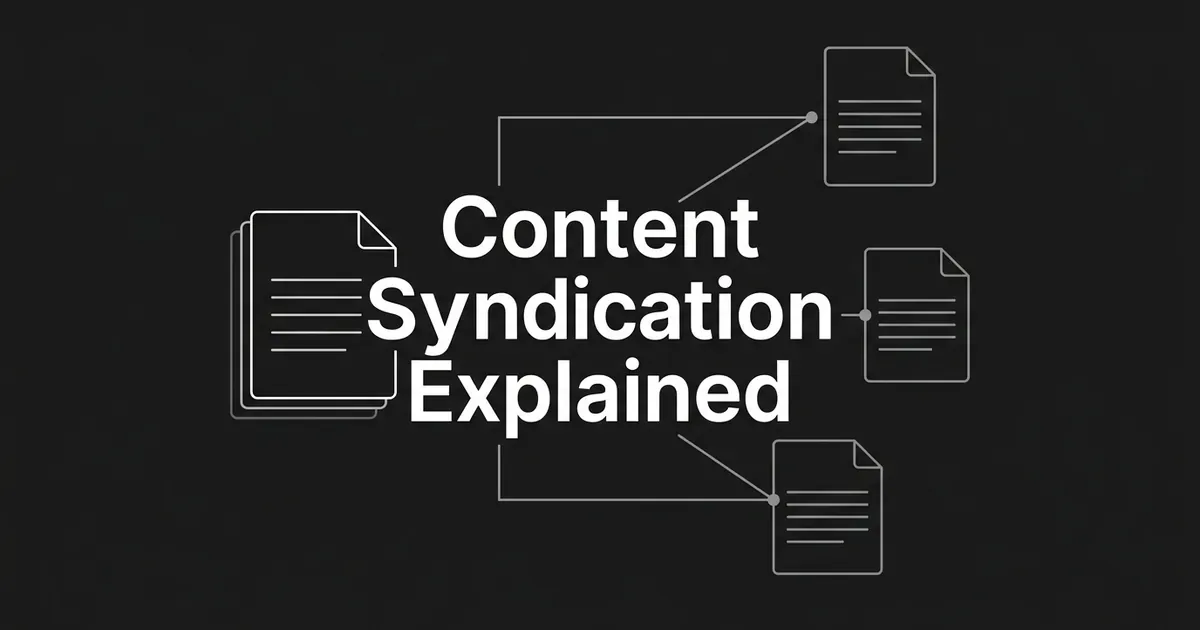
Content syndication is the authorized republication or distribution of an existing piece of content through another publisher or platform, so that its audience can find the work beyond its original home. If you're asking what is content syndication and whether it's the same as writing for another site, the short answer is no. Syndication starts with something you already have, and it lets that same work show up in front of a second audience.
A simple picture helps. Say a company publishes a research article on its own site, and an industry publication later carries that article, or a clearly credited excerpt of it, for its own readers. There is one existing work, a second place it's allowed to appear, and a second audience. That is the whole idea, and the rest of this guide fills in the parts around it. It's meant as content syndication explained in plain terms, so you have the content syndication basics straight before you decide whether to try it.
What is content syndication?
Content syndication is reuse and distribution of an existing asset, not the writing of a fresh piece for a new destination. That's the part that separates it from most of the other things people confuse it with.
There are four parties in a typical arrangement, and it's worth keeping them straight:
- The original creator or rights holder, who made the work or holds the rights to it.
- The receiving publisher or distribution partner, who makes the work available to its own people.
- The existing asset, which might be an article, a video, a report or something similar.
- The partner's audience, who get to see it.
Permission matters a great deal here. Syndication is authorized, which means the receiving side has the right to use the material. A credit line is a nice courtesy and it's common, but a credit line on its own doesn't give anyone permission to reproduce your work. That comes from the agreement or the usage rights behind it.
It's also worth knowing that the definition doesn't promise any particular result. Nothing in the term itself guarantees a payment, a jump in traffic, or a lead. Those depend on the specific arrangement, and we'll come back to that in the section on misconceptions.
How content syndication works
These content syndication basics are easy to follow. The creator already has a piece of content. Another publication, platform or distribution partner makes that work available to its own audience, under an arrangement that allows it. The receiving site usually identifies the original publisher and links back to it, though it's not safe to assume every syndicated page does that.
What the second audience sees can take a few forms:
- The whole text, reproduced in full.
- An edited version of the piece.
- An excerpt that points readers to the original.
The exchange of value is easy to follow without knowing any payment details. The receiving publisher gets material for its audience, and the creator's work can be seen by people who would never have visited the original site. Whether money changes hands, in which direction, and whether any traffic follows, all depend on the deal in front of you.
Two documented examples show how this looks in practice.
The first is a publisher republication. Semrush describes a World Economic Forum commentary that was first contributed to Fortune and later republished on the World Economic Forum's own site, with a line acknowledging and linking to Fortune as the original publisher. So the direction can run from a guest contribution back to the contributor's own site, as long as the publishing rights allow it. The work doesn't have to appear on "our site" first.
The second is a platform copy. Medium's help documentation says a writer can import a story that was published elsewhere and put it on their Medium profile, and that they should only do so when they have the right to import that material. This is another destination for a piece that already exists. It doesn't mean every article on Medium is syndicated, since plenty of it is written there first.
If you want to picture the mechanics, think of a chain with three links: the work exists, someone with the right to share it agrees to let another outlet carry it, and the outlet shows it to its own readers. Every real arrangement is a variation on that chain.
What kinds of content get syndicated?
Articles and blog posts are the easiest examples to picture, but the term also covers other existing assets. Video, infographics, podcasts, ebooks and webinars can all be syndicated. Anything that already exists and can be shared with permission is a candidate.
The bigger source of confusion is that people use the word in a few different ways, and it helps to know which one someone means. This table lays out the three most common usages.
| Usage | What the audience encounters | Defining distinction |
|---|---|---|
| Editorial republication | An existing article, or a substantial authorized version of it, on another site | The work appears again for a second audience |
| Excerpt-based syndication | A credited portion of the existing work on another site | The destination doesn't need to carry the whole article |
| B2B asset distribution | An existing guide, report or webinar promoted through an external publisher, network or professional audience | The partner may promote the asset rather than reproduce every page of it |
A few notes on that table. In the excerpt case, a bare link with no meaningful reused content is better described as a link or a promotion than as syndication. In the B2B case, a form might collect contact details from interested people, but that's one particular lead generation model and not a condition of syndication in general.
The routes differ too. Publishers, self-publishing platforms and paid distribution partners are all possible channels. Some marketing providers use "content syndication" broadly to mean distributing an asset, while the narrower editorial meaning is the authorized reuse of the content itself. So if a vendor tells you they do syndication, it's fair to ask which of these they mean, because paid promotion of a link is not the same thing as an editorial republication.
How is syndication different from guest posting and licensing?
Most of the confusion comes from a handful of nearby ideas. Here's how each one relates to syndication, along with a quick question you can ask yourself to tell them apart.
| Concept | What happens | A question to ask |
|---|---|---|
| Content syndication | Existing content is made available to another audience through authorized republication or partner distribution | Was there already an asset being reused or distributed? |
| Guest posting | A new piece is written for another publication | Was the piece newly created for that destination? |
| Content licensing | A rights holder grants specified reuse rights under agreed terms | Am I describing the rights arrangement or the distribution of the work? |
| Repurposing | An existing idea or asset is transformed into a different piece or format | Is it the same work appearing elsewhere, or a new derivative? |
| Sharing or linking | Someone points an audience to the original work | Is the content itself shown again, or only a link to it? |
Syndication and guest posting
A guest post is written for someone else's site, so it's new work made for that destination. Syndication redistributes something that exists already. The two can meet, though. If you wrote a guest post and your rights allow it, that piece could later be syndicated on another site, and that later appearance would be syndication.
Syndication and licensing
Licensing is about rights, and syndication is about where the work goes. A license is one way a rights holder can grant permission for reuse, and paid publisher licensing is one commercial form of it. The New York Times' licensing operation, for example, separates syndication, which is distribution to third-party publications, from content licensing, which is a formal, paid agreement for specified republication rights. That describes how one company runs its own business, and it isn't a universal rule. Not every syndicated placement is free, and not every rights agreement is paid.
So a license can be what makes a syndication allowed, and the two can happen together. If you'd like to see how the rights question plays out in a different setting, our piece on whether you should license content to AI companies walks through it.
Syndication and repurposing
Repurposing means turning an existing idea or asset into something different, like taking an article and reshaping it into a set of social posts. That's a new derivative, and it isn't the same work showing up on another site. The two can be part of one plan, but they aren't synonyms. If you're curious about the repurposing side, our guide to AI content repurposing workflows covers it.
Syndication and sharing
Sharing is the lightest of the group. Posting a link to your article on social media points people to the original. Nothing is republished, so it isn't syndication.
One caution on rights. Please don't assume a guest publisher always owns a contribution, or that an author always keeps unrestricted rights. Those points depend on the actual agreement, so it's worth reading the terms that apply to your piece.
What do people commonly misunderstand about syndication?
This is content syndication explained through its most common mix-ups.
A few ideas come up again and again. Clearing them up early saves confusion later, especially if you end up talking with partners or vendors who each use the word slightly differently.
"It means writing another article for somebody else." That describes a guest post, where the work is made new for the destination. Syndication starts with an existing asset.
"The whole article has to be copied word for word." A receiving publisher may carry the whole work, an edited version, or an excerpt. When you read about an example, check whether it's republication, an excerpt, or just promotion.
"The original always has to live on the brand's own website." Not necessarily. A guest contribution can later appear somewhere else when its rights allow it. The original publisher and the eventual destination aren't always the same organization, as the Fortune and World Economic Forum example showed.
"Giving credit makes copying acceptable." Attribution tells readers where something came from. Permission or the relevant usage rights decide whether someone else can reproduce it. Medium limits imports to material the importer has the right to use, which is a good illustration.
"Syndication and licensing are alternatives." They aren't. A license can be the arrangement that grants the republication rights, and syndication describes the onward distribution, so they can sit side by side.
"Every arrangement is paid," or "every arrangement is free." Channels and commercial terms vary a lot. There's no standard price and no standard direction of payment.
"Every syndicated piece produces a sales lead." Someone reading your article on another site is not automatically a lead. In a B2B lead generation setup, an asset can be offered to a targeted audience and a contact captured with consent, but engaging with an asset is not the same as asking for a demo.
"Posting about an article is the same as syndicating it." A social post that points to an article, or turns its ideas into a new format, isn't necessarily a republication of that article. It helps to describe what material is actually being reused.
There's one more thing to be honest about. The edges of the term aren't perfectly uniform. Editorial explanations lean on republication of an existing work, while B2B lead generation providers may use the same word for partner promotion of an existing gated asset. Neither use means all partners host the complete content. Whether a particular publisher accepts edits, asks for exclusivity, pays or charges, allows later republication, or shares contact details isn't settled for syndication as a whole. The terms of the arrangement decide.
What should you do with this?
If you take one practical step after reading this, make it a habit of naming the model whenever the word comes up. Ask yourself, or the person you're talking to, whether the work is being republished in full, edited, excerpted, or promoted as an asset. Asking that one question tends to clear up most of the mixed signals.
Here are a few more things you can do with what you've read:
- When someone pitches you "syndication," ask whether they mean reproducing your content on their site or promoting a link to it.
- Before you agree to anything, check who holds the rights to the piece, especially if it began as a guest contribution.
- Look at how the receiving site handles credit, and ask about it rather than assuming.
- Keep the lead question separate. Ask whether contacts are captured at all, and how, before you expect any.
A few related topics deserve their own space and are not covered here: how syndication affects search rankings, technical tags and duplicate-content fixes, choosing partners, campaign setup and budgets, and whether syndication is worth doing at all. Those are separate questions, and the definition above doesn't promise any particular result on them. Syndication doesn't guarantee rankings, traffic, leads, authority or AI citations.
If you're building up a library of articles that are worth passing along in the first place, you can try DeepSmith free for 7 days at app.deepsmith.ai and see how a steady stream of publish-ready articles fits into your team's week.
The main thing to hold on to is the difference between making a new work for someone else and letting a work you already have travel to another audience. Once you see how content syndication works at that level, the rest of the vocabulary gets much easier to sort out.