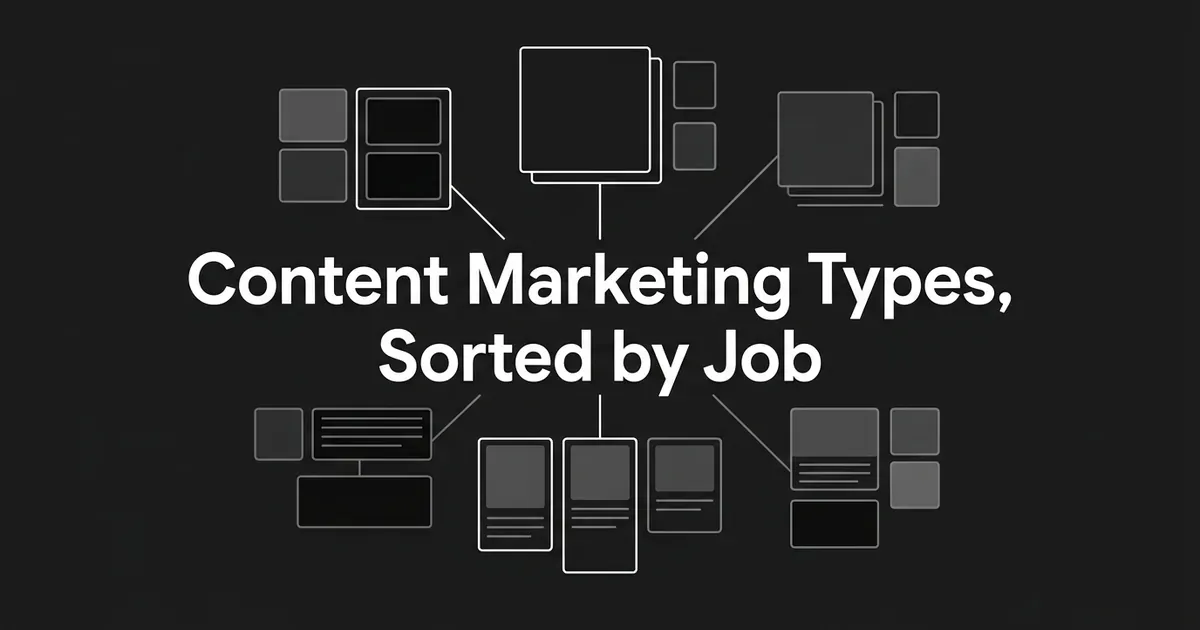
Content marketing means creating and distributing content that is genuinely useful on its own, not just a wrapper around a pitch. Most lists of types of content marketing stop there and hand you twenty five content marketing formats with no way to choose between them. That is not a taxonomy, it is an inventory. The useful question is not how many formats exist. It is what job each piece of content is doing for you, because a blog post, a webinar, a case study, and a pricing page all fail or succeed for completely different reasons.
This taxonomy of content types for B2B SaaS groups formats by the job they perform: problem education, solution education, proof, decision enablement, customer success, and advocacy. Some of these formats you already know. What changes is how you decide which one to build next, and when to stop building more of what you already have.
Content that attracts and teaches
The first job is helping someone recognize a problem, understand it, and learn the language of the category. This is where most B2B SaaS content marketing effort lands, often for good reason: a reader who cannot yet name their problem is not going to evaluate your product, no matter how good your demo is.
The formats that do this job well include problem-led blog posts, search-focused explainers, educational newsletters, short-form social posts and video, podcasts, infographics, introductory checklists, and beginner guides. Founder or executive point-of-view pieces belong here too, along with plain-language summaries of original research or industry trends.
What makes this content work is starting from the reader's problem instead of your product's feature list. Define the unfamiliar terms. Give the reader one useful mental model or diagnostic step they did not have before. Answer one specific question well rather than trying to cover an entire category in one piece, and let the next relevant question become obvious on its own.
Do not force a free trial CTA into every piece here. A reader who just learned what a problem is called is not ready to evaluate vendors, and pushing them there too early reads as a bait and switch. The useful next step is usually a deeper guide, a newsletter signup, or a related resource, not a sales conversation.
Measure this content by qualified organic visits, engaged sessions, returning readers, newsletter subscriptions, branded search growth, and whether the piece is reaching the persona you actually want. Raw traffic without qualification tells you very little.
Content that helps buyers evaluate approaches
Once someone understands their problem, the next job is helping them compare approaches, build evaluation criteria, and figure out what kind of solution would actually fit. This is where a lot of B2B SaaS content gets too thin, because it is genuinely harder to write than a problem-education piece. You have to take a stand on tradeoffs instead of just explaining a concept.
Formats that do this job: long-form guides, research reports, frameworks and maturity models, webinars, workshops, interactive assessments, templates and planning checklists, and product-agnostic comparison or decision guides. Email nurture sequences that build on each other over time also belong here.
Good solution-education content explains the decision itself, not just the category surrounding it. It gives the reader criteria they can actually apply, makes tradeoffs explicit instead of hedging around them, and helps the reader carry the information to a colleague who was not in the room. It draws a line between strategic questions (what kind of approach fits us) and implementation questions (how do we set this up), because conflating the two leaves the reader with neither answered well.
On gating: a long asset is not automatically better because it is gated. Recent buyer research points toward content that is shorter, more shareable, and useful on its own terms, away from long gated experiences that ask for a form before proving any value. Gate something only when the exchange is genuinely worth it to the reader, and when your team has a real plan for the lead that comes out the other side.
Measure this stage with returning visits, webinar registrations and attendance, assessment completions, downloads, content-assisted opportunities, and whether readers are moving on to use-case or product content afterward.
Content that proves fit and reduces risk
This is the job most B2B SaaS teams underinvest in relative to how much it matters. The reader already understands their problem and has narrowed their options. What they need now is evidence that your solution works for organizations like theirs, and something they can show a skeptical colleague or a procurement team.
Formats: customer case studies and implementation stories, testimonials, user and third-party reviews, security and compliance documentation, privacy explanations, integration and migration guides, ROI and total-cost-of-ownership resources, objection-handling FAQs, product walkthroughs, and comparison pages.
A strong case study explains who the customer is, what the problem looked like before, why they considered your solution over alternatives, what actually happened during implementation, and what changed afterward. If a quantified outcome has not been approved for publication, use concrete operational detail instead of inventing a number. Specific beats generic every time here: "cut our internal linking time from an hour per article to five minutes" tells a reader something. "Saved us so much time" tells them nothing.
Security, integration, and implementation documentation counts as marketing content in this taxonomy when it removes a real buying objection. This matters more in B2B SaaS than almost anywhere else, because your buyer is not only evaluating what the product does, they are evaluating the risk and effort of bringing it into an environment that already works a certain way.
A comparison page earns its place when a reader is actively weighing alternatives. It should explain real differences honestly rather than manufacturing symmetry or attacking a competitor on a point that does not matter to the buyer.
Measure this content by demo requests, trial starts, sales-opportunity progression, security-review completions, comparison-page engagement, and pipeline that can be traced back to a proof asset a rep actually used.
Content that enables the decision
The job here is narrow and specific: remove the last practical and commercial barriers between a confident buyer and a signed deal. This is not the place for more education. The reader has enough confidence. What they need is to know exactly what happens next.
Formats: product and feature pages, use-case and role pages, pricing pages, demo and free trial pages, product demo videos, interactive product tours, ROI calculators, business-case templates, procurement and security packets, sales one-pagers, and frequently asked questions.
A product page explains what the solution does broadly. A use-case page explains how it fits one particular workflow or role, and use-case pages tend to do more work in B2B SaaS because different stakeholders arrive with different starting needs: a marketing lead wants a different answer than the person evaluating security posture. Build both, and do not assume the product page alone covers what a use-case page would.
The CTA at this stage should match where the reader actually is. An early educational article can link to a related guide. A comparison page can lead to a demo or pricing page. A decision-stage page should make the next action unmistakably clear, but clarity is the goal, not manufactured urgency.
Measure this stage with trial starts, demo requests, qualified leads, pricing-page progression, activation rate after signup, and conversion rate broken out by source and use case.
Content that helps customers reach value
Content marketing does not stop at the signature. The job here is getting a new customer to a real first outcome quickly, building habits around the product, and supporting renewal and expansion later. If you skip this stage, whatever you spend on acquisition keeps leaking back out through customers who never got settled in.
Formats: welcome and onboarding email sequences, quick-start guides, role-specific enablement content, help-center articles and documentation, in-app guidance, product-update communications, customer education webinars, training libraries, how-to content, troubleshooting guides, and renewal support materials.
Good customer-success content gets someone to a meaningful first outcome fast, supports roles beyond the original buyer (the person who signed the contract is rarely the only one using the product), answers questions at the exact moment they come up, and surfaces advanced use cases the customer would not have found on their own. Treat retention content as a connected system rather than a single onboarding email sequence: it spans onboarding, lifecycle email, in-app messaging, help-center content, product updates, and renewal materials, working together.
This content often gets owned by product or customer success rather than marketing, and that is fine. The taxonomy includes it here because the strategic job matters more than which team's name is on the byline.
Measure it with time to first value, activation, feature adoption, support deflection, renewal rate, churn, and expansion revenue or net revenue retention.
Content that turns customer value into distribution
The final job converts a customer's real experience into credible reach that brings in new demand. This is the stage teams most often skip, not because it is hard to see the value, but because it depends on customers who are actually willing to participate.
Formats: customer testimonials and interviews, user reviews, customer-led webinars, community discussions and peer groups, referral and partner content, guest posts, co-marketing reports, and social content built from real customer stories.
What makes this content work is preserving the customer's actual voice instead of rewriting it into generic brand copy. Give the practitioner something they would genuinely want to share, connect their outcome to a problem other readers will recognize, and make the customer the credible subject rather than a logo on a slide. One good customer story can become a case study, a sales-enablement asset, social content, and webinar material all at once. The value is not more content for its own sake, it is multiplying one credible source across several jobs at once.
Advocacy is not automatic. Customers need a real outcome worth talking about, a reason to participate, and a low-friction way to contribute. Do not assume every happy customer will agree to become a public case study, because most will not, and treating the pipeline of willing advocates as guaranteed will leave this stage consistently understaffed.
Measure it with referral traffic, referred pipeline, review volume, community participation, social sharing, and partner-sourced opportunities.
The jobs form a loop, not a straight line
The classic awareness, consideration, and decision model is still a useful planning shorthand, but it undersells what a B2B SaaS content program actually needs to do. Post-purchase content matters because retention and expansion are revenue outcomes in their own right, not an afterthought once the deal closes. Advocacy matters because customers can generate reach and proof that no amount of outbound content can manufacture on its own.
The same asset regularly does more than one job. A webinar can introduce a problem to a cold audience, teach an approach to a warmer one, or train an existing customer, depending on who shows up. A case study can create awareness for someone stumbling onto it through search, support a sales rep mid-deal, and later become onboarding material for the customer it was written about. Assign a primary job to each asset when you plan it, but do not be surprised when it earns a second one later.

A small B2B SaaS team does not need one asset in every format listed here. It needs coverage across the jobs that matter to its stage. A reasonable minimum: a small cluster of problem-education content around the problems your ideal customer already has, one durable evaluation asset, use-case coverage for your highest-value roles or workflows, at least one credible proof asset, a clear decision layer of pricing and demo and FAQ content, a customer-success layer of quick starts and documentation, and a repeatable way to turn one strong asset into several distribution formats.
How to choose what to build next
Work backward from where the content program is actually stuck, not from a list of content marketing formats you have not tried yet.
If you have almost no qualified reach, start with problem education, because nothing downstream works if no one who fits your ideal customer profile is finding you. If you have decent traffic but weak evaluation, the gap is usually proof and use-case content, not more top-of-funnel articles. If people are starting trials but not activating, the highest-leverage content is customer-success material, and no amount of new demo generation will fix a leaky trial experience. If your product genuinely delivers strong outcomes but almost no one outside your existing customers knows it, the gap is advocacy and distribution, and that is a different kind of work than writing another blog post.
Before building anything, ask what buyer or customer question you are actually answering, what job the asset performs, who needs to consume or share it, and what uncertainty is genuinely blocking someone right now: uncertainty about the problem, the solution, the fit, the risk, the price, or how to get real value after buying. Match the format to that uncertainty rather than to what is easiest to produce or what a competitor happens to be publishing.
One more filter matters for a lean team specifically: can you actually maintain this format. An interactive assessment or a webinar series looks appealing on a roadmap, but it requires recurring production that a team of one or two people may not be able to sustain. A format that goes stale after the first quarter is often a worse choice than a simpler one you can keep current.
None of this depends on chasing a single format that supposedly wins in AI search. Standard guidance from Google states that ordinary SEO fundamentals remain relevant to AI Overviews and AI Mode, with no separate special requirements layered on top. Write content that is clear, well structured, evidenced, and genuinely useful, and treat that as the whole AI-visibility strategy rather than looking for a shortcut format.