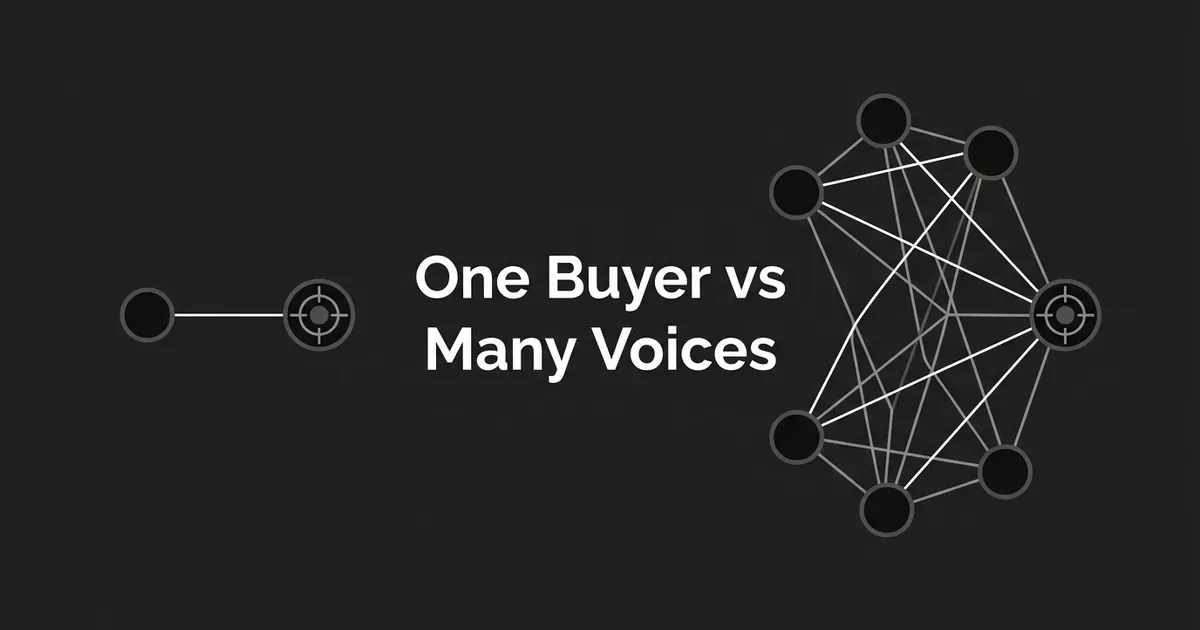
If you're trying to figure out b2b vs b2c content marketing, the question that actually matters isn't tone. It's who has to say yes before anyone buys. When one person can look at your content, decide they need what you're offering, and buy it on their own, you're planning like a B2C marketer. When a purchase has to survive a group of people with different jobs and different worries, some of whom will never read your blog, you're planning like a B2B marketer. Price doesn't settle it. Neither does whether your buyer works for a company or shops for themselves. What settles it is how many people have to agree, and what they need from your content to get there.
That's the real split. Everything people usually point to when they talk about content marketing b2b b2c, the formal language, the longer pieces, the case studies, is downstream of that one structural fact: how many people are involved in the decision, and how much they need to defend it to each other.
Here's a quick look at where the two actually diverge.
| What changes | B2B | B2C |
|---|---|---|
| Who decides | A group: users, finance, IT, procurement, sometimes legal | Usually one person or a household |
| How long it takes | Often months, and not a straight line | Often days or weeks |
| What proof has to do | Hold up when someone else questions it | Feel true and personal, fast |
| What happens next | Read more, run a tool, book a call, share internally | Compare, add to cart, buy |
The rest of this piece walks through why those rows look the way they do, and what to actually do differently because of it.
What B2B content marketing actually is
B2B means business-to-business: the content is there to support a purchase an organization is making, not a person buying for themselves. That organization might be a five-person startup where one founder decides everything, or it might be a department where six different people each have a say. Either way, the content's job is bigger than "explain the product." It has to help real people:
- Figure out what their actual problem is, in language they can use internally.
- Understand what kinds of solutions even exist for it.
- Write down what they need from a vendor.
- Compare the options seriously.
- Check that the claims being made hold up.
- Build a case they can bring to whoever signs the check.
- Get everyone with a stake in the decision to actually agree.
Notice none of that is about persuading one reader to feel excited. It's about giving a group of people, who may never talk to each other directly, enough shared material to reach the same conclusion. That group dynamic is one of the clearest b2b content strategy differences from anything you'd plan for a single buyer.
What B2C content marketing actually is
B2C means business-to-consumer: content supporting a purchase someone is making for themselves or their household. The person reading your article is usually the same person who will use the product and the same person who will pay for it. That doesn't make the decision simple. Someone buying a car, choosing a school, or picking a health plan can do just as much research as any B2B buyer, and they might loop in a partner or a parent along the way. But most of the time, the content's job is narrower:
- Help someone notice they have a need or a want.
- Make it easy to understand what you're offering and how it compares.
- Show that the product actually delivers what it promises.
- Give them a reason to trust you, fast, usually through reviews, demonstrations, or other people's experience.
- Remove whatever friction sits between "interested" and "bought."
- Give them a reason to come back and buy again.
These aren't laws. A cheap software subscription might get bought by one person in an afternoon, which behaves more like a B2C decision even though it's technically B2B. A washing machine might involve two people, a spreadsheet, and three weeks of comparison shopping, which behaves more like a B2B decision even though it's a household buying for itself. The label on the buyer matters less than how the decision actually gets made.
Who has to agree before anyone buys
This is where most of the practical differences start. In B2B, you're rarely writing for one reader. A person using the product day to day cares about whether it fits their workflow. Someone in finance cares about cost and payback. A leader cares about whether it moves something they're accountable for. Procurement cares about contract terms and risk. Depending on what you sell, security, legal, or operations might have their own list of questions too.
That changes what "one piece of content" has to do. A single blog post can't answer all of those questions for all of those people, and it shouldn't try. What it can do is be clear and specific enough that the person who read it can hand it to a colleague who didn't, and it still makes sense. A good B2B piece gets forwarded. It gets pasted into a requirements doc. It shows up again three weeks later in a meeting the writer never attended. If your content can't survive being read by someone who wasn't in the room for the original conversation, it's not doing its job.
In B2C, the person reading and the person buying are usually the same, so you're mostly writing to one set of needs at a time: what does this person want, what's stopping them, what would make them trust you enough to act. Research still matters here. A parent choosing childcare or someone shopping for a mortgage might spend weeks comparing options. But even then, you're not usually trying to get a finance team, a security team, and an executive to independently sign off on the same purchase.
The planning move: for B2B, stop writing to a single persona and start mapping the roles in the buying group. For each one, note what problem they're solving, what would satisfy them, and what objection they're likely to raise. For B2C, map the need state instead: what triggered the search, what they're worried about, and what would make them trust you enough to act.
How long the decision takes
B2B sales cycles are usually longer, but "longer" undersells what's actually happening. It's not a slow version of a B2C purchase. It's a process that loops back on itself. A buying group might revisit "do we even have this problem" after they've already started comparing vendors, because someone new joined the conversation or a budget got questioned. Research on B2B buying journeys describes this as a set of jobs (recognizing the problem, exploring options, setting requirements, picking a supplier, building consensus) that buyers move between out of order, not a funnel they walk down once.
Industry research on B2B buying puts the typical journey at close to a year for larger deals, though that figure comes from a specific study of buying groups averaging more than ten people and six-figure deal sizes, so it describes that population, not every B2B purchase. A small team buying a $50-a-month tool is not going through a year-long evaluation. What's consistent across B2B in general is that the timeline is long enough that one blog post and a demo page won't carry a buyer from first visit to signed contract. You need material that's still useful to someone six weeks into their research as it was to them on day one.
B2C purchases usually move faster because there are fewer approval steps standing between "I want this" and "I bought it." That doesn't mean B2C content can be shallow. It means the strategy leans harder on being found quickly, being clear about value immediately, and getting out of the buyer's way once they've decided. A complex consumer purchase, like a car or a fertility treatment, can still take months and borrow B2B-style comparison tools and detailed evidence. The point isn't that B2C is always fast. It's that the default is shorter, and your content plan should assume a longer runway only when the actual decision requires one.
What has to be proven
This is the difference that matters most, more than the buying group, more than the timeline. In B2B, proof has to survive being questioned by someone who wasn't convinced by your pitch. A buyer isn't just asking "will this work for me." They're asking "how do I explain this to my boss," "what happens if this breaks," and "will I look bad in six months if I recommend this." That means useful B2B proof looks like specific customer examples with real context, clear before-and-after numbers where you can actually back them up, product demonstrations tied to a real use case, and documentation that answers implementation and security questions before someone has to ask.
Content Marketing Institute's 2025 benchmark research found that B2B marketers rated video and customer case studies among their most effective content formats, well ahead of shorter, less substantive posts. Take those effectiveness ratings as a signal, not causal proof, since they reflect what marketers believe worked rather than a controlled test, but the direction holds: B2B buyers reward content that gives them something to evaluate, not just something to feel good about.
In B2C, proof mostly has to answer a narrower question: will this work for me, and can I trust the people telling me so. An early study of the consumer decision journey found that consumers actively sought out other people's experiences and information rather than just absorbing brand messaging once they'd started comparing options, and that pattern still shows up today through reviews, ratings, demonstrations, and other people's experiences. The proof burden can still be high for a considered purchase, but it usually doesn't have to survive a chain of people who each have their own reason to say no.
It's worth being careful here, because the common shorthand, "B2B is rational and B2C is emotional," isn't accurate. Business buyers are still people who respond to trust, status, and fear of making a bad call. Consumers still weigh price, specifications, and whether a product will actually hold up. The real difference isn't rational versus emotional. It's whether the proof has to be defensible to other people, or just personally convincing.
Which channels do the work
A channel isn't a strategy on its own. Video isn't inherently a B2C format, and long articles aren't inherently a B2B one. The question that matters is what job the channel is doing for the buyer in front of it. A B2B video that walks through implementation is doing evidence work. A B2C video showing someone unbox a product is doing discovery work. Same format, different job, which is the part people miss when they talk about content marketing b2b b2c as if the formats themselves were the difference.
That said, the channels each side leans on do tend to differ, because they're built to reach different buying systems. B2B content shows up more in search for problem-stage questions, in long-form pieces that build category understanding, in webinars where a buyer can ask questions directly, and in material sales teams pull into their own conversations. B2C content leans harder on social platforms for discovery, on reviews and other buyers' opinions for reassurance, and on commerce pages that make comparing and buying frictionless.
What tactics actually transfer, and what doesn't
A lot of B2C tactics can work in B2B if you keep their job intact rather than copying the surface. Video demonstrations transfer if the subject matches what the buying group actually needs to see. Customer stories transfer if they carry enough context to mean something to a stranger reading them cold. Personalization transfers if it reflects someone's role or stage in the decision, not just their first name in a subject line.
What doesn't transfer is treating a business account like it's one person with one motivation. Using a discount as the answer to a business case doesn't work, because the objection was never about price alone. Assuming a single warm story will move an entire buying group doesn't work either, because half that group never read it and needs their own reason to say yes. And ending every piece of content with a hard "buy now" push falls flat when the buyer you're talking to is still three steps away from being allowed to buy anything.
When each approach wins
You don't have to guess which playbook fits. Ask how many people actually have to agree before money changes hands, and what would happen if the decision turned out to be wrong. If a purchase needs a formal business case, has to survive procurement, or puts someone's job on the line if it fails, plan for a buying group even if your product is simple. If one person can recognize a need and act on it with limited coordination, plan for an individual buyer even if the price tag is large.
Most teams get this wrong in one of two directions. They either treat a genuinely simple, low-risk purchase like it needs a six-month nurture sequence, which slows down a buyer who was ready to act. Or they treat a purchase that needs real internal buy-in like it's a single-reader decision, publish one confident blog post, and wonder why nobody converts. The fix in both cases is the same: look at how the decision actually gets made, not at which column your company falls into on an org chart.
If part of your job is figuring out which of your pages are actually doing this work for your buyers, and which ones are getting skipped over once you scale past a handful of posts, that's less about writing better content and more about knowing where your existing content is landing and where the gaps sit. A platform like DeepSmith is built for exactly that: it tracks how your content shows up in AI answers and search, and helps you spot where a buying-group question or a discovery-stage question is going unanswered, so you know what to write next instead of guessing.