You searched your own brand in Perplexity, and a competitor came back cited instead of you. That stings. It also means you are already doing the hard part, which is paying attention while most teams still are not.
Here is the good news. You do not need a huge program to fix this. You need one Perplexity-specific workflow and the right tool to run it. This guide walks through the best perplexity optimization tools, what each one is genuinely good at, and how to pick the one that fits your team and budget.
We will keep it honest. Some tools only measure. Some only write. A few do both, and one is free. By the end you will know which perplexity seo tools fit your team, and what to do with the one you pick. Let's find yours.
Why Perplexity needs its own playbook
Perplexity is not Google with a chatbot on top, and it is not ChatGPT with browsing. It is a real-time answer engine, and it picks its sources differently from both.
The biggest difference is where it looks. Perplexity leans heavily on user-generated content like Reddit, YouTube, and Quora, plus a handful of high-authority publishers. In one comparative dataset from Profound, Reddit made up roughly 46.5% of Perplexity's top citations, far above what shows up in Google AI Overviews or ChatGPT.
It also cites differently. Perplexity cites a passage, not a page. A specific span of text on your URL has to survive the whole retrieval-to-answer pipeline before your link ever reaches the footnotes. And it weighs freshness hard, so a stale cornerstone page gets discounted fast.
What does that mean for you? A generic AEO checklist that treats Perplexity the same as every other engine will underperform. To improve your perplexity visibility, you need tactics built for how Perplexity actually reads the web.
How Perplexity actually picks sources
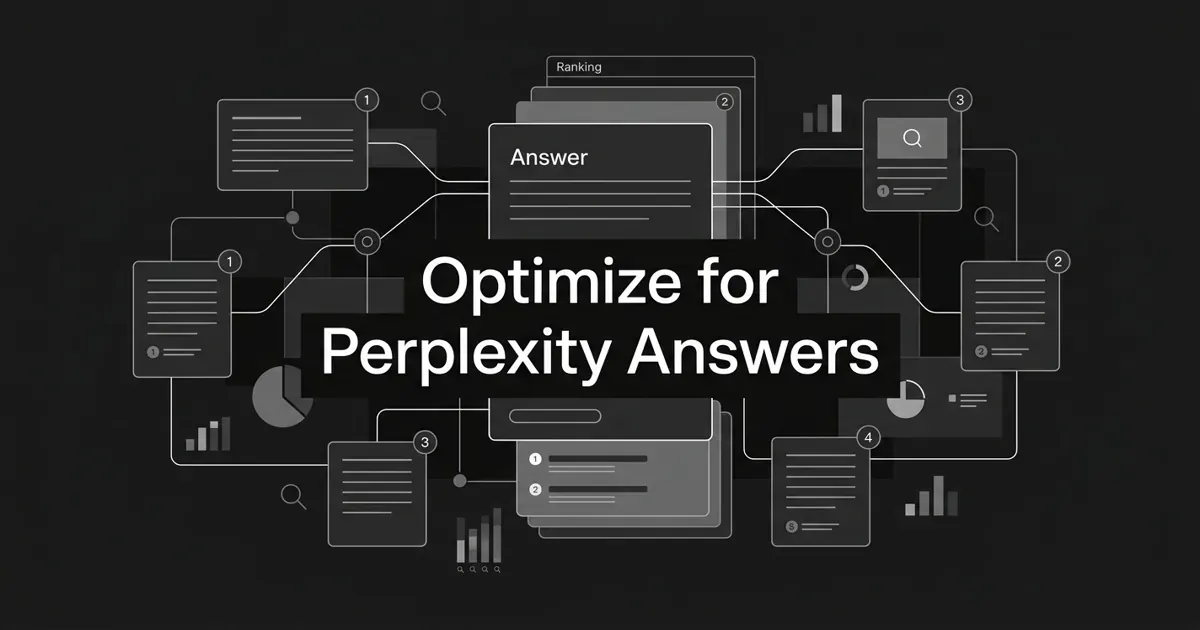
It helps to see the pipeline. Perplexity runs six stages on every query: it parses your intent, retrieves candidate pages from the live web, reranks them on relevance and freshness and authority, assembles the top sources into a prompt, writes the answer, then binds citations to specific passages.
Roughly 5 to 10 pages get pulled per query, and only about 3 to 4 get cited. A page earns a footnote only if it clears every filter along the way: relevance, recency, entity clarity, extractability, authority, and attribution quality. Miss one, and you usually miss the citation.
You do not need to memorize this. You just need a tool that captures which passage was cited, not only whether your brand appeared.
Why this matters right now
Perplexity is big enough to matter and still young enough that early movers can win. Estimates put monthly active users somewhere between 30 and 45 million, with around 170 million monthly visits to the web app and roughly 60 to 70 million queries a day. Revenue is climbing fast too, from about $80M ARR in 2025 toward a $200M run-rate in 2026 by one estimate.
Treat those numbers as directional, not gospel. The point stands either way. The teams that learn to track brand in perplexity now, and act on what they find, are the ones building a lead their competitors will struggle to close later.
So where do you begin? You begin by measuring your perplexity visibility honestly, then closing the gaps one page at a time. The tools below help you do both.
How we picked these tools
A good roundup earns its keep by telling you the criteria up front. Here is exactly how each tool below was judged.
- Perplexity coverage. Does it actually run prompts against Perplexity and capture the cited URLs, not just mentions?
- Action surface. Does it stop at a dashboard, or does it help you produce and ship the content that earns citations?
- Production integration. Can it generate on-brand, publish-ready content, or do you still need a separate writing pipeline?
- Cost-to-value. At the per-prompt and per-article price, does it save you time and earn you citations?
Not every tool needs to win on all four. A free auditor and an enterprise analytics suite serve different people. What matters is matching the tool to where you actually are.
Perplexity optimization tools at a glance
| Tool | Best for | Perplexity tracking | Content production | Pricing |
|---|---|---|---|---|
| DeepSmith | Tracking and content in one platform | Yes (Grow tier and up) | Yes, publish-ready | $99–$399/mo, custom Enterprise |
| Profound | Enterprise analytics | Yes | Light | Quote-based |
| Peec AI | Fast, transparent analytics | Yes | Light | Published tiers, free trial |
| Otterly AI | Solo marketers starting out | Yes | Minimal | Published Lite/Pro/Premium |
| AthenaHQ | Tracking plus content briefs | Yes | Recommendations only | Tiered, $25 free credit |
| Rankscale | Multi-region, multi-engine | Yes | Light | From $99/mo Pro |
| LLMrefs | Meta AI and Grok coverage | Yes | Limited | Published |
| Writesonic GEO | SEO teams adding AI visibility | Yes | Optimization actions | From $99/mo |
| Semrush AI SEO Toolkit | Existing Semrush customers | Yes | Add-on | Semrush add-on |
| Ahrefs Brand Radar | Existing Ahrefs customers | Yes | Analytics only | Ahrefs add-on |
| Nightwatch | SEO rank tracking plus AI | Yes | Light | Published |
| LovedByAI GEO Checker | A free first audit | Point-in-time | None | Free |
The tools, one by one
1. DeepSmith: best for closing the loop from insight to content

Most perplexity seo tools stop at a dashboard. They show you that a competitor is winning an answer, then leave the actual fixing to you. DeepSmith is built to close that gap in one place: it shows you where you lose in Perplexity, then produces the on-brand content to win those answers, from the same shared context.
Here is how that plays out.
AI Search Visibility. You define the prompts your buyers ask. DeepSmith checks them on a schedule across each covered engine and reports mention rate, citation rate, share of voice, and a competitor leaderboard, with per-platform trends. Perplexity coverage starts on the Grow tier.

Content Map. Your site and your competitors' sites become one map of the topics you all write about, with full page history: coverage gaps where a competitor publishes more, untapped topics where you have nothing at all, and the classification that powers internal linking and dedup.
Opportunity Agents. Agents read your Content Map and your AI visibility data and hand back content ideas with the data point that justifies each one attached, dropping straight into New Ideas.
Content Studio. Ideas move from New Ideas to Planned Content to Produced. The Writer turns one planned idea into a finished, brand-grounded article, researched, internally and externally linked, with a cover image and metadata. Autowrite runs unattended on a schedule and lands articles in Produced Content, so the pipeline keeps moving even during busy weeks.

Deep IQ. A structured brand layer holds your positioning, products, personas, brand voice, visual guidelines, and content types. Every module draws from it, so produced content sounds like you and stays inside your claim boundaries. No re-briefing per article.
Repurpose and Apps. Every finished article arrives with social posts drafted, plus one-click adaptations for LinkedIn, X, Substack, and more.
You can publish straight to WordPress, Webflow, Strapi, Sanity, or Contentful, or to your own webhooks, with Markdown and HTML export as a fallback. There is a 7-day free trial with real data and real drafts before you pay, and no long-term contracts.
Pricing: Pro is $99/mo ($80/mo annual, ChatGPT only). Grow is $199/mo ($160/mo annual) and adds Perplexity. Scale is $399/mo ($299/mo annual) and adds Gemini. Enterprise is custom and covers all ten tracked engines.
Best for: Marketing leads who want to see where they lose in Perplexity answers and ship the content that wins them, without switching tools.
One honest limitation: Perplexity coverage begins at Grow, not the entry Pro tier. For a Perplexity program that is the tier you want anyway, and at $199/mo ($160/mo annual) it still lands below the quote-gated analytics suites while adding the production none of them match. The other seven of the ten tracked engines, Claude and Google AI Mode among them, sit on Enterprise, and article volume is capped per plan, so agencies running many clients will likely need Enterprise.
2. Profound: best for enterprise analytics

If you want research-grade analytics across many AI surfaces and have budget for a sales-led purchase, Profound is a strong pick. It tracks ChatGPT, Perplexity, Google AI Overviews, and Claude, plus Shopping Agent analytics and prompt-volume data.
Its Answer Engine Insights give you mentions, citations, and share of voice per prompt, with an Agents layer that automates actions on visibility signals and an optimization layer on top. Profound also runs its own research arm publishing original citation data, which is where several numbers in this guide trace back to.
Best for: Enterprise brands and agencies that want the deepest analytics feature set.
One honest limitation: Pricing is gated behind a demo, the content and production side is lighter than the analytics side, and Perplexity is one engine among several rather than the focus.
3. Peec AI: best fast-onboarding analytics

Want something you can stand up quickly with pricing you can actually see? Peec AI tracks ChatGPT, Perplexity, and Gemini with brand mentions, citations, share of voice, and prompt-level competitor benchmarking.
The dashboard is clean, time-to-value is fast, and the prompt view is built to be acted on. Pricing is published with a free trial, and prompt volume is capped per tier.
Best for: European and global marketing teams that want a focused analytics tool with transparent pricing.
One honest limitation: It is analytics-first. Content generation is light, and Perplexity is one of several engines it tracks.
4. Otterly AI: best budget entry point

Just starting to measure your AI search visibility and do not want a big commitment? Otterly AI is a low-friction way in. It tracks ChatGPT, Perplexity, Google AI Overviews, and Microsoft Copilot, with prompt tracking, a brand report, citations, links, and sentiment on a prompt-set basis.
Pricing is transparent across Lite, Pro, and Premium tiers, so you know what you are paying before you commit.
Best for: Solo marketers and small teams taking their first step into AI search monitoring.
One honest limitation: Prompt volume is capped per tier, reporting depth is shallower than enterprise tools, and production capabilities are minimal.
5. AthenaHQ: best for tracking plus content briefs

AthenaHQ sits between pure measurement and full production. It tracks ChatGPT, Perplexity, Gemini, Claude, and Google AI Overviews, with brand mentions, a competitor leaderboard, and content recommendations that translate visibility gaps into briefs.
That bridge from insight to a clear next step is the draw. You get an entry credit to try it before moving to a paid tier.
Best for: Teams that want measurement plus a clear path to act on the gaps.
One honest limitation: The recommendations are a layer, not a full production engine, so you still write the articles yourself. The buying motion leans enterprise.
6. Rankscale: best for multi-region, multi-engine tracking

Running many markets or languages? Rankscale tracks 17-plus engines, including ChatGPT, Perplexity, Claude, Gemini, and Google AI Overviews, with multi-region and multi-language support and agency-friendly dashboards.
Its published plans start at $99/mo for Pro on a credit-based model.
Best for: Agencies and global brands that need multi-engine, multi-region visibility.
One honest limitation: It is analytics-first, production is light, and the credit model can feel opaque to a first-time buyer.
7. LLMrefs: best for Meta AI and Grok coverage

If your audience lives on surfaces most tools skip, LLMrefs is worth a look. It covers eight surfaces, including ChatGPT, Claude, Google AI Mode, Grok, Microsoft Copilot, Meta AI, Gemini, and Perplexity, with prompt-volume data and published pricing.
Meta AI and Grok are the standout here, since most competitors do not track them.
Best for: Teams that specifically need visibility into Meta AI and Grok alongside Perplexity.
One honest limitation: It is analytics-focused, so production capabilities are limited.
8. Writesonic GEO: best for SEO teams extending their stack

Already run an SEO program and want to add AI visibility without adopting a whole new philosophy? Writesonic GEO tracks 10-plus AI platforms, including ChatGPT, Perplexity, and Google AI, and pairs visibility tracking with on-page optimization actions.
Self-serve plans start at $99/mo, and the SEO heritage means the interface will feel familiar.
Best for: SEO teams extending an existing stack into AI visibility with on-page fix recommendations.
One honest limitation: The dashboards are general AI visibility rather than Perplexity-specific in depth, and production is optimization-oriented, not full article generation.
9. Semrush AI SEO Toolkit: best for existing Semrush customers

If Semrush is already your home base, its AI SEO Toolkit lets you bolt AI visibility onto workflows you know, covering major AI surfaces including Perplexity.
The win is integration: it sits next to your existing SEO data instead of living in a separate tab.
Best for: Teams already paying for Semrush who want AI visibility without a new login.
One honest limitation: It is an add-on, and AI visibility is one feature in a much broader suite rather than the focus.
10. Ahrefs Brand Radar: best for existing Ahrefs customers

Ahrefs Brand Radar brings AI visibility into the Ahrefs world, using the backlink and crawl data you already rely on for extra context across major AI surfaces.
Best for: Existing Ahrefs customers extending into AI visibility.
One honest limitation: It is an emerging product, pricing is gated behind an Ahrefs subscription, and it stays analytics-focused.
11. Nightwatch: best for combining rank tracking with AI

Nightwatch pulls traditional SERP rank tracking and AI search surfaces into one dashboard, so you watch classic rankings and AI answers side by side. Pricing is published on the site.
Best for: SEO teams that want one dashboard for both traditional rankings and AI answers.
One honest limitation: AI visibility is part of a broader SEO suite, not the main event.
12. LovedByAI GEO Checker: best free Perplexity audit

No budget yet? Start here. LovedByAI's GEO Checker is a free, browser-based tool that audits any URL for Perplexity-specific readiness. It checks schema markup, llms.txt, robots.txt, heading structure, and citation patterns, then hands you an actionable checklist.
Best for: Anyone starting a Perplexity program who wants a free first pass before paying for anything.
One honest limitation: It is a point-in-time audit, so there is no ongoing tracking and no production capability.
What Perplexity optimization actually requires
A tool tells you where you stand. The tactics below are what actually move your ranking, and they come straight from how Perplexity's pipeline reads a page. This is where perplexity optimization diverges from generic AEO.
Structure for extractability. Lead every section with a 40 to 60 word answer block that can stand on its own. Phrase your H2s and H3s as questions, since Perplexity pulls answers that match question phrasing. Add an FAQ of 4 to 6 questions, and use comparison tables for any "X vs Y" topic, because Perplexity lifts tabular data almost verbatim.
Write for passage-level citation. Remember, Perplexity cites a passage, not a page. Put the citable sentence first and push caveats after it. Skip the clickbait intro and the metaphor-heavy opener. Name entities explicitly instead of leaning on pronouns.
Earn citations on Perplexity-favored domains. Reddit and YouTube carry real weight here. Show up authentically: founder presence, honest participation, explainer videos and demos. Chase coverage on high-authority publishers too. Skip the spammy forum links, because authority and recency both get weighed hard.
Keep it crawlable and fresh. Maintain an llms.txt and keep robots.txt and your sitemap current. Then update your cornerstone pages on a schedule, because Perplexity discounts stale content quickly.
If you only change one thing this month, make it extractability. Rewrite your top three pages so the answer sits in the first two sentences of each section. That single move helps you optimize for perplexity more than any dashboard will.
How to choose
There is no single best tool here, only the best tool for where you are. Let's match you to one.
You want tracking and production in one workflow. Pick DeepSmith. It is the only option on this list that both shows you the Perplexity gap and ships the content to close it, so you are not stitching a tracker to a separate writing tool.
You want research-grade enterprise analytics and have budget. Pick Profound. Its depth and original research are hard to beat if measurement is the whole job.
You want fast, transparent analytics. Pick Peec AI, or Otterly AI if you are a solo marketer on a tight budget.
You need the broadest engine coverage. Pick Rankscale for multi-region reach. DeepSmith tracks ten engines, Meta AI and Grok included, but those sit on Enterprise, so LLMrefs is the published-pricing route if those two are the whole reason you are buying.
You already live in Semrush or Ahrefs. Use their AI add-ons and skip the new login.
You only need a free audit to start. Run the LovedByAI GEO Checker today, then revisit paid tools once you know your gaps.
Be honest about your real constraint. If your bottleneck is knowing where you stand, an analytics tool is enough. If your bottleneck is producing the content to actually close the gap, and for most teams it is, you will want production built in.
Ready to see where you show up in Perplexity and close the gaps in the same place? Start a DeepSmith free trial and get real data and real drafts before you pay.